
Auction Highlights
-
.jpg)
Greek Marble Head of Dionysus
Sold for (Inc. bp): £23,400
Carved in the half-round in three-quarter view, youthful male head with stern features, hair gathered in a browband, horns to the brow; from a frieze or relief; mounted on a custom-made stand. -
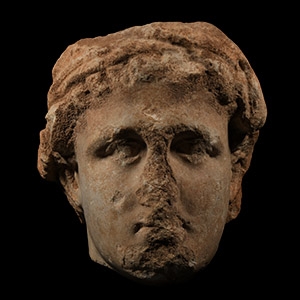
Greek Marble Head of a Ruler
Sold for (Inc. bp): £31,200
Carved in the round with thick wreath of laurel leaves to the brow, short tousled hair, stern face with thick jaw; mounted on a custom-made stand. -
.jpg)
Roman Veined Marble Torso of an Athlete
Sold for (Inc. bp): £48,100
Standing contrapposto with his weight on his right leg and the left leg brought slightly forward; the musculature of the torso displaying well-defined pectoral muscles, prominent abdominal muscles and wide shoulders, the back with equally toned musculature and well-formed rounded buttocks; the veining of the marble accentuating the idealised anatomy; the now-absent head was most probably turned towards the supporting leg and the left arm would have been raised; mounted on a custom-made display stand. -
.jpg)
Large Middle Elamite Cylinder Seal of Kidnu, Chief Overseer of King Tan-Ruhurater II
Sold for (Inc. bp): £15,600
A high-status green chalcedony seal with frieze depicting a seated figure in horned headdress facing a standing figure with arms outstretched, small monkey to the legs; six columns of Akkadian cuneiform text transliterated as: 1. ki-di-nu UGULA KUŠ-MEŠ 2. GAL šà tan-dru-hu- 3. ra-te-er EŠŠANA šu-ši 4. u an-za-an ARAD 5. šà dha-te-ri-iš 6. šak(?) ì-lí-šu 'Kidinu, chief overseer of the equerries(?) of Tan-Ruhurater, King of Susa and Anzan, servant of Haterishshak, his god'. The seal's owner was an official of King Tan-Ruhurater II (circa 1450 B.C.), king of Susa and Anzan. The title used to describe Kidinu is sometimes translated 'high official', elsewhere 'horse groom' or 'animal trainer'; the Elamite deity Haterish is otherwise unknown. -
.jpg)
Mesopotamian Torch Bearer Stand with Lion Tamer
Sold for (Inc. bp): £46,800
A substantial torch bearer depicting a male lion or panther standing with legs firmly planted on a rectangular base, tail extending to the ground, with a massive circular shaped armature or candelabra issuing from its back and wearing an elaborate muzzle, the eyes retaining shell inlay with a circular hollow for the pupils; to the right of the beast a kneeling nude male wearing a large belt-armour and a diadem, eyes inlaid, left hand extended to the side and holding the lion's leash.
-
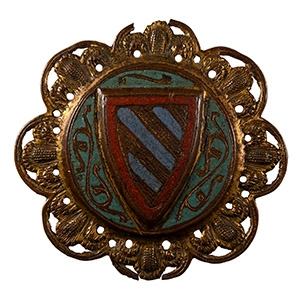
Medieval Limoges 'House of Burgundy' Bronze Heraldic Medallion with Champlevé Enamel
Limoges, circa 1300 A.D.Sold for (Inc. bp): £4,160
Parcel-gilt plaque from a coffre, with openwork foliage border, central disc with raised heater shield flanked by reserved scrolled tendrils; shield with red border and field of diagonal stripes; Limoges workmanship; blazoned 'bendy of seven azure an or within a bordure gules', the arms of the house of Burgundy. 75 grams, 99 mm
Private collection, Paris, France. with Pierre-Richard Royer, 2006. Ex private collection, Suffolk, UK. This lot has been checked against the Interpol Database of stolen works of art and is accompanied by a search certificate number no.12148-217468. -
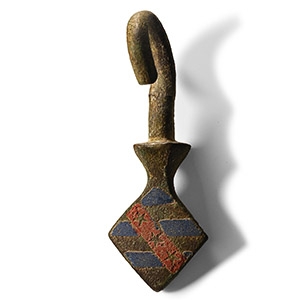
Medieval Knight's Enamelled Bronze 'Richard de Valoines' Heraldic Horse Harness Pendant
14th-15th century A.D.Sold for (Inc. bp): £520
With substantial hook, pyramidal collar and enamelled lozenge panels: obverse with a red bend bearing three reserved stars on a blue-striped field; reverse with reserved bend on blue field with six reserved stars, an extremely rare type. 38 grams, 78 mm
Found Grimsby, UK. From an East Anglian private collection.
The arms to the obverse are similar to those of Richard de Valoines (barry of six azure and or, a bend gules). -
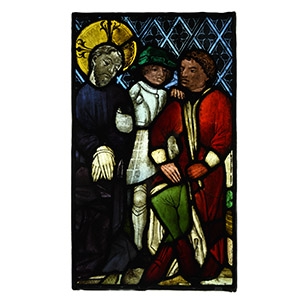
Medieval Stained Glass Panel with Christ before Pilate
Southern Germany, perhaps Ravensburg, circa 1420 A.D.Sold for (Inc. bp): £8,450
Rectangular glass panel in lead frame; nimbate figure of Christ confronting Pontius Pilate in a landscape. 2.65 kg, 60.5 x 36 cm
From the estate of Lloyd and Margit Cotsen, 2023. Ex central London gallery. This lot has been checked against the Interpol Database of stolen works of art and is accompanied by a search certificate number no.12147-217458. -
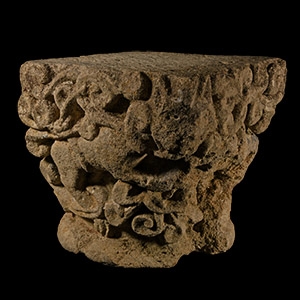
Medieval Limestone Capital with Felines
Bordeaux, 12th century A.D.Sold for (Inc. bp): £598
Square in plan with round base and expanding trunk decorated on two faces with dense scrolled foliage and two opposed lions perching on branches within; high-relief modelling and some deep undercutting. 27.5 kg, 26 cm
Private collection in Bordeaux. with Pierre Berge, 29 November 2017, no.7. This lot has been checked against the Interpol Database of stolen works of art and is accompanied by a search certificate number no.12146-217446. -
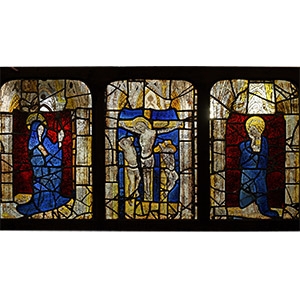
Very Large Medieval Stained Glass Crucifixion Triptych
Germany, Erfurt, circa 1420 A.D.Sold for (Inc. bp): £11,050
Triptych in a wooden frame comprising: Left: Mary in blue robe advancing against a red field, one hand raised before her face; Centre: crucifixion scene with Corpus Christi flanked by two thieves on smaller crosses beside truncated pillars, all against a blue field; Right: St John the Evangelist in floor-length blue robe matching that of Mary, standing in a red field with head tilted downwards; substantial modern metal supporting frame to the reverse with electrical cable for integral illumination (untested). 26.5 kg, 153 x 78.5 cm
Collection of Philip Kohler, Normandy, France, acquired by his parents in 1950s-1960s. Acquired from the above, 2009. Ex private collection, Suffolk, UK. This lot has been checked against the Interpol Database of stolen works of art and is accompanied by a search certificate number no.12150-217449. -
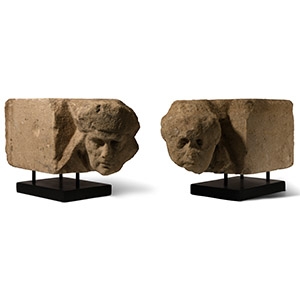
Medieval Pair of English Limestone Corbels
Circa 15th century A.D.Sold for (Inc. bp): £1,300
Each a rectangular block with carved male head; the figure looking to his right wearing a low chaperon with thick rolled brim; the other figure wearing a close-fitting cap with broad upturned rim; each mounted on a custom-made stand. 62.55 kg total including stands, 43.5-44.5 cm deep
Believed to be from a building in the West Country, UK. Acquired from Lichen Garden Antiques, Oxfordshire, UK, in 2012. Property of a Kent collector. -

Medieval Salvator Mundi Appearing to an Old Man
15th century A.D.Sold for (Inc. bp): £1,105
Rectangular vellum panel, hand-coloured initial 'D' from a manuscript page; to the left edge, a bearded male face in profile wearing a red cap; around the capital, four coral-pink dragons with head in profile; within the loop of the 'D' a scene depicting an old man with long white hair and beard kneeling before a table, above him Christ in 'Salvator Mundi' guise nimbate and holding an orb; in an old glazed wooden frame with cartapesta panel to the reverse. 347 grams, 18 x 18.7 cm
Private collection, Tuscany, inherited, 1969. This lot has been checked against the Interpol Database of stolen works of art and is accompanied by a search certificate number no.12060-217464.
The illumination is from a cutting of dismembered Code, likely representing a book of the ancient Testament. It is difficult to say who is the character to which God is appearing, although his costume betrays the intention to represent a grieving man, in Jewish garb. This points to a possible individuation of the man as David (an interpretation supported by the letter D), who, penitent in front of God for the sin he committed by killing Uriah, receives the blessing and forgiveness of God, whose hand is depicted in the blessing gesture. -
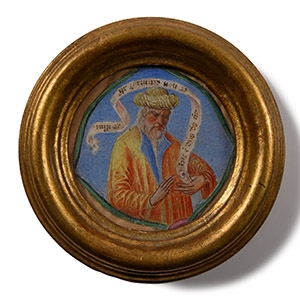
Medieval Prophet Cutting from an Illustrated Manuscript
Florence, Italy, circa 1470 A.D.Sold for (Inc. bp): £780
Discoid glazed mount with tiered profile, painted miniature of an Old Testament prophet with epigraphic scroll and incomplete Latin inscription reciting 'Hic e Deus tuus..et non estimavi ali...ac illus' [He is your God...and I did not estimate other...and He...' 57 grams, 11.4 cm
Private collection, Tuscany, inherited, 1969. This lot has been checked against the Interpol Database of stolen works of art and is accompanied by a search certificate number no.12059-217465.
The illumination is from a cutting of dismembered codex, likely representing a book of the Old Testament. In 15th century North Italy there were proficient artists realising images on vellum, like the Master of Murano Gradual (active between 1430-1460). The miniature represents an Eastern Prophet, dressed with turban and long coat, maybe Ezekiel, or Abacuc, or even Moses, a prophet linked with the prophecies related to the Messiah. -
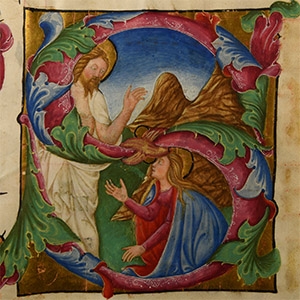
Medieval Large Miniature of Letter 'S' from a Choir Book, The Risen Christ with Mary Magdala
Tuscany, Italy, circa 1450 A.D.Sold for (Inc. bp): £2,860
Vellum manuscript page with hand-coloured large initial 'S' in a square frame and miniature painting of Christ emerging resurrected from the tomb and Mary kneeling before him; lateral band with acanthus-leaf scrolls and asterisks; mounted in a glazed wooden frame with a reveal. 1.06 kg total, 37.5 x 33.5 cm
Private collection, Barcelona, 2022. Ex central London gallery. This lot has been checked against the Interpol Database of stolen works of art and is accompanied by a search certificate number no.12151-217463. -
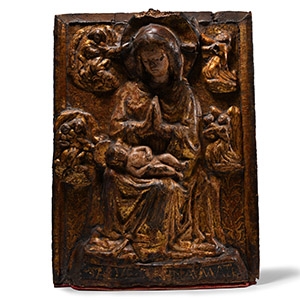
Medieval Gilt Wooden Relief with Enthroned Virgin and Child Surrounded by Angels
Italian, Lombardy, circa 1480 A.D.Sold for (Inc. bp): £3,900
Rectangular panel with cartapesta relief of Virgin and Child carved in the half-round; Mary seated, nimbate with hands pressed together in prayer, infant lying across her lap, flanked by four winged angels in poses of adoration; gilt surface with pink flesh tones; inscribed to base 'SALVE REGINA MATE[R MISERICORDIAE]' (Hail Mother the Queen). 1.07 kg, 36.5 x 27 cm
German private collection, 2019. Ex central London gallery. This lot has been checked against the Interpol Database of stolen works of art and is accompanied by a search certificate number no.12056-217445.
Like all the ancient and medieval statues, this artwork was also originally lavishly painted and most of the colours are still visible with gold and red and light blue being the main colours used for Saint Mary. Interestingly, the inscription recalls the three first words of the Cluny prayer to the Virgin Mary: SALVE REGINA, MATER MISERICORDIAE (Hail Holy Queen Merciful Mother), used by the Templars as a war song. -
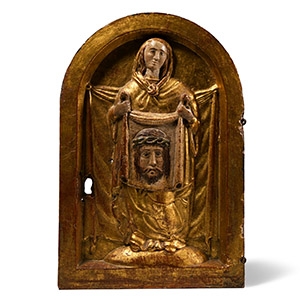
Medieval Tabernacle 'Sudarium' Carved in Relief
Eastern France, circa 1480 A.D.Sold for (Inc. bp): £2,860
Wooden carved archway with high-relief image of St Veronica in floor-length robe standing on a domed base holding up the sudarium with the transferred image of the face of Christ with crown of thorns; raised edges and keyhole to the left edge with attachment holes for a lock mechanism, recess to the reverse. 810 grams, 32.5 cm high
Private collection, Bonn, Germany. This lot has been checked against the Interpol Database of stolen works of art and is accompanied by a search certificate number no.12057-217471.
The sudarium or 'veil of Veronica' (or Mandylion of Edessa) is alleged to bear the image of Christ's face. The story of the image's origin refers to the sixth Station of the Cross, where Saint Veronica met Jesus along the Via Dolorosa to Calvary and wiped the blood and sweat from his face with her veil. She later travelled to Rome to present the cloth to the Roman Emperor Tiberius. The veil has been said to have healing properties. -
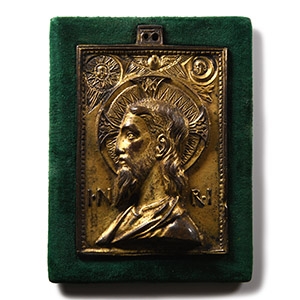
Medieval Gilt Bronze Plaque of the True Face of Christ
Italy, circa 1500 A.D.Sold for (Inc. bp): £1,820
With raised rim, nimbate bust of Christ in profile with long beard and shoulder-length hair, folded collar to the mantle; dove above with wings spread between sun and moon, each with a facing mask; inscription I.N.R.I. visible on either side of the portrait; mounted on a velvet-covered stand. 216 grams, 10.1 x 6.6 cm
with Pierre-Richard Royer, 2010. Ex central London gallery.
The icon represents the profile bust of Christ found on a Byzantine emerald, whence it is known as an 'Emerald Icon'. The emerald was one of the several holy objects sent to Pope Innocent VIII in the 1490's by the Turkish Sultan Bajazet II. The icon was considered one of the Christianity's most precious relics. The letters "I N R I" stand for 'Iesus Nazarenus Rex Iudaeorum,' i.e.' Jesus of Nazareth, King of the Jews' This is the inscription that, according to the Evangelist John, Pilate had written on the plaque above Christ's head on the cross. The sun and moon allude to the cosmic significance of his sacrifice.
