
Auction Highlights
-
.jpg)
Greek Marble Head of Dionysus
Sold for (Inc. bp): £23,400
Carved in the half-round in three-quarter view, youthful male head with stern features, hair gathered in a browband, horns to the brow; from a frieze or relief; mounted on a custom-made stand. -
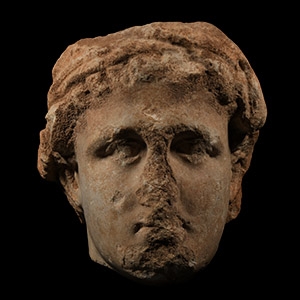
Greek Marble Head of a Ruler
Sold for (Inc. bp): £31,200
Carved in the round with thick wreath of laurel leaves to the brow, short tousled hair, stern face with thick jaw; mounted on a custom-made stand. -
.jpg)
Roman Veined Marble Torso of an Athlete
Sold for (Inc. bp): £48,100
Standing contrapposto with his weight on his right leg and the left leg brought slightly forward; the musculature of the torso displaying well-defined pectoral muscles, prominent abdominal muscles and wide shoulders, the back with equally toned musculature and well-formed rounded buttocks; the veining of the marble accentuating the idealised anatomy; the now-absent head was most probably turned towards the supporting leg and the left arm would have been raised; mounted on a custom-made display stand. -
.jpg)
Large Middle Elamite Cylinder Seal of Kidnu, Chief Overseer of King Tan-Ruhurater II
Sold for (Inc. bp): £15,600
A high-status green chalcedony seal with frieze depicting a seated figure in horned headdress facing a standing figure with arms outstretched, small monkey to the legs; six columns of Akkadian cuneiform text transliterated as: 1. ki-di-nu UGULA KUŠ-MEŠ 2. GAL šà tan-dru-hu- 3. ra-te-er EŠŠANA šu-ši 4. u an-za-an ARAD 5. šà dha-te-ri-iš 6. šak(?) ì-lí-šu 'Kidinu, chief overseer of the equerries(?) of Tan-Ruhurater, King of Susa and Anzan, servant of Haterishshak, his god'. The seal's owner was an official of King Tan-Ruhurater II (circa 1450 B.C.), king of Susa and Anzan. The title used to describe Kidinu is sometimes translated 'high official', elsewhere 'horse groom' or 'animal trainer'; the Elamite deity Haterish is otherwise unknown. -
.jpg)
Mesopotamian Torch Bearer Stand with Lion Tamer
Sold for (Inc. bp): £46,800
A substantial torch bearer depicting a male lion or panther standing with legs firmly planted on a rectangular base, tail extending to the ground, with a massive circular shaped armature or candelabra issuing from its back and wearing an elaborate muzzle, the eyes retaining shell inlay with a circular hollow for the pupils; to the right of the beast a kneeling nude male wearing a large belt-armour and a diadem, eyes inlaid, left hand extended to the side and holding the lion's leash.
-
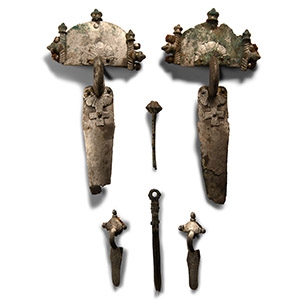
Visigothic Silver Bow-Brooch and Other Items Group
5th century A.D.Sold for (Inc. bp): £2,340
Comprising: matched pair of silver bow brooches, each a D-shaped headplate with lateral posts and knop finials, C-shaped bow with rosette to each end and cross below, tongue-shaped footplate, two transverse bars to reverse of headplate, spring and pin, catch below; matched pair of smaller bow brooches each with triangular headplate and radiating knops, carinated bow, tongue-shaped footplate, remains of ferrous spring and catch to the reverse; dress pin with biconvex fluted head; tweezers with pointillé band to each arm. 132 grams total, 5.1-14.6 cm
Acquired in the mid 1980s-1990s. From the family collection of Mr S.A., Switzerland, thence by descent. Private collection since the late 1990s. This lot has been checked against the Interpol Database of stolen works of art and is accompanied by a search certificate number no.12143-218210. -
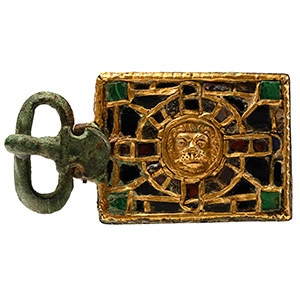
Visigothic Bronze Belt Buckle with Gold and Garnet Inlays
5th-6th century A.D.Sold for (Inc. bp): £10,400
Comprising: ellipsoid loop with hollowed underside, segmented at lateral edges; tongue with violin-shaped shield, waisted and curved over the forward edge of the loop; rectangular plate with applied sheet-gold cellwork and frame to the obverse, segmented along the edges, comprising a central gold lion-mask in a circular frame surrounded by a ring of cells with garnet cloisons and four radiating arms forming a cross also with garnet cloisons, field of larger cells with cloisons, inset malachite square inlay to each corner; four pierced attachment lugs to the reverse. 165 grams, 10 cm
From the collection of Adolphe Stoclet, 1871-1949.
The buckle plate is large and impressive, while the loop is somewhat narrower and may have been replaced. Cruciform motifs on the buckle plate are a feature of Visigothic belt-sets at this time. The use of malachite is unusual for this period, but semi-precious stones of various types appear on such plates (e.g. Menghin, IX.1.1). -
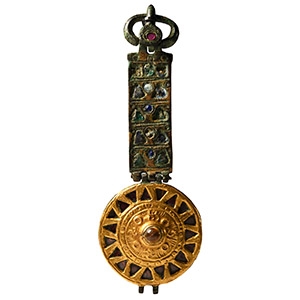
Merovingian Bronze Harness Buckle with Gold and Garnet Inlays
5th-7th century A.D.Sold for (Inc. bp): £6,500
Comprising: ellipsoid loop with hollow reverse; tongue with discoid shield, curved over the forward edge of the loop; rectangular plate with five rectangular segments, each set with two triangular glass cloisons flanking a discoid cabochon, with roundel detailing to the end of each row and three more at the outer end of the plate; slightly domed disc with sheet-gold surface, to the outer edge a series of inset triangular garnet cloison, repoussé segmented band enclosing four roundels with interstitial gammadions, central stepped dome with banded agate cabochon to the centre, hinge knuckles to the outer edge. 169 grams, 17.5 cm
From the collection of Adolphe Stoclet, 1871-1949. This lot has been checked against the Interpol Database of stolen works of art and is accompanied by a search certificate number no.12138-217045.
The buckle plate is long and narrow and the loop is proportionate in size, but the inset glass elements have suffered from abrasion and usage wear. Normally, the buckle plate would have four pierced attachment lugs to the reverse, but the reverse of this plate is plain. The large gold-covered panel resembles a phalera or harness fitting rather than a belt-buckle fitting. On this basis, it is suggested that the item is likely a marriage of a belt-buckle with a harness fitting. -
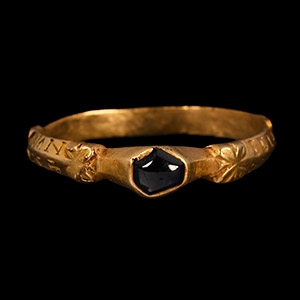
'The Drayton' Medieval Gold Ring with Magical Inscription
1200-1300 A.D.Sold for (Inc. bp): £7,150
The bezel developing to a low pyramid with lateral facets, surmounted by an inset cabochon sapphire set within an irregular cell; a quatrefoil plaque to each shoulder, and three more regularly placed around the shank; carinated hoop with magical Lombardic script '+NI ONAN NRIO ONIC / NIAI AINO ANIOI NAN'. 3.95 grams, 25.72 mm overall, 19.75 x 18.44 mm internal diameter (approximate size British R, USA 8 1/2, Europe 18 3/4, Japan 18)
Found whilst searching with a metal detector near Drayton, Vale of the White Horse, Oxfordshire, UK, on Sunday 16th September 2018 by Chris Weir. Declared as treasure under the Treasure Act with reference no.2018T853, subsequently disclaimed and returned to the finder. Accompanied by a copy of the British Museum's Portable Antiquities Scheme (PAS) report no.GLO-0BFB91. Accompanied by a letter from the finder describing the circumstances of finding. This lot has been checked against the Interpol Database of stolen works of art and is accompanied by search certificate no.12118-214086.
Many late medieval rings and brooches bear similarly meaningless inscriptions, perhaps due to the illiteracy of the engraver who nevertheless was aware that customers required an inscription, so provided one. Alternatively, since the text is composed from repeated sequences 'NI', 'AI', etc. based on an open syllabic structure, the words may be intended as a chant or magical charm. For discussion of such inscriptions see Evans, J., Magical Jewels of the Middle Ages and the Renaissance, Oxford, 1922, pp.121-132, for inscribed jewels. -
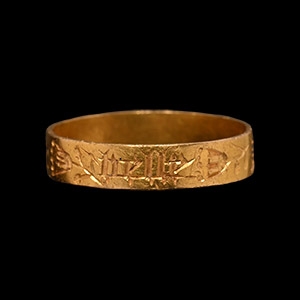
'The Witham on the Hill' Medieval Gold 'The Beautiful Game' Posy Ring with Matched Pairs of Flowers
Circa 1400-1500 A.D.Sold for (Inc. bp): £4,160
Flat-section straightened hoop with incised blackletter text 'le belle ie[u]' translating to 'the beautiful game' with interposed flowers and stalks. 1.68 grams, 16.92 mm overall, 15.39 mm internal diameter (approximate size British I 1/2, USA 4 1/2, Europe 8.07, Japan 7)
Found whilst searching with a metal detector near Witham on the Hill, South Kesteven, Lincolnshire, UK, on Sunday 9th January 2022, by Mark Bowen. Accompanied by a copy of the British Museum's Portable Antiquities Scheme (PAS) report no.CAM-D675E8. Accompanied by a copy of the Department for Digital, Culture, Media and Sport Treasure receipt and and disclaimed with Treasure case tracking no.2022T153. This lot has been checked against the Interpol Database of stolen works of art and is accompanied by a search certificate number no.12139-214843.
The final word of the inscription is ie for ie[u], an Anglo-Norman spelling of modern French jeu ‘game’. The game in question is, of course, love (not football!). The ‘game’ of love here is what we now refer to as Courtly Love (amour courtois, fin amor) and the phrase ‘beautiful game’ is also found on another ring recorded on the PAS database as YORYM-0A0FD2, the whole, a rhyming couplet, reading AMIE EN VV/ [E]ST MA VIE BELE GIEV [Beloved, in you my life is a beautiful game]. -
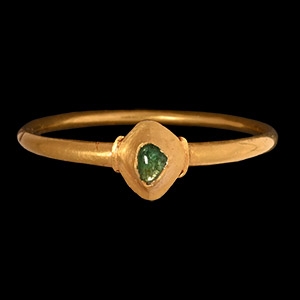
'The Frinton' Medieval Gold Bishop's Ring with Emerald
13th-14th century A.D.Sold for (Inc. bp): £2,600
Comprising a slender hoop and pie-dish bezel with flanges at the junction, D-shaped aperture with inset emerald cabochon. 1.76 grams, 24.07 mm overall, 18.96 mm internal diameter (approximate size British R, USA 8 1/2, Europe 18 3/4, Japan 18)
Found whilst searching with a metal detector near Frinton, Essex, UK, on Thursday 25th May 2023, by Jim Ridge. Accompanied by a copy of the British Museum's Portable Antiquities Scheme (PAS) report no.ESS-0840AB. Accompanied by a copy of a letter, and video from the finder explaining the circumstances of finding. This lot has been checked against the Interpol Database of stolen works of art and is accompanied by a search certificate number no.12140-214660. -
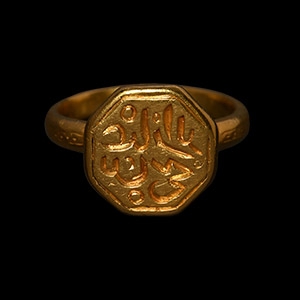
Medieval Gold Signet Ring with Hexagonal Bezel Engraved with an Arabic Inscription
14th-15th century A.D.Sold for (Inc. bp): £1,235
Comprising a D-section hoop with traces of engraved guilloche to the outer edge, knop to the underside, scooped shoulders; octagonal bezel with facetted cup beneath, each face with engraved scroll motif, bevelled rim, engraved Arabic legend. 11.91 grams, 24.13 mm overall, 17.47 mm internal diameter (approximate size British M, USA 6, Europe 12.46, Japan 12)
From an old French collection believed to have been formed in the 1960s. Acquired privately as part of a collection in the early 1990s. Accompanied by a copy of a previous illustrated catalogue information page. This lot has been checked against the Interpol Database of stolen works of art and is accompanied by a search certificate number no.12141-214818. -
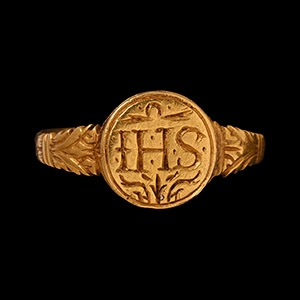
Elizabethan Period Gold Ring with IHS Monogram
Late 16th century A.D.Sold for (Inc. bp): £2,600
Comprising a slender hoop with acanthus-leaf detailing to the shoulders, discoid box bezel with engraved design to the upper face of IHS Christogram between scrolled tendrils and points. 3.15 grams, 21.73 mm overall, 19.88 mm internal diameter (approximate size British R, USA 8 1/2, Europe 18 3/4, Japan 18)
From an old UK collection. Acquired from Derek Content, UK, in the early 1990s. This lot has been checked against the Interpol Database of stolen works of art and is accompanied by a search certificate number no.12142-214824. -
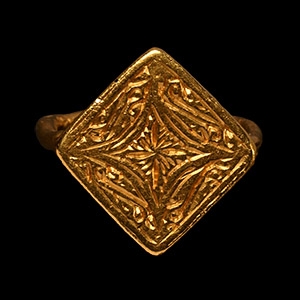
Gold Ring with Diamond-Shaped Bezel Engraved with a Star
17th century A.D.Sold for (Inc. bp): £598
Slender hoop supporting a square bezel with domed underside with incised hatched detailing, hatched band to the rim, reserved motif to the upper face comprising a four-pointed star in reserved frame with scrolls surrounding. 7.20 grams, 22.25 mm overall, 15.94 mm internal diameter (approximate size British I 1/2, USA 4 1/2, Europe 8.07, Japan 7)
From an old French collection believed to have been formed in the 1960s. Acquired privately as part of a collection in the early 1990s. Accompanied by a copy of a previous illustrated catalogue information page. -
.jpg)
Medieval Silver Seal Matrix for John the Evangelist with Roman Eagle Gemstone
13th-14th century A.D.Sold for (Inc. bp): £3,380
The outer band with incuse legend '+ AQUILA IOhANNIS' (Eagle of [Saint] John]), suspension loop above with a leaf terminal to the reverse; set with a 2nd century A.D. Roman carnelian intaglio with a military eagle standing with spread wings, a laurel crown held in its beak, the claws gripping the base, two military standards at its sides; both shafts decorated with alternating phalerae, and lunulae. 3.74 grams, 21 mm
From the Smith family collection, formed in the late 1940s-1980s. Accompanied by an academic report by Dr Raffaele D’Amato. This lot has been checked against the Interpol Database of stolen works of art and is accompanied by a search certificate number no. 12045-217155.
Often the military intaglio gemstones of the ancient Rome were carved with an eagle between two standards. These intaglios could have been inserted in rings that belonged to an officer with the rank of Aquilifer (bearer of the legionary eagle). From the 4th century A.D., the vision of Ezekiel and John's Apocalypse, assigned the lion, the angel, the eagle, and the ox a place in the iconography of the Tetramorph to represent the four evangelists. -
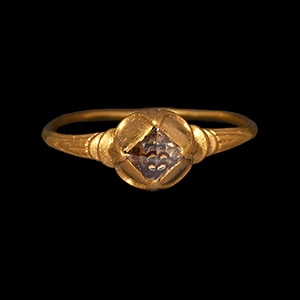
Elizabethan Period Gold Ring with Polished Natural Diamond Crystal
Mid 16th century A.D.Sold for (Inc. bp): £13,000
Comprising a slender hoop with flared shoulders; the bezel formed as four intersecting scallops, with gussets to the underside and tiered collars below; inset polished octahedral diamond crystal. 3.49 grams, 24.44 mm overall, 17.56 mm internal diameter (approximate size British N, USA 6 1/2, Europe 13.72, Japan 13)
Private collection of a North London lady before 2000. Property of a London gentleman. This lot has been checked against the Interpol Database of stolen works of art and is accompanied by a search certificate number no.12145-215540. -
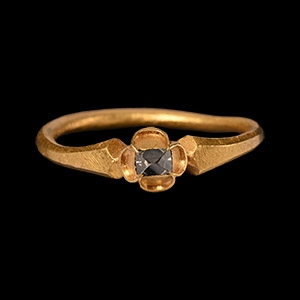
Elizabethan Period Gold Ring with Natural Diamond Crystal
Mid 16th century A.D.Sold for (Inc. bp): £2,925
Comprising a slender hoop with flared shoulders; the bezel formed as four intersecting scallops, with gussets to the underside and tiered collars below; inset octahedral diamond crystal. 2.72 grams, 21.96 mm overall, 16.47 mm internal diameter (approximate size British J, USA 4 3/4, Europe 8.69, Japan 8)
From a 1980s family collection; thence by descent. Property of a Yorkshire, UK, gentleman. This lot has been checked against the Interpol Database of stolen works of art and is accompanied by a search certificate number no.12149-216359.
