
Auction Highlights
-
.jpg)
Greek Marble Head of Dionysus
Sold for (Inc. bp): £23,400
Carved in the half-round in three-quarter view, youthful male head with stern features, hair gathered in a browband, horns to the brow; from a frieze or relief; mounted on a custom-made stand. -
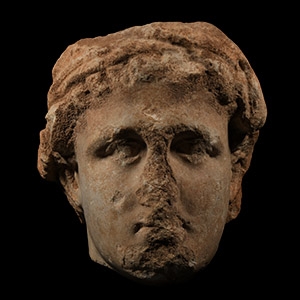
Greek Marble Head of a Ruler
Sold for (Inc. bp): £31,200
Carved in the round with thick wreath of laurel leaves to the brow, short tousled hair, stern face with thick jaw; mounted on a custom-made stand. -
.jpg)
Roman Veined Marble Torso of an Athlete
Sold for (Inc. bp): £48,100
Standing contrapposto with his weight on his right leg and the left leg brought slightly forward; the musculature of the torso displaying well-defined pectoral muscles, prominent abdominal muscles and wide shoulders, the back with equally toned musculature and well-formed rounded buttocks; the veining of the marble accentuating the idealised anatomy; the now-absent head was most probably turned towards the supporting leg and the left arm would have been raised; mounted on a custom-made display stand. -
.jpg)
Large Middle Elamite Cylinder Seal of Kidnu, Chief Overseer of King Tan-Ruhurater II
Sold for (Inc. bp): £15,600
A high-status green chalcedony seal with frieze depicting a seated figure in horned headdress facing a standing figure with arms outstretched, small monkey to the legs; six columns of Akkadian cuneiform text transliterated as: 1. ki-di-nu UGULA KUŠ-MEŠ 2. GAL šà tan-dru-hu- 3. ra-te-er EŠŠANA šu-ši 4. u an-za-an ARAD 5. šà dha-te-ri-iš 6. šak(?) ì-lí-šu 'Kidinu, chief overseer of the equerries(?) of Tan-Ruhurater, King of Susa and Anzan, servant of Haterishshak, his god'. The seal's owner was an official of King Tan-Ruhurater II (circa 1450 B.C.), king of Susa and Anzan. The title used to describe Kidinu is sometimes translated 'high official', elsewhere 'horse groom' or 'animal trainer'; the Elamite deity Haterish is otherwise unknown. -
.jpg)
Mesopotamian Torch Bearer Stand with Lion Tamer
Sold for (Inc. bp): £46,800
A substantial torch bearer depicting a male lion or panther standing with legs firmly planted on a rectangular base, tail extending to the ground, with a massive circular shaped armature or candelabra issuing from its back and wearing an elaborate muzzle, the eyes retaining shell inlay with a circular hollow for the pupils; to the right of the beast a kneeling nude male wearing a large belt-armour and a diadem, eyes inlaid, left hand extended to the side and holding the lion's leash.
-
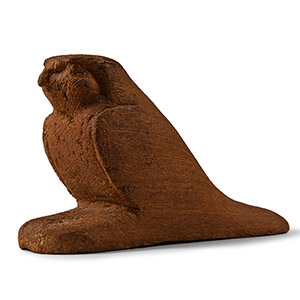
Egyptian Wooden Falcon
Late Period-Ptolemaic Period, 664-31 B.C.Sold for (Inc. bp): £1,170
Carved figure of a falcon perching on an ellipsoid base, with mortice in the top of the head for a separately-fashioned crown (missing); traces of painted decoration visible on the face; old collector's numbers to the underside 'E.18' and 'ΛOC'. 124 grams, 16.3 cm
Ex R. Liechti (1934-2010) Geneva, Switzerland, formed between 1950-1990s. -
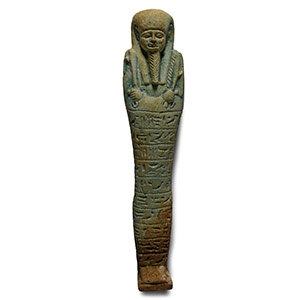
Large Egyptian Blue Glazed Hieroglyphic Shabti for Ta-Amun
Saite Period, 26th Dynasty, 664-525 B.C.Sold for (Inc. bp): £1,430
With finely modelled facial details, a plaited beard, holding a hoe and the cord of a seed bag at the left shoulder and a pick at the right, ten horizontal bands of hieroglyphic text to the lower body. 140 grams, 18 cm
Acquired on the German art market, 1989-1995. with The Museum Gallery, 19 Bury Place, London, WC1, UK, 1998-2003. Property of a London based academic, 2003-present. -
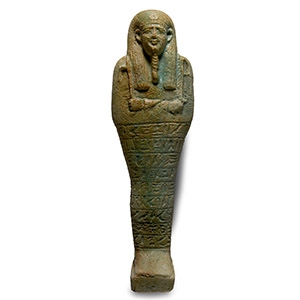
Large Egyptian Blue Glazed Hieroglyphic Shabti for a Sem Priest
Saite Period, 26th Dynasty, 664-525 B.C.Sold for (Inc. bp): £1,950
Pale blue composition with moulded detail to the wig, beard, tools and seed bag; nine horizontal bands of hieroglyphic text to the lower half of the body; dorsal pillar. 230 grams, 18.2 cm
Acquired on the German art market, 1989-1995. with The Museum Gallery, 19 Bury Place, London, WC1, UK, 1998-2003. Property of a London based academic, 2003-present. -
.jpg)
Egyptian Limestone Painted Shabti Inscribed for Ir-Nu
New Kingdom, 19th-20th Dynasty, 1295-1077 B.C.Sold for (Inc. bp): £18,200
Inscribed for Ir-nu; with carefully modelled face, large eyes and unnaturally large ears, wearing a neck-strap, a long tripartite wig with incised striations and a broad three-band collar; holding a pick in his left hand, a hoe in the right and a seed bag hanging over the left shoulder; the unusual position of the hands opposed on the chest; the text beginning in the vertical column running down the front of the figure, continuing in five horizontal bands with pale red-ochre pigment colouring to the top, middle and bottom bands; the same pigment used to colour the implements and also alternates with blue striations of the wig, the neck strap and details of the collar also in blue; the inscription from the Book of the Dead Chapter 6, reading: (Vertical column:) 'The illuminated one, the Osiris' (Horizontal rows:) 1) Ir-nu, true of voice, he says: O, this shabti 2) if one is counted, if one is reckoned to do the work 3) [to do all that is to be done in] the god’s land, to cultivate the riparian lands, transport by boat 4) [sand of] the west to the east, to act 5) at any time, to serve there (you) shall say true of voice(?). 1.4 kg total, 28.4 cm high including stand
Carieau family collection, Belgium, acquired in 1952. Ex Maspero collection, Paris, 1963. Acquired from a private European collection, in 1978. Accompanied by a copy of a technical report by Edmund S. Meltzer Ph.D. Accompanied by an academic report by Egyptologist Paul Whelan. This lot has been checked against the Interpol Database of stolen works of art and is accompanied by a search certificate number no.12080-217053. -
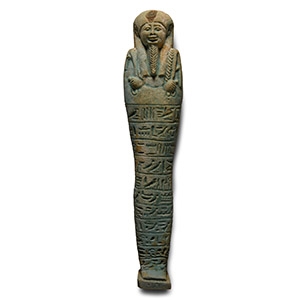
Large Egyptian Blue Glazed Hieroglyphic Shabti for Ta-Amun
Saite Period, 26th Dynasty, 664-525 B.C.Sold for (Inc. bp): £1,690
With finely modelled facial details, a plaited beard, holding a hoe and the cord of a seed bag at the left shoulder and a pick at the right, eleven horizontal bands of hieroglyphic text to the lower body. 140 grams, 18 cm
Acquired on the German art market, 1989-1995. with The Museum Gallery, 19 Bury Place, London, WC1, UK, 1998-2003. Property of a London based academic, 2003-present. -
.jpg)
Egyptian Faience Shabti for Nesy-Amun
Third Intermediate Period, 21st Dynasty, 1069-943 B.C.Sold for (Inc. bp): £1,170
Modelled in deep blue faience with applied black detailing to the hair, eyes, seed bag, agricultural tools and three bands of hieroglyphs to the lower body reading giving the title and name of 'Nesy-Amun, Justified'; very rare. 75 grams, 11.1 cm
European collection, latterly in private UK collection, 1990. Read by John Taylor at the British Museum on 27 February 2009. Accompanied by a copy of a handwritten information card and a print out of the Christie's example.
Nesy-Amun was the Fourth Prophet of Amun in the 21st Dynasty. The mummy was recovered from the priest's hole, cache II, Deir el-Bahari. -
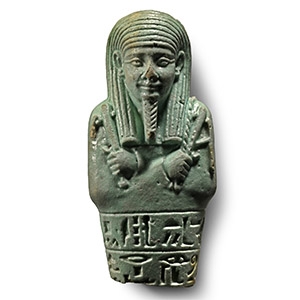
Egyptian Blue Glazed Hieroglyphic Shabti Fragment
Saite Period, 26th Dynasty, 664-525 B.C.Sold for (Inc. bp): £1,820
Pale blue composition with detailed texture to the headcloth, pick and hoe held at the shoulders with cord supporting the seed bag over the shoulder; the lower body with two bands of crisp hieroglyphic text remaining. 96 grams, 90 mm
Acquired on the German art market, 1989-1995. with The Museum Gallery, 19 Bury Place, London, WC1, UK, 1998-2003. Property of a London based academic, 2003-present.
Although the individual's name is lost, his titles: 'member of the elite' and 'mayor/prince/governor', indicate his high status. -
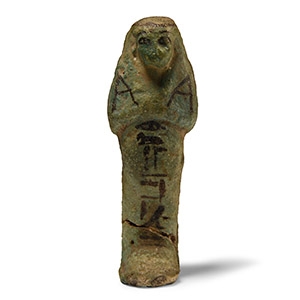
Egyptian Blue Glazed Shabti for the Priest of Amun Mi
Third Intermediate Period, 21st Dynasty, 1077-943 B.C.Sold for (Inc. bp): £442
Applied black pigment to the wig, eyes, two hoes, seed bag at the reverse, and a vertical panel of hieroglyphic text on the lower body with the dedication: 'The Osiris, the Priest of Amun Mi, true of voice'. 132 grams, 11.8 cm
Probably from a priests’ cachette at Luxor. Acquired in Egypt by Lieutenant James Alexander Goodman in the 1920s. Thence by descent to his grandson.
Lieutenant Goodman served in the 4th Battalion Welsh Regiment during World War I and saw action in Palestine during the capture of Bethlehem, (for which he won an MC). After the war, he setup a business selling Fordson trucks and tractors in Alexandria, Egypt. A keen antiquarian, he collected ancient objects during his time in Alexandria and when he visited the pyramids at Giza. After his first marriage failed, he returned to the UK in the early 1930s. On his death in 1959, he passed his small collection of Egyptian objects on to his second wife, Ruby Goodman. On Ruby’s death in 1994, they were left to their second daughter, Rosemary Johnson, (née Goodman), and are currently in the possession of her son. -
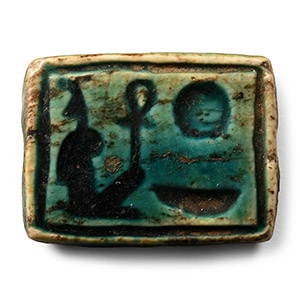
Egyptian Faience Block Bead for Amenhotep III and Queen Tiye
New Kingdom, 18th Dynasty, circa 1398-1338 B.C.Sold for (Inc. bp): £520
Rectangular bifacial stamp with hieroglyphs writing the prenomen of Amenhotep III (Neb-Maat-Re) to obverse, and to reverse 'King's Wife Tiye'. 1.84 grams, 16 mm
Ex Emile Bouillon Bey, c. 1880. From the Gaston Maspero Archaeological Fund. with Hotel des Ventes du Perigord, Bergerac, 24 June 2007. Property of a French collector. -
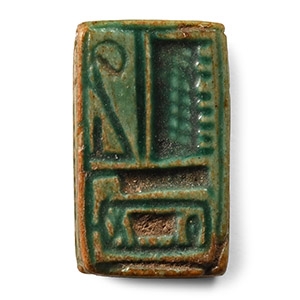
Egyptian Faience Block Bead of Thutmose III
New Kingdom, 18th Dynasty, circa 1504-1452 B.C.Sold for (Inc. bp): £442
With impressed hieroglyphs on all four faces, two sides giving the throne name of Thutmose III (Men-kheper-Re), the others mentioning the god Amun. 1.1 grams, 12 mm
From the old collection of Emile Bouillon Bey, c. 1880. Ex Gaston Maspero archaeological fund. Property of a French collector.
Thutmose III was a renowned warrior king widely revered even centuries after his reign. -
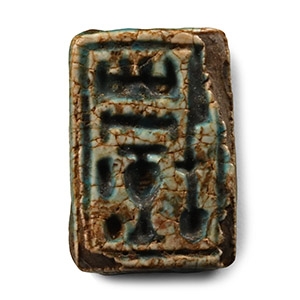
Egyptian Faience Block Bead with Bes and Amun
New Kingdom, 19th-20th Dynasty, 1279-1081 B.C.Sold for (Inc. bp): £286
Rectangular bead with reserved image of Bes to one face, hieroglyphs to the reverse giving the legend 'beautiful praise (of) Amun'. 1.31 grams, 13 mm
Ex Emile Bouillon Bey, c. 1880. From the Gaston Maspero Archaeological Fund. with Hotel des Ventes du Perigord, Bergerac, 24 June 2007. Property of a French collector.
Bes became one of ancient Egypt's most popular apotropaic deities from the New Kingdom onwards. Despite his somewhat fearful appearance, Bes was the patron and protector of pregnant women and children. He was also believed to protect from snakes. -
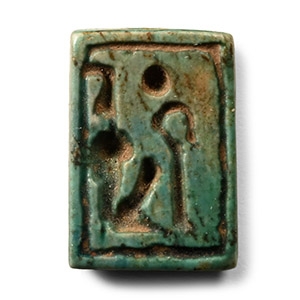
Egyptian Faience Block Bead of Ramesses IV
New Kingdom, 20th Dynasty, 1166-1160 B.C.Sold for (Inc. bp): £416
Rectangular block with hieroglyphs on both faces; one side gives the throne name of Ramesses IV (Heka-Maat-Re), the other side gives the name of the god Amun-Re. 1.45 grams, 14 mm
Ex Emile Bouillon Bey, c. 1880. From the Gaston Maspero Archaeological Fund. with Hotel des Ventes du Perigord, Bergerac, 24 June 2007. Property of a French collector.
