
Auction Highlights
-
.jpg)
Greek Marble Head of Dionysus
Sold for (Inc. bp): £23,400
Carved in the half-round in three-quarter view, youthful male head with stern features, hair gathered in a browband, horns to the brow; from a frieze or relief; mounted on a custom-made stand. -
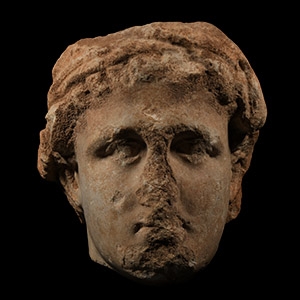
Greek Marble Head of a Ruler
Sold for (Inc. bp): £31,200
Carved in the round with thick wreath of laurel leaves to the brow, short tousled hair, stern face with thick jaw; mounted on a custom-made stand. -
.jpg)
Roman Veined Marble Torso of an Athlete
Sold for (Inc. bp): £48,100
Standing contrapposto with his weight on his right leg and the left leg brought slightly forward; the musculature of the torso displaying well-defined pectoral muscles, prominent abdominal muscles and wide shoulders, the back with equally toned musculature and well-formed rounded buttocks; the veining of the marble accentuating the idealised anatomy; the now-absent head was most probably turned towards the supporting leg and the left arm would have been raised; mounted on a custom-made display stand. -
.jpg)
Large Middle Elamite Cylinder Seal of Kidnu, Chief Overseer of King Tan-Ruhurater II
Sold for (Inc. bp): £15,600
A high-status green chalcedony seal with frieze depicting a seated figure in horned headdress facing a standing figure with arms outstretched, small monkey to the legs; six columns of Akkadian cuneiform text transliterated as: 1. ki-di-nu UGULA KUŠ-MEŠ 2. GAL šà tan-dru-hu- 3. ra-te-er EŠŠANA šu-ši 4. u an-za-an ARAD 5. šà dha-te-ri-iš 6. šak(?) ì-lí-šu 'Kidinu, chief overseer of the equerries(?) of Tan-Ruhurater, King of Susa and Anzan, servant of Haterishshak, his god'. The seal's owner was an official of King Tan-Ruhurater II (circa 1450 B.C.), king of Susa and Anzan. The title used to describe Kidinu is sometimes translated 'high official', elsewhere 'horse groom' or 'animal trainer'; the Elamite deity Haterish is otherwise unknown. -
.jpg)
Mesopotamian Torch Bearer Stand with Lion Tamer
Sold for (Inc. bp): £46,800
A substantial torch bearer depicting a male lion or panther standing with legs firmly planted on a rectangular base, tail extending to the ground, with a massive circular shaped armature or candelabra issuing from its back and wearing an elaborate muzzle, the eyes retaining shell inlay with a circular hollow for the pupils; to the right of the beast a kneeling nude male wearing a large belt-armour and a diadem, eyes inlaid, left hand extended to the side and holding the lion's leash.
-
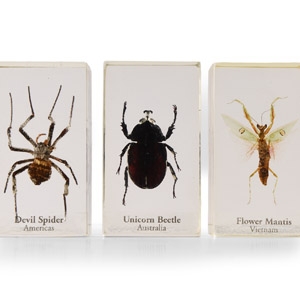
Natural History - Insect Paper Weight Group
20th century A.D.Sold for (Inc. bp): £111
Comprising three insects set in a resin block, comprising: a unicorn beetle from Australia; a flower mantis from Vietnam; a devil spider from Americas. 272 grams total, 74 x 41 mm each
Acquired from Newark Fossil and Gem Fair, circa 2012. Ian Wilkinson collection, Nottinghamshire, UK. -
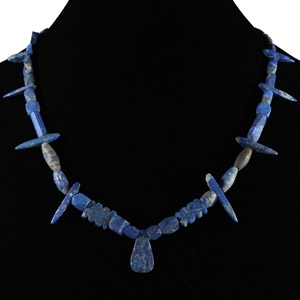
Bactrian Style Lapis Lazuli Bead Necklace
20th century A.D.Sold for (Inc. bp): £13
Restrung with polyhedral, oblate and other beads, with a tear-shaped dangle. 41.1 grams, 40 cm
Acquired on the London, UK, art market in the 1990s. Ex London, UK, gallery. -
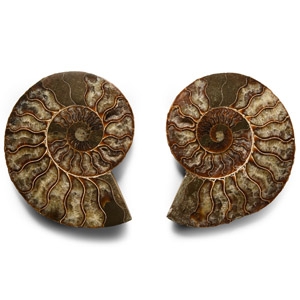
Natural History - Cut and Polished Fossil Ammonite
Cretaceous Period, circa 113-100 million years B.P.Sold for (Inc. bp): £39
Comprising a large Cleoniceras sp. ammonite cut into halves and polished to highlight the internal gas chambers, some iridescence to the outer surfaces. 559 grams total, 13-13.1 cm
From a Lincolnshire, UK, collection. Property of a Cambridgeshire, UK, gentleman. -
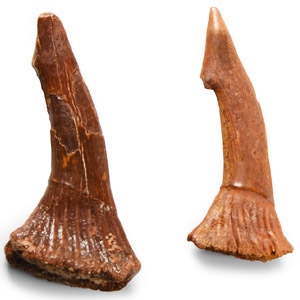
Natural History - Fossil Onchosaurus Rostral Spines
Cretaceous Period, circa 100-66 million years B.P.Sold for (Inc. bp): £20
Comprising two Onchopristus numidus snout spines. 26 grams total, 50-54 mm
From a Cambridgeshire, UK, collection. Property of a Cambridgeshire, UK, gentleman. -
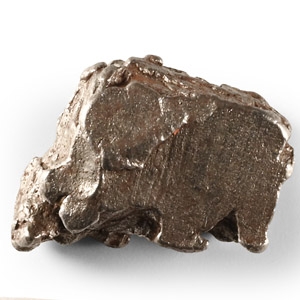
Natural History - Sikhote Alin Meteorite
Fell 12th February 1947 A.D.Sold for (Inc. bp): £85
A coarse octahedrite class IIB iron meteorite from a witnessed fall in the former USSR, showing exceptional ablation forms and surface preservation, cleaned. 11.7 grams, 19 mm
Acquired from Steve Arnold, co-star of 'Meteorite Men'. Ian Wilkinson collection, Nottinghamshire, UK.
Sikhote-Alin is an iron meteorite that fell on February, 13, 1947 on the Sikhote-Alin Mountains in eastern Siberia. Though large iron meteorite falls had been witnessed previously and fragments recovered, never before in recorded history had a fall of this magnitude been observed. An estimated 70 tonnes of material survived the fiery passage through the atmosphere and reached the Earth. The strewn field for this meteorite covered an elliptical area of about 1.3 km2 (0.50 sq mi). Some of the fragments made impact craters, the largest of which was about 26 m (85 ft) across and 6 m (20 ft) deep. Fragments of the meteorite were also driven into the surrounding trees. The Soviet Union issued a stamp for the 10th anniversary of the Sikhote-Alin meteorite shower and this reproduces a painting by P. J. Medvedev, a Soviet artist who witnessed the fall: he was sitting in his window starting a sketch when the fireball appeared, so he immediately began drawing what he saw. -
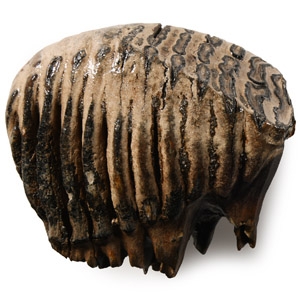
Natural History - Fossil Baby Woolly Mammoth Tooth
Pleistocene Period, 2.6 million-11,700 years B.P.Sold for (Inc. bp): £169
A conserved and varnished juvenile Mammuthus primigenius tooth. 493 grams, 10.4 cm
Dredged from the North Sea, probably from Brown Bank, Lowestoft, Suffolk, England, UK. From the collection of a Norfolk, UK, lady collector. -
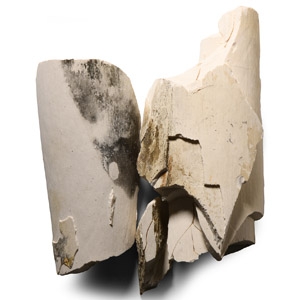
Natural History - British Woolly Mammoth Fossil Tusk Section Group
Pleistocene Period, circa 40,000 years B.P.Sold for (Inc. bp): £39
Mammuthus primigenius tusk fragments. 259 grams total, 4.7-14 cm
Found North Sea, UK. Ian Wilkinson collection, Nottinghamshire, UK, formed since 1985. -
.jpg)
Natural History - Fossil Fly Group
Eocene Period, 50 million years B.P.Sold for (Inc. bp): £13
Comprising three specimens on a matrix. 145 grams total, 51-66 mm
From the Green River Formation, south western Wyoming, U.S.A. Collected between 1930 and 1960. From the collection of the palaeontologist R Gledhill. -
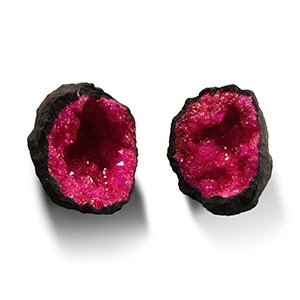
Natural History - Pink Quartz Crystal Nodule
Sold for (Inc. bp): £65
The nodule split in half to expose the crystal filled cavity with enhanced pink crystals. 127 grams total, 53 mm each
From a Cambridgeshire, UK, collection. Property of a Cambridgeshire, UK, gentleman. -
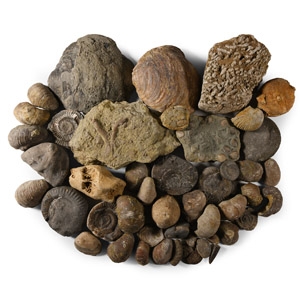
Natural History - Historic Mixed Fossil Collection
Sold for (Inc. bp): £20
Comprising a variety of fossils including bivalves, Dactylioceras sp. specimens, a sea urchin, Gryphaea specimens and others. 4.4 kg total, 2-15.5 cm
Acquired from various sources within the UK. Ian Wilkinson collection, Nottinghamshire, UK, formed since 1985. -
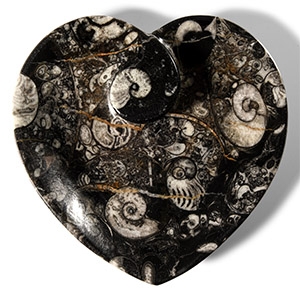
Natural History - Fossil Goniatite Heart-Shaped Trinket Tray
Devonian Period, circa 417-354 million years B.P.Sold for (Inc. bp): £46
The fossiliferous matrix with convex body displaying several fossils with a raised pedestal at the top, set with a single Goniatite sp. fossil. 524 grams, 16.5 cm
From a Cambridgeshire, UK, collection. Property of a Cambridgeshire, UK, gentleman. -
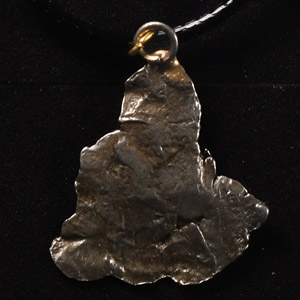
Natural History - Campo del Cielo Meteorite Necklace
Fell 6000-5000 years B.P.Sold for (Inc. bp): £52
Comprising a section of nickel-iron meteorite (IAB) set with a suspension loop and suspended from a cord necklace; supplied in a gift box. 27 grams total, meteorite: 30 mm
From a Lincolnshire, UK, collection. Property of a Cambridgeshire, UK, gentleman.
A crater field of roughly 26 craters was found in the vicinity of this crater, which is estimated to date to 4-5 thousand years BP. The age of the meteorite itself is thought to be c.4.5 billion years, formed as part of the development of this solar system. The largest two fragments, the 30.8 ton Gancedo and 28.8 ton El Chaco, are among the heaviest meteorite masses ever recovered on Earth. In 1576, the governor of a province in Northern Argentina commissioned the military to search for a large mass of iron, which it was believed the local people claimed had fallen from the sky and which they used for their weapon production. The expedition discovered a large mass of metal which was assumed to be an iron mine and brought back a few samples, which were described as being of unusual purity. Following the legends, in 1774 Don Bartolomé Francisco de Maguna rediscovered the iron mass. He himself did not believe that the stone had fallen from the sky and assumed that it had formed by a volcanic eruption. However, he sent the samples to the Royal Society of London. In 1990 it became protected by law.
