
Auction Highlights
-
.jpg)
Greek Marble Head of Dionysus
Sold for (Inc. bp): £23,400
Carved in the half-round in three-quarter view, youthful male head with stern features, hair gathered in a browband, horns to the brow; from a frieze or relief; mounted on a custom-made stand. -
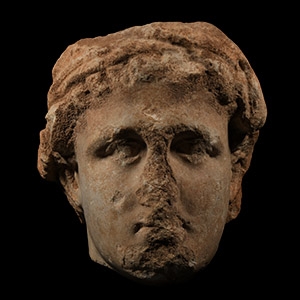
Greek Marble Head of a Ruler
Sold for (Inc. bp): £31,200
Carved in the round with thick wreath of laurel leaves to the brow, short tousled hair, stern face with thick jaw; mounted on a custom-made stand. -
.jpg)
Roman Veined Marble Torso of an Athlete
Sold for (Inc. bp): £48,100
Standing contrapposto with his weight on his right leg and the left leg brought slightly forward; the musculature of the torso displaying well-defined pectoral muscles, prominent abdominal muscles and wide shoulders, the back with equally toned musculature and well-formed rounded buttocks; the veining of the marble accentuating the idealised anatomy; the now-absent head was most probably turned towards the supporting leg and the left arm would have been raised; mounted on a custom-made display stand. -
.jpg)
Large Middle Elamite Cylinder Seal of Kidnu, Chief Overseer of King Tan-Ruhurater II
Sold for (Inc. bp): £15,600
A high-status green chalcedony seal with frieze depicting a seated figure in horned headdress facing a standing figure with arms outstretched, small monkey to the legs; six columns of Akkadian cuneiform text transliterated as: 1. ki-di-nu UGULA KUŠ-MEŠ 2. GAL šà tan-dru-hu- 3. ra-te-er EŠŠANA šu-ši 4. u an-za-an ARAD 5. šà dha-te-ri-iš 6. šak(?) ì-lí-šu 'Kidinu, chief overseer of the equerries(?) of Tan-Ruhurater, King of Susa and Anzan, servant of Haterishshak, his god'. The seal's owner was an official of King Tan-Ruhurater II (circa 1450 B.C.), king of Susa and Anzan. The title used to describe Kidinu is sometimes translated 'high official', elsewhere 'horse groom' or 'animal trainer'; the Elamite deity Haterish is otherwise unknown. -
.jpg)
Mesopotamian Torch Bearer Stand with Lion Tamer
Sold for (Inc. bp): £46,800
A substantial torch bearer depicting a male lion or panther standing with legs firmly planted on a rectangular base, tail extending to the ground, with a massive circular shaped armature or candelabra issuing from its back and wearing an elaborate muzzle, the eyes retaining shell inlay with a circular hollow for the pupils; to the right of the beast a kneeling nude male wearing a large belt-armour and a diadem, eyes inlaid, left hand extended to the side and holding the lion's leash.
-
.jpg)
Viking Iron Sword with Three-Lobed Pommel
10th-11th century A.D.Sold for (Inc. bp): £2,990
Double-edged cutting sword of Petersen Type S or T variant with tapering blade bearing some deep battle scars; boat-shaped straight lower guard and tapering tang; boat-shaped upper guard supporting a massive three-lobed pommel with remains of silver inlay to both sides. 1.07 kg, 92.5 cm
From the private collection of a London gentleman, from his grandfather's collection formed before the early 1970s. Accompanied by an academic report by Dr Raffaele D’Amato. This lot has been checked against the Interpol Database of stolen works of art and is accompanied by a search certificate number no.12039-216430.
These swords were widely used in the Baltic area, to the extent that V. Kazakevicius noticed a variation within the decoration of some Type T swords, creating a Curonian type T, which were most likely of Baltic manufacture (at least the hilt construction). The traces of silver ornaments are not sufficient to determine the type of ornamentation, but the remains are artistically consistent with archaeological examples of decorative work from the geographic region or estimated cultural point of origin, probably Eastern Scandinavia or the Baltic areas. -
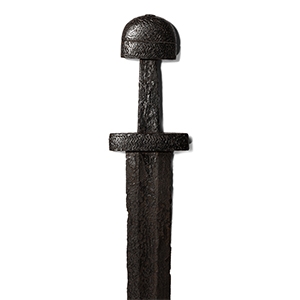
Viking Peterson Type X Sword with Inlaid Hilt
Circa 10th-11th century A.D.Sold for (Inc. bp): £3,900
With pattern-welded double-edged blade, showing well-defined shallow fullers and wide cutting edges, the fullers occupying not less than one third of the entire width and running to a point about 19 cm from the tip; massive, simply decorated hilt; the pommel, as well as the cross-guard, with visible zig-zag patterns; the pommel of solid tea-cosy type, divided into two sections by a well marked groove, the bottom being the larger, the curved top portion of the pommel further divided into three lobes; traces of inlay visible on the pommel and on the cross-guard. 1.25 kg, 94 cm
Acquired on the European art market in the 1990s. From the property of a Suffolk collector.
The blade shows in its central section, and on both cutting edges, the blodiձa style pattern-welding through the central portion of the blade (Oakeshott, 1960, fig.70). The fine pattern-welded blade patterns of Viking swords are the blodiձa (Blood-Eddy) and 'ann' (rows of mown hay) known from Norse poetry. -
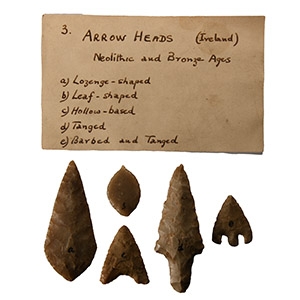
'The General Sir George Cockburn' Stone Age Flint Arrowhead Collection
Neolithic Period, circa 5th-3rd millennium B.C.Sold for (Inc. bp): £1,950
Mixed group including leaf-shaped, barbed and barbed-and-tanged types, each with inked collector's number and card giving details of provenance. 33.2 grams total, 29-71 mm
Probably from the collection of General Sir George Cockburn (1763-1947), Shanganagh Castle, Co. Wicklow, Ireland, sold at auction between 1935-1939. Accompanied by an old handwritten identification card. -
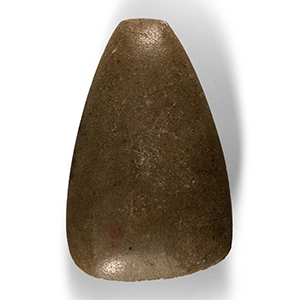
'The General Sir George Cockburn' Stone Age Polished Axehead
Neolithic Period, circa 4th-3rd millennium B.C.Sold for (Inc. bp): £364
Highly polished with slightly convex cutting edge, body tapering to a narrow square butt. 416 grams, 12.5 cm
Probably from the collection of General Sir George Cockburn (1763-1947), Shanganagh Castle, Co. Wicklow, Ireland, sold at auction between 1935-1939. -
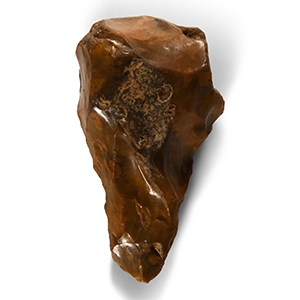
'The General Sir George Cockburn' Stone Age Classic British Teardrop-Shaped Knapped Flint Handaxe
Palaeolithic Period, circa 200,000 B.C.Sold for (Inc. bp): £260
With broad rounded butt, D-shaped in section, some cortex in place; old inked '3' beneath a natural cavity with cortex. 278 grams, 12 cm
Probably from the collection of General Sir George Cockburn (1763-1947), Shanganagh Castle, Co. Wicklow, Ireland, sold at auction between 1935-1939. -
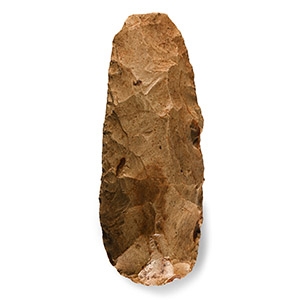
Very Large Stone Age 'Charente' Knapped Flint Axe Head
Neolithic Period, circa 5000 years B.P.Sold for (Inc. bp): £208
Biconvex in section with square butt and broad cutting edge, regular in shape and with unusual colouration. 1.19 kg, 22.5 cm
Found Charente, Dordogne Region, France. From an old French collection formed in the early 1900s. From the collection of a Norfolk, UK, lady collector. -
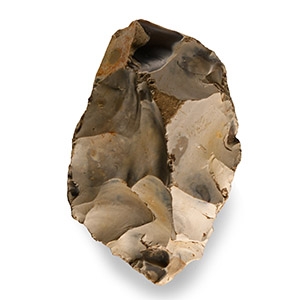
Stone Age 'Salisbury' Knapped Flint Handaxe
Lower Palaeolithic Period, 480,000-250,000 B.C.Sold for (Inc. bp): £169
Irregular ovate form with cortex remaining, broad knapped edge. 744 grams, 15.5 cm
Found whilst field walking near Salisbury, Wiltshire, UK. Ex British private collection. From the collection of a South West London, UK, specialist Stone Age collector. -
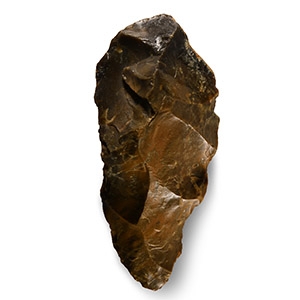
Very Large Stone Age 'Abbevilleien' Caramel and Burnt-Orange Knapped Flint Handaxe
Lower Palaeolithic Period, 600,000-400,000 years B.P.Sold for (Inc. bp): £390
Substantial flint pointed tool with much cortex remaining. 1.12 kg, 20 cm
Found by the Somme River at Abbeville, France. From an old French collection formed in the early 1900s. From the collection of a Norfolk, UK, lady collector.
Abbervillien in style - a phase of the Olduwan that occured in Europe dated to 600,000 to 400,000 years ago. -
.jpg)
Extremely Large Stone Age 'Melton Constable' Knapped Flint Axe Head
Neolithic Period, circa 4000 years B.P.Sold for (Inc. bp): £312
Biconvex in section with square butt and broad cutting edge, regular in shape. 1.3 kg, 22 cm
Found whilst fieldwalking in the Melton Constable area, Norfolk, UK, in the 1960s; thence by descent to the finder's daughter. From the collection of a Norfolk, UK, lady collector. -
.jpg)
Stone Age Danish Knapped Flint Dagger
Late Neolithic Period, circa 2000-1700 B.C.Sold for (Inc. bp): £1,105
With lentoid-section shank, leaf-shaped blade. 120 grams, 22.5 cm
From a collection acquired on the UK art market from various auction houses and collections mostly before 2000. From an important Cambridgeshire estate; thence by descent. -
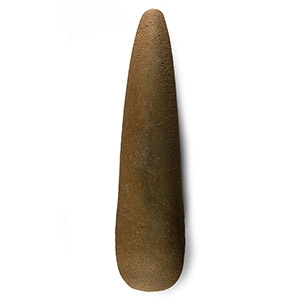
Massive Stone Age Speckled Polished Axehead
Neolithic Period, circa 7th-5th millennium B.C.Sold for (Inc. bp): £221
With rounded cutting edge and almost-circular shank, thin pointed butt. 3.17 grams, 39 cm
From a collection acquired on the UK art market from various auction houses and collections mostly before 2000. From an important Cambridgeshire estate; thence by descent. -
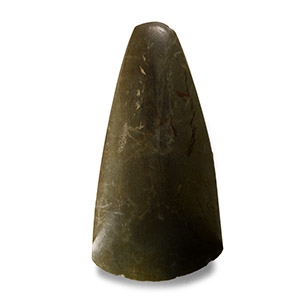
Stone Age Polished Greenstone Axehead
Neolithic Period, 4,000-3,500 B.C.Sold for (Inc. bp): £585
Of teardrop shape in polished greenstone with broad curving cutting edge, lentoid-section body and narrow rounded butt. 131 grams, 95 mm
Found Grimsby, UK, in 2014. From an East Anglian private collection. Accompanied by a copy of the British Museum's Portable Antiquities Scheme (PAS) record report slip entry no.5266.
