
Auction Highlights
-
.jpg)
Greek Marble Head of Dionysus
Sold for (Inc. bp): £23,400
Carved in the half-round in three-quarter view, youthful male head with stern features, hair gathered in a browband, horns to the brow; from a frieze or relief; mounted on a custom-made stand. -
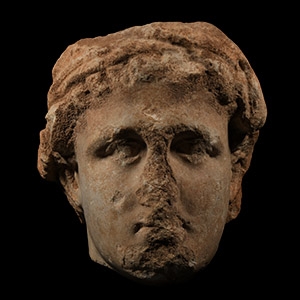
Greek Marble Head of a Ruler
Sold for (Inc. bp): £31,200
Carved in the round with thick wreath of laurel leaves to the brow, short tousled hair, stern face with thick jaw; mounted on a custom-made stand. -
.jpg)
Roman Veined Marble Torso of an Athlete
Sold for (Inc. bp): £48,100
Standing contrapposto with his weight on his right leg and the left leg brought slightly forward; the musculature of the torso displaying well-defined pectoral muscles, prominent abdominal muscles and wide shoulders, the back with equally toned musculature and well-formed rounded buttocks; the veining of the marble accentuating the idealised anatomy; the now-absent head was most probably turned towards the supporting leg and the left arm would have been raised; mounted on a custom-made display stand. -
.jpg)
Large Middle Elamite Cylinder Seal of Kidnu, Chief Overseer of King Tan-Ruhurater II
Sold for (Inc. bp): £15,600
A high-status green chalcedony seal with frieze depicting a seated figure in horned headdress facing a standing figure with arms outstretched, small monkey to the legs; six columns of Akkadian cuneiform text transliterated as: 1. ki-di-nu UGULA KUŠ-MEŠ 2. GAL šà tan-dru-hu- 3. ra-te-er EŠŠANA šu-ši 4. u an-za-an ARAD 5. šà dha-te-ri-iš 6. šak(?) ì-lí-šu 'Kidinu, chief overseer of the equerries(?) of Tan-Ruhurater, King of Susa and Anzan, servant of Haterishshak, his god'. The seal's owner was an official of King Tan-Ruhurater II (circa 1450 B.C.), king of Susa and Anzan. The title used to describe Kidinu is sometimes translated 'high official', elsewhere 'horse groom' or 'animal trainer'; the Elamite deity Haterish is otherwise unknown. -
.jpg)
Mesopotamian Torch Bearer Stand with Lion Tamer
Sold for (Inc. bp): £46,800
A substantial torch bearer depicting a male lion or panther standing with legs firmly planted on a rectangular base, tail extending to the ground, with a massive circular shaped armature or candelabra issuing from its back and wearing an elaborate muzzle, the eyes retaining shell inlay with a circular hollow for the pupils; to the right of the beast a kneeling nude male wearing a large belt-armour and a diadem, eyes inlaid, left hand extended to the side and holding the lion's leash.
-
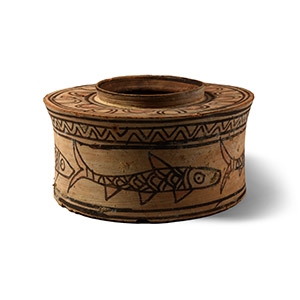
Indus Valley Mehrgarh Storage Jar with Fish
2nd millennium B.C.Sold for (Inc. bp): £1,950
Drum-shaped jar with slightly flared shoulder, raised rim to the mouth; bands of painted decoration including alternating horseshoe panels to the shoulder, frieze of fishes to the sidewall. 300 grams, 13.3 cm
Ex London, UK, gallery, 1971-early 2000s. Accompanied by an original thermoluminescence analysis report no.N111m55 from Oxford Authentication. -
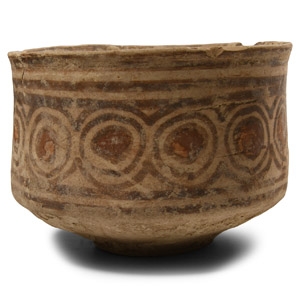
Indus Valley Terracotta Cup with Circle Decoration
3rd-2nd millennium B.C.Sold for (Inc. bp): £72
Small vessel with slightly convergent sidewall, and flared lip, carinated profile; painted band of conjoined roundels. 81 grams, 79 mm
Acquired from Alexander Gotz, London, UK. Ex M Scyoyen collection, Norway, collection no.38. -
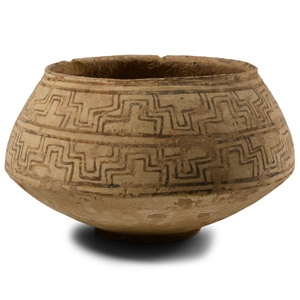
Large Indus Valley Terracotta Jar with Meander Pattern
3rd-2nd millennium B.C.Sold for (Inc. bp): £247
Biconvex in profile with slightly stepped rim, basal ring; to the shoulder, a dense pattern of interlocking steps or meander in two rows. 532 grams, 19 cm wide
Acquired from Alexander Gotz, London, UK. Ex M Scyoyen collection, Norway, collection no.20. -
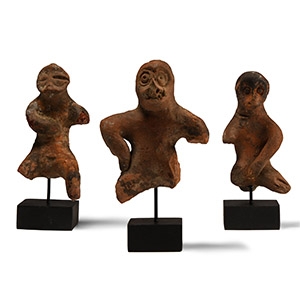
Indus Valley Terracotta Figure Group
2nd millennium B.C.Sold for (Inc. bp): £169
Group of three simians with exaggerated facial features, each with a stub tail; each mounted on a custom-made display stand. 247 grams total, 9.9-10.4 cm including stand
From a collection acquired on the UK art market from various auction houses and collections mostly before 2000. From an important Cambridgeshire estate; thence by descent. -
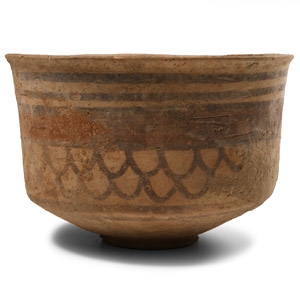
Indus Valley Painted Terracotta Bowl
3rd-2nd millennium B.C.Sold for (Inc. bp): £78
Bell-shaped in profile with painted horizontal bands, scale pattern below. 290 grams, 12 cm
Acquired 1990s-2000s. From the late David Gold (d.2015) collection of pottery.
David Gold and his brother were famous for setting up the first clothes shop in Carnaby Street and dressed the famous in the swinging 1960s, making Carnaby Street famous. -
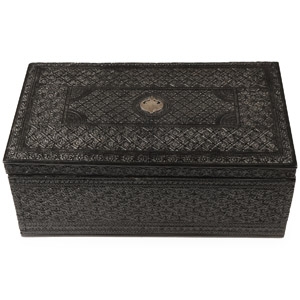
Northern Indian Nagina Ebony Writing Box with 'M H' Initials
Circa 1840 A.D.Sold for (Inc. bp): £195
Finely carved with repeating foliate and geometric designs on top and sides; the hinged lid set with a silver mount engraved with initials 'M H'; repaired. 2.3 kg, 35 x 20.5 x 14.3 cm
Acquired from the UK art market. Private Scottish collection. -
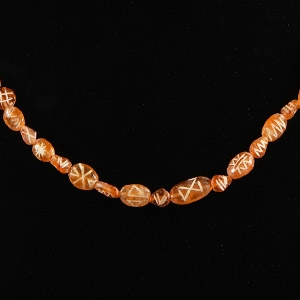
Indus Valley Etched Orange Carnelian Bead Necklace String
Circa 2nd millennium B.C. and laterSold for (Inc. bp): £312
Composed of restrung graduated and polished beads, each etched with a white geometric design on both faces. 12.1 grams, 50 cm long
UK gallery, early 2000s.
Etched carnelian beads are characteristic of the Indus Valley culture and have been produced since the third millennium B.C. They are a typical product of the Harappa culture, but they are also attested in later millennia and produced elsewhere in Southeast Asia. The oldest specimens come from the Indus Valley and from Mesopotamia. A few specimens were found in the so-called royal cemetery of Ur, where they were identified in the excavation publication as coming from India. -
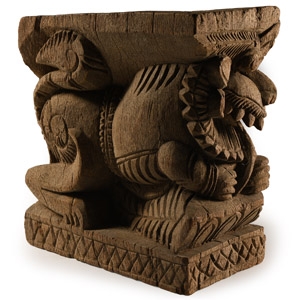
Tamil Carved Architectural Wooden Yali Lion
Sri Lanka, circa 19th century A.D.Sold for (Inc. bp): £33
Architectural feature carved from a rectangular block with texture detailing to the mane and facial features; rear face degraded. 1.69 kg, 18.2 cm
From a collection acquired on the UK art market from various auction houses and collections mostly before 2000. From an important Cambridgeshire estate; thence by descent. -
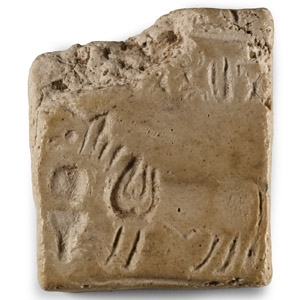
Indus Valley Limestone Stamp Seal with Quadruped
2nd millennium B.C.Sold for (Inc. bp): £78
Rectangular in plan with incuse image of an ox beside a tree, objects in the field. 14.3 grams, 37 mm
Acquired on the Paris art market in 1989. From the personal collection of a West London, UK, gentleman. -
.jpg)
Gandharan Schist Figural Buddha Freize
2nd-4th century A.D.Sold for (Inc. bp): £468
Rectangular panel with rosettes to the lateral borders; frieze with seated Buddha on a dais flanked by attendants. 4.73 kg, 31 cm wide
Acquired in the early 1980s. Private collection, North London, UK. From the private collection of Mr David Barker, London, UK; thence by descent. -
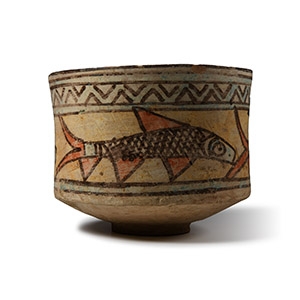
Indus Valley Mehrgarh Polychrome Storage Jar with Fish
2nd millennium B.C.Sold for (Inc. bp): £1,300
Bell-shaped with basal ring, frieze of fishes to the sidewall and zigzag above. 145 grams, 10 cm
Ex London, UK, gallery, 1971-early 2000s. Accompanied by an original thermoluminescence analysis report no.N111m58 from Oxford Authentication. -
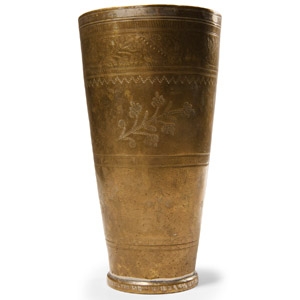
Indian Benares Brass Embossed Vessel
Circa 1890 A.D.Sold for (Inc. bp): £39
Funicular in profile with thick base, horizontal bands of punched fronds, hatched bands, pointillé leaves and other motifs; white metal rings to mouth and base. 489 grams, 17.5 cm
Acquired from the UK art market. Private Scottish collection.
