
Auction Highlights
-
.jpg)
Greek Marble Head of Dionysus
Sold for (Inc. bp): £23,400
Carved in the half-round in three-quarter view, youthful male head with stern features, hair gathered in a browband, horns to the brow; from a frieze or relief; mounted on a custom-made stand. -
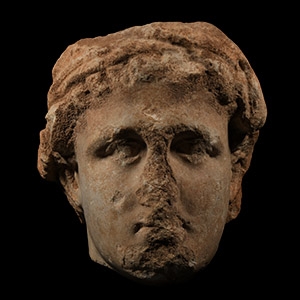
Greek Marble Head of a Ruler
Sold for (Inc. bp): £31,200
Carved in the round with thick wreath of laurel leaves to the brow, short tousled hair, stern face with thick jaw; mounted on a custom-made stand. -
.jpg)
Roman Veined Marble Torso of an Athlete
Sold for (Inc. bp): £48,100
Standing contrapposto with his weight on his right leg and the left leg brought slightly forward; the musculature of the torso displaying well-defined pectoral muscles, prominent abdominal muscles and wide shoulders, the back with equally toned musculature and well-formed rounded buttocks; the veining of the marble accentuating the idealised anatomy; the now-absent head was most probably turned towards the supporting leg and the left arm would have been raised; mounted on a custom-made display stand. -
.jpg)
Large Middle Elamite Cylinder Seal of Kidnu, Chief Overseer of King Tan-Ruhurater II
Sold for (Inc. bp): £15,600
A high-status green chalcedony seal with frieze depicting a seated figure in horned headdress facing a standing figure with arms outstretched, small monkey to the legs; six columns of Akkadian cuneiform text transliterated as: 1. ki-di-nu UGULA KUŠ-MEŠ 2. GAL šà tan-dru-hu- 3. ra-te-er EŠŠANA šu-ši 4. u an-za-an ARAD 5. šà dha-te-ri-iš 6. šak(?) ì-lí-šu 'Kidinu, chief overseer of the equerries(?) of Tan-Ruhurater, King of Susa and Anzan, servant of Haterishshak, his god'. The seal's owner was an official of King Tan-Ruhurater II (circa 1450 B.C.), king of Susa and Anzan. The title used to describe Kidinu is sometimes translated 'high official', elsewhere 'horse groom' or 'animal trainer'; the Elamite deity Haterish is otherwise unknown. -
.jpg)
Mesopotamian Torch Bearer Stand with Lion Tamer
Sold for (Inc. bp): £46,800
A substantial torch bearer depicting a male lion or panther standing with legs firmly planted on a rectangular base, tail extending to the ground, with a massive circular shaped armature or candelabra issuing from its back and wearing an elaborate muzzle, the eyes retaining shell inlay with a circular hollow for the pupils; to the right of the beast a kneeling nude male wearing a large belt-armour and a diadem, eyes inlaid, left hand extended to the side and holding the lion's leash.
-
.jpg)
Indian Framed Watercolour Manuscript
17th-18th century A.D.Sold for (Inc. bp): £39
Framed and glazed with polychrome embellishment; from a Diwan by Hafez, comprising two vertical columns of handwritten script, panels of floral ornament and concentric borders; explanatory label to reverse. 293 grams, 22.3 x 17.4 cm
Acquired by the vendor's father on the UK art market, before 1990.
Hafez was the most famous of the Islamic Sufi poets. This manuscript was evidently owned by a distinguished and affluent individual. -
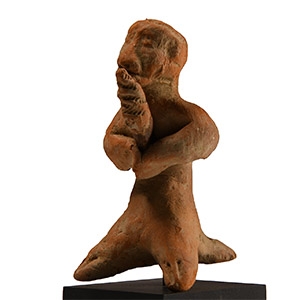
Indus Valley Terracotta Figure
2nd millennium B.C.Sold for (Inc. bp): £52
Modelled as a monkey standing and holding a conch shell; textured fur and shell, stub tail; mounted on a custom-made display stand. 132 grams total, 10.7 cm including stand
From a collection acquired on the UK art market from various auction houses and collections mostly before 2000. From an important Cambridgeshire estate; thence by descent. -
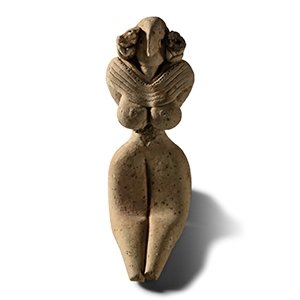
Indus Valley Seated Terracotta Fertility Figure
Circa 3000 B.C.Sold for (Inc. bp): £390
Seated goddess with legs extended in front of the body, pinched head and face, wearing an applied headdress and broad tiered collar; detailing to the collar applied with a point. 19.1 grams, 77 mm
Acquired from Alexander Gotz, London, UK. Ex Martin Schoyen collection, London, UK. -
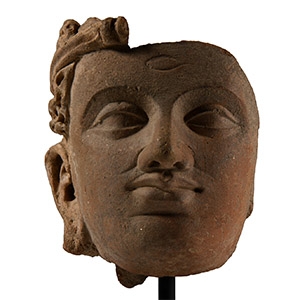
Gandharan Terracotta Head
2nd-4th century A.D.Sold for (Inc. bp): £910
Male head with finely modelled facial features, urna to the brow, horizontal band to secure the hair, long earlobe with stud; mounted on a custom-made stand. 1.23 kg total, 15 cm high including stand
Ex London, UK, gallery, 1971-early 2000s.
The partial delamination of the head shows quite strikingly the method of construction: at the centre is a rough, irregular ball to which the outer layer of clay has been added carrying the finer modelling; the brow-band appears to have been modelled at this time from the same material as formed the hair. -
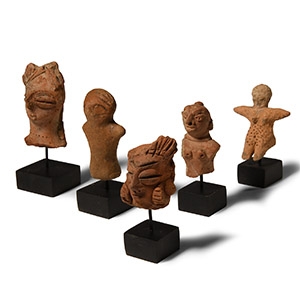
Indus Valley Terracotta Figure Group
2nd millennium B.C.Sold for (Inc. bp): £195
Including female bust with looped handle to the reverse, head with detailed hair and earrings, female with pointillé abdomen and other types; each mounted on a custom-made display stand. 231 grams total, 72-95 mm including stand
From a collection acquired on the UK art market from various auction houses and collections mostly before 2000. From an important Cambridgeshire estate; thence by descent. -
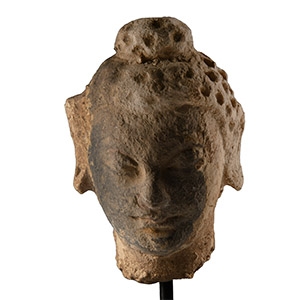
Gandharan Stone and Stucco Head
2nd-4th century A.D.Sold for (Inc. bp): £72
With top-knot ushnisha and large lentoid eyes; mounted on a custom-made stand. 264 grams total, 12.4 cm including stand
From a collection acquired on the UK art market from various auction houses and collections mostly before 2000. From an important Cambridgeshire estate; thence by descent. -
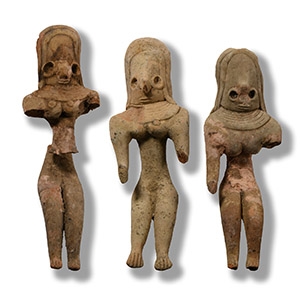
Indus Valley Seated Terracotta Fertility Idol Group
2nd-1st millennium B.C. or laterSold for (Inc. bp): £78
Including two white clay figures with applied details to the hair, collar, arms and breasts, both with one arm absent and one repaired; and two further fragments of similar. 119 grams total, 6.5-11.2 cm
From a collection acquired on the UK art market from various auction houses and collections mostly before 2000. From an important Cambridgeshire estate; thence by descent. -
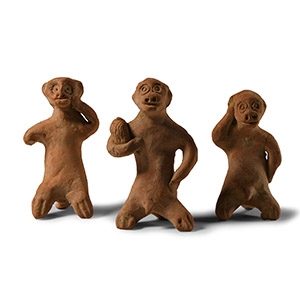
Indus Valley Terracotta Monkey Statuette Group
2nd millennium B.C. or laterSold for (Inc. bp): £111
In various poses with legs and tail forming a tripod base. 231 grams total, 86-97 mm
From a collection acquired on the UK art market from various auction houses and collections mostly before 2000. From an important Cambridgeshire estate; thence by descent. -
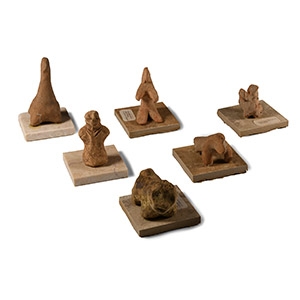
Indus Valley Terracotta Figure Group
1st millennium B.C. or laterSold for (Inc. bp): £78
Including quadrupeds, a bird and human figures, all on square display bases. 441 grams total, 41-73 mm
From a collection acquired on the UK art market from various auction houses and collections mostly before 2000. From an important Cambridgeshire estate; thence by descent. -
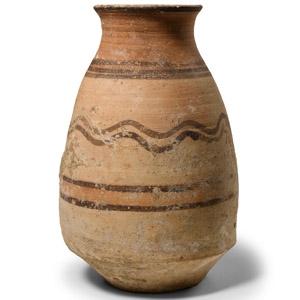
Large Indus Valley Terracotta Jar with River Pattern
3rd-2nd millennium B.C.Sold for (Inc. bp): £286
Piriform in profile with gently fared mouth, painted horizontal bands to the shoulder and wavy lines to the body. 1.08 kg, 23.3 cm
Acquired from Alexander Gotz, London, UK. Ex M Scyoyen collection, Norway, collection no.15. -
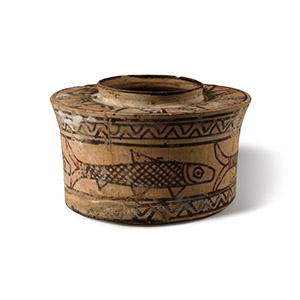
Indus Valley Mehrgarh Polychrome Storage Jar with Fish
2nd millennium B.C.Sold for (Inc. bp): £910
Drum-shaped jar with slightly flared shoulder, raised rim to the mouth; bands of painted decoration including interlocked stepped panels to the shoulder, frieze of fishes to the sidewall. 433 grams, 15.2 cm wide
Ex London, UK, gallery, 1971-early 2000s. Accompanied by an original thermoluminescence analysis report no.N111m54 from Oxford Authentication. -
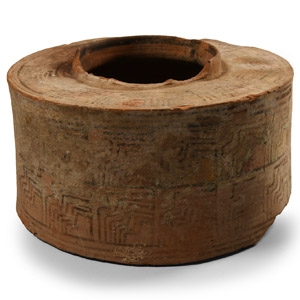
Indus Valley Painted Terracotta Jar
3rd-2nd millennium B.C.Sold for (Inc. bp): £59
With slightly sloping sidewall, flat shoulder and everted rim to the broad mouth; painted geometric bands to side and shoulder; chipped. 600 grams, 16 cm wide
Acquired 1990s-2000s. From the late David Gold (d.2015) collection of pottery.
David Gold and his brother were famous for setting up the first clothes shop in Carnaby Street and dressed the famous in the swinging 1960s, making Carnaby Street famous.
