
Auction Highlights
-
.jpg)
Greek Marble Head of Dionysus
Sold for (Inc. bp): £23,400
Carved in the half-round in three-quarter view, youthful male head with stern features, hair gathered in a browband, horns to the brow; from a frieze or relief; mounted on a custom-made stand. -
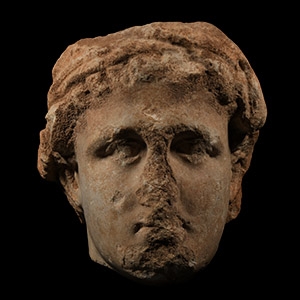
Greek Marble Head of a Ruler
Sold for (Inc. bp): £31,200
Carved in the round with thick wreath of laurel leaves to the brow, short tousled hair, stern face with thick jaw; mounted on a custom-made stand. -
.jpg)
Roman Veined Marble Torso of an Athlete
Sold for (Inc. bp): £48,100
Standing contrapposto with his weight on his right leg and the left leg brought slightly forward; the musculature of the torso displaying well-defined pectoral muscles, prominent abdominal muscles and wide shoulders, the back with equally toned musculature and well-formed rounded buttocks; the veining of the marble accentuating the idealised anatomy; the now-absent head was most probably turned towards the supporting leg and the left arm would have been raised; mounted on a custom-made display stand. -
.jpg)
Large Middle Elamite Cylinder Seal of Kidnu, Chief Overseer of King Tan-Ruhurater II
Sold for (Inc. bp): £15,600
A high-status green chalcedony seal with frieze depicting a seated figure in horned headdress facing a standing figure with arms outstretched, small monkey to the legs; six columns of Akkadian cuneiform text transliterated as: 1. ki-di-nu UGULA KUŠ-MEŠ 2. GAL šà tan-dru-hu- 3. ra-te-er EŠŠANA šu-ši 4. u an-za-an ARAD 5. šà dha-te-ri-iš 6. šak(?) ì-lí-šu 'Kidinu, chief overseer of the equerries(?) of Tan-Ruhurater, King of Susa and Anzan, servant of Haterishshak, his god'. The seal's owner was an official of King Tan-Ruhurater II (circa 1450 B.C.), king of Susa and Anzan. The title used to describe Kidinu is sometimes translated 'high official', elsewhere 'horse groom' or 'animal trainer'; the Elamite deity Haterish is otherwise unknown. -
.jpg)
Mesopotamian Torch Bearer Stand with Lion Tamer
Sold for (Inc. bp): £46,800
A substantial torch bearer depicting a male lion or panther standing with legs firmly planted on a rectangular base, tail extending to the ground, with a massive circular shaped armature or candelabra issuing from its back and wearing an elaborate muzzle, the eyes retaining shell inlay with a circular hollow for the pupils; to the right of the beast a kneeling nude male wearing a large belt-armour and a diadem, eyes inlaid, left hand extended to the side and holding the lion's leash.
-
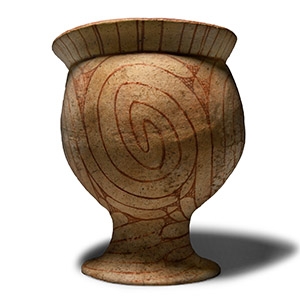
Ban Chiang Period Painted Chalice
Middle Period, 900-300 B.C.Sold for (Inc. bp): £195
Broad bowl with flared rim atop a trumpet-shaped base, all decorated with a dense series of interlocking spiral motifs. 2.6 kg, 27 cm
From a collection acquired on the UK art market from various auction houses and collections mostly before 2000. From an important Cambridgeshire estate; thence by descent. -
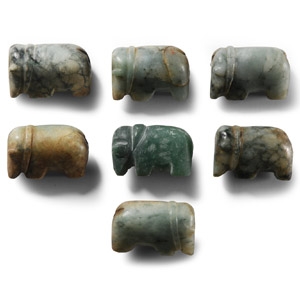
Burmese Green Stone Elephant Bead Collection
20th century A.D.Sold for (Inc. bp): £85
Each modelled in the round with a collar, pierced longitudinally for suspension. 156 grams total, 33-35 mm
From a collection acquired on the UK art market from various auction houses and collections mostly before 2000. From an important Cambridgeshire estate; thence by descent. -
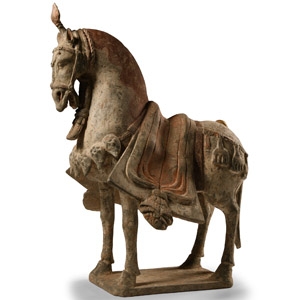
Chinese Warring States Caparisoned Horse
Warring States Period, 475-221 B.C.Sold for (Inc. bp): £1,430
With head raised, mouth open and ears pricked; integrally modelled saddle, caparison, bridle and plume; band of piriform bells to the chest; much pigment remaining; restored. 2.3 kg, 34.5 cm
Ex West Country, UK, collection, 1980-1990s. Accompanied by an indeterminate thermoluminescence analysis report no.C122g66 from Oxford Authentication. -
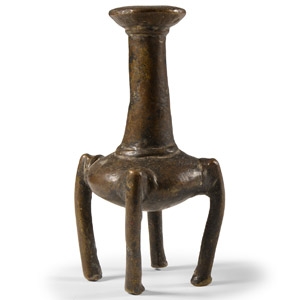
South East Asian Bronze Kohl Pot
18th-19th century A.D.Sold for (Inc. bp): £20
Biconvex reservoir with four spindle legs, tapering neck and flared rim to the mouth. 160 grams, 97 mm
From the H.N. collection, Milton Keynes, Berkshire, UK, 1990s. -
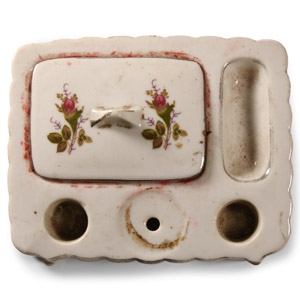
Chinese Qing Glazed Writing Set
Qing Dynasty, 1644-1911 A.D. or laterSold for (Inc. bp): £13
The ceramic palette with a lidded container containing red pigment, the lid decorated with fine red flowers and green foliage; an oval recess to the side and two round recesses to the top flanking a round shallow indentation with a hole to the centre. 324 grams, 13 x 10.2 cm
Ex West Country, UK, collection, 1980-1990s. -
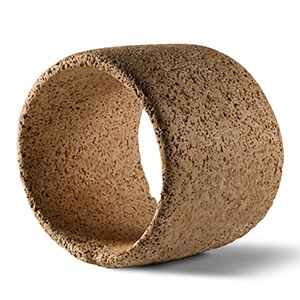
Chinese Stone Bracelet
Neolithic Period, circa 3rd millennium B.C.Sold for (Inc. bp): £98
Broad carved bangle with rounded rims. 270 grams, 83 mm wide
From a collection acquired on the UK art market from various auction houses and collections mostly before 2000. From an important Cambridgeshire estate; thence by descent. -
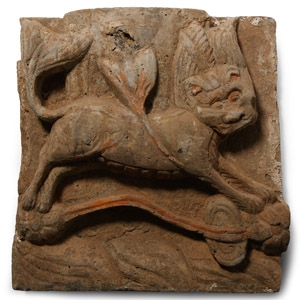
Chinese Song Lion Tile
Song Dynasty, 960-1279 A.D. or laterSold for (Inc. bp): £195
Rectangular in plan with figure modelled in the half-round of a lion pouncing; traces of pigment remaining. 4 kg, 26.5 x 26 cm
Ex West Country, UK, collection, 1980-1990s. -
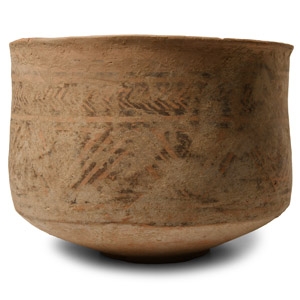
Indus Valley Painted Terracotta Jar
3rd-2nd millennium B.C.Sold for (Inc. bp): £59
With slightly sloping sidewall and everted rim, narrow foot; painted geometric bands. 425 grams, 14.5 cm wide
Acquired 1990s-2000s. From the late David Gold (d.2015) collection of pottery.
David Gold and his brother were famous for setting up the first clothes shop in Carnaby Street and dressed the famous in the swinging 1960s, making Carnaby Street famous. -
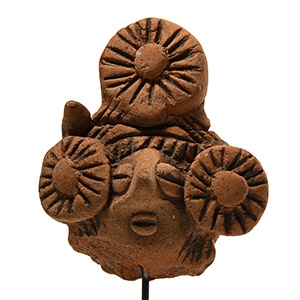
Indus Valley Terracotta Figure Head
2nd millennium B.C.Sold for (Inc. bp): £442
Modelled in the half-round with elaborate hair and rosette ornaments, pinched and applied facial detailing; mounted on a custom-made display stand. 88 grams total, 10.7 cm including stand
From a collection acquired on the UK art market from various auction houses and collections mostly before 2000. From an important Cambridgeshire estate; thence by descent. -
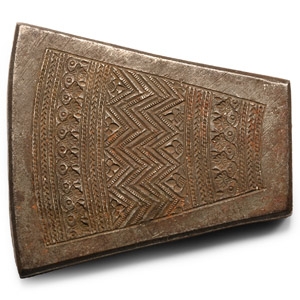
Indian Decorative Iron Mould
14th-16th century A.D.Sold for (Inc. bp): £7
Rectangular with rounded lower edge, intricate three panel design divided with rope-pattern; used for making embossed panels out of sheet-metal. 120 grams, 59 mm
UK private collection before 2000. On the UK art market. Property of a London gentleman. -
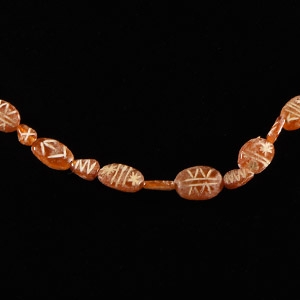
Indus Valley Etched Orange Carnelian Bead Necklace String
Circa 2nd century B.C. and laterSold for (Inc. bp): £338
Comprising polished carnelian beads etched with geometric motifs to both faces; restrung. 14.9 grams, 44 cm long
UK gallery, early 2000s.
Etched carnelian beads are characteristic of the Indus Valley culture and have been produced since the third millennium B.C. They are a typical product of the Harappa culture, but they are also attested in later millennia and produced elsewhere in Southeast Asia. The oldest specimens come from the Indus Valley and from Mesopotamia. A few specimens were found in the so-called royal cemetery of Ur, where they were identified in the excavation publication as coming from India. -
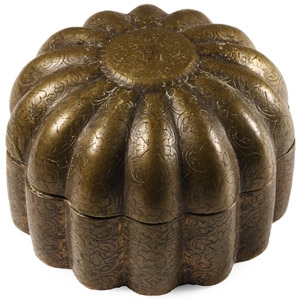
Indian Inscribed Bronze Container
19th century A.D.Sold for (Inc. bp): £117
Hollow-formed domed caddy with detachable lid, ribbed in plan with incised scrolls and tendrils. 488 grams, 11.4 cm wide
Ex London, UK, gallery, 1971-early 2000s.
