
Auction Highlights
-
.jpg)
Greek Marble Head of Dionysus
Sold for (Inc. bp): £23,400
Carved in the half-round in three-quarter view, youthful male head with stern features, hair gathered in a browband, horns to the brow; from a frieze or relief; mounted on a custom-made stand. -
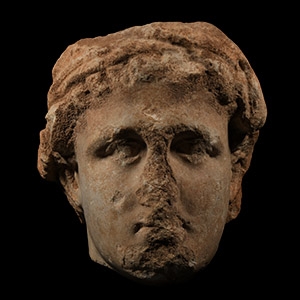
Greek Marble Head of a Ruler
Sold for (Inc. bp): £31,200
Carved in the round with thick wreath of laurel leaves to the brow, short tousled hair, stern face with thick jaw; mounted on a custom-made stand. -
.jpg)
Roman Veined Marble Torso of an Athlete
Sold for (Inc. bp): £48,100
Standing contrapposto with his weight on his right leg and the left leg brought slightly forward; the musculature of the torso displaying well-defined pectoral muscles, prominent abdominal muscles and wide shoulders, the back with equally toned musculature and well-formed rounded buttocks; the veining of the marble accentuating the idealised anatomy; the now-absent head was most probably turned towards the supporting leg and the left arm would have been raised; mounted on a custom-made display stand. -
.jpg)
Large Middle Elamite Cylinder Seal of Kidnu, Chief Overseer of King Tan-Ruhurater II
Sold for (Inc. bp): £15,600
A high-status green chalcedony seal with frieze depicting a seated figure in horned headdress facing a standing figure with arms outstretched, small monkey to the legs; six columns of Akkadian cuneiform text transliterated as: 1. ki-di-nu UGULA KUŠ-MEŠ 2. GAL šà tan-dru-hu- 3. ra-te-er EŠŠANA šu-ši 4. u an-za-an ARAD 5. šà dha-te-ri-iš 6. šak(?) ì-lí-šu 'Kidinu, chief overseer of the equerries(?) of Tan-Ruhurater, King of Susa and Anzan, servant of Haterishshak, his god'. The seal's owner was an official of King Tan-Ruhurater II (circa 1450 B.C.), king of Susa and Anzan. The title used to describe Kidinu is sometimes translated 'high official', elsewhere 'horse groom' or 'animal trainer'; the Elamite deity Haterish is otherwise unknown. -
.jpg)
Mesopotamian Torch Bearer Stand with Lion Tamer
Sold for (Inc. bp): £46,800
A substantial torch bearer depicting a male lion or panther standing with legs firmly planted on a rectangular base, tail extending to the ground, with a massive circular shaped armature or candelabra issuing from its back and wearing an elaborate muzzle, the eyes retaining shell inlay with a circular hollow for the pupils; to the right of the beast a kneeling nude male wearing a large belt-armour and a diadem, eyes inlaid, left hand extended to the side and holding the lion's leash.
-
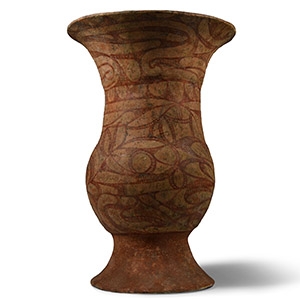
Ban Chiang Period Painted Tall Vase
Middle Period, 900-300 B.C.Sold for (Inc. bp): £247
With flared rim, globular body and trumpet-shaped base; red-on-buff decoration in the form of curvilinear meandering lines on a hatched field. 3.25 kg, 35 cm
From a collection acquired on the UK art market from various auction houses and collections mostly before 2000. From an important Cambridgeshire estate; thence by descent. -
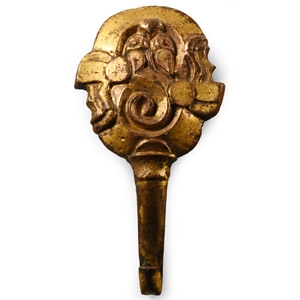
Chinese Gilt Bronze Zoomorphic Belt Hook
20th century A.D. or earlierSold for (Inc. bp): £65
With D-section neck and hook finial, ovid plaque with grotesque mask and animal body detailing. 45.9 grams, 87 mm
From a collection acquired on the UK art market from various auction houses and collections mostly before 2000. From an important Cambridgeshire estate; thence by descent. -
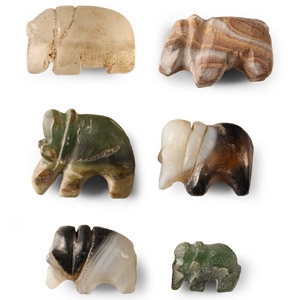
Burmese Stone Elephant Bead Collection
20th century A.D. and earlierSold for (Inc. bp): £91
Standing Puy-style elephants modelled in the round in various stones. 16.3 grams total, 12-20 mm
From a collection acquired on the UK art market from various auction houses and collections mostly before 2000. From an important Cambridgeshire estate; thence by descent. -
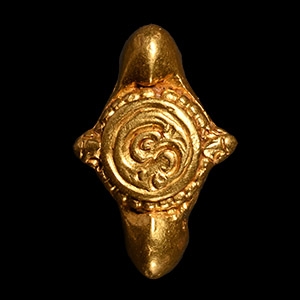
South East Asian Decorated Gold Ring
Circa 16th-17th century A.D. or earlierSold for (Inc. bp): £715
With narrow hoop expanding to bulb at each shoulder, discoid bezel with applied beaded wire collar, lateral spurs and S-swirl to the centre; child's size hoop. 7.04 grams, 19.78 mm overall, 13.41 mm internal diameter
Ex property of a late Japanese collector, 1970-2000s. -
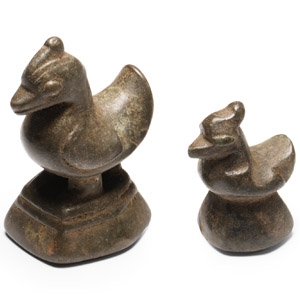
Bronze Mandarin Duck Opium Weight Group
19th century A.D.Sold for (Inc. bp): £33
Each modelled in the round on a hexagonal tiered base. 113 grams total, 28-43 mm
From a collection acquired on the UK art market from various auction houses and collections mostly before 2000. From an important Cambridgeshire estate; thence by descent. -
.jpg)
Pair of Large Chinese Tang Terracotta Musicians
Tang Dynasty, 618-907 A.D.Sold for (Inc. bp): £3,380
Two mounted musicians comprising: the horse standing on a rectangular base with painted harness, bridle and saddle detailing; the integral rider in loose coat and riding boots, wearing a floppy cap and playing a p'i-p'a (Chinese lute); the other similar, playing a ling-gu tambour held in the left hand. 5.35 kg total, 38.5 cm high each
Acquired 1990s. West Country, UK, collection. Accompanied by a copy of a thermoluminescence analysis report no.13CM180321 from Laboratory Kotalla for one of the figures. This lot has been checked against the Interpol Database of stolen works of art and is accompanied by search certificate no.11990-209554. -
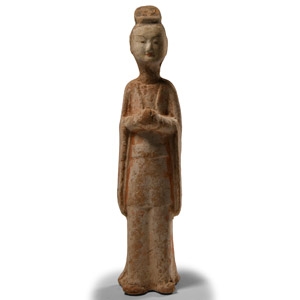
Chinese Tang Standing Figure
Tang Dynasty, 618-907 A.DSold for (Inc. bp): £117
Hollow-formed standing figure of a courtly lady in floor-length robes with hands clasped at the chest, pierced to accept a staff or handle; painted facial and other detailing. 240 grams, 22.5 cm
Ex West Country, UK, collection, 1980-1990s. -
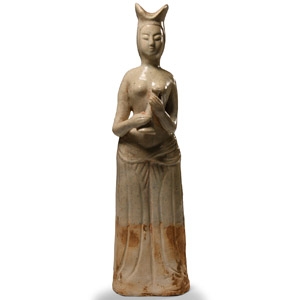
Chinese Sui Straw Glazed Figure
Sui Dynasty, 581-618 A.D. or laterSold for (Inc. bp): £234
Hollow-formed female figure in floor-length flared robe, hair dressed in two parallel crests, holding a conical vessel to her chest. 482 grams, 27 cm
Ex West Country, UK, collection, 1980-1990s. -
.jpg)
Large Chinese Terracotta Horse
17th-19th century A.D.Sold for (Inc. bp): £715
Advancing horse modelled in the round with one foreleg raised, detailed bridle, crupper and other harness, textured saddlecloth; painted detailing. 5.9 kg, 47 cm wide
Ex West Country, UK, collection, 1980-1990s. This lot has been checked against the Interpol Database of stolen works of art and is accompanied by a search certificate number no.12155-217876. -
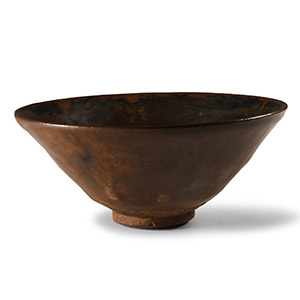
Chinese Jianyao Brown Glazed Tea Bowl
Song Dynasty, 960-1279 A.D.Sold for (Inc. bp): £169
Conical in profile with rounded rim and basal ring. 182 grams, 12.1 cm
UK gallery, early 2000s. -
.jpg)
Chinese Tang Terracotta Camel with Rider
Tang Dynasty, 618-907 A.D.Sold for (Inc. bp): £2,600
Modelled in the round advancing on a polygonal base, head tossed backwards and mouth open exposing the animal's teeth and tongue, saddled with a camel bag decorated with beast heads, rider staring into the distance whilst playing a set of pipes held in his right hand, the left held lower with hand making a fist to grip reins; remains of polychrome pigmentation. 6.2 kg, 53 cm
Acquired 1990s. West Country, UK, collection. Accompanied by an original thermoluminescence analysis report no.CJ22522022 from Laboratory Kotalla. This lot has been checked against the Interpol Database of stolen works of art and is accompanied by search certificate no.11369-192727.
Camels symbolised the prosperity of the Silk Route- the trade routes between China, Europe, and the Middle East- as they were the main form of transportation in the caravans. A popular theme for Tang court painters and sculptors was that of foreign ambassadors submitting tribute to the emperor. Diplomatic missions and the concomitant opulent offerings were an important medium of international exchange. In the dynasty’s first decades, the Tang expanded control north and east to Goguryeo and Baekje in Manchuria and the Korean peninsula, north to the steppes of Mongolia, west to the deserts and oases of Central Asia, and south to parts of the present-day provinces of Guangxi, Yunnan, and northern Vietnam. These and other kingdoms sent staples and exotica: lions from Persia and rhinoceroses from the kingdom of Champa in south and central Vietnam, hawks from the Korean peninsula, ostriches sent by Western Turks, sandalwood from the Indonesian archipelago, cardamom from the coast of the Malay peninsula, indigo from Samarkand, and wool from Tibet. Even entertainers such as musicians, dancers, and performers, as depicted on this piece, were presented as gifts. As is evident in tomb paintings and figurines, international trade whetted a taste for striking and sumptuous fashions among the Tang elite. Leopard-skin hats and close-fitting sleeves, imitating the clothing of Central Asians and Persians to the west, were popular in the mid-8th century. High boots, practical for riding, were worn by both men and women, as were short tunics. -
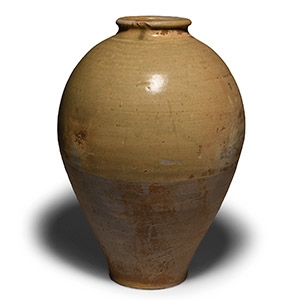
Chinese Tang Whiteware Jar
Tang Dynasty, 618-907 A.D.Sold for (Inc. bp): £247
Piriform in profile with broad mouth and rolled rim, cream glaze. 4.05 kg, 34 cm
Ex West country, UK, collection, 1990s.
