
Auction Highlights
-
.jpg)
Greek Marble Head of Dionysus
Sold for (Inc. bp): £23,400
Carved in the half-round in three-quarter view, youthful male head with stern features, hair gathered in a browband, horns to the brow; from a frieze or relief; mounted on a custom-made stand. -
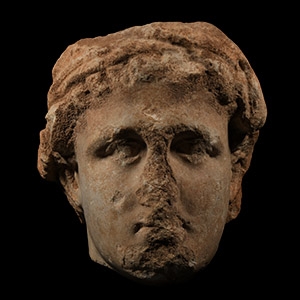
Greek Marble Head of a Ruler
Sold for (Inc. bp): £31,200
Carved in the round with thick wreath of laurel leaves to the brow, short tousled hair, stern face with thick jaw; mounted on a custom-made stand. -
.jpg)
Roman Veined Marble Torso of an Athlete
Sold for (Inc. bp): £48,100
Standing contrapposto with his weight on his right leg and the left leg brought slightly forward; the musculature of the torso displaying well-defined pectoral muscles, prominent abdominal muscles and wide shoulders, the back with equally toned musculature and well-formed rounded buttocks; the veining of the marble accentuating the idealised anatomy; the now-absent head was most probably turned towards the supporting leg and the left arm would have been raised; mounted on a custom-made display stand. -
.jpg)
Large Middle Elamite Cylinder Seal of Kidnu, Chief Overseer of King Tan-Ruhurater II
Sold for (Inc. bp): £15,600
A high-status green chalcedony seal with frieze depicting a seated figure in horned headdress facing a standing figure with arms outstretched, small monkey to the legs; six columns of Akkadian cuneiform text transliterated as: 1. ki-di-nu UGULA KUŠ-MEŠ 2. GAL šà tan-dru-hu- 3. ra-te-er EŠŠANA šu-ši 4. u an-za-an ARAD 5. šà dha-te-ri-iš 6. šak(?) ì-lí-šu 'Kidinu, chief overseer of the equerries(?) of Tan-Ruhurater, King of Susa and Anzan, servant of Haterishshak, his god'. The seal's owner was an official of King Tan-Ruhurater II (circa 1450 B.C.), king of Susa and Anzan. The title used to describe Kidinu is sometimes translated 'high official', elsewhere 'horse groom' or 'animal trainer'; the Elamite deity Haterish is otherwise unknown. -
.jpg)
Mesopotamian Torch Bearer Stand with Lion Tamer
Sold for (Inc. bp): £46,800
A substantial torch bearer depicting a male lion or panther standing with legs firmly planted on a rectangular base, tail extending to the ground, with a massive circular shaped armature or candelabra issuing from its back and wearing an elaborate muzzle, the eyes retaining shell inlay with a circular hollow for the pupils; to the right of the beast a kneeling nude male wearing a large belt-armour and a diadem, eyes inlaid, left hand extended to the side and holding the lion's leash.
-
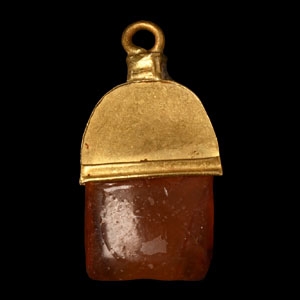
Viking Period Gold 'Elf Shot' Pendant
9th-11th century A.D. or earlierSold for (Inc. bp): £715
Gold cup with hoop and suspension loop, with carnelian insert. 0.78 grams, 16 mm
Ex property of a late Japanese collector, 1970-2000s.
This amulet was believed to offer protection against 'Elfshot'. The attack of elves was believed responsible for mysterious suffering in men and livestock: sudden shooting pains localised to a particular area of the body, such as in rheumatism, arthritis or muscle stitches or cramps. Elves were thought to shoot darts or arrows where such pains had no obvious external cause. Belief in elfshot persisted into the 20th century in rural areas, and as proof country folk would sometimes find small arrowheads (the remains of Neolithic or Mesolithic flints, or naturally-occurring spear-shaped stones) that were believed to be the magical weapons that caused the afflictions. Belief in elfshot began in the Pagan Germanic period. -
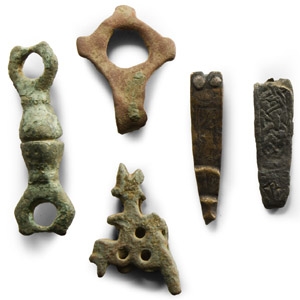
Anglo-Saxon and Norman 'Essex' Bronze Artefact Group
8th-11th century A.D.Sold for (Inc. bp): £33
Including silver-inlaid strap end, dagger chape, harness junction and other items. 31.9 grams total, 31-46 mm
Found various sites in Essex, UK. Property of an Essex collector. -
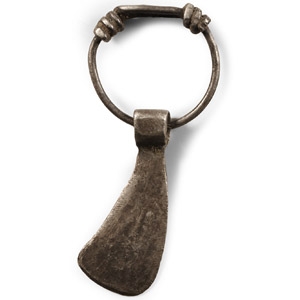
Viking Axe Silver Axe-Shaped Pendant
9th-11th century A.D.Sold for (Inc. bp): £98
Curved blade attached to a wire hoop with the ends wound round the shank. 1.61 grams, 34 mm
Ex German art market, 2000s. Acquired from an EU collector living in London. From the collection of Surrey, UK, gentleman. -
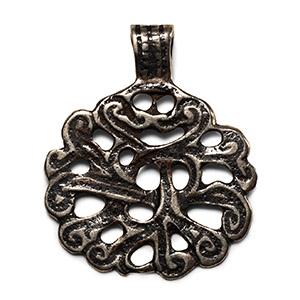
Viking Age Scandinavian Silver Interlaced Pendant
Circa 9th-11th century A.D.Sold for (Inc. bp): £234
A silver openwork kolovrat pendant formed as interlaced tendrils with inlaid niello scroll finials; integral ribbed suspension loop. 6.50 grams, 35 mm
Private collection formed in Europe in the 1980s. Westminster collection, central London, UK. -
.jpg)
Anglo-Scandinavian Viking 'Essex' Bronze Dragon's Head Strap End
Circa 11th century A.D.Sold for (Inc. bp): £85
With broad triangular plate split transversely for attachment and beast-head finial with scooped muzzle. 6.7 grams, 42 mm
Found Essex, UK. Property of an Essex collector. -
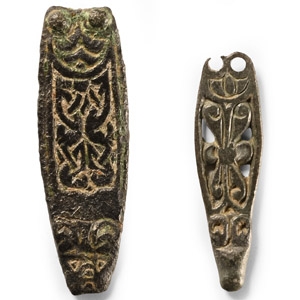
Anglo-Saxon Bronze Strap End Group
Circa 9th century A.D.Sold for (Inc. bp): £208
Comprising: one with scooped upper end, low-relief knotwork, beast-head finial; one with pierced lobes at the upper end, leaf-shaped body with openwork foliage motif, beast-head finial. 7.19 grams total, 33-40 mm
Found Gloucestershire, UK. -
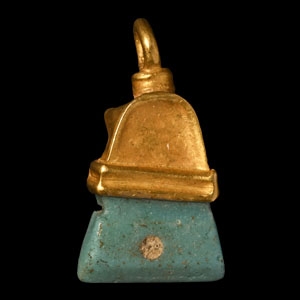
Viking Period Gold 'Elf Shot' Pendant
9th-11th century A.D. or earlierSold for (Inc. bp): £715
Gold cup with hoop and suspension loop, with glass insert. 1.37 grams, 17 mm
Ex property of a late Japanese collector, 1970-2000s.
This amulet was believed to offer protection against 'Elfshot'. The attack of elves was believed responsible for mysterious suffering in men and livestock: sudden shooting pains localised to a particular area of the body, such as in rheumatism, arthritis or muscle stitches or cramps. Elves were thought to shoot darts or arrows where such pains had no obvious external cause. Belief in elfshot persisted into the 20th century in rural areas, and as proof country folk would sometimes find small arrowheads (the remains of Neolithic or Mesolithic flints, or naturally-occurring spear-shaped stones) that were believed to be the magical weapons that caused the afflictions. Belief in elfshot began in the Pagan Germanic period. -
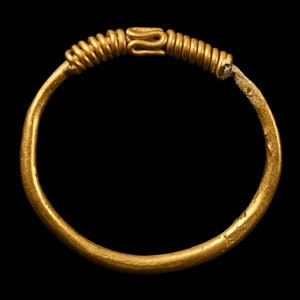
Viking Age Gold Twisted Wire Terminal Ring
Circa 9th-11th century A.D.Sold for (Inc. bp): £326
Irregular hoop with ends coiled about the shank. 2.11 grams, 21.95 mm overall, 19.16 mm internal diameter (approximate size British N, USA 6 1/2, Europe 13.72, Japan 13)
Ex property of a late Japanese collector, 1970s. -
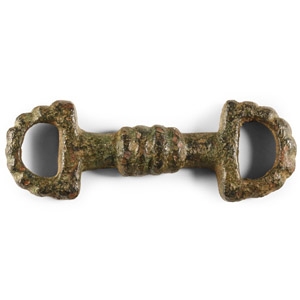
Anglo-Scandinavian Viking Bronze Horse-Harness Strap Junction
9th-11th century A.D.Sold for (Inc. bp): £91
D-section shank with ribbed collar, D-shaped loop to each end with ribbing. 31.9 grams, 67 mm
Found whilst searching with a metal detector in East Anglia, UK. -
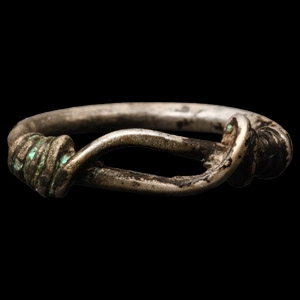
Viking Age Silver Ring with Coiled Shoulders
9th-11th century A.D.Sold for (Inc. bp): £124
Round-section rod with the ends coiled around the shank. 3.15 grams, 23.45 mm overall, 19.57 mm internal diameter (approximate size British R, USA 8 1/2, Europe 18 3/4, Japan 18)
Private collection, Arundel, West Sussex, UK, 1975-late 1990s. -
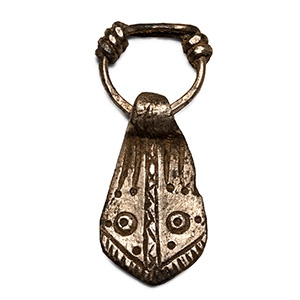
Viking Age Silver Decorated Duck-Foot Pendant
9th-11th century A.D.Sold for (Inc. bp): £169
Trapezoidal plaque with geometric detailing, suspension loop. 4.32 grams, 35 mm
Ex German art market, 2000s. Acquired from an EU collector living in London. From the collection of Surrey, UK, gentleman. -
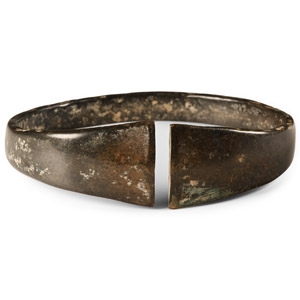
Viking Age Bronze Bracelet with Triangular Terminals
9th-11th century A.D.Sold for (Inc. bp): £39
Rectangular-section shank and flange finials. 36.7 grams, 62 mm
Private collection, Arundel, West Sussex, UK, 1975-late 1990s.
