
Auction Highlights
-
.jpg)
Greek Marble Head of Dionysus
Sold for (Inc. bp): £23,400
Carved in the half-round in three-quarter view, youthful male head with stern features, hair gathered in a browband, horns to the brow; from a frieze or relief; mounted on a custom-made stand. -
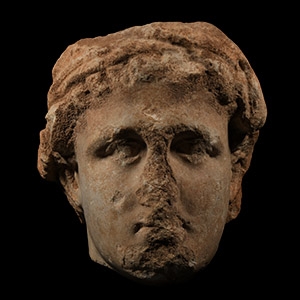
Greek Marble Head of a Ruler
Sold for (Inc. bp): £31,200
Carved in the round with thick wreath of laurel leaves to the brow, short tousled hair, stern face with thick jaw; mounted on a custom-made stand. -
.jpg)
Roman Veined Marble Torso of an Athlete
Sold for (Inc. bp): £48,100
Standing contrapposto with his weight on his right leg and the left leg brought slightly forward; the musculature of the torso displaying well-defined pectoral muscles, prominent abdominal muscles and wide shoulders, the back with equally toned musculature and well-formed rounded buttocks; the veining of the marble accentuating the idealised anatomy; the now-absent head was most probably turned towards the supporting leg and the left arm would have been raised; mounted on a custom-made display stand. -
.jpg)
Large Middle Elamite Cylinder Seal of Kidnu, Chief Overseer of King Tan-Ruhurater II
Sold for (Inc. bp): £15,600
A high-status green chalcedony seal with frieze depicting a seated figure in horned headdress facing a standing figure with arms outstretched, small monkey to the legs; six columns of Akkadian cuneiform text transliterated as: 1. ki-di-nu UGULA KUŠ-MEŠ 2. GAL šà tan-dru-hu- 3. ra-te-er EŠŠANA šu-ši 4. u an-za-an ARAD 5. šà dha-te-ri-iš 6. šak(?) ì-lí-šu 'Kidinu, chief overseer of the equerries(?) of Tan-Ruhurater, King of Susa and Anzan, servant of Haterishshak, his god'. The seal's owner was an official of King Tan-Ruhurater II (circa 1450 B.C.), king of Susa and Anzan. The title used to describe Kidinu is sometimes translated 'high official', elsewhere 'horse groom' or 'animal trainer'; the Elamite deity Haterish is otherwise unknown. -
.jpg)
Mesopotamian Torch Bearer Stand with Lion Tamer
Sold for (Inc. bp): £46,800
A substantial torch bearer depicting a male lion or panther standing with legs firmly planted on a rectangular base, tail extending to the ground, with a massive circular shaped armature or candelabra issuing from its back and wearing an elaborate muzzle, the eyes retaining shell inlay with a circular hollow for the pupils; to the right of the beast a kneeling nude male wearing a large belt-armour and a diadem, eyes inlaid, left hand extended to the side and holding the lion's leash.
-
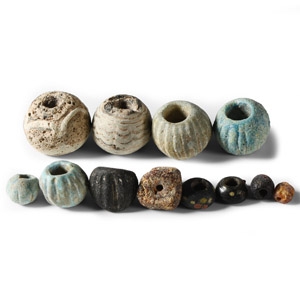
Anglo-Saxon Glass and Ceramic Bead Group
6th-8th century A.D.Sold for (Inc. bp): £91
Including aqua glass melon beads, mosaic glass spherical beads and other types. 47 grams total, 7-24 mm
Found on an Anglo-Saxon site in Suffolk, UK. Acquired from Den of Antiquity, 2009. Ian Wilkinson collection, Nottinghamshire, UK. -
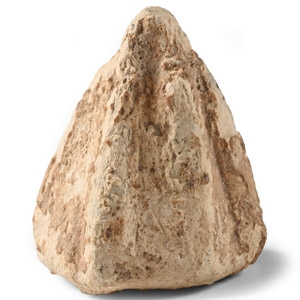
Viking Lead Gaming Piece
9th-11th century A.D.Sold for (Inc. bp): £85
Conical lead counter with six vertical ribs. 24.4 grams, 21 mm
Found whilst searching with a metal detector in Yorkshire, UK. -
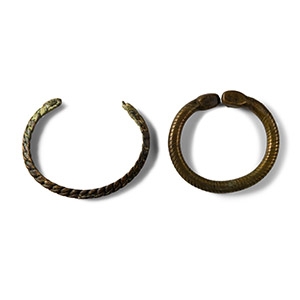
Viking Age Bronze Bracelet Group
Circa 9th-11th century A.D.Sold for (Inc. bp): £221
Comprising: braided wire penannular bracelet with with clubbed finials; twisted rod bracelet with polyhedral finials. 57.2 grams total, 55-63 mm
From a collection acquired on the UK art market from various auction houses and collections mostly before 2000. From an important Cambridgeshire estate; thence by descent. -
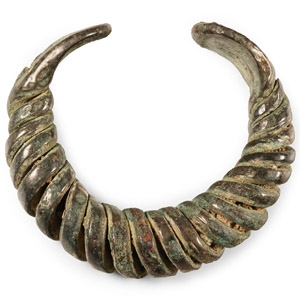
Viking Age Bronze Twisted Bracelet
9th-11th century A.D.Sold for (Inc. bp): £286
Substantial penannular type with looped finials. 162 grams, 76 mm
Private collection, Arundel, West Sussex, UK, 1975-late 1990s. -
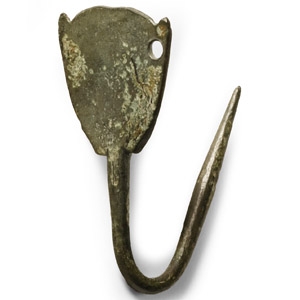
Anglo-Saxon 'Gloucestershire' Bronze Decorated Pin
Circa 6th-8th century A.D.Sold for (Inc. bp): £13
Hipped dress pin with slight bulb to the lower shank, D-shaped headplate with lateral spurs to the upper edge, impressed ring-and-dot ornament, pierced close to one edge for attachment. 3.34 grams, 33 mm
Found Gloucestershire, UK. -
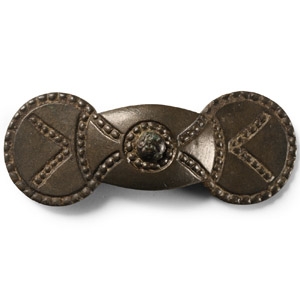
Anglo-Saxon Bronze Ansate Brooch
Circa 8th century A.D.Sold for (Inc. bp): £156
Comprising two discs connected by a low median bow, the discs with pelleted chevrons and rims, the bow with pelletted chevrons and central knop; solder scars to the reverse where the catch and pin-lugs were attached. 8.41 grams, 43 mm
Found Norfolk, UK. From an East Anglian private collection. -
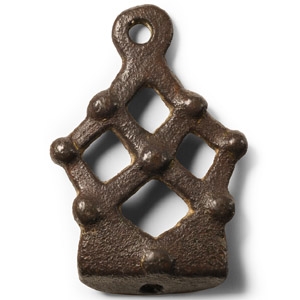
Anglo-Scandinavian Viking Bronze Lozenge-Shaped Openwork Apex Stirrup Mount
9th-11th century A.D.Sold for (Inc. bp): £104
Lozenge-shaped piercings and raised pellets to the body, a single piercing to both terminals. 18.12 grams, 47 mm
Found whilst searching with a metal detector in East Anglia, UK. -
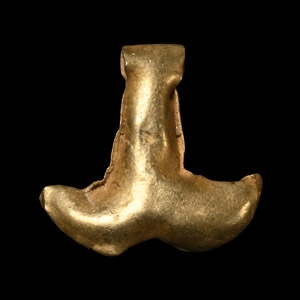
Viking Age Gold Hammer Pendant
Circa 9th-11th century A.D.Sold for (Inc. bp): £221
Hollow-formed sheet gold pendant with shank and curved head. 0.18 grams, 8 mm
Ex property of a late Japanese collector, 1970s. -
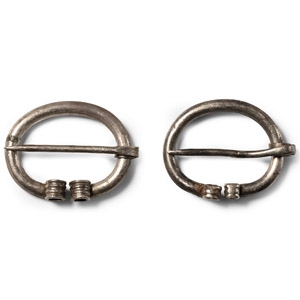
Viking Age Silver Penannular Brooch Pair
9th-11th century A.D.Sold for (Inc. bp): £208
Each a round-section shank with the ends flattened, ribbed and coiled, and with a tapering movable pin. 18.1 grams total, 32-34 mm
Private collection, Arundel, West Sussex, UK, 1975-late 1990s. -
.jpg)
Anglo-Saxon Glass Bead Group
6th-8th century A.D.Sold for (Inc. bp): £104
Restrung, comprising melon and biconvex types and a pierced Roman bronze coin used as a pendant. 14 grams, 59 mm
Found on an Anglo-Saxon site in Suffolk, UK. Acquired from Den of Antiquity, 2009. Ian Wilkinson collection, Nottinghamshire, UK. -
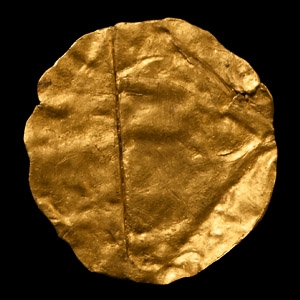
Saxon Gold Jewel Backing Disc
6th-8th century A.D.Sold for (Inc. bp): £98
Thin foil panel, possibly used as the backing to mount a jewel. 1.16 grams, 20 mm
From an old English collection. Acquired from Spink, York, circa 1986. Ian Wilkinson collection, Nottinghamshire, UK.
The foil is unlikely to have been used as a backing for a garnet cloison or cabochon since it is almost flat, but it may have been intended for treatment with the waffle-pattern texture normally used to mount such jewels. -
.jpg)
Hiberno-Viking Enamelled Bronze 'Balladoole Type' Trade Weight
9th-10th century A.D.Sold for (Inc. bp): £442
A discoid lead insular Scandinavian domed trade weight with inset boss; the copper-alloy bridle mount very similar in design to one found at the late 9th/early 10th century Balladoole Viking boat burial on the Isle of Man in the 1940s; enamel-inlaid copper-alloy mount from a horse-harness set with a ribbed rim; the obverse decorated with a series of rectangular cells filled with opaque yellowish-green and reddish enamel, forming a circular border around a zoomorphic interlaced and spiral design formed by a series of sub-triangular and curving cloisons surrounding a circular central cell; the lead weight undecorated on the reverse. 194 grams, 43.5 mm
Possibly found in Hampshire, UK. Acquired at a boot sale in Alton, Hampshire, UK in August 2023. Property of an Australian collector. Accompanied by a copy of the British Museum’s Portable Antiquities Scheme (PAS) report no.HAMP-7AD372. Recorded with Winchester City Museum and later the Finds Liaison Officer, Hampshire Cultural Trust, who in turn consulted with Medieval experts at the British Museum.
This is an Insular Scandinavian weight which would have had an original weight of 8 ounces which is towards the heavier extreme for weights of this type, which re-use a variety of insular metalwork items as ready-made decoration. They appear to have originated in Viking contexts in England and/or Ireland in the late 9th century-early 10th century. Manufacture in the Isle of Man has been suggested for the entire group with similar designs and manufacturing techniques. The copper-alloy element is likely to be part of a Hiberno-Norse, Manx or possibly Scottish horse-harness boss; it probably has a pierced lug to the reverse, now embedded in the lead plug. It is very similar to pieces of the harness set from the ship burial at Balladoole, Arbory Isle of Man. No find spot is available, but the majority of weights with decorative insets do come from archaeological contexts such sites such as Torksey, Aldwark and Woodstown, or graves such as Kiloran Bay.
