
Auction Highlights
-
.jpg)
Greek Marble Head of Dionysus
Sold for (Inc. bp): £23,400
Carved in the half-round in three-quarter view, youthful male head with stern features, hair gathered in a browband, horns to the brow; from a frieze or relief; mounted on a custom-made stand. -
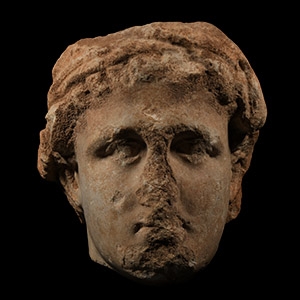
Greek Marble Head of a Ruler
Sold for (Inc. bp): £31,200
Carved in the round with thick wreath of laurel leaves to the brow, short tousled hair, stern face with thick jaw; mounted on a custom-made stand. -
.jpg)
Roman Veined Marble Torso of an Athlete
Sold for (Inc. bp): £48,100
Standing contrapposto with his weight on his right leg and the left leg brought slightly forward; the musculature of the torso displaying well-defined pectoral muscles, prominent abdominal muscles and wide shoulders, the back with equally toned musculature and well-formed rounded buttocks; the veining of the marble accentuating the idealised anatomy; the now-absent head was most probably turned towards the supporting leg and the left arm would have been raised; mounted on a custom-made display stand. -
.jpg)
Large Middle Elamite Cylinder Seal of Kidnu, Chief Overseer of King Tan-Ruhurater II
Sold for (Inc. bp): £15,600
A high-status green chalcedony seal with frieze depicting a seated figure in horned headdress facing a standing figure with arms outstretched, small monkey to the legs; six columns of Akkadian cuneiform text transliterated as: 1. ki-di-nu UGULA KUŠ-MEŠ 2. GAL šà tan-dru-hu- 3. ra-te-er EŠŠANA šu-ši 4. u an-za-an ARAD 5. šà dha-te-ri-iš 6. šak(?) ì-lí-šu 'Kidinu, chief overseer of the equerries(?) of Tan-Ruhurater, King of Susa and Anzan, servant of Haterishshak, his god'. The seal's owner was an official of King Tan-Ruhurater II (circa 1450 B.C.), king of Susa and Anzan. The title used to describe Kidinu is sometimes translated 'high official', elsewhere 'horse groom' or 'animal trainer'; the Elamite deity Haterish is otherwise unknown. -
.jpg)
Mesopotamian Torch Bearer Stand with Lion Tamer
Sold for (Inc. bp): £46,800
A substantial torch bearer depicting a male lion or panther standing with legs firmly planted on a rectangular base, tail extending to the ground, with a massive circular shaped armature or candelabra issuing from its back and wearing an elaborate muzzle, the eyes retaining shell inlay with a circular hollow for the pupils; to the right of the beast a kneeling nude male wearing a large belt-armour and a diadem, eyes inlaid, left hand extended to the side and holding the lion's leash.
-
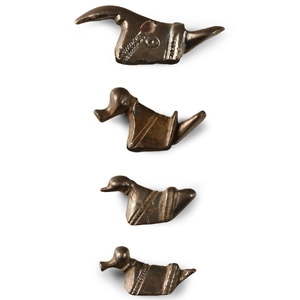
Iron Age Celtic Silver Duck Mount Group
2nd century B.C.-1st century A.D.Sold for (Inc. bp): £221
Each with saddle-shaped body, hatched bands, bulbous head, two with scooped beak and two with pointed beak; all concave to the underside. 11.1 grams total, 17-26 mm
Property of a Suffolk, UK, gentleman; from his private collection acquired in continental Europe. Acquired on the UK art market in 2015. Property of a Kent lady collector.
The duck appears in a number of contexts in Celtic art, mainly on vessels associated with feasting. Ducks are also sacred to the Gallic goddess, Sequana who had a major healing shrine based at the source of the river Seine in Burgundy, France. A bronze figure was found at the temple depicting Sequana standing in a boat which had a duck head at the prow. The duck appears to be an attribute of a celestial deity as well. We know that in the Celtic period the sun and sky gods were complicated figures who were linked not only with the heavens but also with water and the underworld. It is possible that the duck was perceived as a suitable solar emblem because it was both able to fly and swim, thus bringing together the elements of sky and water. To the pagan Celts, the sun and water were both related to healing and so it is possible that small votive images such as these were offered at shrines in the hope of a cure. -
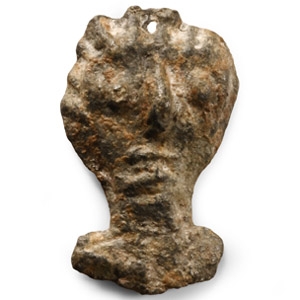
Iron Age Celtic Bronze Votive Head of a Deity
1st century B.C.-1st century A.D.Sold for (Inc. bp): £46
Bust modelled in the half-round, facing male with impressive hair; possibly a votive for a deity. 3.31 grams, 20 mm
Found near Coventry, Warwickshire, UK. -
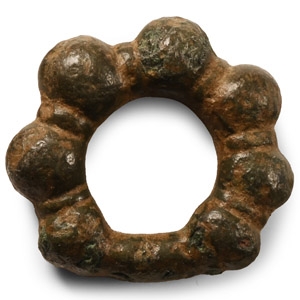
Iron Age Celtic 'East Anglia' Bronze Terret Ring
1st century B.C.-1st century A.D.Sold for (Inc. bp): £52
Comprising a round-section expanding shank, segmented bulbs. 11.7 grams, 25 mm
Found whilst searching with a metal detector in East Anglia, UK. -
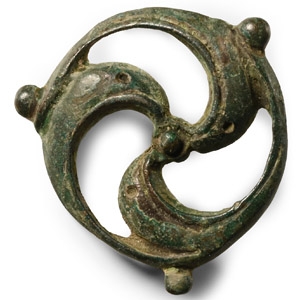
Romano-Celtic Bronze Dolphin Whorl Brooch
1st-2nd century A.D.Sold for (Inc. bp): £312
Openwork plate brooch, La Tène swirl with pellets to centre and rim; catch and pin-lug to reverse. 7.53 grams, 31 mm
Ex German art market, 2000s. Acquired from an EU collector living in London. From the collection of Surrey, UK, gentleman. -
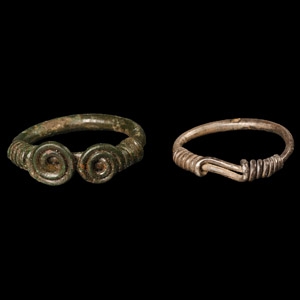
Iron Age Coiled Ring Pair
1st century B.C.-2nd century A.D.Sold for (Inc. bp): £124
Pair of rings comprising: a bronze ring with overlapping terminals tapering into coiled discoid plaques, coiled wire sleeves; a silver ring with overlapping terminals coiled around the hoop. 3.76 grams total, 18-21 mm
UK private collection before 2000. On the UK art market. Property of a London gentleman. -
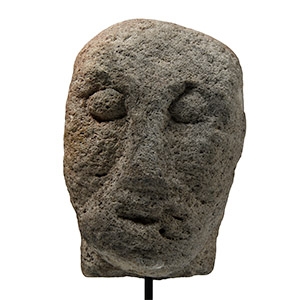
Iron Age Celtic Sandstone Head
Circa 2nd century B.C.-1st century A.D. or laterSold for (Inc. bp): £572
Sturdy carved stone head with almond-shaped face, incised disc eyes and slotted mouth, rectangular brow; mounted on a custom-made display stand. 2.47 kg total, 21 cm including stand
From a collection acquired on the UK art market from various auction houses and collections mostly before 2000. From an important Cambridgeshire estate; thence by descent.
The cult of the human head was prevalent in the Celtic world, being associated with warding-off evil spirits and bearing of good luck. -
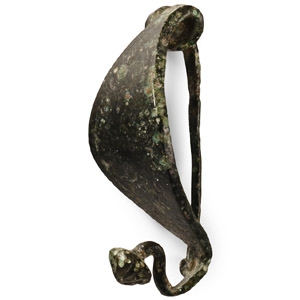
Iron Age Celtic Bronze La Tene Fibula
1st century B.C.-1st century A.D.Sold for (Inc. bp): £104
With wide bow and S-curved tail with conical knop; integral spring and pin. 3.34 grams, 28 mm
Ex M Braham and Lord Alistair McAlpine collections, 1970-1980s. -
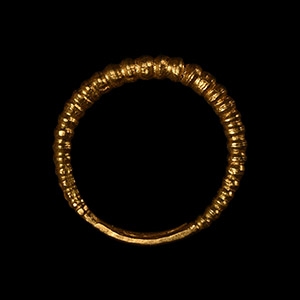
Viking Age Gold Ribbed Ring
Circa 9th-11th century A.D.Sold for (Inc. bp): £468
Formed as a graduated sequence of bulbs, plain reverse. 2.61 grams, 19.59 mm overall, 15.39 mm internal diameter (approximate size British I 1/2, USA 4 1/2, Europe 8.07, Japan 7)
Ex property of a late Japanese collector, 1970-2000s. -
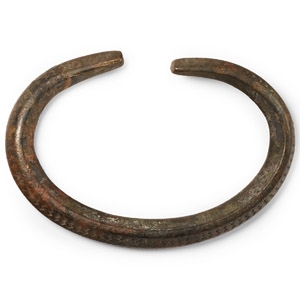
Viking Age Bronze Decorated Bracelet
9th-11th century A.D.Sold for (Inc. bp): £72
Penannular square-section shank with punched detailing to the upper faces; narrow lentoid-section finials. 58 grams, 77 mm
From the private collection of a London gentleman, from his grandfather's collection formed before the early 1970s. -
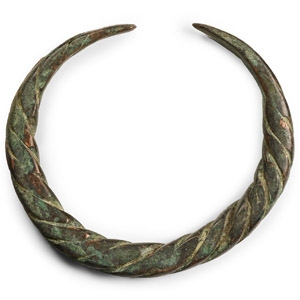
Viking Age Bronze Twisted Bracelet
9th-11th century A.D.Sold for (Inc. bp): £85
Twisted rods forming a penannular shank with hammered finials. 40.6 grams, 64 mm
Private collection, Arundel, West Sussex, UK, 1975-late 1990s. -
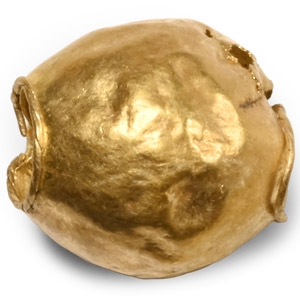
Merovingian Gold Necklace Bead
6th-7th century A.D.Sold for (Inc. bp): £143
Hollow-formed sheet gold with applied filigree collar to each mouth. 1.53 grams, 15 mm
Acquired circa 2015. Property of a Cambridgeshire, UK, collector. -
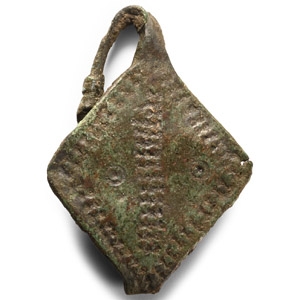
Anglo-Scandinavian Viking Bronze Ring
9th-11th century A.D.Sold for (Inc. bp): £143
A slender shank with the ends twisted together, lozengiform plaque with punched ring-and-dot and bowtie motifs. 1.76 grams, 29 mm
Found North Wold, Norfolk, UK. From an East Anglian private collection.
