
Auction Highlights
-
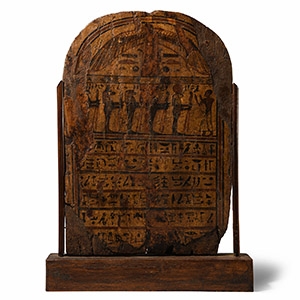
Egyptian Wooden Stela for Pa-di-Amun-(em)-ipat with Ra-Horakhty
Sold for (Inc. bp): £15,600
Arch-topped and composed of two vertical boards, coated with gesso and skilfully painted on one side; the lunette decorated with a winged sun-disc and two pendant uraei; the central vignette depicting the deceased worshipping the falcon-headed god Ra-Horakhty with the Four Sons of Horus standing behind, each with their name written above; the lower register with six lines of hieroglyphic text providing an offering formula for the benefit of the deceased: Transliteration of the hieroglyphs: 1) ḥtp-dı-͗nsw rꜤ-ḥr-Ꜣḫtı͗nṯr Ꜥ nb pt sḥḏ [.....] wsır͗ ẖntt [ım͗ntt?] 2) nṯr Ꜥ nb Ꜣbḏw dı⸗͗f pr.t-ḫrw t ḥnḳt kꜢ Ꜣpd [....] ḫt nb(t) (n) fr(t) wꜢbt […] 3) ḫt nbt nḏm dı⸗͗f ḥtpw ḏfꜢw [...]f ḫꜢ m t dı⸗͗f ḫꜢ m 4) ḥnḳt dı⸗͗f ẖꜢ ır͗p [...] dı⸗͗f ḫꜢ m ı͗[...] dı⸗͗f ḫꜢ ı(͗Ꜣ)r(r)t dı⸗͗f 5) m snṯr ḥr ḫꜢwt [...] ḳrs nfr ḥr ım͗nt nfr 6) n [..] wsır͗ [......] pꜢ-dı-͗ım͗n(m) ıp͗ Ꜣ.t ms (n) ḫꜢ [....] Translation: 1) An offering that the king and Ra-Horakhty, Great God, Lord of Heaven, the illuminated [...] Osiris Foremost [of the West?] 2) Great God, Lord of Abydos (that) he may give a voice-offering (of) bread, beer, oxen, and fowl […] everything good and pure […] 3) everything sweet, he gives offerings of provisions […] a thousand of bread, he gives a thousand of 4) beer, he gives a thousand of wine […], he gives a thousand of vines, he gives a thousand of 5) incense on the altar […] a good burial in the beautiful West 6) for […] the Osiris[…] Pa-di-Amun-(em)-ipat born (to) Kha[…]; on the verso, an old handwritten collection label reading: 'From Harding & Sm[ith] Collection Sale Sotheby 2 Nov 1922 L.N. 234. A families[sic] stele, arched top, with the deceased worshipping a standing Horus attended by the four Children of Horus and six horizontal lines of inscription in colour. SP/10a'; mounted in a custom-made wooden frame. -
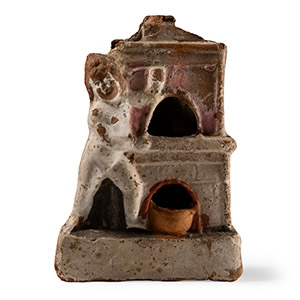
Romano-Egyptian Terracotta Figure of Eros
Sold for (Inc. bp): £5,850
Depicted nude in a dynamic pose with his legs apart and the weight of the body upon his right leg, standing in front of a two storey structure, probably an oven; his left arm raised and right arm extended in front of his torso and resting on the edge of the structure; the oven painted pink at the top and white at the bottom with an offering receptacle at floor level. -
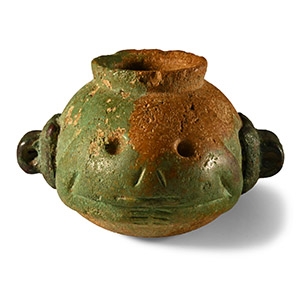
Egyptian Indurated Limestone Frog-Shaped Cosmetic Vessel
Sold for (Inc. bp): £9,750
Squat ovoid in profile, modelled with the legs folded beneath the body, with hollow socket eyes, flared rim to mouth; copper lug on either side. -
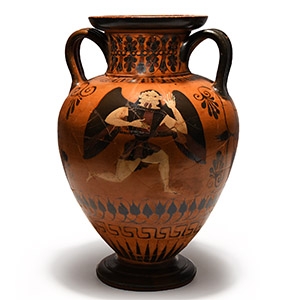
Attic Black-Figure Neck-Amphora with Gorgon and Quadriga Attributed to the Swing Painter
Sold for (Inc. bp): £41,600
With inverted echinus lip and tall neck, a ribbed handle to each side with coiling lotus buds and palmettes beneath the handles; Side a) a running winged Gorgon depicted frontally, dressed in a black and red chiton; Side b) an aristocratic warrior wearing a Chalcidian helmet and driving a quadriga, the two central horses superimposed, the other two turned outward; a frieze of lotus buds and a band Greek key motifs below, the neck decorated with red and black palmettes, and elongated lotus blossoms; restored. -
.jpg)
Attic Red-Figure Bell Krater with Drunken Male Revellers Attributed to the Kadmos Painter
Sold for (Inc. bp): £32,500
With a high foot, laurel wreath encircling the neck, checkerboard and meander patterns alternating around the lower body, roundels of tongue motif to the handles with palmettes and tendrils below; two red-figure scenes to the body: Side a: a high-quality depiction of a kōmos composed of five figures, including a young man holding a torch, a double flute player next to three dancers, all possibly followers of Dionysus; Side b: three draped figures conversing comprising a central female figure between two opposed male figures, one holding a staff; two old labels: one with 3061-133 on the inner rim, and 113/2 (believed to be an old Christie's lot label from the 1960s by Richard Falkiner) on the sidewall, further old accession numbers 321 and 35 under the base. -
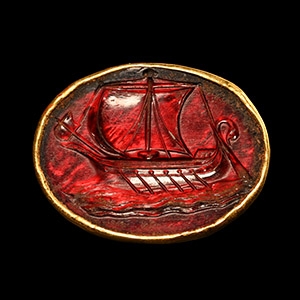
Hellenistic Gold Ring with Galley Gemstone
Sold for (Inc. bp): £29,900
With D-section hollow-formed hoop and flared ellipsoid bezel, set with a Roman intaglio depicting a war galley under sail. -
.jpg)
Roman 'Published' Terracotta Oil Lamp with Fighting Gladiators
Sold for (Inc. bp): £2,340
Grey fabric, broad discus with concentric rings and chamfered shoulder, short nozzle flanked by volute scrolls; scene of two murmillo gladiators in combat, one having fallen to the ground; maker's stamp to the underside 'MAR[..]S'; mounted on a custom-made stand. -
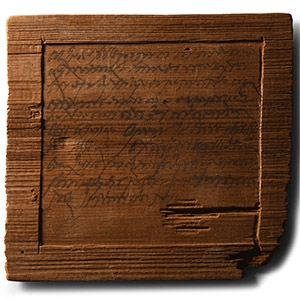
Roman Inked Wooden Tablet for a Contract Between Bassus and Neronianus
Sold for (Inc. bp): £15,600
A reused tablet with a recessed panel on one side, the last tablet of a legal document which consisted of two (diptychon) or three tablets (triptychon); ten black inked lines of New Roman cursive script, the end of a record of a transaction in formulaic legal language, probably a sales contract, between the buyer (emptor) Bassus and a person called Neronianus; traces of text (perhaps in rustic capitals) to the reverse. -
.jpg)
Roman Marble Head of Hercules Wearing the Nemean Lion Skin
Sold for (Inc. bp): £7,800
Modelled with naturalistic features, gazing left, sculpted pupils and strong lids; luxuriant beard and moustache framing the face; strong forehead with tightly formed curls emerging from beneath the lion's skin hood; the hood with clear eye detailing and the mane with regularly arranged tufts; original iron pin to the front of the muzzle; mounted on a custom-made display stand. -
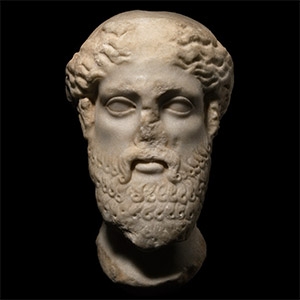
Roman Marble Head of Dionysus
Sold for (Inc. bp): £23,400
From a Greek original, wearing a crown of leaves and corymbs, hair falling in straight lines underneath the diadem; full beard composed of four rows of thick tufts with drilled holes; slightly open mouth with a fleshy lower lip; low cheekbones and hollow cheeks; large almond-shaped eyes with lachrymal duct; mounted on a custom-made display stand. -
.jpg)
'The Anglesey' Romano-British Marble Head of a Celtic Warrior
Sold for (Inc. bp): £7,150
Carved with comma-leaf detailing to the hair, a low brow over almond-shaped eyes, broad triangular nose and thick moustache obscuring the mouth; mounted on a custom-made stand. -
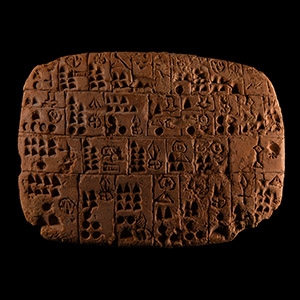
Proto-Sumerian Terracotta Tablet with Archaic Text
Sold for (Inc. bp): £11,050
Lentoid-section slab with incised grid to each face: one with three columns, impressed roundels and crescents, grid and other symbols; the other face with four columns, each cell filled with marks and symbols. -
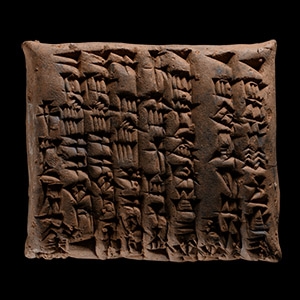
Babylonian Cuneiform Tablet, a Clothes Receipt from Puzur-Akum to Astaqar
Sold for (Inc. bp): £3,640
Pillow-shaped clay tablet with cuneiform text to both broad faces and one edge from Garšana (iv/Šu-Sîn 8?), a receipt for various clothing, with several dedications to the deities Ninsiana, Mami, Dadmuštum and Šubula; Dadmuštum is rarely mentioned, reading: '1 tu ba-tab tuh-hu-um 3-kam us 2 1 tu ša -ga-du ba-tab tug-hu-um / 3-kam us 1 tu ta -ki-ru-um 3-kam us 4 dnin- dsi -an-na 4 tu guz-za 4-kam us 6 2 tu guz-za 4-kam us dma-mi x ? 2 tu guz-za 4-kam us / dda-ad-muš-tum R 8 2 tu niĝ -lam 4-kam us dšu-bu-la ki-la -bi 26 1/3 ma-na 10 2 tu bar-dul us-bar 4 tu sag us-bar 12 5 tu us -bar 4 ma-na 3 tu mug 14 ki !-aš-ta -gar -ta puzur -a-ku-um šu ba-ti 16 iti ki-siki- dnin-a-zu mu ma -gur -mah mu-/dim' translation: '1 (simple) garment batab tuhhum (a kind of fabric?), thrice, medium quality 1 garment šagadu (of linen) batab tuhhum thrice, medium quality 1 garment takirum, thrice, medium quality (for) Ninsiana; 4 tufted garments, in quadruple, medium quality 2 tufted garments, in quadruple, medium quality : (for) Mami 2 tufted garments, in quadruple, medium quality : (for) Dadmuštum. 2 niglam garments, in quadruple, medium quality : (for) Šubula Their weight is 26 1/3 mines. 2 bardul garments (from) the weavers 4 garments if first quality (from) the weavers 5 (simple) garments étoffes (from) the weavers : 4 mines 3 garments in coarse wool Puzur-Akum has received (these garments) from Aštaqar. In the month of Kisiki.Ninazu The year in which the big (ceremonial) boat was built'. -
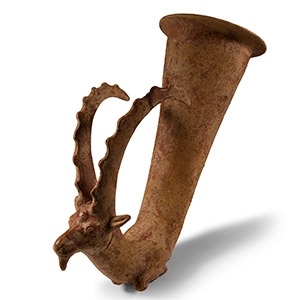
Western Asiatic Ceramic Ibex Rhyton
Sold for (Inc. bp): £7,800
With trumpet-shaped mouth, ibex-shaped finial with curved horns and legs folded beneath the body, spout to the chest; repaired. -
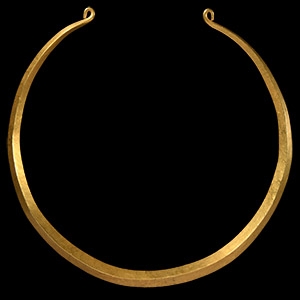
Celtiberian Gold Neck Torc
Sold for (Inc. bp): £14,950
A heavy penannular neck torc with carinated body and tapering coiled terminals. -
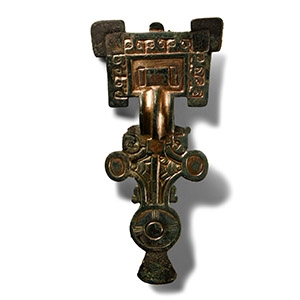
'The Dullingham' Anglo-Saxon Gilt Bronze Great Square-Headed Brooch
Sold for (Inc. bp): £3,120
With trapezoidal headplate, shallow bow, narrow triangular foot and pelta-shaped finial, pin-lugs and catch to the reverse; the headplate with (originally silvered) angled panels to the upper corners and D-shaped lug at the middle of the upper edge; rectangular corner panels interrupting a frieze of Salin's Style I face motifs, inner plain band and raised rectangular panel above the junction with the ribbed bow; lappets of Salin's Style I profile heads flanking the junction of the bow with the footplate and vertical bar running to the finial, bisecting a cruciform panel with Salin's Style I zoomorphic forms, and outer plain lobes; finial comprising a disc with four radiating ribbed arms and central boss, pelta-shaped terminal; cleaned and one lateral lobe reattached. -
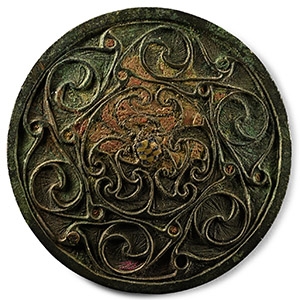
'The Driffield' Anglo-Saxon Enamelled Bowl Mount
Sold for (Inc. bp): £4,160
With a slightly domed profile and a raised circumferential border to the upper face; decorated with Celtic designs featuring elaborate curvilinear tendrils and triskele-style swirls enclosing an area of fine-line trumpet spiral designs, set around a central rectangular panel filled with millefiori-style enamel work in the form of an irregular chequerboard of blue and yellow enamel, the circular recesses retaining red enamel traces; two parallel rivets to the reverse. -
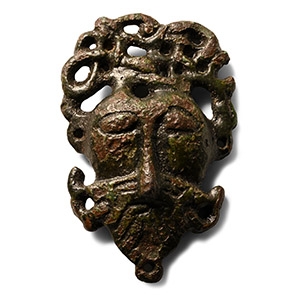
'The Ferryhill' Anglo-Scandinavian Viking Bronze Three-Dimensional Urnes Stirrup-Type Mount with Head of Odin
Sold for (Inc. bp): £9,100
A bowed anthropomorphic mount in the form of the face of Odin, with oval right and damaged left eye, beard and hair raised to form a convex shape, rounded cheeks, a triangular nose and a beard, moustache with lateral protrusion, the hair openwork and formed of entwined linear elements, five rivet holes present. -
.jpg)
Medieval Decorated 'He who loves from the heart, gives with a good heart' Posy Boxwood Comb
Sold for (Inc. bp): £9,100
Central panel decorated with a heart pierced by two arrows and inscription: 'qui de bon [COER] eyme', and verso openwork carving of blind interlaces and inscription: 'de bon [COER] donne', translating to 'He who loves from the heart, gives with a good heart'; probably given as a love token. -
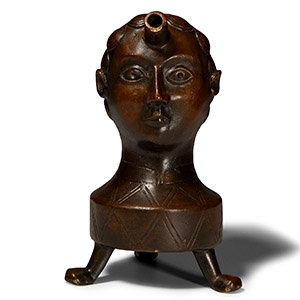
Medieval Bronze Aquamanile of a Male Bust
Sold for (Inc. bp): £11,050
Hollow-formed vessel formed as a male bust; discoid body with chamfered shoulder bearing bands of running zigzag detailing and three splayed feet; the head with low-relief hair and rim of bosses with linear spirals, gracile facial features with lentoid eyes and slender nose, small pouting mouth; short spout to the forehead, filler-hole to top of the head with hinged cover; handle to the rear formed as a reptile with head and forepaws placed on the hair below the hinge and joining the base above one of the feet. -
.jpg)
Medieval Limoges Gilt Christ Crowned on the Cross
Sold for (Inc. bp): £7,150
Parcel-gilt bronze crucifix with cloisonné enamel geometric ornament; separate appliqué Corpus Christi, crowned with detailed musculature; lower legs and feet absent; mounted on a custom-made stand. -
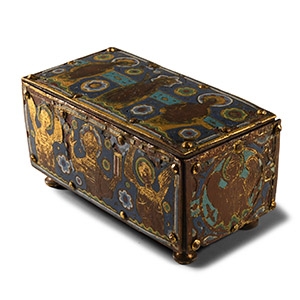
Medieval Chrismatory with Limoges Panels
Sold for (Inc. bp): £22,100
Inner wooden casket with chamfered rim and separate lid, encased within rectangular gilt-bronze panels with enamel decoration, four gilt-bronze stud feet to the underside; the lid with three nimbate figures, a female saint with palm frond and two flanking figures holding books, all reserved on a blue field with interstitial polychrome rosettes; Side A: nimbate bearded bust of Christ in Majesty with right hand in gesture of benison, left hand supporting a book, flanked by two winged nimbate angels; Side B: nimbate bust of a winged angel in a roundel; Side C: geometric repeating pattern of lozenges with floral fill; Side D: mirror image of Side B. -
.jpg)
Medieval Gold Heraldic Signet Ring with Goat
Sold for (Inc. bp): £28,600
Substantial D-section hoop, expanding shoulders with reserved flowers and foliage, discoid bezel with intaglio regardant leaping goat in a pelletted ring, fronds and stars in the field, enigmatic inscription 'd[..] / de.to'. -
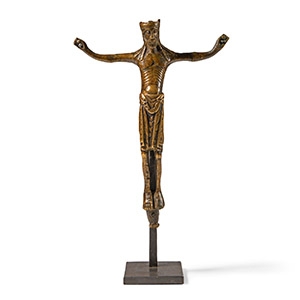
Medieval Bronze Corpus Christi
Sold for (Inc. bp): £13,650
With flat-topped crown, hair hanging in hanks to the shoulders, long D-shaped face with domed eyes, slender figure with ribs emphasised, knee-length loincloth falling in rippling folds; mounted on a custom-made stand.
-
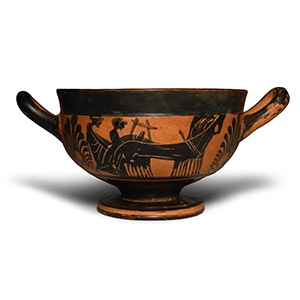
Greek Attic Black Figure Ware Kylix with Chariot Scene
Circa 5th century B.C.Sold for (Inc. bp): £1,430
With broad flat foot, short stem, broad bowl with carination at the shoulder, two square strap handles; frieze of black-painted decoration including two scenes of a quadriga chariot with a man stepping in to the chariot and a musician with a kithara, between palmettes; some restoration. 520 grams, 24.5 cm wide
Cambridgeshire, UK, collection, 1990s-2000s. Ex property of a Suffolk, UK, gentleman. Accompanied by an original thermoluminescence analysis report no.N124a8 from Oxford Authentication.
These Attic kylikes were usually presented with a stemmed base, a deep bowl and two upturned loop handles, on a concave base. The exterior walls were decorated with black-figure technique on red background, here in a style remarkably similar to that of the Haimon Painter. -
Attic Black-Figure Neck-Amphora with Gorgon and Quadriga Attributed to the Swing Painter
Circa 550 B.C.Sold for (Inc. bp): £41,600
With inverted echinus lip and tall neck, a ribbed handle to each side with coiling lotus buds and palmettes beneath the handles; Side a) a running winged Gorgon depicted frontally, dressed in a black and red chiton; Side b) an aristocratic warrior wearing a Chalcidian helmet and driving a quadriga, the two central horses superimposed, the other two turned outward; a frieze of lotus buds and a band Greek key motifs below, the neck decorated with red and black palmettes, and elongated lotus blossoms; restored. 3.25 kg, 39 cm high
Acquired in Geneva in 1954. Formerly in the Y. Forrer collection, Geneva, Switzerland. Private collection, Switzerland, 1999. with Gorny & Mosch, Munich, 20 June 2012, no.73. Accompanied by an academic report by Dr Raffaele D’Amato. This lot has been checked against the Interpol Database of stolen works of art and is accompanied by a search certificate number no.11798-206784.
This wonderful vase can be attributed to the Swing Painter, active in Athens during the last part of the 6th century B.C. Beazley named him after the subject of a girl on a swing that he painted more than once. He was a pot painter, perhaps a pupil of the Princeton Painter. His black-figure paintings included a range of mythological subjects and some quite unusual images. A very large number of vases have been attributed to his hand on the basis of style. Characteristic of his paintings are contemporary touches, such as the presence of hoplites, in mythological scenes (München, Staatliche Antikensammlungen 1385 [J 729], Beazley Archive Pottery Database 301590; Poseidon fighting the giant Polybotes, Louvre F226). An important artwork is the famous representation of the Tyrant Pysistratos and his Rabdophoroi (bodyguards armed with clubs, Athens National Archaeological Museum 15111, Beazley Archive Pottery Database 301523). -
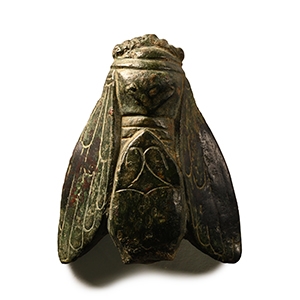
Greek Bronze Snake Biting a Cicada Mount Fragment
Circa 5th century B.C.Sold for (Inc. bp): £520
D-section insect body with lateral splayed wings, merging with the head of a serpent with scale detailing. 46.15 grams, 43 mm
From the collection of an London antiquarian, 1980s. -
Attic Red-Figure Bell Krater with Drunken Male Revellers Attributed to the Kadmos Painter
5th-4th century B.C.Sold for (Inc. bp): £32,500
With a high foot, laurel wreath encircling the neck, checkerboard and meander patterns alternating around the lower body, roundels of tongue motif to the handles with palmettes and tendrils below; two red-figure scenes to the body: Side a: a high-quality depiction of a kōmos composed of five figures, including a young man holding a torch, a double flute player next to three dancers, all possibly followers of Dionysus; Side b: three draped figures conversing comprising a central female figure between two opposed male figures, one holding a staff; two old labels: one with 3061-133 on the inner rim, and 113/2 (believed to be an old Christie's lot label from the 1960s by Richard Falkiner) on the sidewall, further old accession numbers 321 and 35 under the base. 3.8 kg, 37 cm wide
Thomas Hope (1769-1831), London and the Deepdene, Surrey, Thence by descent to Lord Henry Francis Hope Pelham-Clinton-Hope (1866-1941), the Deepdene. The Celebrated Collection of Greek, Roman and Egyptian Sculpture and Ancient Vases being a portion of The Hope Heirlooms; Christie's, London, 23-24 July 1917, no.113. Private collection, acquired in Paris, 2004. Accompanied by a copy of a thermoluminescence analysis report no.N111j79 from Oxford Authentication. Accompanied by an academic report by Dr Raffaele D’Amato. This lot has been checked against the Interpol Database of stolen works of art and is accompanied by search certificate number no.11786-206517.
The Kadmos Painter was an Athenian red-figure vase painter, whose real name is unknown. His nickname was bestowed by Beazley, naming him after the subject of a famous hydria in Berlin (Antikensammlungen Berlin/Altes Museum, found in Vulci). He illustrated many mythological scenes, sometimes with figures arranged up and down the field, usually on bell craters, vessels used in symposia for mixing wine and water. A komos was a ritualistic drunken procession performed by revellers in ancient Greece. It preceded and/or followed the banquet, whether unbridled in nature with music and games, or serious and philosophical. -
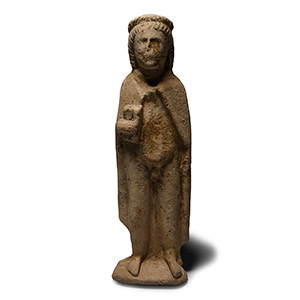
Cypro-Archaic Standing Limestone Male Scribe
Circa 4th-3rd century B.C.Sold for (Inc. bp): £780
Modelled in the half-round, standing nude male with mantle to the shoulders, clutching a codex in the right hand; with carefully dressed hair and diadem; D-shaped base. 536 grams, 27 cm
Acquired Bonhams, London, UK. From a collection acquired on the UK art market from various auction houses and collections mostly before 2000. From an important Cambridgeshire estate; thence by descent. -
.jpg)
Phoenician Limestone Herakles Melqart Wearing Lionskin
Circa 6th-5th century B.C.Sold for (Inc. bp): £845
Modelled in the round, standing with lionskin mantle tied around the shoulders at the chest, with girdle to the waist and knee-length tunic; left hand resting on the handle of a club; mounted on a custom-made display stand. 1.85 kg total, 36.5 cm including stand
From a collection acquired on the UK art market from various auction houses and collections mostly before 2000. From an important Cambridgeshire estate; thence by descent.
Melqart was the Phoenician tutelary deity whose name means 'king of the city'; in the Roman interpretation, he was identified with Hercules. -
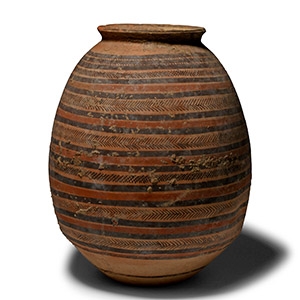
Daunian Painted Terracotta Storage Jar
Circa 5th-4th century B.C.Sold for (Inc. bp): £169
Ovate in profile with slightly stepped lower body, everted rim; circumferential painted bands, hatching and herringbone patterns. 1.13 kg, 25 cm high
Acquired Bonhams, London, UK. From a collection acquired on the UK art market from various auction houses and collections mostly before 2000. From an important Cambridgeshire estate; thence by descent. -
.jpg)
Greek Terracotta Shipwreck Amphora
5th-3rd century B.C.Sold for (Inc. bp): £2,470
Slender in profile with narrow shoulder, short neck, collar to the mouth and two lateral strap handles; stepped conical point to base; part of neck absent, marine encrustation. 5.45 kg, 65 cm
From a collection acquired on the UK art market from various auction houses and collections mostly before 2000. From an important Cambridgeshire estate; thence by descent. -
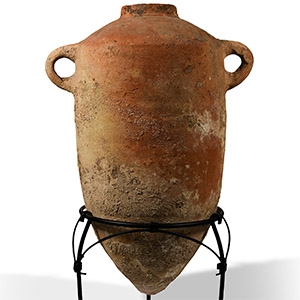
Phoenician Shipwreck Pottery Amphora
Iron Age, 1050-850 B.C.Sold for (Inc. bp): £1,560
With small looped side handles, short sloping shoulder and ring neck, slender body tapering to a pointed base. 7.35 kg total, 61 cm high including stand
Ex old Lebanese collection imported into Germany in the middle of the 1970s. Acquired Bonhams, London, 20 October 2005, no.413 (part). Property of a North London collector, acquired from a Cambridgeshire gentleman in 2007. Accompanied by a copy of the relevant Bonhams catalogue pages. Accompanied by a previous owner's certificate of authenticity. -
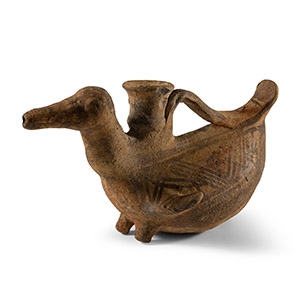
Cypro-Archaic Terracotta Bird Askos
Late Bronze Age, 1100-1000 B.C.Sold for (Inc. bp): £494
Hollow-formed as a bird, possibly a duck, with its beak acting as a spout, small lateral flanges for wings and painted geometric detailing; strap handle from funicular filler tube with a strainer inside to the fan-shaped tail. 670 grams, 24 cm
From a collection acquired on the UK art market from various auction houses and collections mostly before 2000. From an important Cambridgeshire estate; thence by descent. -
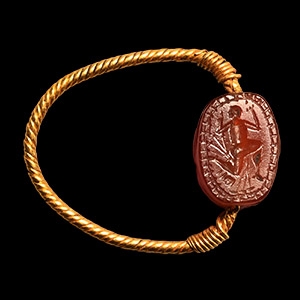
Etruscan Carnelian Scarab Gold Ring
5th-4th century B.C.Sold for (Inc. bp): £1,430
Hoop made from twisted wire with coils to the shoulders, carnelian scarab bezel with carapace detailing and intaglio kneeling figure to the reverse. 4.62 grams, 31.50 mm overall, 21.60 mm internal diameter (approximate size British W, USA 11, Europe 25, Japan 24)
Acquired from the collection of Mr K.A., a Parisian gentleman. European private collection. -
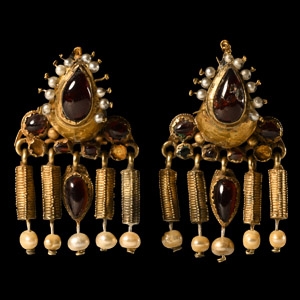
Hellenistic Gold Earring Pair
1st century B.C.-1st century A.D.Sold for (Inc. bp): £5,980
Each with a hollow-form crescentic body with a large teardrop-shaped garnet set within a cell with radiating pearl studs; a pendant panel below with garnet cabochons, five pendant drops with pearl finials and a central teardrop-shaped garnet; accompanied by a custom-made display stand. 22.40 grams total, 47-49 mm (107 grams total, 92 mm high including stand)
From a private collection. Acquired from Mr D.S., 7 February 2008. Private UK collection. This lot has been checked against the Interpol Database of stolen works of art and is accompanied by search certificate no.12119-214174.
The material culture of the Hellenistic east followed the eastern Mediterranean polychromy. Many beautiful jewels were produced in Alexandria or in the Syrian cities and the majority of their precious decorations was imitated by jewellers of more remote provinces, like those of the Greek Pontic cities.
