
Auction Highlights
-
.jpg)
Egyptian Relief with List of Offerings
Sold for (Inc. bp): £18,200
A section of tomb wall with a central register of eight rectangular panels each containing hieroglyphs naming offerings for the deceased; the top and bottom groups of eight rectangular panels each contain a depiction of a kneeling offering-bearer; all carved in high-relief; mounted on a custom-made display stand. -
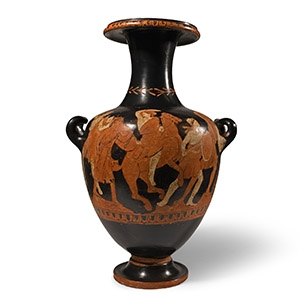
Greek Red-Figure Hydria with Combat Scene Between Amazons and Greek or Trojan Heroes
Sold for (Inc. bp): £7,800
The vessel with integral round-section upward-facing handles, a third, round-section handle placed vertically between shoulder and upper neck to rear; laurel sprigs to the neck with traces of gilding; combat scene with Amazons (and Trojans?) below, armed with short swords and crescent shields, most wearing an exomis leaving the shoulder and one breast uncovered; volute palmettes below both side-handles, a panel of tiered and swirling volutes to the rear, all on a band of egg-moulding, repeated around the rim; possibly Apulian or Campanian; restored. -
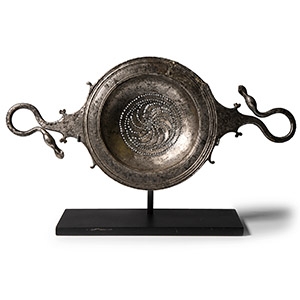
Greek Silver Wine Strainer
Sold for (Inc. bp): £16,900
Composed of a shallow bowl and broad flange rim, two integral scalloped handles with scrolled flourishes, tapering to a loop handle with swan head terminals each with incised eye and beak detailing; perforated whirl within roundel to interior base; accompanied by a custom-made display stand. -
.jpg)
Eastern Roman Bust of the Daughter of Aqima
Sold for (Inc. bp): £37,700
Modelled in the round with a fragment of stand to the rear; the figure carefully carved to exhibit the delicate facial features and elaborate hairstyle; the palla drawn up over the head and falling over the shoulders to the upper arms; a diadem to the brow with foliage and tendril detailing; elaborate earrings with dangles; necklace of fusiform and tubular beads and a longer one below with piriform plaques; large disc brooch to the left breast with dangles; peplos-style dress draped across the body beneath the palla; left arm bent and hand passing across the body to grasp the hem of the palla with a herringbone bracelet at the wrist; the palla displayed pinned with rosettes to the rear panel; with inscription of thirteen Palmyrene characters above the left shoulder 'NRW' // BRT // 'QM' // ḤBL' meaning 'daughter of Aqima'; traces of red and green pigment; mounted on a custom-made stand by Colin Bowles Ltd. -
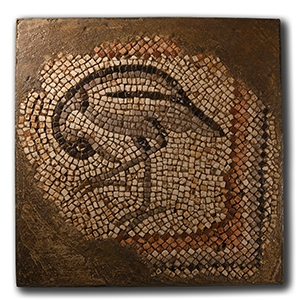
Eastern Roman Mosaic Depicting a Bird
Sold for (Inc. bp): £2,860
In a rectangular matrix; cream, olive, pink and other tesserae depicting a bird advancing with head bowed, with banded frame. -
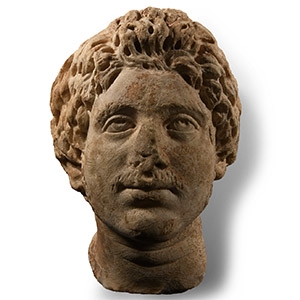
Roman Marble Head of a Germanic Warrior
Sold for (Inc. bp): £28,600
Modelled naturalistically in the round, directing his gaze upwards left, the eyes with sculpted pupils originally decorated with stone insertions, his face framed by voluminous short curls swept up off the forehead, sideburns and a moustache. -
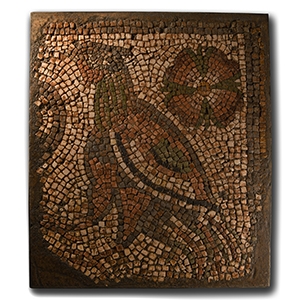
Eastern Roman Mosaic Depicting a Bird
Sold for (Inc. bp): £2,860
In a rectangular matrix; cream, olive, pink and other tesserae depicting a perching bird with rosette above. -
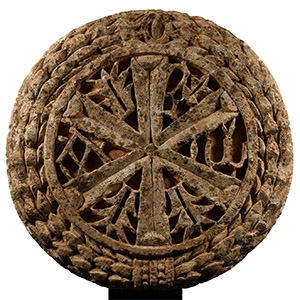
Monumental Byzantine Limestone Chi Rho Roundel
Sold for (Inc. bp): £36,400
Divided into six sections by Christogram letters chi and rho, two of the segments with Greek letters alpha and omega, the other four segments with floral ornaments; a laurel wreath to the edge; mounted on a custom-made display stand. -

Old Babylonian Clay Cuneiform Tablet, a Letter From a Local Governor in Arrapha to His Colleague in Ešnunna,
Sold for (Inc. bp): £8,450
Written across two principal faces and three side edges, reading: 1-2) Say to Zakur-ahum, thus says Uzazza, your brother. 3) I have read the tablet you sent me. You wrote to me as follows: 4-5)'Five nomadic Suteans plundered the district of Zippat and I sent a troop. 6-7) I drove them back. I prevented them from taking anything. 7-8) So this troop left empty-handed. It is to be feared that they will go to the land of Arrapha and raise havoc, take action!' 11) This is what you wrote to me, and I rejoiced greatly. 12) In your tablet is written:'500 nomadic Suteans'. 13) Now, your servants whom you sent to me told me this: 14) 'A troop of 1,500 men has come. 15) Among them were many men with bows.'16 This is what they told me. Now never 17) have there been archers among the nomad-Suteans. 18) Is it not to be feared that the heavily-equipped 19) part of a foreign army is here itself comprising the nomad-Suteans with their bows? 20) The (result of the) divination I found said: 'Fire will devour the base of the reed.' 21) [...] its ... will not reach me. 22-23) [Now], shall I rejoice over the heavily equipped troop (that is) there? 24) [...]. 25-26) Now investigate this troop. 26-27) Send a full report urgently one way or the other, 28-29) so that I may circulate [a swift messenger] so that 29-30) the whole country may be gathered [in my fortresses] and so that I may take action. 31-33) Moreover, earlier, nomadic Suteans assaulted the palace cowherds one evening and 33-34) carried away all the cows from the palace. They left nothing behind. 35-36) There are none left, including the cows they had been entrusted with that evening. The next day, 37) a rescue troop (sent) by Ašrum, in pursuit of them 38) went as far as the banks of the Euphrates, but 39 returned empty-handed. 39) Another thing, 40) concerning what you wrote to me: 41-42) 'Looters set up a siege instrument- kalbanatum against a fortified farm and killed people. In addition, they carried off ten oxen. 43) And Ašrum went in there. Check that 44 their oxen no longer disappear.' This is what you wrote to me. 45-46) Now, shall I rejoice in this matter, or shall I [not] [...] them [...]. 47-48) Now, is there a plunderer who can plunder on my watch? Now, when I hear (about them) 49-50) and as soon as I send a message, do I not put them on the pal? No doubt 51-52) these people are foreigners, but you consider them to be Arrapha inhabitants! Now, precisely according to what you've written to me, 53-54) I'm going to send a fast messenger to the very interior of Arrapha and carry out a check. ; repaired. -

Uruk Clay Pictographic Tablet Bearing an Economic Text Relating to Farm Produce
Sold for (Inc. bp): £9,100
Written over two faces; lentoid cross-section. -
.jpg)
Italic Bronze Triple-Disc Cuirass
Sold for (Inc. bp): £9,360
Matched pair of Samnite triangular breast and backplates, a suite of 'triple-disc' type, each with three repoussé panels with carinated rim, flat spandrel above and curved on the lower sides, with perforated edges to affix to a separate mail garment; rivetted loops to the shoulders for attachment of supporting straps, and similar lateral loops with portion of round-link chain in situ; mounted on a custom-made stand. -
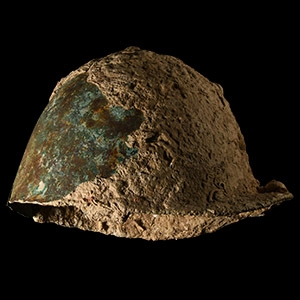
Roman Bronze Legionary Helmet with Inscription
Sold for (Inc. bp): £9,100
Montefortino helmet with bulbous domed skull and a plain crest knob with flattened top; plain and flat neck guard with thickened rim; the front with punched Latin inscription 'A N CFN'; the surface largely covered in marine encrustations; accompanied by a custom-made display stand. -
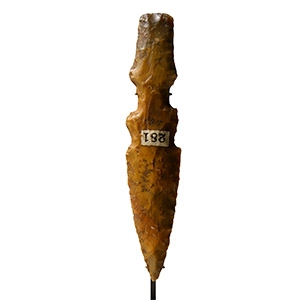
Exceptional Neolithic Flint Dagger
Sold for (Inc. bp): £5,980
Finely knapped lentoid-section dagger with lateral recesses and square butt; old collector's label '281'. -
.jpg)
Massive Stone Age British Bifacial Lanceolate Flint Handaxe
Sold for (Inc. bp): £10,400
Long blade with small portion of cortex at the upper end, sharply tapering point with edges worked from both sides. -
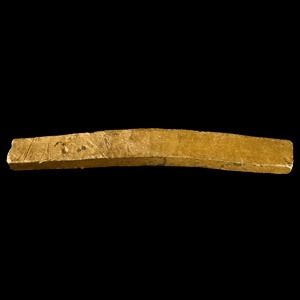
Viking Age or Earlier Hacked Gold Trade Ingot
Sold for (Inc. bp): £3,120
A slightly bent irregular bar of hacked gold with rectangular cross-section, showing evidence of compression and fracture to each end, some subtle transverse lines on both of the main surfaces. -
.jpg)
Anglo-Scandinavian Viking Bronze Three-Dimensional Urnes Stirrup Apex Mount
Sold for (Inc. bp): £6,500
The substantial heater-shaped plaque with spectacular openwork Urnes style design, the standing beast with entwined tendrils, pronounced head at the apex, narrow ledge to the reverse and rivet holes to each corner with two rivets remaining. -
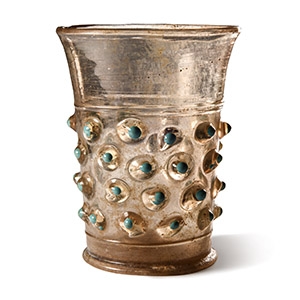
Medieval Glass Beaker with Prunts
Sold for (Inc. bp): £7,800
Of tubular form with flared rim and applied collar to the foot, applied trails to the sidewall and four rows of prunts with applied blue-glass ornament. -
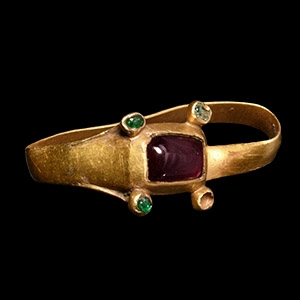
Medieval Gold Ring Set with Gemstones
Sold for (Inc. bp): £4,160
With a slender D-section hoop, bevelled rectangular cell set with a garnet cabochon; satellite settings at the corners, each with a green cabochon (one absent), the ring preserved in the same condition as it was when found. -
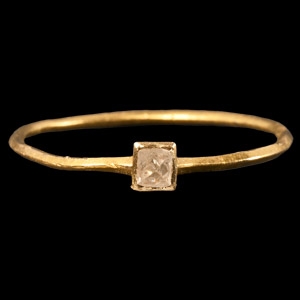
'The Fressingfield' Medieval Gold Ring with Diamond
Sold for (Inc. bp): £2,860
With plain circular hoop and square diamond-shaped bezel with replicant natural diamond crystal. -
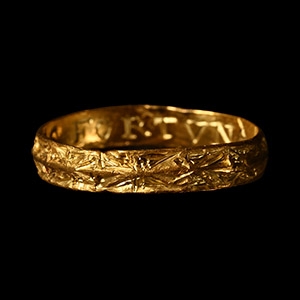
'The Wingham' Gold 'Fortune Favours the Brave' Posy Ring
Sold for (Inc. bp): £2,080
Broadly rectangular in cross-section and constructed from two sheets of gold; the external hoop carrying an etched decorative design comprised of a row of eight-armed stars in relief with a prominent horizontal line connecting the stars; the internal hoop with Latin inscription in block capitals reading '+FORTES FORTVNA IVVAT' translating to 'fortune favours the brave/strong'; straightened.
-
.jpg)
Roman Severus Alexander Denarius Forger's Coin Die Pair and Crucible
Circa 222-235 A.D.Sold for (Inc. bp): £1,300
A contemporary pair of clay coin dies used to manufacture coin forgeries, the working faces depicting a gold aureus or silver denarius of Emperor Severus Alexander, with incuse and reversed legends; each counterfeit die with inscribed numbering to verso [(((( LXIIII = 64]; accompanied by a clay crucible excavated at the same time with inked inscription to the underside: 'Arch.-Nr. / 6612-1975', another object that would have been required in the casting process of manufacturing of fake coins. 86.86 grams total, 44-58 mm
1 - 1 1/4 in.
In a private collection of Roman objects since 1975. Accompanied by a copy of a letter and schedule addressed to the Director of the Library Faculty of Kamp-Linfurt, a branch of Stadsparkasse Duisburg regarding the loan of the forger's die and crucible for exhibition, dated 13 December 1993.
Towards the end of the 2nd century and the early 3rd century A.D. the quality of Roman coinage began to be altered. Probably from the beginning of the reign of Severus Alexander, forgers were tacitly allowed by the Roman government to issue counterfeit coins. There are many ancient coins of this emperor that appear to have been cast in moulds. Most of these moulds would have been employed by forgers, and the dies were normally destroyed quickly after use in an effort to dispose of the evidence. -
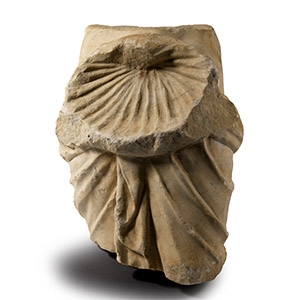
Roman Marble Fragment of Venus Rising from the Water
Circa 1st century A.D.Sold for (Inc. bp): £2,665
Statue fragment comprising the hips, buttocks and draped stola with a scallop-shell at the waist. 11.5 kg, 28.5 cm
Ex Paris collection. French gallery, Paris, 1990-2000s. This lot has been checked against the Interpol Database of stolen works of art and is accompanied by search certificate no.11956-20935. -
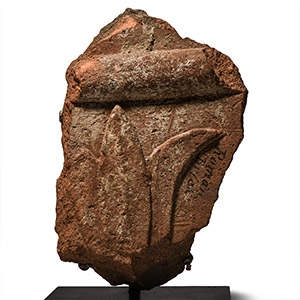
Roman Terracotta Architectural Element
1st century A.D.Sold for (Inc. bp): £546
Irregular terracotta fragment with horizontal rib and high-relief palmette motif to the obverse; old inked collector's inscription 'Roman Brick' to one side; remains of light-coloured pigment; vertical mounting rib to reverse; mounted on a custom-made display stand. 1.38 kg total, 21 cm high including stand
Private collection of Katherine Carson, Delaware, acquired in the 1930s and thence by descent to great-nephew before sale by Ms Carson. This artefact was part of a large collection of curios, a photo of which is in the Dover Post (8 October 1975, p.3) when in the ownership of Alan Hunn of Delaware. Previously offered at auction by Artemis Gallery, 14 February 2010, lot 30 (unsold lot with pre-sale estimate of 2,000 – 3,000 USD). Ex Sands of Time Ancient Art Gallery, Washington D.C. U.S.A., January 2012, item number RT903. -
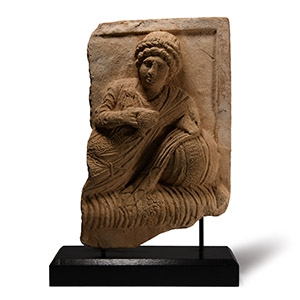
Eastern Roman Sandstone Frieze Fragment with Banquet Scene
Circa 2nd-3rd century A.D.Sold for (Inc. bp): £2,470
The rectangular stele modelled in the half-round representing a banqueting scene with elaborate couch and reclining character; the couch with banded and padded platform, rounded cushion with bands of ornament; the figure depicting a young noble wearing a male Palmyrene costume with band of scrolled foliage ornament, hair dressed into braided tresses and wound round the brow; left arm supporting the body on the cushion, right hand placed before the chest holding the handle of a footed kylix; rectangular border; mounted on a custom-made stand; head restored. 11.2 kg total, 46 cm including stand
Ex P.A., Hertfordshire, UK, specialist collection of Greek art, 1980-1990s.
The character shows a typical male in Palmyrene costume, with long sleeved tunic and large central band, decorated with interlaced vegetal embroidery. Its position is typical of the so-called 'banquet' reliefs. The belt is also decidedly masculine. The sculpture, originally headless, was probably reworked in the upper part, with the addition of a female head incompatible with the rest of the body. -
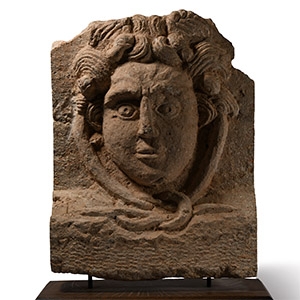
Eastern Roman Stone Relief of Medusa
2nd-3rd century A.D.Sold for (Inc. bp): £1,300
With a ledge to the base, carved high-relief mask of Medusa with complex banded hairstyle with diadem to the brow, lateral tresses framing the face developing to serpents forming a 'Hercules knot' beneath the chin; the face with deep-set eyes beneath a heavy brow, prominent nose above pursed lip; the base keyed to accept a plaster overlay; mounted on a custom-made stand. 33.1 kg total, 53 cm including stand
Ex P.A., Hertfordshire, UK, specialist collection of Greek art, 1980-1990s. -
Eastern Roman Bust of the Daughter of Aqima
2nd-3rd century A.D.Sold for (Inc. bp): £37,700
Modelled in the round with a fragment of stand to the rear; the figure carefully carved to exhibit the delicate facial features and elaborate hairstyle; the palla drawn up over the head and falling over the shoulders to the upper arms; a diadem to the brow with foliage and tendril detailing; elaborate earrings with dangles; necklace of fusiform and tubular beads and a longer one below with piriform plaques; large disc brooch to the left breast with dangles; peplos-style dress draped across the body beneath the palla; left arm bent and hand passing across the body to grasp the hem of the palla with a herringbone bracelet at the wrist; the palla displayed pinned with rosettes to the rear panel; with inscription of thirteen Palmyrene characters above the left shoulder 'NRW' // BRT // 'QM' // ḤBL' meaning 'daughter of Aqima'; traces of red and green pigment; mounted on a custom-made stand by Colin Bowles Ltd. 78.2 kg total, 57 cm high including stand
From a private American collection, acquired in the 1970s. Ex Leon Simard, a Trustee to the National Museum of Canada, prior to 1986. Acquired from Summer Gallery, 29 May 1986. with Archaelogia Gallery, Canada, 1986 to present. Accompanied by an Art Loss Register certificate number S00237794, dated 3 November 2023. Accompanied by an academic report by Dr Raffaele D’Amato. This lot has been checked against the Interpol Database of stolen works of art and is accompanied by search certificate no.11825-207620.
The sculpture is a good example of 2nd-3rd century A.D. Palmyrene female funerary portrait types. The amount of jewellery displayed in these portraits could be a direct reflection of the wealth of the family, and certainly they reflected the jewellery possessed by the owner of the grave. Particularly important is the gesture of the raised hand: the evidence from several sanctuaries in the city corroborates the connection between this gesture and the female gender. There is no indication that the raised arm was associated with worship in the funerary sphere. -
.jpg)
Roman Bronze Plaque with Eros on Lion
Circa 2nd-4th century A.D.Sold for (Inc. bp): £1,430
Modelled in relief with openwork elements, stylised detailing to both figures; hollow reverse. 182 grams, 10.2 cm high
Acquired 1990s-early 2000s. East Anglian private collection.
Hollow cast bronze images of Eros riding a lion are linked to the Eastern Levant and have been found for example in Tamna, probably a Roman import. The importance of long-distance contacts within the Eastern Mediterranean areas was rapidly reflected in provincial artistic styles, probably as soon as in Hellenistic times, at the beginning of the third century B.C., possibly even earlier. The unquestionable Greek influence led a number of scholars to define three main styles for the bronzes discovered in the eastern Roman provinces: a local type and iconography locally produced, Greek or Roman imports, and Oriental, Hellenistic, or Roman style, locally produced. -
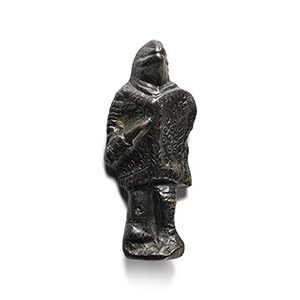
Roman Bronze Gladiator Mount
Circa 1st-2nd century A.D.Sold for (Inc. bp): £338
Modelled in the half-round with hollow reverse and fixing stud; gladiator advancing with a gladius short-sword drawn in right hand, holding a rectangular shield (scutum) and wearing greaves (ocreae); the arm protected by an armoured manica. 48 grams, 62 mm
From the French collection of M Garcia, 1990s.
The gladiator represented here belongs to the class of the scutarii (wearers of big shields) of the familia of the secutor or provocatores. The secutor was the chronological evolution of samnite gladiators. The title of secutor appears historically only in the imperial era and is closely linked to the title of contraretiarius, the retiarius being his true and only opponent. The secutor's armament consisted of the gladius and a large shield, a short ocrea on the left leg and a padded or armoured sleeve with chiroteca to protect his arm and hand. -
.jpg)
Roman Inked Wooden Tablet for the Tutorship of Iulius Maianus
End of the 3rd century A.D.Sold for (Inc. bp): £24,700
A reused tablet with a recessed writing field on side one, containing twenty-one lines in younger Roman cursive script, the lower edge slightly damaged but not affecting the text; side two with a broad flat-bottomed groove (sulcus), originally containing the cord with which the tablets of a legal document were bound together, the cord was fixed with wax, and on the wax the witnesses’ seals were impressed to certify that the document was not opened, since both the wax and the older text had been removed; this tablet had been reused at least once; the tablet shows similar features (material, use of ink, writing style etc.) like several other similar tablets and as far as can be seen, it was part of a private archive of legal documents probably of a family bearing the nomen gentile Iulius and living in the 3rd and 4th century A.D. in the north African province of Byzacena; this unique tablet is the copy (Latin exemplum, see page 1, line 1) of a document regarding the tutorship of Iulius Maianus, who is well known from several other tabulae, he was the son of Iulius Dontiquus, who died in 282 A.D.; in his will (from 281 A.D.) his father appointed as tutors for his son his two paternal uncles Iulius Felix and Iulius Fortunatus, both are mentioned on this tablet, as well as a specialised judge (iudex tutelarius) Iulius Faustus who was involved with the supervision of the tutorship; Iulius Maianus was at that time still a very young child, unable to write himself (sine litteris). 110 grams, 24.5 cm
From an important London collection since 1975. Accompanied by a copy of an academic report by Prof. Dr Peter Rothenhoefer. This lot has been checked against the Interpol Database of stolen works of art and is accompanied by search certificate no.11957-209850.
This extraordinary document contains references to properties of Iulius Maianus, which were to be administered by his tutors. Among other things, auctoritates agrorum (ownership titles over land) are mentioned. The language is typical for Roman legal documents and contains highly developed legal formula which apparently was well known in Roman North Africa. -
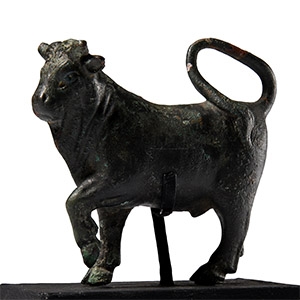
Roman Apis Bull Statuette
Circa 2nd century A.D.Sold for (Inc. bp): £624
Standing with its left foreleg raised, the head held high and turned slightly left with a full, fleshy dewlap cascading to the brisket; the tail looping over the rump, with its end adhering to the left flank; wide-open eyes and flaring nostrils; accompanied by a custom-made display stand. 106 grams, 72 mm wide (207 grams total, 91 mm high including stand)
Acquired from Charles Ede Ltd., London, UK, in 2004. From the collection of a South West London, UK, collector.
After the Roman annexation of Egypt, Egyptian cults such as that of the Apis bull were syncretised, becoming part of a distinctively Egyptian form of Roman polytheism. Representations of prancing Apis bulls, turned either left or right, have been found throughout the Roman empire. Various parallels can be found in the Cincinnati Art Museum (inv.1956.13), in Walters Art Gallery (inv.54.1565) and in the British Museum. -
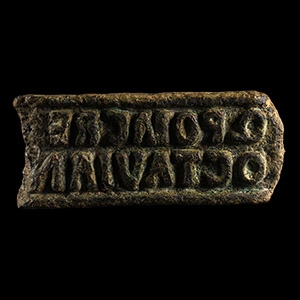
Roman Bronze Stamp for Octavian
Circa 1st century A.D.Sold for (Inc. bp): £650
Formed as a tablet-shaped stamp (signaculum), with raised border above and below containing an inscription in Latin in reverse over two lines, reading: 'Q[UINTI] POM [PONII] CRE [SCONII} ? / OCTAVIAN[I]' possibly translating to: 'Of Quintus Pomponius Cresconius Octavianus', this latter being the owner; with a large loop to verso. 92 grams, 64 mm
From an old private collection formed before 1985. Accompanied by a copy of a previous dealer's certificate of authenticity including provenance.
Used to stamp documents and a broad range of different materials and food, signacula came into use in the Roman res publica during the 2nd century B.C., becoming both popular and widely used in many areas of everyday life during the Imperial period. These signacula were not exclusively used in the sphere of economy and property administration, but also in public and private sphere, determining the identity of their owners. The bronze stamp - also definable as a tessera, like the wooden one - was an instrumentum vicarium (auxiliary tool) of the annulus signatorius (seal ring), but compared to the annulus, it was much stronger and more practical, capable of leaving a better recognisable imprint. By analogy, the press note of a wooden or terracotta stamp also had an important certifying function, but the object that produced it only lasted a limited time, while the signaculum ex aere (bronze stamp) lasted a lifetime. -
Eastern Roman Mosaic Depicting a Bird
4th century A.D.Sold for (Inc. bp): £2,860
In a rectangular matrix; cream, olive, pink and other tesserae depicting a bird advancing with head bowed, with banded frame. 10.35 kg, 40.3 x 40.3 cm
Former collection of Mr Pierre Bart (1889-1964), official of the French mandate in Syria and Lebanon (1919-1936) and delegate to the Lebanese government until 1946. Transmitted by descent.
