
Auction Highlights
-
.jpg)
Egyptian Relief with List of Offerings
Sold for (Inc. bp): £18,200
A section of tomb wall with a central register of eight rectangular panels each containing hieroglyphs naming offerings for the deceased; the top and bottom groups of eight rectangular panels each contain a depiction of a kneeling offering-bearer; all carved in high-relief; mounted on a custom-made display stand. -
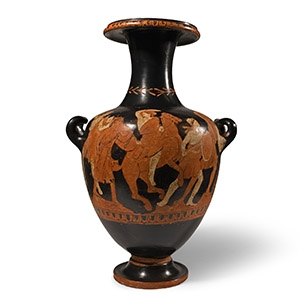
Greek Red-Figure Hydria with Combat Scene Between Amazons and Greek or Trojan Heroes
Sold for (Inc. bp): £7,800
The vessel with integral round-section upward-facing handles, a third, round-section handle placed vertically between shoulder and upper neck to rear; laurel sprigs to the neck with traces of gilding; combat scene with Amazons (and Trojans?) below, armed with short swords and crescent shields, most wearing an exomis leaving the shoulder and one breast uncovered; volute palmettes below both side-handles, a panel of tiered and swirling volutes to the rear, all on a band of egg-moulding, repeated around the rim; possibly Apulian or Campanian; restored. -
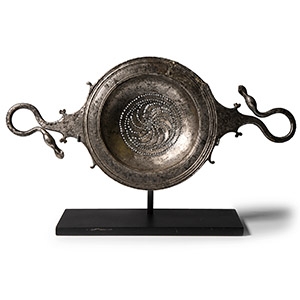
Greek Silver Wine Strainer
Sold for (Inc. bp): £16,900
Composed of a shallow bowl and broad flange rim, two integral scalloped handles with scrolled flourishes, tapering to a loop handle with swan head terminals each with incised eye and beak detailing; perforated whirl within roundel to interior base; accompanied by a custom-made display stand. -
.jpg)
Eastern Roman Bust of the Daughter of Aqima
Sold for (Inc. bp): £37,700
Modelled in the round with a fragment of stand to the rear; the figure carefully carved to exhibit the delicate facial features and elaborate hairstyle; the palla drawn up over the head and falling over the shoulders to the upper arms; a diadem to the brow with foliage and tendril detailing; elaborate earrings with dangles; necklace of fusiform and tubular beads and a longer one below with piriform plaques; large disc brooch to the left breast with dangles; peplos-style dress draped across the body beneath the palla; left arm bent and hand passing across the body to grasp the hem of the palla with a herringbone bracelet at the wrist; the palla displayed pinned with rosettes to the rear panel; with inscription of thirteen Palmyrene characters above the left shoulder 'NRW' // BRT // 'QM' // ḤBL' meaning 'daughter of Aqima'; traces of red and green pigment; mounted on a custom-made stand by Colin Bowles Ltd. -
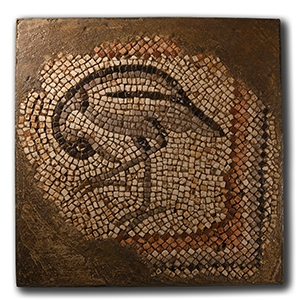
Eastern Roman Mosaic Depicting a Bird
Sold for (Inc. bp): £2,860
In a rectangular matrix; cream, olive, pink and other tesserae depicting a bird advancing with head bowed, with banded frame. -
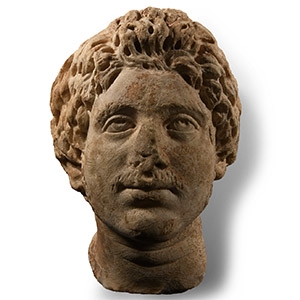
Roman Marble Head of a Germanic Warrior
Sold for (Inc. bp): £28,600
Modelled naturalistically in the round, directing his gaze upwards left, the eyes with sculpted pupils originally decorated with stone insertions, his face framed by voluminous short curls swept up off the forehead, sideburns and a moustache. -
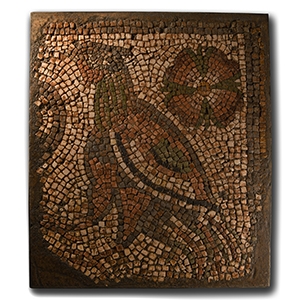
Eastern Roman Mosaic Depicting a Bird
Sold for (Inc. bp): £2,860
In a rectangular matrix; cream, olive, pink and other tesserae depicting a perching bird with rosette above. -
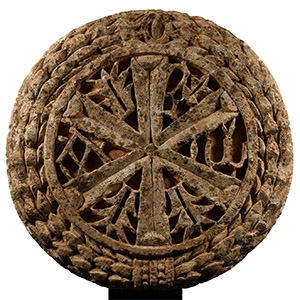
Monumental Byzantine Limestone Chi Rho Roundel
Sold for (Inc. bp): £36,400
Divided into six sections by Christogram letters chi and rho, two of the segments with Greek letters alpha and omega, the other four segments with floral ornaments; a laurel wreath to the edge; mounted on a custom-made display stand. -

Old Babylonian Clay Cuneiform Tablet, a Letter From a Local Governor in Arrapha to His Colleague in Ešnunna,
Sold for (Inc. bp): £8,450
Written across two principal faces and three side edges, reading: 1-2) Say to Zakur-ahum, thus says Uzazza, your brother. 3) I have read the tablet you sent me. You wrote to me as follows: 4-5)'Five nomadic Suteans plundered the district of Zippat and I sent a troop. 6-7) I drove them back. I prevented them from taking anything. 7-8) So this troop left empty-handed. It is to be feared that they will go to the land of Arrapha and raise havoc, take action!' 11) This is what you wrote to me, and I rejoiced greatly. 12) In your tablet is written:'500 nomadic Suteans'. 13) Now, your servants whom you sent to me told me this: 14) 'A troop of 1,500 men has come. 15) Among them were many men with bows.'16 This is what they told me. Now never 17) have there been archers among the nomad-Suteans. 18) Is it not to be feared that the heavily-equipped 19) part of a foreign army is here itself comprising the nomad-Suteans with their bows? 20) The (result of the) divination I found said: 'Fire will devour the base of the reed.' 21) [...] its ... will not reach me. 22-23) [Now], shall I rejoice over the heavily equipped troop (that is) there? 24) [...]. 25-26) Now investigate this troop. 26-27) Send a full report urgently one way or the other, 28-29) so that I may circulate [a swift messenger] so that 29-30) the whole country may be gathered [in my fortresses] and so that I may take action. 31-33) Moreover, earlier, nomadic Suteans assaulted the palace cowherds one evening and 33-34) carried away all the cows from the palace. They left nothing behind. 35-36) There are none left, including the cows they had been entrusted with that evening. The next day, 37) a rescue troop (sent) by Ašrum, in pursuit of them 38) went as far as the banks of the Euphrates, but 39 returned empty-handed. 39) Another thing, 40) concerning what you wrote to me: 41-42) 'Looters set up a siege instrument- kalbanatum against a fortified farm and killed people. In addition, they carried off ten oxen. 43) And Ašrum went in there. Check that 44 their oxen no longer disappear.' This is what you wrote to me. 45-46) Now, shall I rejoice in this matter, or shall I [not] [...] them [...]. 47-48) Now, is there a plunderer who can plunder on my watch? Now, when I hear (about them) 49-50) and as soon as I send a message, do I not put them on the pal? No doubt 51-52) these people are foreigners, but you consider them to be Arrapha inhabitants! Now, precisely according to what you've written to me, 53-54) I'm going to send a fast messenger to the very interior of Arrapha and carry out a check. ; repaired. -

Uruk Clay Pictographic Tablet Bearing an Economic Text Relating to Farm Produce
Sold for (Inc. bp): £9,100
Written over two faces; lentoid cross-section. -
.jpg)
Italic Bronze Triple-Disc Cuirass
Sold for (Inc. bp): £9,360
Matched pair of Samnite triangular breast and backplates, a suite of 'triple-disc' type, each with three repoussé panels with carinated rim, flat spandrel above and curved on the lower sides, with perforated edges to affix to a separate mail garment; rivetted loops to the shoulders for attachment of supporting straps, and similar lateral loops with portion of round-link chain in situ; mounted on a custom-made stand. -
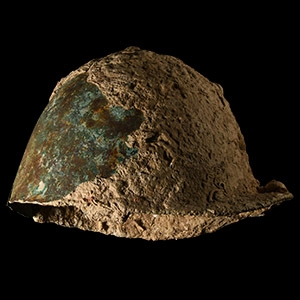
Roman Bronze Legionary Helmet with Inscription
Sold for (Inc. bp): £9,100
Montefortino helmet with bulbous domed skull and a plain crest knob with flattened top; plain and flat neck guard with thickened rim; the front with punched Latin inscription 'A N CFN'; the surface largely covered in marine encrustations; accompanied by a custom-made display stand. -
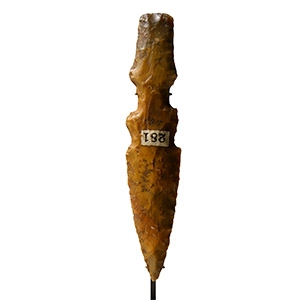
Exceptional Neolithic Flint Dagger
Sold for (Inc. bp): £5,980
Finely knapped lentoid-section dagger with lateral recesses and square butt; old collector's label '281'. -
.jpg)
Massive Stone Age British Bifacial Lanceolate Flint Handaxe
Sold for (Inc. bp): £10,400
Long blade with small portion of cortex at the upper end, sharply tapering point with edges worked from both sides. -
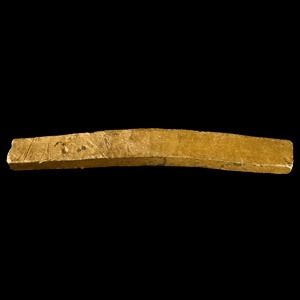
Viking Age or Earlier Hacked Gold Trade Ingot
Sold for (Inc. bp): £3,120
A slightly bent irregular bar of hacked gold with rectangular cross-section, showing evidence of compression and fracture to each end, some subtle transverse lines on both of the main surfaces. -
.jpg)
Anglo-Scandinavian Viking Bronze Three-Dimensional Urnes Stirrup Apex Mount
Sold for (Inc. bp): £6,500
The substantial heater-shaped plaque with spectacular openwork Urnes style design, the standing beast with entwined tendrils, pronounced head at the apex, narrow ledge to the reverse and rivet holes to each corner with two rivets remaining. -
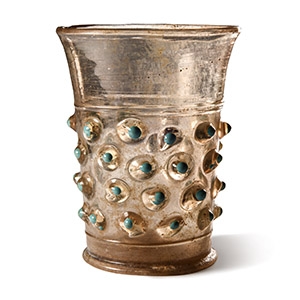
Medieval Glass Beaker with Prunts
Sold for (Inc. bp): £7,800
Of tubular form with flared rim and applied collar to the foot, applied trails to the sidewall and four rows of prunts with applied blue-glass ornament. -
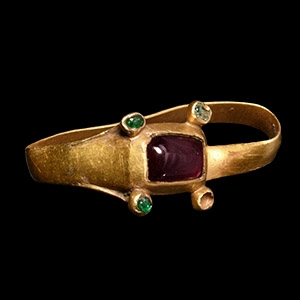
Medieval Gold Ring Set with Gemstones
Sold for (Inc. bp): £4,160
With a slender D-section hoop, bevelled rectangular cell set with a garnet cabochon; satellite settings at the corners, each with a green cabochon (one absent), the ring preserved in the same condition as it was when found. -
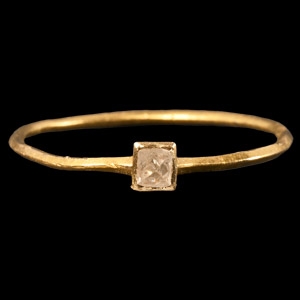
'The Fressingfield' Medieval Gold Ring with Diamond
Sold for (Inc. bp): £2,860
With plain circular hoop and square diamond-shaped bezel with replicant natural diamond crystal. -
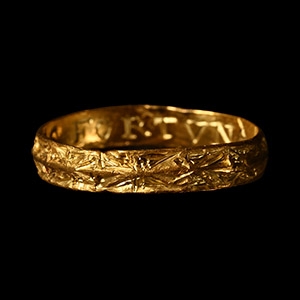
'The Wingham' Gold 'Fortune Favours the Brave' Posy Ring
Sold for (Inc. bp): £2,080
Broadly rectangular in cross-section and constructed from two sheets of gold; the external hoop carrying an etched decorative design comprised of a row of eight-armed stars in relief with a prominent horizontal line connecting the stars; the internal hoop with Latin inscription in block capitals reading '+FORTES FORTVNA IVVAT' translating to 'fortune favours the brave/strong'; straightened.
-
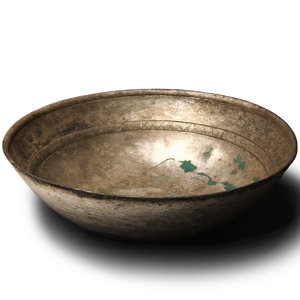
Hellenistic Decorated Silver Bowl
Circa 3rd-2nd century B.C.Sold for (Inc. bp): £416
With everted flaring rim, the exterior plain, the interior with ridged band at the shoulder composed of alternating X-motifs, stylised opposing plants, and dots interspersed with transverse bands. 222 grams, 18.5 cm wide
From a late Japanese specialist collector, 1970-2000s.
Similar segment-shaped silver bowls with partial gilding, decorated on the inside with friezes in the form of garlands or wickerwork, have been found in many nomad mounds in the Caucasus region. Treister attributes them to Parthian workshops. Such cups could also be undecorated or decorated only with a frieze of Ionian cymatium along the edge. -
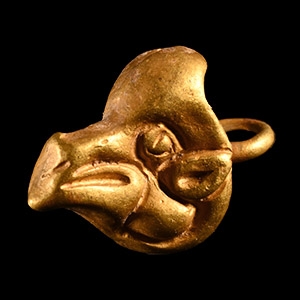
Scythian Gold Animal Head Pendant
4th-5th century B.C.Sold for (Inc. bp): £416
Comprising a stylised head of a boar modelled in the round, annular eye and tall bristles above the head; loop to the rear. 0.81 grams, 12 mm
From a late Japanese specialist collector, 1970-2000s. -
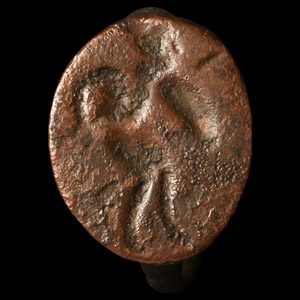
Hellenistic Bronze Ring with Hoplite
Circa 2nd-1st century B.C.Sold for (Inc. bp): £78
Ellipsoid bezel with low-relief image of a warrior with pilos helmet, shield and xiphos short-sword. 6.93 grams, 22.90 mm overall, 20.17 mm internal diameter (approximate size British Q, USA 8, Europe 17.46, Japan 16)
Ex old English collection. London art market, pre 2000. Property of a London, UK, gentleman. -
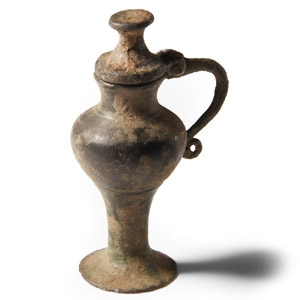
Hellenistic Bronze Lidded Cosmetic Vessel
Circa 1st century B.C.Sold for (Inc. bp): £117
Elegantly proportioned miniature ewer with trumpet-shaped base, swept loop handle with recurved finial, hinged lid. 54.4 grams, 66 mm
Acquired on the German art market before 2000. From an EU collection before 2020. -
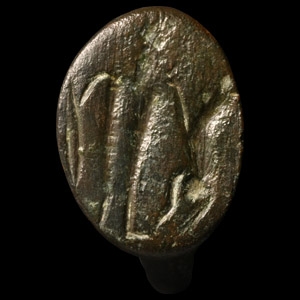
Hellenistic Bronze Ring with Lion Attacking a Warrior
Circa 3rd-1st century B.C.Sold for (Inc. bp): £39
With narrow flat-bottomed hoop, ellipsoid bezel with incuse combat scene of a standing human figure with a shield seizing a rearing lion. 9.17 grams, 24.52 mm overall, 19.78 mm internal diameter (approximate size British Q 1/2, USA 8 1/4, Europe 18.12, Japan 17)
Ex old English collection. London art market, pre 2000. Property of a London, UK, gentleman. -
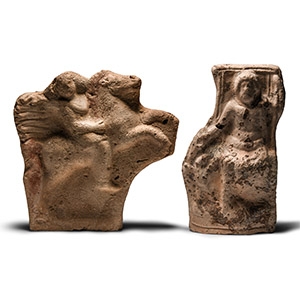
Parthian Terracotta Statuette Group
3rd century B.C.Sold for (Inc. bp): £351
Hollow-formed, comprising: a rider on a rearing horse with chlamys extended in the wind, and wearing wide Persian trousers (saravara), red pigment in the field; Zeus enthroned, facing with an eagle at his feet, hole to the reverse. 598 grams total, 15.5 cm each
Ex private European collection. with Genève Enchères, 14 December 2017, lot 863.
The costume of Parthian nobles consisted of a tunic or wrapped jacket, trousers and boots/footwear, generally typical of a riding dress. Interestingly, the right side of the tunic was knee-length (such as those seen om early Sassanian noblemen depicted in the Persepolis graffiti) but the left side of the tunic, for many Parthian cavalrymen, appeared shorter and only reached to the upper thigh. -
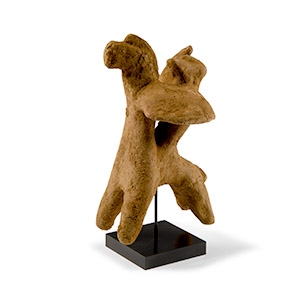
Archaic Greek Terracotta Figure of Mounted Warrior with Shield
7th-5th century B.C.Sold for (Inc. bp): £247
The horse with an elongated neck and stylised features; mounted by a bearded rider gazing towards the sky, holding a shield in his left hand and a sword(?) in his right hand; mounted on a custom-made display stand. 286 grams total, 15 cm high including stand
Acquired before 1990. From an old German collection.
Terracotta figurines of horse and rider were common grave offerings in Boeotia, northwest of Attica, particularly during the 6th century B.C. Representations of warriors on horseback were already widespread in the Geometric Period, and widely used in Cyprus, during this period. -
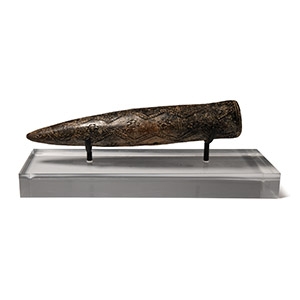
Cypriot Bronze Age Cone
2100-1850 B.C.Sold for (Inc. bp): £520
Hollow-formed ceramic cone withlongitudonal hatched zigzag bands, incised circumferential band, impressed 'cross barby' and lozenge motifs; vertical 'seam' to the reverse with impressed 'stitching'; mounted on a custom-made stand. 1.55 kg total, 26.5 cm (30.5 cm including stand)
US private collection. with DuMouchelles Auction, Detroit, 18 February 2023, lot 1123. -
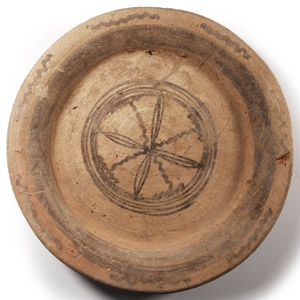
Eastern Mediterranean Terracotta Plate with Star
Late 1st millennium B.C.Sold for (Inc. bp): £117
With painted rosette motif to the centre, with concentric rings and other motifs. 740 grams, 25 cm wide
London, UK, collection, 1990s. -
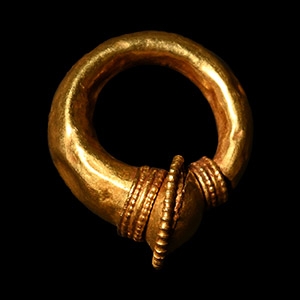
Etruscan Gold Trumpet-Shaped Earring
Circa 350 B.C.Sold for (Inc. bp): £143
Hollow-formed sheet-gold earring with applied trumpet-shaped finial, filigree collars and beaded wire fillet to the rim. 1.34 grams, 20 mm
Ex Parisian dealers including Jean-Phillipe Mariaud de Serres; subsequently dispersed with other pieces at auction. French private collection of a French lady, acquired in the 1980s. Accompanied by a copy of an illustrated three page collector's cataloguing document. -
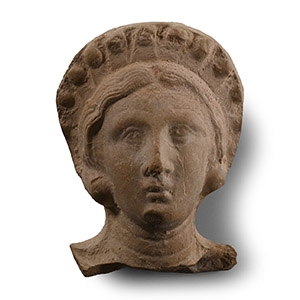
Hellenistic Terracotta Head of the Goddess Demeter
Circa 2nd-1st century B.C.Sold for (Inc. bp): £780
Hollow-formed and with rounded facial features; wavy hair with central partition, dressed with a tall diadem. 74 grams total, 78 mm high
UK private collection. Acquired Spink, York, UK, 2009. Property of a Nottinghamshire gentleman.
The head is probably from a cult statuette of Demeter. Statuettes of the goddess, seated or standing, or even busts, are well documented in the south of Italy, both among the Greek colonists and the local populations; many have been excavated from regional sanctuaries. -
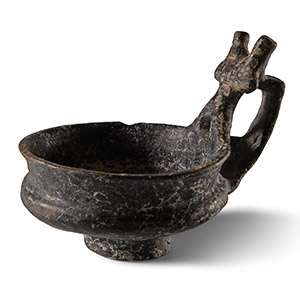
Villanovan Terracotta Kyathos with Zoomorphic Handle
Circa 7th century B.C.Sold for (Inc. bp): £312
Small impasto kyathos with carinated profile, basal ring, zoomorphic handle with spurs above. 113 grams, 10 cm wide
Belgium (Uccle) – Haynault Ventes Publiques, Collectibles Auction, 21 September 2021, lot 15. Property of a South Australian private collector, with collection reference 21.100. Accompanied by a detailed collector's catalogue page including description and photograph.
Villanovan culture is often regarded as the earliest phase of Etruscan civilisation in the Iron Age.
