
Auction Highlights
-
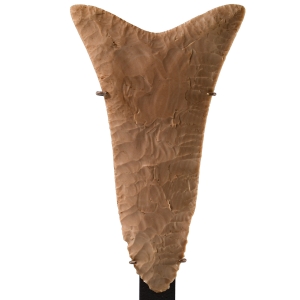
Egyptian Fishtail Flint Knife
Sold for (Inc. bp): £7,150
Knapped bifacial tan knife with fishtail butt to receive a hilt; the rounded tip tapering and flaring along the edges; with a custom-made display stand. -
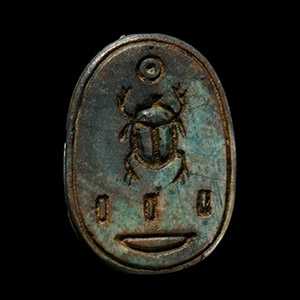
Egyptian Stone Scarab Inscribed for Tutankhamun
Sold for (Inc. bp): £6,500
Naturalistically modelled and coloured blue, hieroglyphs on base; pierced for suspension. -
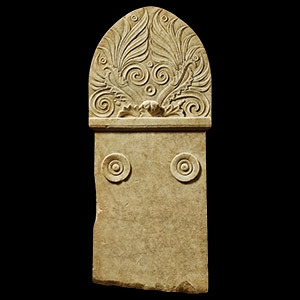
Greek Marble Funerary Anthemion Stele
Sold for (Inc. bp): £17,550
Comprising a tall, plain body with two rosettes; crowned by an elaborate palmette and volute design with shallow acanthus stalks and small rosettes; mounted on a custom-made display stand. -
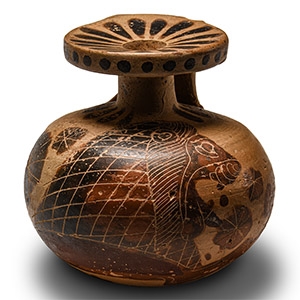
Corinthian Black-Figure Aryballos with a Lion
Sold for (Inc. bp): £3,900
The squat oil flask with slender neck and broad everted rim, painted with rosette petals around the mouth and base, spots encircling the rim, horizontal stipes to the strap handle, vegetal motifs and the forequarters of a roaring lion to one face of the body. -
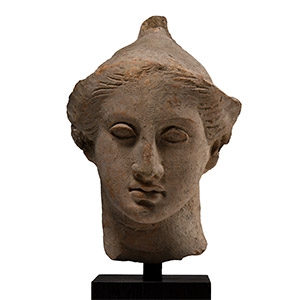
Greek Tarentine Terracotta Head of a Youth
Sold for (Inc. bp): £5,720
Possibly depicting Ganymede or Paris, wearing a soft Phrygian cap with everted brim, the hair swept back from the face; almond-shaped eyes with pronounced eyelids, straight nose and fleshy lips; mounted on a custom-made display stand. -
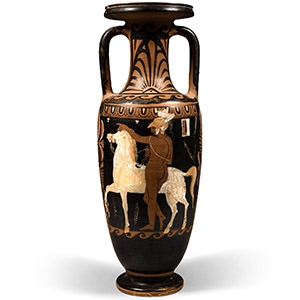
Campanian Red-Figure Neck-Amphora with Cavalryman
Sold for (Inc. bp): £10,400
The piriform body with broad, stepped rim and two round-section handles; red-figure frieze depicting two standing women facing, wearing a himation and stephane; the other side with a nude standing warrior wearing an Apulo-Corinthian helmet, holding the reins of his horse, acanthus leaves, ovolo and wave motifs to the neck and lower body; probably from a Cuma workshop. -
.jpg)
Hellenistic Gold Earrings with Lapis and Mother of Pearl
Sold for (Inc. bp): £19,500
Comprising a shallow disc with central flower motif inlaid with carnelian and lapis lazuli, surrounded by a beaded border, the outer pearled border inlaid with mostly replicant lapis lazuli, and mother of pearl inserts; three pendants to the lower edge, two with chain and carnelian bead, the central pendant formed as a miniature amphora with filigree, repaired; housed in a custom-made display box. -
.jpg)
Hellenistic Terracotta Head of a Youth
Sold for (Inc. bp): £18,200
Tousled curly hair, strong aquiline nose and full mouth; the deep eyes marked by raised eyelids and prominent semi-circular eyebrows; the hair arranged in overlapping rows of locks; repaired; mounted on a later porphyry plinth. -
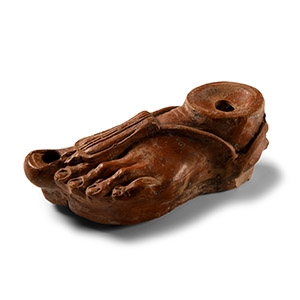
Roman Terracotta Foot Lamp
Sold for (Inc. bp): £3,380
Mould-made and shaped as a sandaled left foot, filling-hole surrounded by a ridge in the ankle area, the sandal with two leather straps tied together near the ankle, wick-hole in the big toe; inscription 'ƩΑΛΣΙϹ' to the base, heel chipped. -
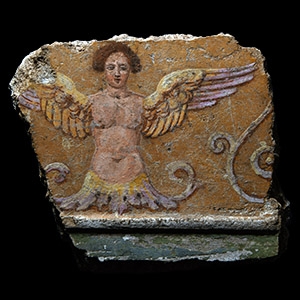
Roman Polychrome Wall Painting Fragment with Winged Siren
Sold for (Inc. bp): £20,800
Decorated with a frieze of partially preserved acanthus volutes from which emerges a figure of a winged female, possibly a siren, the body and the head of a woman with brown hair, the outstretched wings in pink and yellow; ochre background, cream-coloured line border with a green raised edge (part of the wall) below; mounted on a custom-made display stand. -
.jpg)
Neo-Assyrian Bronze Horse Trapping with Eagle-Headed God Nisroch and Winged Supernatural Figures
Sold for (Inc. bp): £15,600
The left side of a trapping for a horse pulling a chariot, comprising two hammered elements with a hinge; rectangular upper section with a loop to one end, decorated with an eagle-headed genius-demon, wearing a tunic and a fringed kilt, a shawl wrapped around the body, hanging down on the back, carrying a bucket of purifying water in his right hand and a conical pot of incense in his left hand, bracelets to arms, two rows of lotus buds above; the discoid lower section divided in two registers, each with a winged genii in combat with winged bulls; the dividing raised band with fish motifs similar to the border formed of fish; the edges of both elements with punched edges for the attachment of leather lining; Neo-Assyrian or Urartian; mounted on a custom-made display stand. -
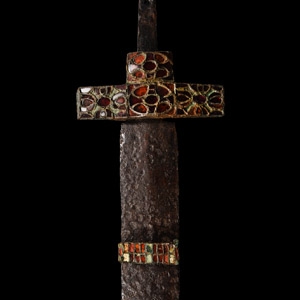
Migration Period Iron Sword with Garnet Cross Guard and Scabbard Fittings
Sold for (Inc. bp): £7,150
With a double-edged parallel-sided blade with broad pointed tip; the lower guard inlaid with garnet cloisonné divided into four segments; accompanied by a rectangular scabbard slide inlaid with two rows of garnets and other stone; and a part of a sheet-silver chape. -
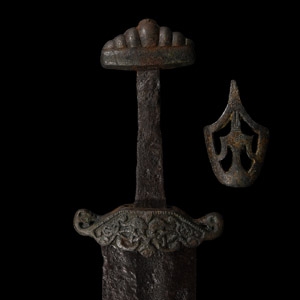
Viking Iron Sword with Cross Guard Surmounted by Interlaced Dragons
Sold for (Inc. bp): £8,450
Comprising a double-edged cutting blade with tapering fullers and hefty tang; the bronze cross guard in Jellinge style with dragon head finials and a central human face to the lower edge; the pommel with seven lobes; accompanied by a bronze openwork chape with central bird motif decorated with stamped ring-and-dot design. -
.jpg)
Bronze Age Gold Torc-Shaped Bracelet
Sold for (Inc. bp): £11,050
Of solid heavy penannular form, round in section with clubbed terminals. -
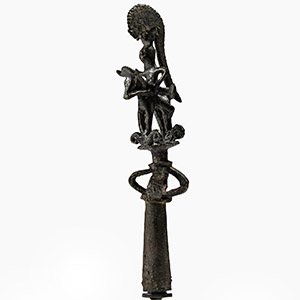
Iberian Celtic 'Axel Guttman' Bronze Warrior Finial
Sold for (Inc. bp): £13,000
With slightly tapering socket and openwork bulb above, discoid platform supporting a mounted warrior modelled in the round; horse with long vertical tail and horizontal reins, bowed legs and scrolls at the hooves; warrior astride the horse with legs bent and feet to the rear, helmet with lateral horns and large swept crest with notched edge; arms bent to show the warrior in the act of drawing his falcata sword from the scabbard worn across his midriff; mounted on a custom-made stand. -
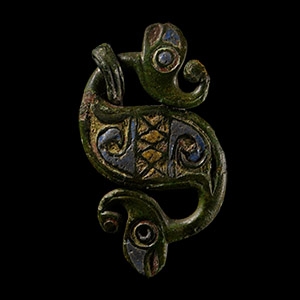
Very Large Celtic Enamelled Bronze Dragonesque Brooch
Sold for (Inc. bp): £4,420
S-shaped with scrolled flourishes to the dragon-head terminals, remains of inlaid blue and red enamelling to the stylised beast heads, wave and lozenge ornament to the body; free-running tongue with head coiled around the neck of one of the creatures; Romano-British. -
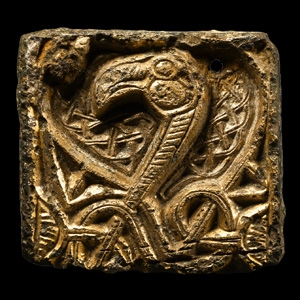
Anglo-Saxon Gilt Bronze Chip-Carved Beast Manuscript Mount
Sold for (Inc. bp): £3,380
With high-relief aviform head and wings and looped ornamental swags, knotwork panels in the field; two holes for mounting; possibly a book-mount, Hiberno-Saxon workmanship. -
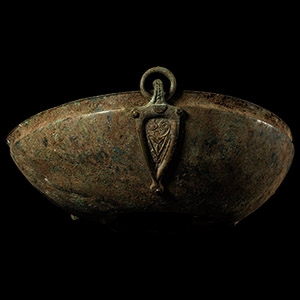
The High-Status 'Ryedale' Anglo-Saxon Bronze Hanging Bowl Complete with all Four Chip-Carved Mounts
Sold for (Inc. bp): £36,400
An excessively rare and almost complete copper-alloy hanging bowl and associated fittings comprising: (i) the bowl with three attached matching hooked escutcheons and suspension rings (ii) the basal disc (iii) a body fragment (or possible repair patch) (iv) a curved bronze fragment (ii) the basal disc with separate frame (iii) fragment of copper-alloy sheet, possibly forming part of a repair to the base of the bow (iv) a curved copper-alloy strip (iv) four skeletal fragments from a sheep or similar. -
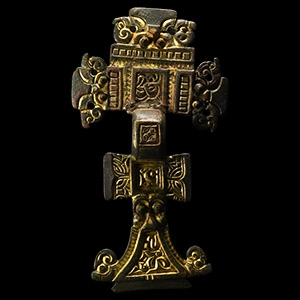
'The Scampton' Published Anglo-Saxon Gilt Bronze Florid Cruciform Brooch
Sold for (Inc. bp): £11,050
Of Martin's Group 4 with rectangular headplate and florid face-masks to the three edges and conical eyes, deep bow with with square central panel, footplate with square lateral lappets, triangular face-mask finial with conical eyes; pin-lug and catchplate to the reverse; gilded surface abraded. -
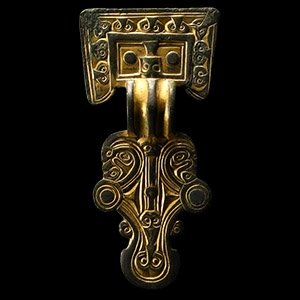
Superb Anglo-Saxon Gilt Bronze Great Square-Headed Brooch
Sold for (Inc. bp): £11,700
Of Hines's Group X with two discs on the headplate in a rectangular frame surrounded by a frieze of facing human masks, and another mask placed centrally above the junction with the bow; shallow bow with three ribs; curved horse-head lappets flanking a vertical shank with facing mask detailing, discoid lobes and an inverted mask below; pin-lugs to the reverse and solder-scar where the catchplate was attached. -
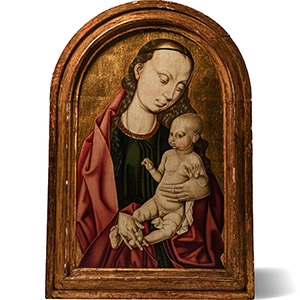
Medieval Virgin and Child by a Follower of Dirk Bouts
Sold for (Inc. bp): £11,700
Oil on board devotional panel in a gilt wooden frame; the Virgin in a bottle-green gown with gilt collar and cream undershift, crimson mantle; the naked Christ supported on his mother's left hip, his left foot clasped in the interleaved fingers of her right hand; textured gilt field; attributed to a follower of Dirk Bouts. -
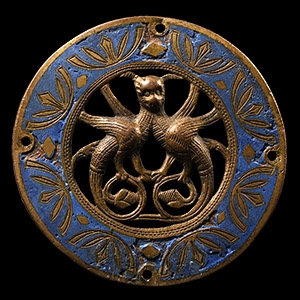
Medieval Limoges Bronze and Champleve Enamel Roundel with Fantastical Creature
Sold for (Inc. bp): £23,400
Openwork winged beast to the centre, its tails curling beneath the body creating the foliate tendrils on which it perches, broad outer roundel decorated with geometric plants alternating with lozenges, extensive remains of blue champlevé enamelling; engraved and chiselled; four attachment holes. -
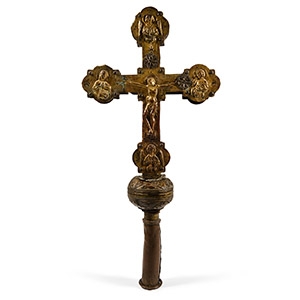
Medieval Gilt Bronze Processional Cross
Sold for (Inc. bp): £16,900
With wooden core to which the embossed sheets have been attached; the obverse with a central nimbate Corpus Christi, an applied rosette above and to the left arm; an angel to the finial of the upper and lower arm with Mary and St John the Evangelist to the side arms; the reverse with a central figure of Jesus holding the Gospel and making the sign of blessing; each finial of the arm with the symbols of the Evangelists (eagle, angel, lion and ox); the cross resting on a floral sphere with a socket below. -
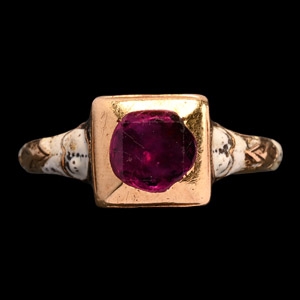
Baroque Gold, Ruby and Enamel Ring
Sold for (Inc. bp): £11,700
Composed of a slender hoop, expanding shoulders decorated with white enamelled foliage and black enamelled pea-pod ornament, repeated around the bezel, bezel with box setting holding a table-cut ruby, white and black enamelled floral design to the underside; minor loss of enamel; likely from France; accompanied by a 'Les Enluminures' hinged presentation box.
-
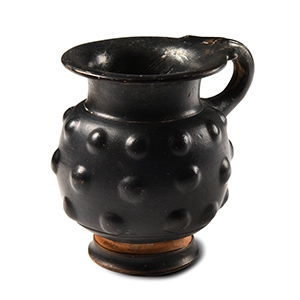
Greek Black-Glazed Pinecone Jug
5th-3rd century B.C.Sold for (Inc. bp): £1,040
With raised domes to the body, broad neck, everted rim, bifurcated handle, foot. 105 grams, 86 mm
Very fine condition.
Acquired European art market, 1980s-1990s. Private English collection. -
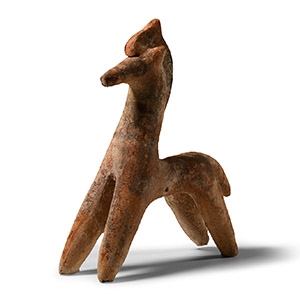
Cypriot Bichrome Ware Terracotta Horse Model
Circa 850-750 B.C.Sold for (Inc. bp): £611
Modelled in the round, detailed in black and crimson. 168 grams, 13 cm high
Lt. Col. H.A. Hill, R.A.M.C. while stationed in Cyprus as S.M.O in the 1920s, thence by descent. -
.jpg)
Cypriot Bichrome Ware Horse Model
Circa 850–750 B.C.Sold for (Inc. bp): £910
Modelled in the round, detailed in black and crimson. 183 grams, 13 cm high
Lt. Col. H.A. Hill, R.A.M.C. while stationed in Cyprus as S.M.O in the 1920s, thence by descent. -
.jpg)
Villanovan Impasto Biconical Urn
Circa 8th century B.C.Sold for (Inc. bp): £650
Black burnished ceramic urn with conical lower body, two flared loop handles, bell-shaped upper body and flat everted rim; band of incised chevrons to the equator, horizontal linear bands and ropework key patterns; one handle restored. 2 kg, 25 cm high
Ex private Orange Country collection. with Ancient Resources Auctions, Auction 34, 14 September 2014, lot 246. Accompanied by a detailed collector's catalogue pages including description and photograph.
Such urns were often deposited with the cremated remains inside, one handle broken off (perhaps part of the funerary rites) and in some case a bronze crested helmet placed over the top of the urn. -
Roman Terracotta Foot Lamp
2nd century A.D.Sold for (Inc. bp): £3,380
Mould-made and shaped as a sandaled left foot, filling-hole surrounded by a ridge in the ankle area, the sandal with two leather straps tied together near the ankle, wick-hole in the big toe; inscription 'ƩΑΛΣΙϹ' to the base, heel chipped. 112 grams, 12.2 cm
With Gorny & Mosch, Auction 194, 14 December 2010, lot 505. This lot has been checked against the Interpol Database of stolen works of art and is accompanied by search certificate number no.11799-206830.
This lamp belongs to a type of plastic lamp made in Anatolia and widespread throughout the Eastern Empire. The sandaled foot was part of the classification of plastic lamps dedicated to the representation of the human body. These lamps were the luxuries of the poor, being brought to temples as votive offerings, however some took their place in the domestic lararia, or were kept by children as playthings. -
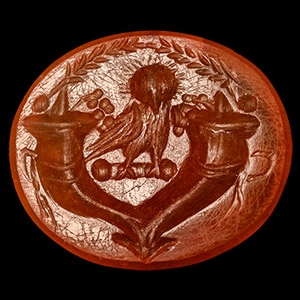
Roman Carnelian Gemstone with Owl Between Cornucopiae
1st century A.D.Sold for (Inc. bp): £975
The oval intaglio engraved with the bird facing, flanked by two opposing cornucopiae. 0.65 grams, 13 mm
Acquired in the late 1980s-early 1990s. Important North West London collection.
According to Greek mythology, the cornucopia was the horn lost by the Achelous river in the fight with Hercules for Deianeira and filled by the Naiads with flowers and fruit as a symbol of abundance, thus alluding to the fertility of the valley where the Achelous flowed. The owl, symbol of Athena, flanked by cornucopiae, evoked the abundance asked from the goddess by the wearer of the gemstone. -
Roman Polychrome Wall Painting Fragment with Winged Siren
Late 1st century B.C.-early 2nd century A.D.Sold for (Inc. bp): £20,800
Decorated with a frieze of partially preserved acanthus volutes from which emerges a figure of a winged female, possibly a siren, the body and the head of a woman with brown hair, the outstretched wings in pink and yellow; ochre background, cream-coloured line border with a green raised edge (part of the wall) below; mounted on a custom-made display stand. 979 grams total, 16 cm high including stand
From a European collection formed in the 19th century or earlier, based on the custom-made tooled leather box similar to another fragment kept in a case of similar manufacture with a label reading 'Fragment de Pompéi provenant de la vente Préat 1868' sold at Sotheby's New York, 12 December 2013, lot 84. Mitsukoshi department store, Nihonbashi, Tokyo, by 1974. Japanese art market, 1974-1978. Accompanied by an academic report by Dr Raffaele D'Amato. This lot has been checked against the Interpol Database of stolen works of art and is accompanied by search certificate number no 11828-207723.
This painted stucco was probably part of a decorative frame. Such decorations can be seen on the famous Villa of Oplontis, where the painted walls of the Triclinium nr. 14 have been divided thrice by columns with a sphinx as ornament on the top of the pillar, decorated with acanthus scrolls and sirens beneath the sphinxes. -
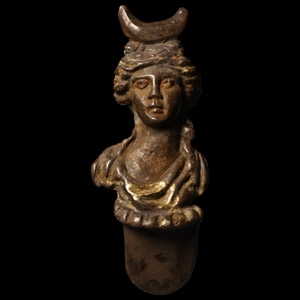
Roman Silver-Gilt Ring with Bust of Goddess
2nd-3rd century A.D.Sold for (Inc. bp): £1,105
Composed of a large hoop with raised tongue-shaped plaques at the shoulders, bezel formed as the bust of goddess Selene wearing a crescentic crown; trace remains of gilding. 12.63 grams, 34.40 mm overall, 21.27 mm internal diameter (approximate size British V, USA 10 1/2, Europe 23.77, Japan 22)
Acquired on the German art market around 2000s. From the collection of an EU gentleman living in the UK. -
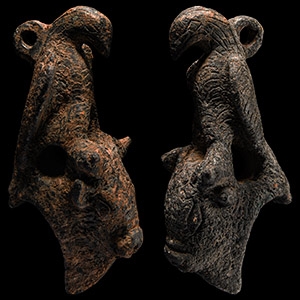
Roman Bronze Jupiter Dolichenus Eagle Pair
2nd-3rd century A.D.Sold for (Inc. bp): £910
The imperial birds modelled in the round, each standing on the head of a horned bull, wings partially spread; semi-naturalistic detailing to the head and feathers; suspension loop behind the neck. 487 grams total, 89-92 mm
Acquired in Europe before 1992.
The cult of Jupiter Dolichenus was a variant of worship of Zeus from Asia Minor whose mystery cult was widespread in the Roman Empire from the early 2nd to mid-3rd centuries A.D., especially in the military. The god is usually represented mounting a bull, with the double axe (labrys or bipennis) in his right raised hand, and dressed in the military attire of a Roman general. -
.jpg)
Roman Bronze Candelabrum Base with Dolphins
1st-2nd century A.D.Sold for (Inc. bp): £4,160
Tripod form with splayed legs, feet formed as scallops and legs as sinuous dolphins, scallops between the tails; central column with fixing spike. 980 grams, 19.5 cm
Ex old English collection. London art market, 1980s. This lot has been checked against the Interpol Database of stolen works of art and is accompanied by search certificate number no.11890-207744. -
.jpg)
Roman Bronze Military Diploma for Marona, son of Baddaus, a Soldier of Ala Bosporanorum
Dated 19th November 102 A.D.Sold for (Inc. bp): £4,940
Bifacial discharge plaque honesta missio, for a soldier from Commagene serving under Emperor Trajan; Side A: diplomatic text in fourteen lines of seriffed capitals: [IMPERATOR CAESAR DIVI NERVAE FILIVS NERVA TRAIANVS AVGVSTVS GERMANICVS DACICVS PONTIFEX MAXIMVS TRIBVNICIA POTESTATE VI IMPERATOR IIII CONSUL IIII PATER PATRIAE ... QUORUM NOMINA SUBSCRIPTA SUNT IPSIS LIBERIS POSTERISQUE EORVM CIVITATEM DEDIT ET CO] NUBIVM CVM UXORIBVS QVAS TVNC HABVISSENT CVM EST CIVITAS IIS DA- TA AVT SIQVI CELIBES ESSENT CVM IIS QUAS POSTEA DVXISSENT DVM- TAXAT SINGVLI SINGVLAS A (NTE) D(IEM) XIII K(ALENDAS) DECEMBR(ES) L(VCIO) ANTONIO ALBO M(ARCO) IVNIO HOMVLLO CO(N)S(VLIBVS) ALAE BOSPORANORVM CVI PRAEST C(AIVS) IVLIUS CAPITO GREGALI MARONAE BADDAEI F(ILIO) COMMAGEN(IENSI) DESCRIPT(VM) ET RECOGNIT(VM) EX TABVLA AENEA QVAE FIXA EST ROMAE Translation: The Emperor Caesar Nerva Traianus Augustus, conqueror of Germany, conqueror of Dacia, son of the deified Nerva, pontifex maximus, in his sixth year of tribunician power, four times acclaimed Imperator, four times consul, father of his country, has granted to the ones...whose names are written below, citizenship for themselves, their children and descendants, and the right of legal marriage with the wives they had when citizenship was granted to them, or, if any were unmarried, with those they later marry, but only a single one each. 19 November, in the consulships of Lucius Antonius Albus and Marcus Iunius Homullus (A.D. 102). To Marona, son of Baddaus, from Commagene, soldier of the Ala Bosporanorum, commanded by Gaius Iulius Capito. Copied and checked from the bronze tablet set up at Rome. Side B: tabulation in two columns of witness names in seriffed rustic capitals: L. TERENTI • NEPOTIS (Seal of) Lucius Terentius Nepos T. VILLI • [hole for sealing the document] HERACLIDES (Seal of) Titus Villus Heraclides A. LARCI • PHRONIMI (Seal of) A. Larcius Phronimus Q • AEMILI • SOTERICI (Seal of) Quintus Aemilius Sotericus P. CAVLI • VITALIS (Seal of) Publius Caulius Vitalis L. PVLLI • [hole for sealing the document]CHARITONIS (Seal of) Lucius Pullius Chariton P. ATINI • TROPHIMI (Seal of) Publius Atinius Trophimus 214 grams, 17 cm
Ex old English collection. London art market, 1980s. This lot has been checked against the Interpol Database of stolen works of art and is accompanied by search certificate number no.11858-207740.
In the 1st century the Ala Bosporanorum was camped near the Euphrates. It was stationed in Dacia in the 2nd century; stayed for a while in Vecel, from where it went to Maroskeresztúr, where stamped bricks of their building work appear. The unit was also stationed in upper Pannonia in 116 A.D. -
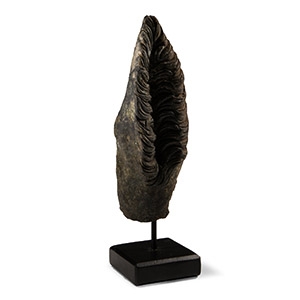
Larger Than Life-Size Roman Bronze Satyr's Ear
1st-3rd century A.D.Sold for (Inc. bp): £1,690
Probably from a colossal statue of Silenus or a satyr, detailed and naturalistic rendering of a left ear, conical shape with accurate depiction of the internal hair. 767 grams, 18.5 cm
Acquired in Europe before 1995. Private collection, Europe.
In the mythology of ancient Greece and in the Graeco-Roman literary world, satyrs were a community of beings who lived mostly in woods, surrounded by nature, and often together with nymphs. In the most ancient period they were imagined by the Greeks like Sileni, in human form, but with the ears, tail and sometimes hooves of horses. Seilenoi were depicted as fat, elderly, white-haired men, with snub noses, balding heads, and the ears and tails of asses. They were sometimes covered in fluffy white hair and occasionally sported a pair of ox horns.
