
Auction Highlights
-
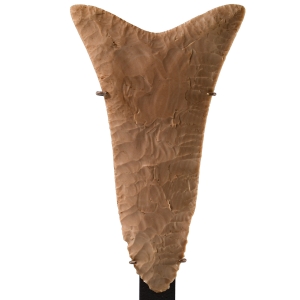
Egyptian Fishtail Flint Knife
Sold for (Inc. bp): £7,150
Knapped bifacial tan knife with fishtail butt to receive a hilt; the rounded tip tapering and flaring along the edges; with a custom-made display stand. -
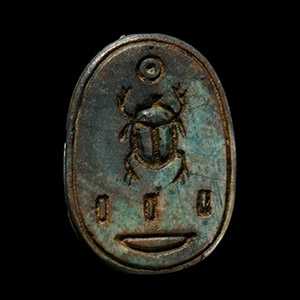
Egyptian Stone Scarab Inscribed for Tutankhamun
Sold for (Inc. bp): £6,500
Naturalistically modelled and coloured blue, hieroglyphs on base; pierced for suspension. -
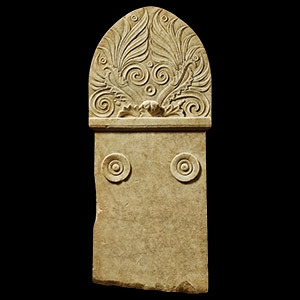
Greek Marble Funerary Anthemion Stele
Sold for (Inc. bp): £17,550
Comprising a tall, plain body with two rosettes; crowned by an elaborate palmette and volute design with shallow acanthus stalks and small rosettes; mounted on a custom-made display stand. -
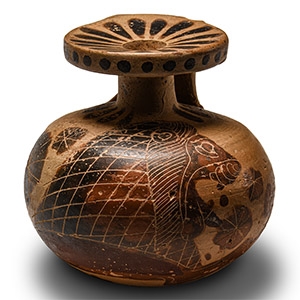
Corinthian Black-Figure Aryballos with a Lion
Sold for (Inc. bp): £3,900
The squat oil flask with slender neck and broad everted rim, painted with rosette petals around the mouth and base, spots encircling the rim, horizontal stipes to the strap handle, vegetal motifs and the forequarters of a roaring lion to one face of the body. -
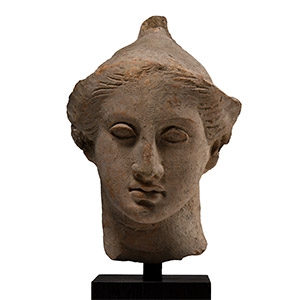
Greek Tarentine Terracotta Head of a Youth
Sold for (Inc. bp): £5,720
Possibly depicting Ganymede or Paris, wearing a soft Phrygian cap with everted brim, the hair swept back from the face; almond-shaped eyes with pronounced eyelids, straight nose and fleshy lips; mounted on a custom-made display stand. -
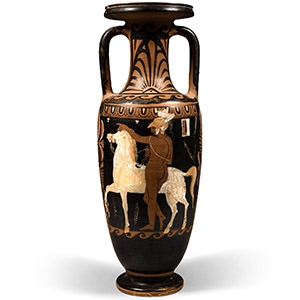
Campanian Red-Figure Neck-Amphora with Cavalryman
Sold for (Inc. bp): £10,400
The piriform body with broad, stepped rim and two round-section handles; red-figure frieze depicting two standing women facing, wearing a himation and stephane; the other side with a nude standing warrior wearing an Apulo-Corinthian helmet, holding the reins of his horse, acanthus leaves, ovolo and wave motifs to the neck and lower body; probably from a Cuma workshop. -
.jpg)
Hellenistic Gold Earrings with Lapis and Mother of Pearl
Sold for (Inc. bp): £19,500
Comprising a shallow disc with central flower motif inlaid with carnelian and lapis lazuli, surrounded by a beaded border, the outer pearled border inlaid with mostly replicant lapis lazuli, and mother of pearl inserts; three pendants to the lower edge, two with chain and carnelian bead, the central pendant formed as a miniature amphora with filigree, repaired; housed in a custom-made display box. -
.jpg)
Hellenistic Terracotta Head of a Youth
Sold for (Inc. bp): £18,200
Tousled curly hair, strong aquiline nose and full mouth; the deep eyes marked by raised eyelids and prominent semi-circular eyebrows; the hair arranged in overlapping rows of locks; repaired; mounted on a later porphyry plinth. -
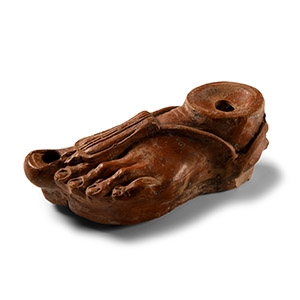
Roman Terracotta Foot Lamp
Sold for (Inc. bp): £3,380
Mould-made and shaped as a sandaled left foot, filling-hole surrounded by a ridge in the ankle area, the sandal with two leather straps tied together near the ankle, wick-hole in the big toe; inscription 'ƩΑΛΣΙϹ' to the base, heel chipped. -
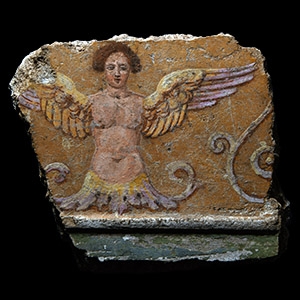
Roman Polychrome Wall Painting Fragment with Winged Siren
Sold for (Inc. bp): £20,800
Decorated with a frieze of partially preserved acanthus volutes from which emerges a figure of a winged female, possibly a siren, the body and the head of a woman with brown hair, the outstretched wings in pink and yellow; ochre background, cream-coloured line border with a green raised edge (part of the wall) below; mounted on a custom-made display stand. -
.jpg)
Neo-Assyrian Bronze Horse Trapping with Eagle-Headed God Nisroch and Winged Supernatural Figures
Sold for (Inc. bp): £15,600
The left side of a trapping for a horse pulling a chariot, comprising two hammered elements with a hinge; rectangular upper section with a loop to one end, decorated with an eagle-headed genius-demon, wearing a tunic and a fringed kilt, a shawl wrapped around the body, hanging down on the back, carrying a bucket of purifying water in his right hand and a conical pot of incense in his left hand, bracelets to arms, two rows of lotus buds above; the discoid lower section divided in two registers, each with a winged genii in combat with winged bulls; the dividing raised band with fish motifs similar to the border formed of fish; the edges of both elements with punched edges for the attachment of leather lining; Neo-Assyrian or Urartian; mounted on a custom-made display stand. -
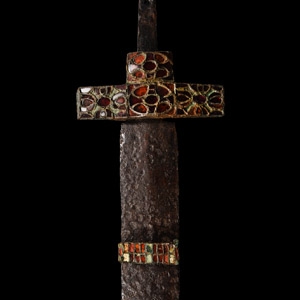
Migration Period Iron Sword with Garnet Cross Guard and Scabbard Fittings
Sold for (Inc. bp): £7,150
With a double-edged parallel-sided blade with broad pointed tip; the lower guard inlaid with garnet cloisonné divided into four segments; accompanied by a rectangular scabbard slide inlaid with two rows of garnets and other stone; and a part of a sheet-silver chape. -
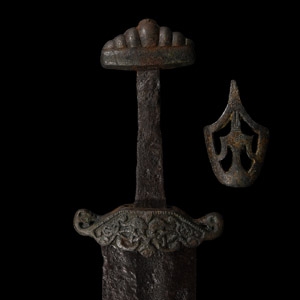
Viking Iron Sword with Cross Guard Surmounted by Interlaced Dragons
Sold for (Inc. bp): £8,450
Comprising a double-edged cutting blade with tapering fullers and hefty tang; the bronze cross guard in Jellinge style with dragon head finials and a central human face to the lower edge; the pommel with seven lobes; accompanied by a bronze openwork chape with central bird motif decorated with stamped ring-and-dot design. -
.jpg)
Bronze Age Gold Torc-Shaped Bracelet
Sold for (Inc. bp): £11,050
Of solid heavy penannular form, round in section with clubbed terminals. -
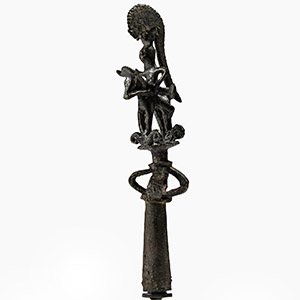
Iberian Celtic 'Axel Guttman' Bronze Warrior Finial
Sold for (Inc. bp): £13,000
With slightly tapering socket and openwork bulb above, discoid platform supporting a mounted warrior modelled in the round; horse with long vertical tail and horizontal reins, bowed legs and scrolls at the hooves; warrior astride the horse with legs bent and feet to the rear, helmet with lateral horns and large swept crest with notched edge; arms bent to show the warrior in the act of drawing his falcata sword from the scabbard worn across his midriff; mounted on a custom-made stand. -
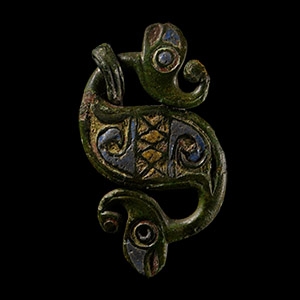
Very Large Celtic Enamelled Bronze Dragonesque Brooch
Sold for (Inc. bp): £4,420
S-shaped with scrolled flourishes to the dragon-head terminals, remains of inlaid blue and red enamelling to the stylised beast heads, wave and lozenge ornament to the body; free-running tongue with head coiled around the neck of one of the creatures; Romano-British. -
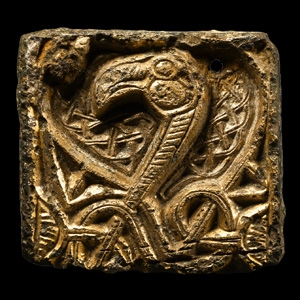
Anglo-Saxon Gilt Bronze Chip-Carved Beast Manuscript Mount
Sold for (Inc. bp): £3,380
With high-relief aviform head and wings and looped ornamental swags, knotwork panels in the field; two holes for mounting; possibly a book-mount, Hiberno-Saxon workmanship. -
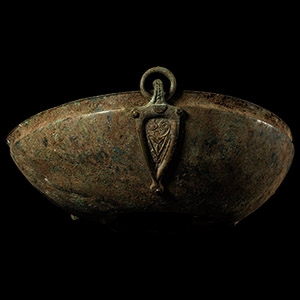
The High-Status 'Ryedale' Anglo-Saxon Bronze Hanging Bowl Complete with all Four Chip-Carved Mounts
Sold for (Inc. bp): £36,400
An excessively rare and almost complete copper-alloy hanging bowl and associated fittings comprising: (i) the bowl with three attached matching hooked escutcheons and suspension rings (ii) the basal disc (iii) a body fragment (or possible repair patch) (iv) a curved bronze fragment (ii) the basal disc with separate frame (iii) fragment of copper-alloy sheet, possibly forming part of a repair to the base of the bow (iv) a curved copper-alloy strip (iv) four skeletal fragments from a sheep or similar. -
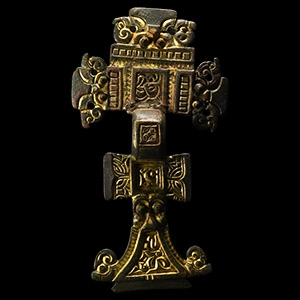
'The Scampton' Published Anglo-Saxon Gilt Bronze Florid Cruciform Brooch
Sold for (Inc. bp): £11,050
Of Martin's Group 4 with rectangular headplate and florid face-masks to the three edges and conical eyes, deep bow with with square central panel, footplate with square lateral lappets, triangular face-mask finial with conical eyes; pin-lug and catchplate to the reverse; gilded surface abraded. -
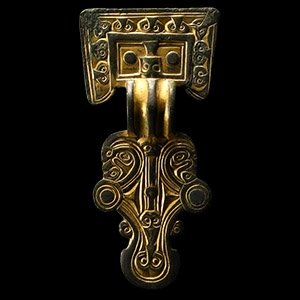
Superb Anglo-Saxon Gilt Bronze Great Square-Headed Brooch
Sold for (Inc. bp): £11,700
Of Hines's Group X with two discs on the headplate in a rectangular frame surrounded by a frieze of facing human masks, and another mask placed centrally above the junction with the bow; shallow bow with three ribs; curved horse-head lappets flanking a vertical shank with facing mask detailing, discoid lobes and an inverted mask below; pin-lugs to the reverse and solder-scar where the catchplate was attached. -
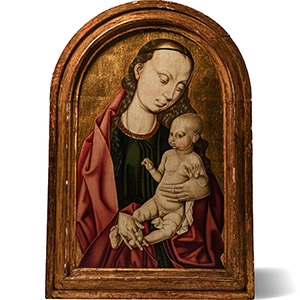
Medieval Virgin and Child by a Follower of Dirk Bouts
Sold for (Inc. bp): £11,700
Oil on board devotional panel in a gilt wooden frame; the Virgin in a bottle-green gown with gilt collar and cream undershift, crimson mantle; the naked Christ supported on his mother's left hip, his left foot clasped in the interleaved fingers of her right hand; textured gilt field; attributed to a follower of Dirk Bouts. -
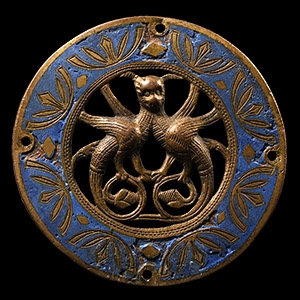
Medieval Limoges Bronze and Champleve Enamel Roundel with Fantastical Creature
Sold for (Inc. bp): £23,400
Openwork winged beast to the centre, its tails curling beneath the body creating the foliate tendrils on which it perches, broad outer roundel decorated with geometric plants alternating with lozenges, extensive remains of blue champlevé enamelling; engraved and chiselled; four attachment holes. -
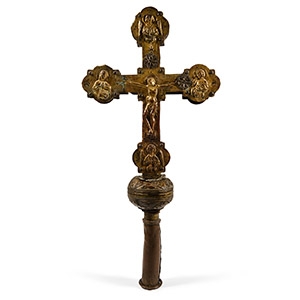
Medieval Gilt Bronze Processional Cross
Sold for (Inc. bp): £16,900
With wooden core to which the embossed sheets have been attached; the obverse with a central nimbate Corpus Christi, an applied rosette above and to the left arm; an angel to the finial of the upper and lower arm with Mary and St John the Evangelist to the side arms; the reverse with a central figure of Jesus holding the Gospel and making the sign of blessing; each finial of the arm with the symbols of the Evangelists (eagle, angel, lion and ox); the cross resting on a floral sphere with a socket below. -
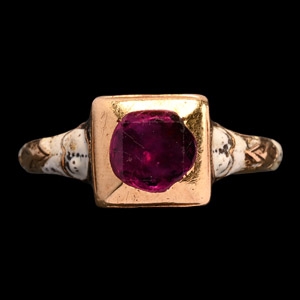
Baroque Gold, Ruby and Enamel Ring
Sold for (Inc. bp): £11,700
Composed of a slender hoop, expanding shoulders decorated with white enamelled foliage and black enamelled pea-pod ornament, repeated around the bezel, bezel with box setting holding a table-cut ruby, white and black enamelled floral design to the underside; minor loss of enamel; likely from France; accompanied by a 'Les Enluminures' hinged presentation box.
-
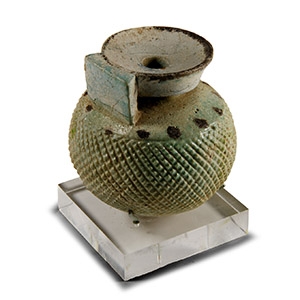
Greek Aryballos Perfume Jar
Circa 6th century B.C.Sold for (Inc. bp): £2,210
Bulbous-bodied with dished rim ad short strap handle, decorative painted trail to the lip, spots to the shoulder and incised cross-hatching to the lower body; accompanied by a custom-made display stand. 104 grams, 63 mm (149 grams total, 82 mm high including stand)
Ex Swiss private collection, C.A., Geneva (1961-2000). Thence in a French collection. with Charles Ede Limited, catalogue 183, item number 31, 2011. Accompanied by a copy of French cultural passport number 116789, dated 15 April 2010. Accompanied by a copy of an Art Loss Register certificate no.S00048851, dated 3 June 2011. -
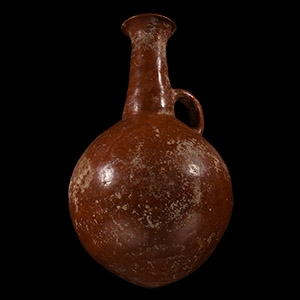
Cypriot Red Burnished Ware Pitcher
Bronze Age, 2300-1650 B.C.Sold for (Inc. bp): £2,340
With burnished surface, tall tapering neck and trumpet-shaped mouth, globular body, one loop handle at the shoulder. 3.4 kg, 42 cm high
From the collection of Dr Takey Crist, Jacksonville, North Carolina, acquired late 1980s. This lot has been checked against the Interpol Database of stolen works of art and is accompanied by search certificate number no.11854-207732. -
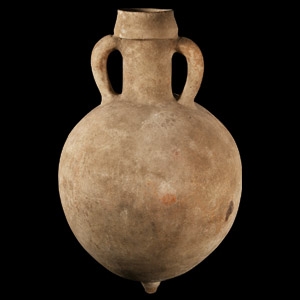
Very Large Greek Brindisi Type Terracotta Amphora
3rd-1st century B.C.Sold for (Inc. bp): £1,040
The wide piriform bodied storage vessel with cylindrical neck, inverted rim, two round-section handles and conical knop to base. 12.45 kg, 75 cm high
Ex. H.P. Payot, Clarens (VD, Switzerland) collection, by inheritance. This lot has been checked against the Interpol Database of stolen works of art and is accompanied by search certificate number no.11855-206531. -
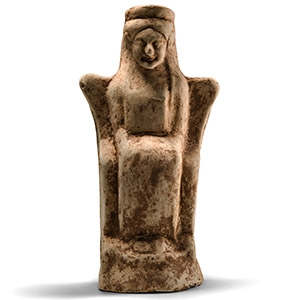
Archaic Greek Terracotta Seated Goddess
5th century B.C.Sold for (Inc. bp): £650
Represented in the typical female attire wearing a long chiton and a polos headgear; seated upon a throne with side horns, hands upon her knees; flat back. 413 grams, 18.5 cm
Acquired in Europe before 1996.
The typical 5th century B.C. terracotta female figurine was a standing or seated woman wearing a chiton and a himation. It usually represented the goddess Demeter, and it was a votive figure offered to the shrines or temples. Attica was one of the principal centres of figurine production, but Corinth continued to produce solid standing or seated females with moulded fronts and flat backs. -
.jpg)
Cypriot Terracotta Goddess Figurine
Late 2nd millennium B.C.Sold for (Inc. bp): £1,690
With columnar body and flared base, arms raised, applied domed breasts, pinched facial features with applied mouth and ears; applied band to the brow for the hair or headdress; remains of coral-pink painted detailing. 299 grams, 20.2 cm
From the collection of French scholar and diplomat Auguste Dozon (1822-1890). Subsequently Hotel Des Ventes Monte Carlo, 6th May 2018, lot 7. With French cultural property passport. -
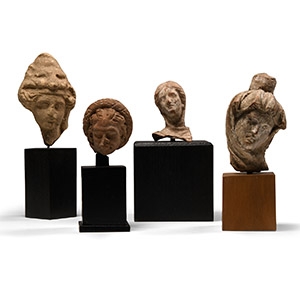
Greek Terracotta Head Collection
3rd-2nd century B.C.Sold for (Inc. bp): £1,690
Each modelled in the round and and derived from a larger female figure, some wearing diadems and some with draped heads; each mounted on a custom-made display base. 491 grams total, 9.5-13.5 cm high including stand
Acquired in the 1970s. Ex European private collection. This lot has been checked against the Interpol Database of stolen works of art and is accompanied by search certificate no.11795-206534.
These figurines reflect sculptural prototypes. Interestingly the head of one of the women is draped in a himation, and the head is turned slightly to the right like the terracotta of Amisos which represents a dancer. These figurines were most probably manufactured in Hellenistic cities by craftsmen who used either light yellow or dark brown clay. After the firing, the surface of the clay became reddish, while the core became grey-brown. The majority of the figurines were made from untreated clay with many impurities, such as coarse grain. Due to the quality of the clay the surface of the figurines was often rugged, despite the retouch, but were painted with vivid colours, as is still visible on the pink polos on one of the heads. -
Hellenistic Terracotta Head of a Youth
3rd century B.C.Sold for (Inc. bp): £18,200
Tousled curly hair, strong aquiline nose and full mouth; the deep eyes marked by raised eyelids and prominent semi-circular eyebrows; the hair arranged in overlapping rows of locks; repaired; mounted on a later porphyry plinth. 1.40 kg total, 23.5 cm high including stand
From the estates of the late Adrian Stanford and Norman St John-Stevas, Baron St John of Fawsley. with the previous owner since 1982. with Christie's, London, South Kensington, 22 February 2017, lot 10. Accompanied by an academic report by Dr Raffaele D’Amato. This lot has been checked against the Interpol Database of stolen works of art and is accompanied by search certificate number no.11774-204595.
The head represents a Hellenistic portrait of a young man, whose characteristics seem to suggest a reference to a youthful portrait of Alexander the Great. Another possibility is that it represents the portrait of Alexander’s companion, Hephaestion. -
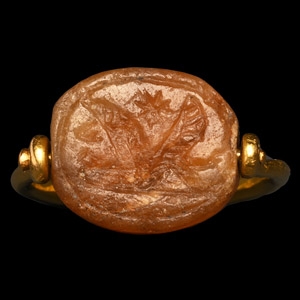
Graeco-Phoenician Stone Scaraboid with Winged Beast in Gold Swivel Ring
Circa 7th-5th century B.C.Sold for (Inc. bp): £546
The scaraboid engraved to one face with a winged creature facing left, possibly a gryphon, a star in the field above; set in a later gold ring with round cross-section and stamped maker's mark in a triangular cartouche; articulate swivel. 7.68 grams, 30.50 mm overall, 20.15 mm internal diameter (approximate size British T 1/2, USA 9 3/4, Europe 21.89, Japan 21)
Collected since the 1970s. Ex Everitt collection, acquired by descent 2017. -
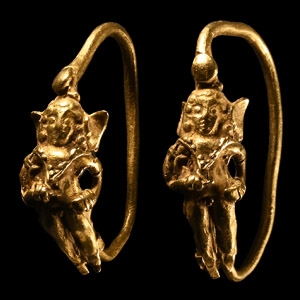
Greek Gold Eros Earrings
3rd-2nd century B.C.Sold for (Inc. bp): £598
Each composed of a slender wire hoop and a winged Eros plaque with detailing to the body, face and hair; closure loop to reverse. 3.24 grams total, 21 mm each
Acquired 1980-2015. Ex Abelita family collection. -
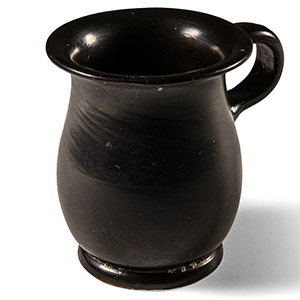
Greek High-Glazed Black Ware Mug
4th-3rd century B.C.Sold for (Inc. bp): £1,820
With flared base, bulbous body. tapering shoulder and flared mouth with everted rim, loop handle. 69 grams, 71 mm
Private collection, Sussex, UK; acquired 1975-1990. -
.jpg)
Attic Red-Figure Fragment Attributed to the Thaliarchos Painter
5th century B.C.Sold for (Inc. bp): £702
Comprising the bottom part of a cup-skyphos or pyxis, decorated with concentric circles in red and black, the internal part painted with the image of a young athlete, wrapped in a short chlamys and leaning upon his staff, the ground represented as a concave space. 95 grams, 12.5 cm
Acquired in Europe before 1990. This lot has been checked against the Interpol Database of stolen works of art and is accompanied by search certificate no.11810-206516.
The everyday life of ancient Greeks is well represented on the Attic red figure paintings. The short cloak (chlamys) is the favourite garment for the men and the hair of the younger men is more often shown cropped than in the black Attic figure paintings. The nakedness of youths exercising at the palaistra could well have been an important source of inspiration for the Greek artists who were becoming increasingly aware of the possibilities to represent the physiology of subtle movement in paintings. The Thaliarchos painter is generally recognised as the artist of the tops of some powder-box pyxides, although it is not excluded that he was actively painting various types of vessels. The type of ground and the way in which the foot of the man is worked can support the thesis that the fragment is from his workshop. -
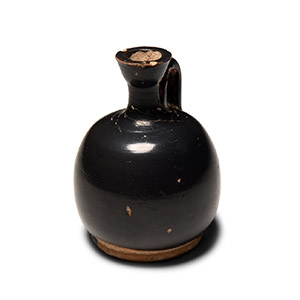
Greek Black-Glazed Lekythos
5th century B.C.Sold for (Inc. bp): £572
Squat-bodied with a slender neck, shaped neck and D-section handle. 47 grams, 66 mm
Acquired in Europe before 2001. European collection.
