
Auction Highlights
-
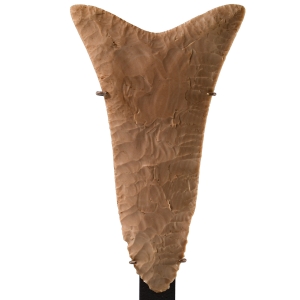
Egyptian Fishtail Flint Knife
Sold for (Inc. bp): £7,150
Knapped bifacial tan knife with fishtail butt to receive a hilt; the rounded tip tapering and flaring along the edges; with a custom-made display stand. -
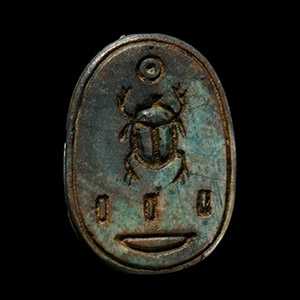
Egyptian Stone Scarab Inscribed for Tutankhamun
Sold for (Inc. bp): £6,500
Naturalistically modelled and coloured blue, hieroglyphs on base; pierced for suspension. -
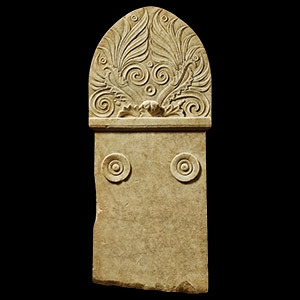
Greek Marble Funerary Anthemion Stele
Sold for (Inc. bp): £17,550
Comprising a tall, plain body with two rosettes; crowned by an elaborate palmette and volute design with shallow acanthus stalks and small rosettes; mounted on a custom-made display stand. -
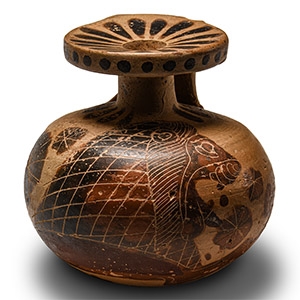
Corinthian Black-Figure Aryballos with a Lion
Sold for (Inc. bp): £3,900
The squat oil flask with slender neck and broad everted rim, painted with rosette petals around the mouth and base, spots encircling the rim, horizontal stipes to the strap handle, vegetal motifs and the forequarters of a roaring lion to one face of the body. -
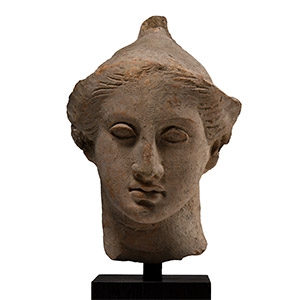
Greek Tarentine Terracotta Head of a Youth
Sold for (Inc. bp): £5,720
Possibly depicting Ganymede or Paris, wearing a soft Phrygian cap with everted brim, the hair swept back from the face; almond-shaped eyes with pronounced eyelids, straight nose and fleshy lips; mounted on a custom-made display stand. -
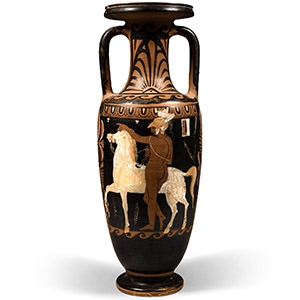
Campanian Red-Figure Neck-Amphora with Cavalryman
Sold for (Inc. bp): £10,400
The piriform body with broad, stepped rim and two round-section handles; red-figure frieze depicting two standing women facing, wearing a himation and stephane; the other side with a nude standing warrior wearing an Apulo-Corinthian helmet, holding the reins of his horse, acanthus leaves, ovolo and wave motifs to the neck and lower body; probably from a Cuma workshop. -
.jpg)
Hellenistic Gold Earrings with Lapis and Mother of Pearl
Sold for (Inc. bp): £19,500
Comprising a shallow disc with central flower motif inlaid with carnelian and lapis lazuli, surrounded by a beaded border, the outer pearled border inlaid with mostly replicant lapis lazuli, and mother of pearl inserts; three pendants to the lower edge, two with chain and carnelian bead, the central pendant formed as a miniature amphora with filigree, repaired; housed in a custom-made display box. -
.jpg)
Hellenistic Terracotta Head of a Youth
Sold for (Inc. bp): £18,200
Tousled curly hair, strong aquiline nose and full mouth; the deep eyes marked by raised eyelids and prominent semi-circular eyebrows; the hair arranged in overlapping rows of locks; repaired; mounted on a later porphyry plinth. -
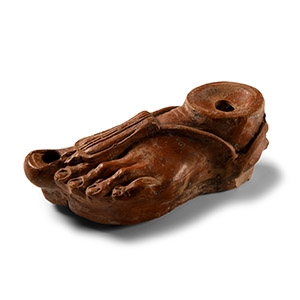
Roman Terracotta Foot Lamp
Sold for (Inc. bp): £3,380
Mould-made and shaped as a sandaled left foot, filling-hole surrounded by a ridge in the ankle area, the sandal with two leather straps tied together near the ankle, wick-hole in the big toe; inscription 'ƩΑΛΣΙϹ' to the base, heel chipped. -
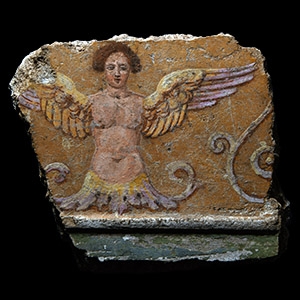
Roman Polychrome Wall Painting Fragment with Winged Siren
Sold for (Inc. bp): £20,800
Decorated with a frieze of partially preserved acanthus volutes from which emerges a figure of a winged female, possibly a siren, the body and the head of a woman with brown hair, the outstretched wings in pink and yellow; ochre background, cream-coloured line border with a green raised edge (part of the wall) below; mounted on a custom-made display stand. -
.jpg)
Neo-Assyrian Bronze Horse Trapping with Eagle-Headed God Nisroch and Winged Supernatural Figures
Sold for (Inc. bp): £15,600
The left side of a trapping for a horse pulling a chariot, comprising two hammered elements with a hinge; rectangular upper section with a loop to one end, decorated with an eagle-headed genius-demon, wearing a tunic and a fringed kilt, a shawl wrapped around the body, hanging down on the back, carrying a bucket of purifying water in his right hand and a conical pot of incense in his left hand, bracelets to arms, two rows of lotus buds above; the discoid lower section divided in two registers, each with a winged genii in combat with winged bulls; the dividing raised band with fish motifs similar to the border formed of fish; the edges of both elements with punched edges for the attachment of leather lining; Neo-Assyrian or Urartian; mounted on a custom-made display stand. -
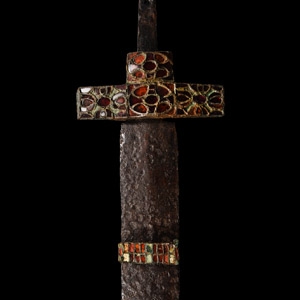
Migration Period Iron Sword with Garnet Cross Guard and Scabbard Fittings
Sold for (Inc. bp): £7,150
With a double-edged parallel-sided blade with broad pointed tip; the lower guard inlaid with garnet cloisonné divided into four segments; accompanied by a rectangular scabbard slide inlaid with two rows of garnets and other stone; and a part of a sheet-silver chape. -
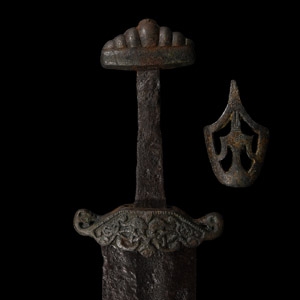
Viking Iron Sword with Cross Guard Surmounted by Interlaced Dragons
Sold for (Inc. bp): £8,450
Comprising a double-edged cutting blade with tapering fullers and hefty tang; the bronze cross guard in Jellinge style with dragon head finials and a central human face to the lower edge; the pommel with seven lobes; accompanied by a bronze openwork chape with central bird motif decorated with stamped ring-and-dot design. -
.jpg)
Bronze Age Gold Torc-Shaped Bracelet
Sold for (Inc. bp): £11,050
Of solid heavy penannular form, round in section with clubbed terminals. -
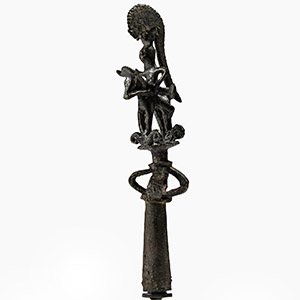
Iberian Celtic 'Axel Guttman' Bronze Warrior Finial
Sold for (Inc. bp): £13,000
With slightly tapering socket and openwork bulb above, discoid platform supporting a mounted warrior modelled in the round; horse with long vertical tail and horizontal reins, bowed legs and scrolls at the hooves; warrior astride the horse with legs bent and feet to the rear, helmet with lateral horns and large swept crest with notched edge; arms bent to show the warrior in the act of drawing his falcata sword from the scabbard worn across his midriff; mounted on a custom-made stand. -
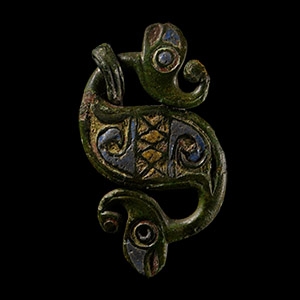
Very Large Celtic Enamelled Bronze Dragonesque Brooch
Sold for (Inc. bp): £4,420
S-shaped with scrolled flourishes to the dragon-head terminals, remains of inlaid blue and red enamelling to the stylised beast heads, wave and lozenge ornament to the body; free-running tongue with head coiled around the neck of one of the creatures; Romano-British. -
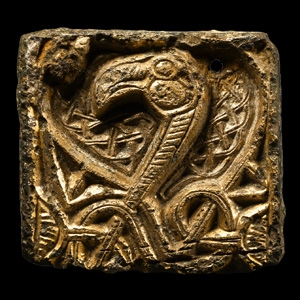
Anglo-Saxon Gilt Bronze Chip-Carved Beast Manuscript Mount
Sold for (Inc. bp): £3,380
With high-relief aviform head and wings and looped ornamental swags, knotwork panels in the field; two holes for mounting; possibly a book-mount, Hiberno-Saxon workmanship. -
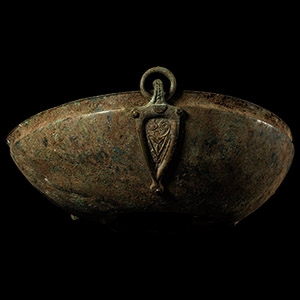
The High-Status 'Ryedale' Anglo-Saxon Bronze Hanging Bowl Complete with all Four Chip-Carved Mounts
Sold for (Inc. bp): £36,400
An excessively rare and almost complete copper-alloy hanging bowl and associated fittings comprising: (i) the bowl with three attached matching hooked escutcheons and suspension rings (ii) the basal disc (iii) a body fragment (or possible repair patch) (iv) a curved bronze fragment (ii) the basal disc with separate frame (iii) fragment of copper-alloy sheet, possibly forming part of a repair to the base of the bow (iv) a curved copper-alloy strip (iv) four skeletal fragments from a sheep or similar. -
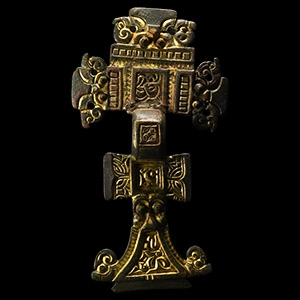
'The Scampton' Published Anglo-Saxon Gilt Bronze Florid Cruciform Brooch
Sold for (Inc. bp): £11,050
Of Martin's Group 4 with rectangular headplate and florid face-masks to the three edges and conical eyes, deep bow with with square central panel, footplate with square lateral lappets, triangular face-mask finial with conical eyes; pin-lug and catchplate to the reverse; gilded surface abraded. -
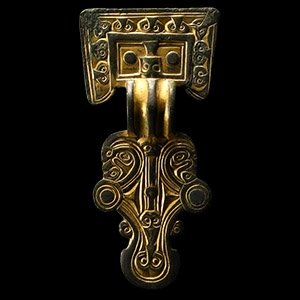
Superb Anglo-Saxon Gilt Bronze Great Square-Headed Brooch
Sold for (Inc. bp): £11,700
Of Hines's Group X with two discs on the headplate in a rectangular frame surrounded by a frieze of facing human masks, and another mask placed centrally above the junction with the bow; shallow bow with three ribs; curved horse-head lappets flanking a vertical shank with facing mask detailing, discoid lobes and an inverted mask below; pin-lugs to the reverse and solder-scar where the catchplate was attached. -
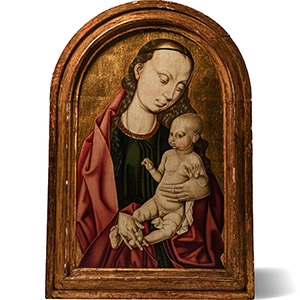
Medieval Virgin and Child by a Follower of Dirk Bouts
Sold for (Inc. bp): £11,700
Oil on board devotional panel in a gilt wooden frame; the Virgin in a bottle-green gown with gilt collar and cream undershift, crimson mantle; the naked Christ supported on his mother's left hip, his left foot clasped in the interleaved fingers of her right hand; textured gilt field; attributed to a follower of Dirk Bouts. -
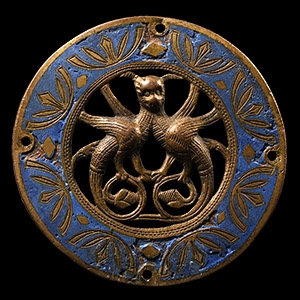
Medieval Limoges Bronze and Champleve Enamel Roundel with Fantastical Creature
Sold for (Inc. bp): £23,400
Openwork winged beast to the centre, its tails curling beneath the body creating the foliate tendrils on which it perches, broad outer roundel decorated with geometric plants alternating with lozenges, extensive remains of blue champlevé enamelling; engraved and chiselled; four attachment holes. -
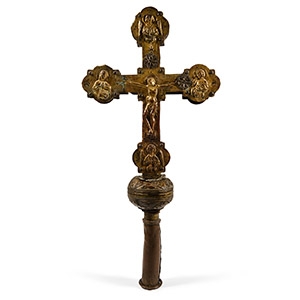
Medieval Gilt Bronze Processional Cross
Sold for (Inc. bp): £16,900
With wooden core to which the embossed sheets have been attached; the obverse with a central nimbate Corpus Christi, an applied rosette above and to the left arm; an angel to the finial of the upper and lower arm with Mary and St John the Evangelist to the side arms; the reverse with a central figure of Jesus holding the Gospel and making the sign of blessing; each finial of the arm with the symbols of the Evangelists (eagle, angel, lion and ox); the cross resting on a floral sphere with a socket below. -
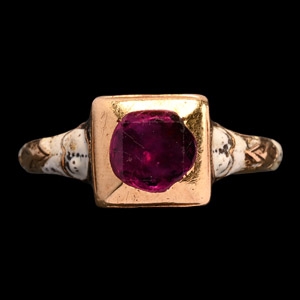
Baroque Gold, Ruby and Enamel Ring
Sold for (Inc. bp): £11,700
Composed of a slender hoop, expanding shoulders decorated with white enamelled foliage and black enamelled pea-pod ornament, repeated around the bezel, bezel with box setting holding a table-cut ruby, white and black enamelled floral design to the underside; minor loss of enamel; likely from France; accompanied by a 'Les Enluminures' hinged presentation box.
-
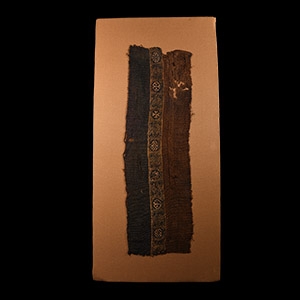
Egyptian Mounted Coptic Textile
Circa 7th-8th century A.D.Sold for (Inc. bp): £78
The fragment of a vertical band (clavus) from a tunic (probably an ecclesiastic garment), woven in linen and wool, the central segment embroidered with polygonal patterns and arabesques, with four crosses inscribed in rhomboids, alternating with floral motifs, edged with two plain bands in dark green and medium brown, probably part of the original garment to which the band was applied. 185 grams, 58 x 27 cm
Acquired 1970s-1996. Property of a North American collector. London collection, 2016.
Yellow wool and linen. In this period, when Egypt passed from Roman to Arabian rule, the garments were still conspicuously decorated with stylised foliage, arabesques and meanders, geometric figures, often made in yellow or white wool over a linen background. -
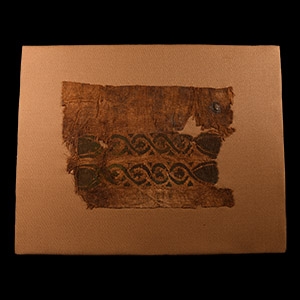
Egyptian Mounted Coptic Textile
Circa 6th-7th century A.D.Sold for (Inc. bp): £39
Comprising a pair of simple segmenta on a woven background, formed of a spiral line surrounding floral images, closed at both ends by a pair of petals. 121 grams, 38 x 30 cm
Acquired 1970s-1996. Property of a North American collector. London collection, 2016.
The textile shows a pair of segmenta, probably from a sleeve of a linen tunic. The wool here seems to be Z-spun, a spin direction not very common in Roman Egypt and suggesting that the spun yarn may have been traded from another province of the empire. Frequently, like in our case, the wool is purple in hue. -
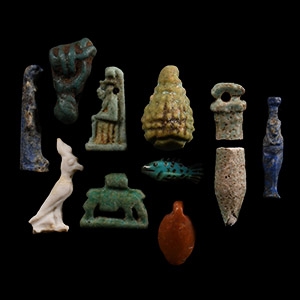
Egyptian Hardstone and Faience Amulet Collection
Late Period, 664-332 B.C.Sold for (Inc. bp): £468
Including red jasper heart ib, bunch of grapes, seated Hathor, Horus falcon, a sow, hand in 'fica' gesture, tilapia fish and other types. 10.8 grams total, 13-25 mm
Acquired 1970s-1996. Property of a North American collector. London collection, 2016. -
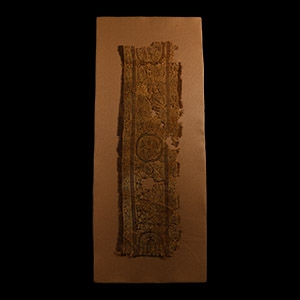
Egyptian Mounted Coptic Textile with Running Hounds
Circa 6th-7th century A.D.Sold for (Inc. bp): £104
Comprising a large fragment with a vertical band (clavus) from a garment, woven in linen and green, blue, yellow and red wool, embroidered with circular patterns filled with vegetal figures and arabesques, alternating with two parallel rows of running animals (hounds?), edged by a red border, a further band of foliage decoration. 163 grams, 59 x 24.5 cm
Acquired 1970s-1996. Property of a North American collector. London collection, 2016.
Tapestry technique on natural linen. It is highly probable that this tapestry was part of a long decorated tunic, a clavus running vertically on the breast and on the back of it, and having a parallel clavus on the other side. Tunic decoration conformed to a specific layout with the back mirroring the front. Matching bands called clavi ran on either side of the neck. They could be full length, like our specimen, or stop above the waistline. -
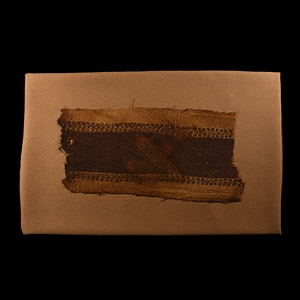
Egyptian Mounted Coptic Textile
Circa 5th-6th century A.D.Sold for (Inc. bp): £33
The decorative border from a garment (cloak?), wool weaving on linen and purple, tendril pattern; the wide, undecorated central red purple panel framed with purple wavy tendrils with arrowhead-shaped leaves. 131 grams, 41.5 x 26 cm
Acquired 1970s-1996. Property of a North American collector. London collection, 2016.
Cloaks and mantles were the main type of outer garments worn by men in late antiquity. They are mentioned in the sources under a variety of names: birrus, caracallus,cucullus, lacerna, sagum, paenula and paludamentum. Unfortunately, despite the fact that cloaks were such important garments they are preserved in far fewer numbers from burials in Egypt than tunics, except as fragments. -
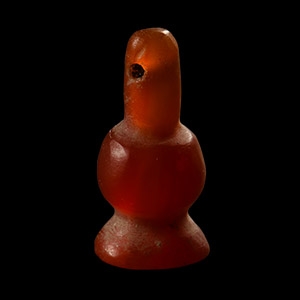
Egyptian Orange Carnelian Poppy Head Amulet
New Kingdom, 18th Dynasty, 1550-1292 B.C.Sold for (Inc. bp): £85
Polished and with an integral pierced suspension loop. 0.59 grams, 13 mm
UK gallery, early 2000s. -
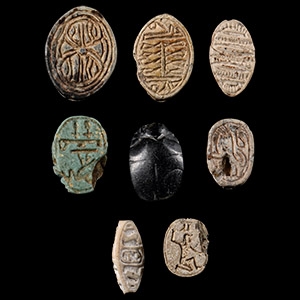
Egyptian Hardstone and Faience Scarab Collection
Late Period, 664-332 B.C.Sold for (Inc. bp): £286
Including hieroglyphic text, figural imagery and geometric designs to the underside. 11.3 grams total, 12-19 mm
Acquired 1970s-1996. Property of a North American collector. London collection, 2016. -
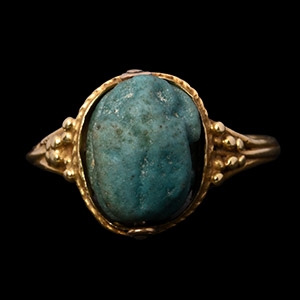
Egyptian Faience Scarab in Gold Swivel Ring
Second Intermediate Period, circa 1650 B.C.Sold for (Inc. bp): £468
With flared shoulders and granulation detailing, applied filigree band, turquoise-coloured faience scarab in swivel mount, hieroglyphs to the underside. 1.88 grams, 23.40 mm overall, 15.97 mm internal diameter (approximate size British K 1/2, USA 5 1/2, Europe 10.58, Japan 10)
From a family collection formed 1900-1950; by descent circa 1980. -
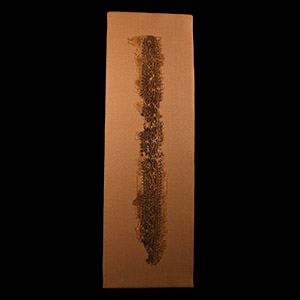
Egyptian Mounted Coptic Textile with Vines
Circa 6th-7th century A.D.Sold for (Inc. bp): £46
Composed of a clavus decorated with grape leaves and vine shoots in light yellow colour upon a purple background, with two bunches of grapes marked in green, the frame formed of a double line surrounded externally by a minute recurring spiral. 111 grams, 58 x 18.5 cm
Acquired 1970s-1996. Property of a North American collector. London collection, 2016.
Tapestry technique on natural light yellow wool upon linen. It is highly probable that this tapestry was part of a tunic decoration, a clavus, running vertically on the breast and on the back of it. -
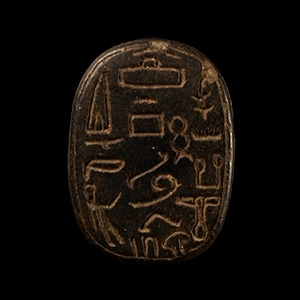
Large Egyptian Hardstone Scarab with Hieroglyphs
Late Period, 664-323 B.C. or laterSold for (Inc. bp): £442
Carved with semi-naturalistic anatomical detailing; shallow engraved hieroglyphs to the base. 8.7 grams, 24 mm
From an early 20th century collection, Carnavon, North Wales, UK. -
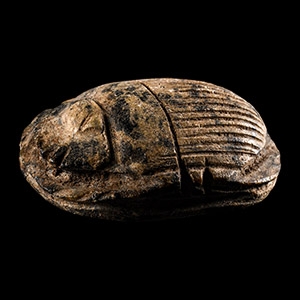
Egyptian Hardstone Scarab
Late Period, 664-332 B.C.Sold for (Inc. bp): £247
With detailed mouth and hatched carapace. 13.8 grams, 34 mm
Acquired 1970s-1996. Property of a North American collector. London collection, 2016. -
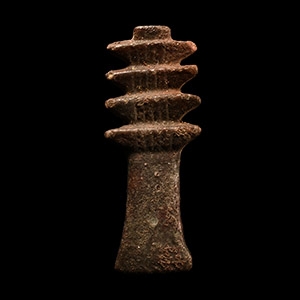
Egyptian Faience Djed Pillar Amulet
Late Period, 664-323 B.C.Sold for (Inc. bp): £91
Decorated with a brown glaze; pierced pillar to reverse for suspension. 3.52 grams, 36 mm
From an early 20th century collection, Carnavon, North Wales, UK.
Associated with the god Osiris.
