
Auction Highlights
-
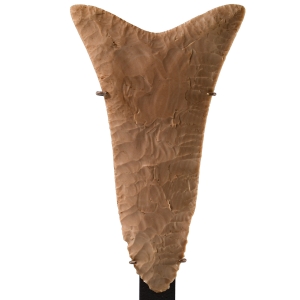
Egyptian Fishtail Flint Knife
Sold for (Inc. bp): £7,150
Knapped bifacial tan knife with fishtail butt to receive a hilt; the rounded tip tapering and flaring along the edges; with a custom-made display stand. -
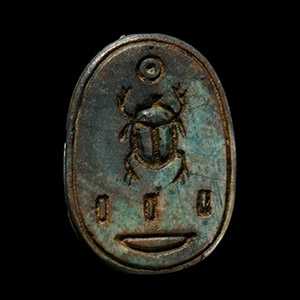
Egyptian Stone Scarab Inscribed for Tutankhamun
Sold for (Inc. bp): £6,500
Naturalistically modelled and coloured blue, hieroglyphs on base; pierced for suspension. -
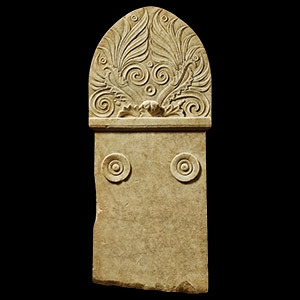
Greek Marble Funerary Anthemion Stele
Sold for (Inc. bp): £17,550
Comprising a tall, plain body with two rosettes; crowned by an elaborate palmette and volute design with shallow acanthus stalks and small rosettes; mounted on a custom-made display stand. -
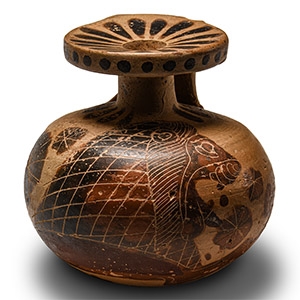
Corinthian Black-Figure Aryballos with a Lion
Sold for (Inc. bp): £3,900
The squat oil flask with slender neck and broad everted rim, painted with rosette petals around the mouth and base, spots encircling the rim, horizontal stipes to the strap handle, vegetal motifs and the forequarters of a roaring lion to one face of the body. -
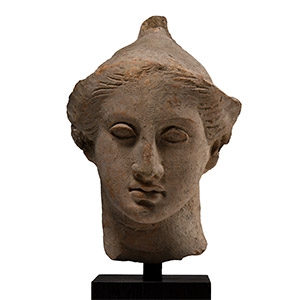
Greek Tarentine Terracotta Head of a Youth
Sold for (Inc. bp): £5,720
Possibly depicting Ganymede or Paris, wearing a soft Phrygian cap with everted brim, the hair swept back from the face; almond-shaped eyes with pronounced eyelids, straight nose and fleshy lips; mounted on a custom-made display stand. -
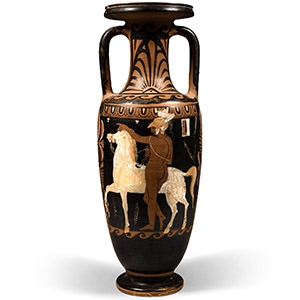
Campanian Red-Figure Neck-Amphora with Cavalryman
Sold for (Inc. bp): £10,400
The piriform body with broad, stepped rim and two round-section handles; red-figure frieze depicting two standing women facing, wearing a himation and stephane; the other side with a nude standing warrior wearing an Apulo-Corinthian helmet, holding the reins of his horse, acanthus leaves, ovolo and wave motifs to the neck and lower body; probably from a Cuma workshop. -
.jpg)
Hellenistic Gold Earrings with Lapis and Mother of Pearl
Sold for (Inc. bp): £19,500
Comprising a shallow disc with central flower motif inlaid with carnelian and lapis lazuli, surrounded by a beaded border, the outer pearled border inlaid with mostly replicant lapis lazuli, and mother of pearl inserts; three pendants to the lower edge, two with chain and carnelian bead, the central pendant formed as a miniature amphora with filigree, repaired; housed in a custom-made display box. -
.jpg)
Hellenistic Terracotta Head of a Youth
Sold for (Inc. bp): £18,200
Tousled curly hair, strong aquiline nose and full mouth; the deep eyes marked by raised eyelids and prominent semi-circular eyebrows; the hair arranged in overlapping rows of locks; repaired; mounted on a later porphyry plinth. -
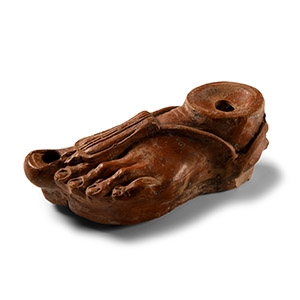
Roman Terracotta Foot Lamp
Sold for (Inc. bp): £3,380
Mould-made and shaped as a sandaled left foot, filling-hole surrounded by a ridge in the ankle area, the sandal with two leather straps tied together near the ankle, wick-hole in the big toe; inscription 'ƩΑΛΣΙϹ' to the base, heel chipped. -
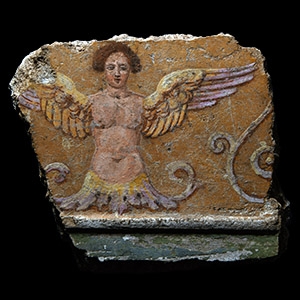
Roman Polychrome Wall Painting Fragment with Winged Siren
Sold for (Inc. bp): £20,800
Decorated with a frieze of partially preserved acanthus volutes from which emerges a figure of a winged female, possibly a siren, the body and the head of a woman with brown hair, the outstretched wings in pink and yellow; ochre background, cream-coloured line border with a green raised edge (part of the wall) below; mounted on a custom-made display stand. -
.jpg)
Neo-Assyrian Bronze Horse Trapping with Eagle-Headed God Nisroch and Winged Supernatural Figures
Sold for (Inc. bp): £15,600
The left side of a trapping for a horse pulling a chariot, comprising two hammered elements with a hinge; rectangular upper section with a loop to one end, decorated with an eagle-headed genius-demon, wearing a tunic and a fringed kilt, a shawl wrapped around the body, hanging down on the back, carrying a bucket of purifying water in his right hand and a conical pot of incense in his left hand, bracelets to arms, two rows of lotus buds above; the discoid lower section divided in two registers, each with a winged genii in combat with winged bulls; the dividing raised band with fish motifs similar to the border formed of fish; the edges of both elements with punched edges for the attachment of leather lining; Neo-Assyrian or Urartian; mounted on a custom-made display stand. -
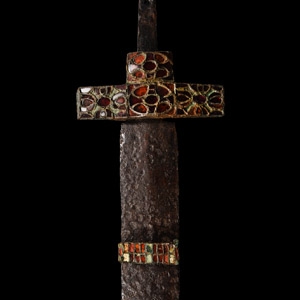
Migration Period Iron Sword with Garnet Cross Guard and Scabbard Fittings
Sold for (Inc. bp): £7,150
With a double-edged parallel-sided blade with broad pointed tip; the lower guard inlaid with garnet cloisonné divided into four segments; accompanied by a rectangular scabbard slide inlaid with two rows of garnets and other stone; and a part of a sheet-silver chape. -
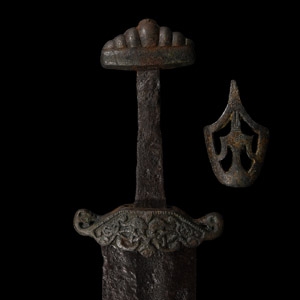
Viking Iron Sword with Cross Guard Surmounted by Interlaced Dragons
Sold for (Inc. bp): £8,450
Comprising a double-edged cutting blade with tapering fullers and hefty tang; the bronze cross guard in Jellinge style with dragon head finials and a central human face to the lower edge; the pommel with seven lobes; accompanied by a bronze openwork chape with central bird motif decorated with stamped ring-and-dot design. -
.jpg)
Bronze Age Gold Torc-Shaped Bracelet
Sold for (Inc. bp): £11,050
Of solid heavy penannular form, round in section with clubbed terminals. -
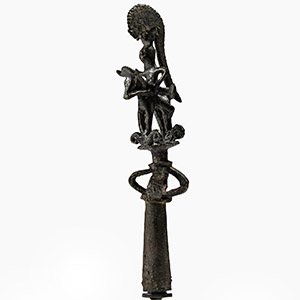
Iberian Celtic 'Axel Guttman' Bronze Warrior Finial
Sold for (Inc. bp): £13,000
With slightly tapering socket and openwork bulb above, discoid platform supporting a mounted warrior modelled in the round; horse with long vertical tail and horizontal reins, bowed legs and scrolls at the hooves; warrior astride the horse with legs bent and feet to the rear, helmet with lateral horns and large swept crest with notched edge; arms bent to show the warrior in the act of drawing his falcata sword from the scabbard worn across his midriff; mounted on a custom-made stand. -
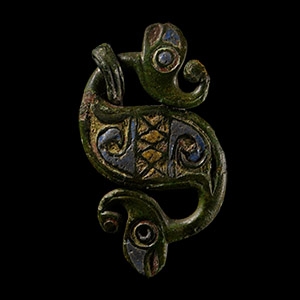
Very Large Celtic Enamelled Bronze Dragonesque Brooch
Sold for (Inc. bp): £4,420
S-shaped with scrolled flourishes to the dragon-head terminals, remains of inlaid blue and red enamelling to the stylised beast heads, wave and lozenge ornament to the body; free-running tongue with head coiled around the neck of one of the creatures; Romano-British. -
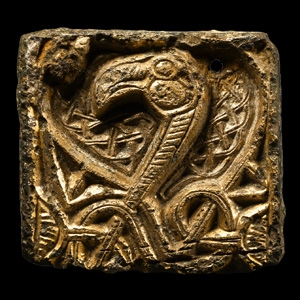
Anglo-Saxon Gilt Bronze Chip-Carved Beast Manuscript Mount
Sold for (Inc. bp): £3,380
With high-relief aviform head and wings and looped ornamental swags, knotwork panels in the field; two holes for mounting; possibly a book-mount, Hiberno-Saxon workmanship. -
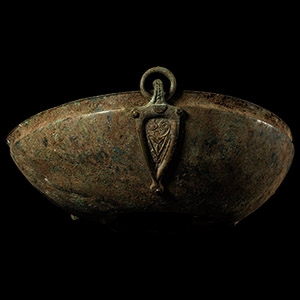
The High-Status 'Ryedale' Anglo-Saxon Bronze Hanging Bowl Complete with all Four Chip-Carved Mounts
Sold for (Inc. bp): £36,400
An excessively rare and almost complete copper-alloy hanging bowl and associated fittings comprising: (i) the bowl with three attached matching hooked escutcheons and suspension rings (ii) the basal disc (iii) a body fragment (or possible repair patch) (iv) a curved bronze fragment (ii) the basal disc with separate frame (iii) fragment of copper-alloy sheet, possibly forming part of a repair to the base of the bow (iv) a curved copper-alloy strip (iv) four skeletal fragments from a sheep or similar. -
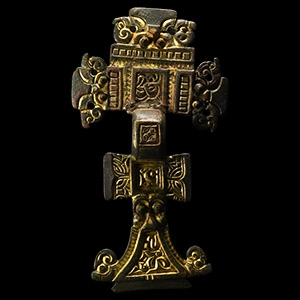
'The Scampton' Published Anglo-Saxon Gilt Bronze Florid Cruciform Brooch
Sold for (Inc. bp): £11,050
Of Martin's Group 4 with rectangular headplate and florid face-masks to the three edges and conical eyes, deep bow with with square central panel, footplate with square lateral lappets, triangular face-mask finial with conical eyes; pin-lug and catchplate to the reverse; gilded surface abraded. -
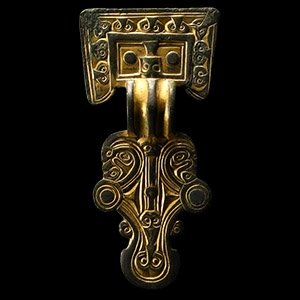
Superb Anglo-Saxon Gilt Bronze Great Square-Headed Brooch
Sold for (Inc. bp): £11,700
Of Hines's Group X with two discs on the headplate in a rectangular frame surrounded by a frieze of facing human masks, and another mask placed centrally above the junction with the bow; shallow bow with three ribs; curved horse-head lappets flanking a vertical shank with facing mask detailing, discoid lobes and an inverted mask below; pin-lugs to the reverse and solder-scar where the catchplate was attached. -
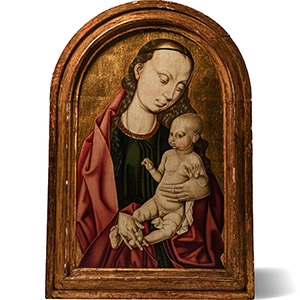
Medieval Virgin and Child by a Follower of Dirk Bouts
Sold for (Inc. bp): £11,700
Oil on board devotional panel in a gilt wooden frame; the Virgin in a bottle-green gown with gilt collar and cream undershift, crimson mantle; the naked Christ supported on his mother's left hip, his left foot clasped in the interleaved fingers of her right hand; textured gilt field; attributed to a follower of Dirk Bouts. -
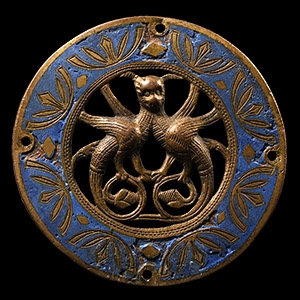
Medieval Limoges Bronze and Champleve Enamel Roundel with Fantastical Creature
Sold for (Inc. bp): £23,400
Openwork winged beast to the centre, its tails curling beneath the body creating the foliate tendrils on which it perches, broad outer roundel decorated with geometric plants alternating with lozenges, extensive remains of blue champlevé enamelling; engraved and chiselled; four attachment holes. -
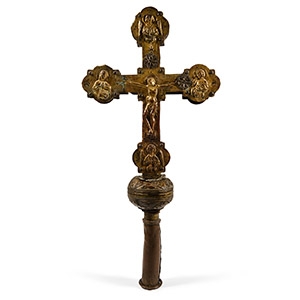
Medieval Gilt Bronze Processional Cross
Sold for (Inc. bp): £16,900
With wooden core to which the embossed sheets have been attached; the obverse with a central nimbate Corpus Christi, an applied rosette above and to the left arm; an angel to the finial of the upper and lower arm with Mary and St John the Evangelist to the side arms; the reverse with a central figure of Jesus holding the Gospel and making the sign of blessing; each finial of the arm with the symbols of the Evangelists (eagle, angel, lion and ox); the cross resting on a floral sphere with a socket below. -
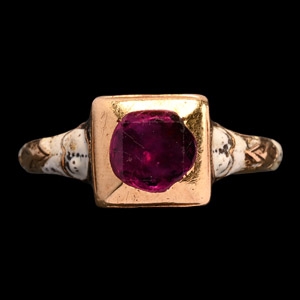
Baroque Gold, Ruby and Enamel Ring
Sold for (Inc. bp): £11,700
Composed of a slender hoop, expanding shoulders decorated with white enamelled foliage and black enamelled pea-pod ornament, repeated around the bezel, bezel with box setting holding a table-cut ruby, white and black enamelled floral design to the underside; minor loss of enamel; likely from France; accompanied by a 'Les Enluminures' hinged presentation box.
-
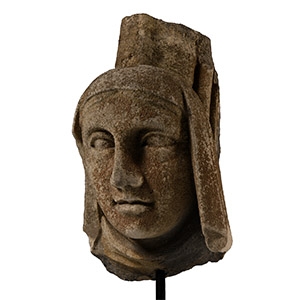
Medieval Limestone Corbel Head
Circa 14th century A.D.Sold for (Inc. bp): £2,210
The figure carved wearing a hooded cowl, face face with furrowed brow, hooded eyes, sunken cheeks and down-turned mouth; remains of moulded springer to the top and rear of the head; chipped; mounted on a custom-made display stand. 3.8 kg, 28 cm including stand
Ex Simmons Gallery, London E11, UK. Ex London collection, 1980s-1990s. -
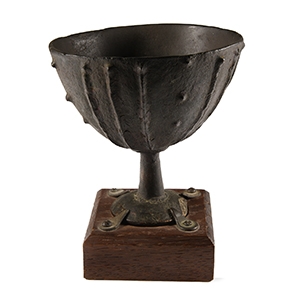
Late Medieval Bronze Chalice
Eastern Europe, 16th-17th century A.D.Sold for (Inc. bp): £1,560
Formed with a U-shaped bowl, tapering cylindrical stem and domed discoid foot, the body exterior displaying clusters of vertical ribs alternating with columns of pellets; mounted on a custom-made wooden display base. 750 grams, 12 cm high (890 grams total, 15 cm high including stand)
Acquired on the UK art market. Property of an East Sussex, UK, gentleman.
The chalice is the most important liturgical object used in Christian worship, and for centuries it has been given a central place on the altar. Its form directly references the vessel used by Christ during the Last Supper when, according to the Gospel of Matthew (26:27-28) he ‘took the cup, and gave thanks, and gave it to [his disciples], saying: Drink ye all of it for this is my blood of the new testament, which is shed for many for the remission of sins.’ Since the moment of transubstantiation is believed to occur while the chalice is filled with the Communion wine, such vessels have historically been created using the richest, most precious materials available to the church and its craftsmen. -
Medieval Limoges Bronze and Champleve Enamel Roundel with Fantastical Creature
Circa 13th century A.D.Sold for (Inc. bp): £23,400
Openwork winged beast to the centre, its tails curling beneath the body creating the foliate tendrils on which it perches, broad outer roundel decorated with geometric plants alternating with lozenges, extensive remains of blue champlevé enamelling; engraved and chiselled; four attachment holes. 61 grams, 89 mm wide
with Sotheby's, London, 9 December 1993, lot 22. Private collection, Europe. This lot has been checked against the Interpol Database of stolen works of art and is accompanied by search certificate no.11903-206496.
Likely used to adorn a coffret. Likely before 1227 A.D. -
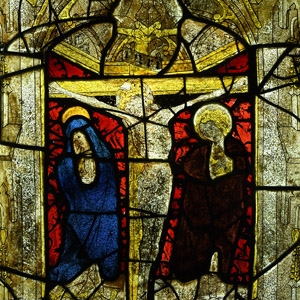
Medieval Stained Glass Panel with the Crucifixion
Germany, Erfurt(?), circa 1420 A.D.Sold for (Inc. bp): £2,889
Rectangular with lead came framing; scene of the Crucifixion with emaciated nimbate Christ on the Christ flanked by a robed and nimbate male and female figure (Mary Magdalene), within an arch formed by two vertical pillars with facet detailing, scroll with 'INRI' above. 3.3 kg, 59.5 x 44 cm
Galerie de Chartres, 8 March 2009, lot 12. Ex central London gallery. This lot has been checked against the Interpol Database of stolen works of art and is accompanied by search certificate no.11904-207296. -
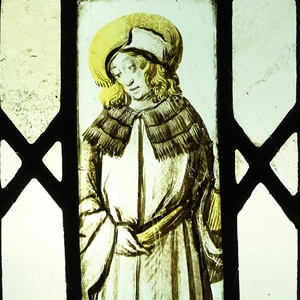
Medieval Stained Glass Panel with Nobleman
Flemish, early 16th century A.D.Sold for (Inc. bp): £975
Rectangular with lead cames in a regular frame with later suspension loops; painted central panel with standing nobleman in floor-length coat with tiered fur collar, chaperon hat, hand resting on the belt. 467 grams, 32 cm high
Ex The Monastery Stained Glass, Northamptonshire, UK, 2004. Ex central London gallery. -
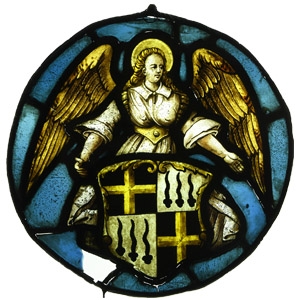
Medieval Stained Glass Panel with an Angel
Switzerland, circa 1500-1550 A.D.Sold for (Inc. bp): £546
With circular lead came frame, painted image of a nimbate angel with wings spread supporting a heraldic shield with quartered arms on a blue celestial field. 416 grams, 23 cm wide
Alder Nordmann, 11 May 2021, lot 97. Ex central London gallery. -
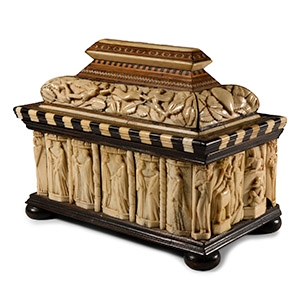
Medieval Carved and Bone-Inlaid Casket
Probably Venice, circa 1400-1420 A.D.Sold for (Inc. bp): £5,460
The wood carcass set to the front with a frieze of bone panels carved with paired figures, the sides with further bone panels of differing subjects, each corner with a figure holding a rod and a shield (one a replacement), the back with associated geometric pierced panels; on bun feet; the lid with bone and ebony alternating fillet rim surrounding alla certosina inlay below bone panels carved with winged figures holding banners against a trailing leaf ground; the sides with vacant drops; all below a stepped top with further intarsia work; from the studio of Baldassare Embriachi (active 1393-1433 A.D.); the geometric piercing of the rear panels appears to be Carolingian in style and may date from as early as the 9th century (see Adolph Goldschmidt, 'Die Elfenbeinskulpturen aus der Zeit der karolingischen und sächsischen Kaiser, VIII.-XI. Jahrhundert', Berlin 1914-26, Vol.II, No.180); these were probably affixed as part of a later restoration of the casket, possibly during the 19th century. 1.28 kg, 25 cm wide
Private collection, London, UK. Sotheby's, London, 9 December 2005, lot 8. Ex central London gallery. This lot has been checked against the Interpol Database of stolen works of art and is accompanied by search certificate no.11905-207284.
The Florentine merchant Baldassare Embriachi (or more correctly, Ubriachi), whose workshop in the city was producing carvings in the 1370s, moved to Venice in around 1390, establishing another atelier there. His widespread diplomatic and mercantile contacts allowed him to promote its wares, including large altar pieces, through much of Europe. On a more domestic front, it is thought a wealthy and burgeoning merchant class used caskets such as this for gifts during the often complicated marriage negotiations of the period (Glyn Davies and Kristin Kennedy, 'Medieval and Renaissance Art: People and Possessions', London, 2009, pp.105-6). Traditionally all such caskets were attributed to the Embriachi workshop, but it is now thought there may have been a number of different workshops operating in Venice in the early 15th century, producing such works, encouraged by the success of the Embriachi enterprise. -
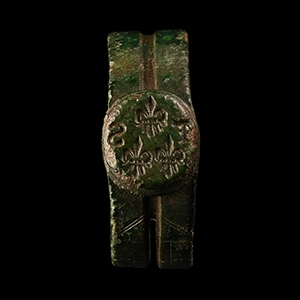
Medieval Bronze Pocket Sundial with Seal of the Arms of France and T S
15th-16th century A.D.Sold for (Inc. bp): £1,430
The flat-section hoop with raised circular seal bezel bearing engraved three fleur de lis flanked by initials T-S, hoop with openwork bar to one side, together with engraved gradation lines and letters representative of the months of the year above and below, and the hours marked on hoop interior. 14.4 grams, 40 mm
Acquired early 1990s. From an East Anglian private collection. -
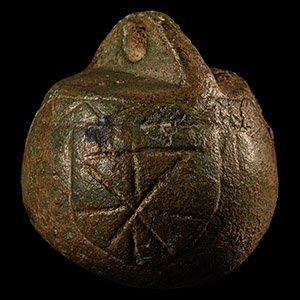
Medieval Bronze Steelyard Weight with Heraldic Shields
Circa 1260-1300 A.D.Sold for (Inc. bp): £442
Heavy with a lead core, spherical in form with pierced flange for suspension above and hatched band to the shoulder; an unusal unofficial copy with three heater shields with raised heraldic arms spaced equally around the body, etched geometric band of chevrons above. 615 grams, 56 mm
Ex Simmons Gallery, London E11, UK, in the 1990s. From a North London collection.
These heraldic steelyard weights were originally made under the official sanction of Richard (brother of King Henry III) or Edmund, Duke of Cornwall on behalf of the King; Edmund died in 1300 A.D. and such weights were banned in 1350. This example would most likely have been made unofficially towards the end of the period 1260-1300 A.D. The Hanseatic League was created in Germany to protect the interests and privileges of merchants in the medieval period, starting in Europe and with influence spreading to England from the 13th century. -
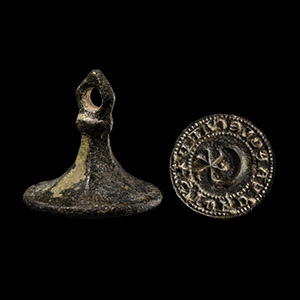
Medieval Bronze Personal Seal Matrix of John de la Pole, Second Duke of Suffolk, Constable of Wallingford Castle and High Steward of Oxford University
14th-15th century A.D.Sold for (Inc. bp): £546
The circular high-quality die bearing a central star/sun over crescent moon with concentric pelleted borders enclosing Latin legend in Lombardic script: 'S' IOh' D' LA POLE CANP'; probably the counterseal of John de la Pole, Second Duke of Suffolk, of facetted hexagonal-section stem with pellet trefoil to show orientation when in use, collar and pentagonal suspension loop; accompanied by an impression. 8.7 grams, 19 mm
Found whilst searching with a metal detector near Wantage, Vale of White Horse, Oxfordshire, UK, between January and May 2011. Accompanied by a copy of the British Museum's Portable Antiquities Scheme (PAS) report no.BERK-749E31.
This seal has been designated of 'County / local importance' in the PAS record, which provides the following interpretation of the inscription: 'The second Duke of Suffolk was John de la Pole, born 27th September 1442. He was Constable of Wallingford Castle and High Steward of Oxford University. He also held the manors of Deddington and Ascot in Oxfordshire from 1477 A.D. He died c. 24th July 1492 (Richardson 2011:48-49). His mother, Alice Chaucer, was the granddaughter of the poet Geoffrey Chaucer (author of the Canterbury Tales). Alice, who died in 1475/76 A.D., is buried in her home village of Ewelme, where the de la Poles spent much of their time. John de la Pole's official seal is recorded in the British Museum Catalogue of Seals (1894:398), and is described as 'a lion rampant queue fourchée'. The matrix now offered is likely to be a personal seal, such as were often used for private correspondence or as a counterseal, when applying a seal of office. -
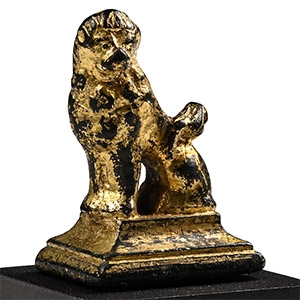
Medieval Gilt Bronze Lion Finial
14th-15th century A.D.Sold for (Inc. bp): £520
Modelled in the half-round standing with head left on a plinth base, rectangular fixing socket to underside. 25.1 grams, 32 mm high
‘The Ancient Menagerie Collection’ formerly the property of a Cambridgeshire lady, collected since the 1990s and acquired from auctions and dealers throughout Europe and the USA, now ex London collection. -
Medieval Gilt Bronze Processional Cross
15th-16th century A.D.Sold for (Inc. bp): £16,900
With wooden core to which the embossed sheets have been attached; the obverse with a central nimbate Corpus Christi, an applied rosette above and to the left arm; an angel to the finial of the upper and lower arm with Mary and St John the Evangelist to the side arms; the reverse with a central figure of Jesus holding the Gospel and making the sign of blessing; each finial of the arm with the symbols of the Evangelists (eagle, angel, lion and ox); the cross resting on a floral sphere with a socket below. 920 grams, 52.5 cm
Some damage and repair.
with Adolphe Goumaz, Pully, Switzerland. Ex private collection. Accompanied by an academic report by Dr Raffaele D’Amato. This lot has been checked against the Interpol Database of stolen works of art and is accompanied by search certificate no.11804-206500.
The metal sheets of the cross seem to be 15th century A.D. North Italian work. The four Evangelists are depicted with a human face at the front of the cross, and in animal forms at the reverse.
