
Auction Highlights
-
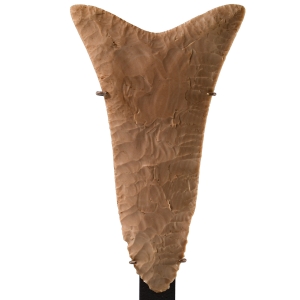
Egyptian Fishtail Flint Knife
Sold for (Inc. bp): £7,150
Knapped bifacial tan knife with fishtail butt to receive a hilt; the rounded tip tapering and flaring along the edges; with a custom-made display stand. -
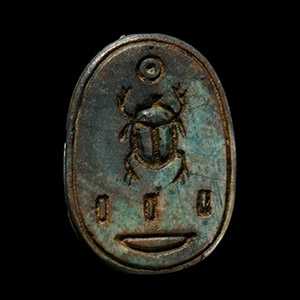
Egyptian Stone Scarab Inscribed for Tutankhamun
Sold for (Inc. bp): £6,500
Naturalistically modelled and coloured blue, hieroglyphs on base; pierced for suspension. -
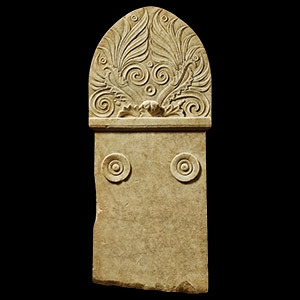
Greek Marble Funerary Anthemion Stele
Sold for (Inc. bp): £17,550
Comprising a tall, plain body with two rosettes; crowned by an elaborate palmette and volute design with shallow acanthus stalks and small rosettes; mounted on a custom-made display stand. -
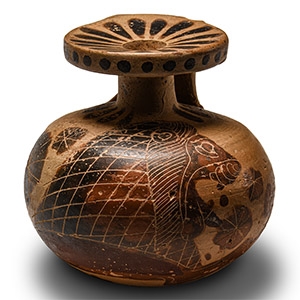
Corinthian Black-Figure Aryballos with a Lion
Sold for (Inc. bp): £3,900
The squat oil flask with slender neck and broad everted rim, painted with rosette petals around the mouth and base, spots encircling the rim, horizontal stipes to the strap handle, vegetal motifs and the forequarters of a roaring lion to one face of the body. -
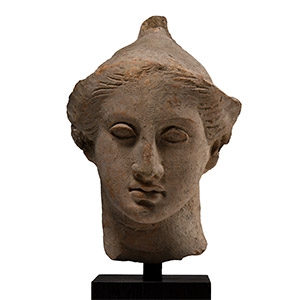
Greek Tarentine Terracotta Head of a Youth
Sold for (Inc. bp): £5,720
Possibly depicting Ganymede or Paris, wearing a soft Phrygian cap with everted brim, the hair swept back from the face; almond-shaped eyes with pronounced eyelids, straight nose and fleshy lips; mounted on a custom-made display stand. -
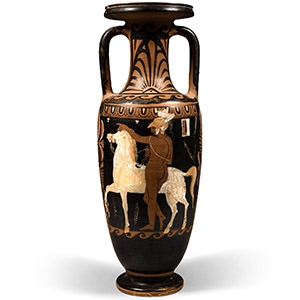
Campanian Red-Figure Neck-Amphora with Cavalryman
Sold for (Inc. bp): £10,400
The piriform body with broad, stepped rim and two round-section handles; red-figure frieze depicting two standing women facing, wearing a himation and stephane; the other side with a nude standing warrior wearing an Apulo-Corinthian helmet, holding the reins of his horse, acanthus leaves, ovolo and wave motifs to the neck and lower body; probably from a Cuma workshop. -
.jpg)
Hellenistic Gold Earrings with Lapis and Mother of Pearl
Sold for (Inc. bp): £19,500
Comprising a shallow disc with central flower motif inlaid with carnelian and lapis lazuli, surrounded by a beaded border, the outer pearled border inlaid with mostly replicant lapis lazuli, and mother of pearl inserts; three pendants to the lower edge, two with chain and carnelian bead, the central pendant formed as a miniature amphora with filigree, repaired; housed in a custom-made display box. -
.jpg)
Hellenistic Terracotta Head of a Youth
Sold for (Inc. bp): £18,200
Tousled curly hair, strong aquiline nose and full mouth; the deep eyes marked by raised eyelids and prominent semi-circular eyebrows; the hair arranged in overlapping rows of locks; repaired; mounted on a later porphyry plinth. -
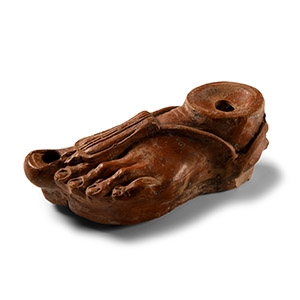
Roman Terracotta Foot Lamp
Sold for (Inc. bp): £3,380
Mould-made and shaped as a sandaled left foot, filling-hole surrounded by a ridge in the ankle area, the sandal with two leather straps tied together near the ankle, wick-hole in the big toe; inscription 'ƩΑΛΣΙϹ' to the base, heel chipped. -
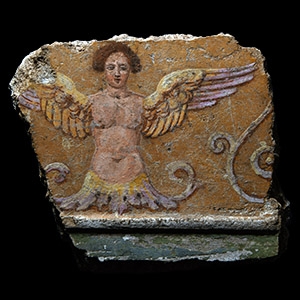
Roman Polychrome Wall Painting Fragment with Winged Siren
Sold for (Inc. bp): £20,800
Decorated with a frieze of partially preserved acanthus volutes from which emerges a figure of a winged female, possibly a siren, the body and the head of a woman with brown hair, the outstretched wings in pink and yellow; ochre background, cream-coloured line border with a green raised edge (part of the wall) below; mounted on a custom-made display stand. -
.jpg)
Neo-Assyrian Bronze Horse Trapping with Eagle-Headed God Nisroch and Winged Supernatural Figures
Sold for (Inc. bp): £15,600
The left side of a trapping for a horse pulling a chariot, comprising two hammered elements with a hinge; rectangular upper section with a loop to one end, decorated with an eagle-headed genius-demon, wearing a tunic and a fringed kilt, a shawl wrapped around the body, hanging down on the back, carrying a bucket of purifying water in his right hand and a conical pot of incense in his left hand, bracelets to arms, two rows of lotus buds above; the discoid lower section divided in two registers, each with a winged genii in combat with winged bulls; the dividing raised band with fish motifs similar to the border formed of fish; the edges of both elements with punched edges for the attachment of leather lining; Neo-Assyrian or Urartian; mounted on a custom-made display stand. -
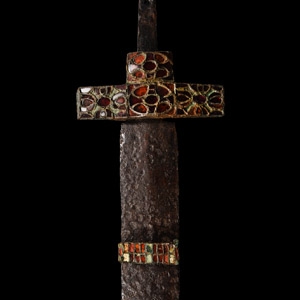
Migration Period Iron Sword with Garnet Cross Guard and Scabbard Fittings
Sold for (Inc. bp): £7,150
With a double-edged parallel-sided blade with broad pointed tip; the lower guard inlaid with garnet cloisonné divided into four segments; accompanied by a rectangular scabbard slide inlaid with two rows of garnets and other stone; and a part of a sheet-silver chape. -
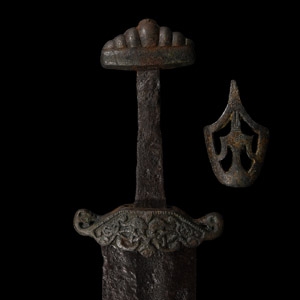
Viking Iron Sword with Cross Guard Surmounted by Interlaced Dragons
Sold for (Inc. bp): £8,450
Comprising a double-edged cutting blade with tapering fullers and hefty tang; the bronze cross guard in Jellinge style with dragon head finials and a central human face to the lower edge; the pommel with seven lobes; accompanied by a bronze openwork chape with central bird motif decorated with stamped ring-and-dot design. -
.jpg)
Bronze Age Gold Torc-Shaped Bracelet
Sold for (Inc. bp): £11,050
Of solid heavy penannular form, round in section with clubbed terminals. -
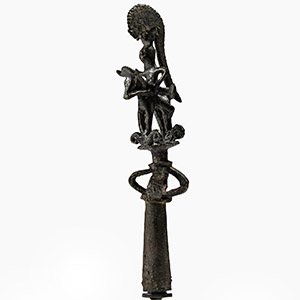
Iberian Celtic 'Axel Guttman' Bronze Warrior Finial
Sold for (Inc. bp): £13,000
With slightly tapering socket and openwork bulb above, discoid platform supporting a mounted warrior modelled in the round; horse with long vertical tail and horizontal reins, bowed legs and scrolls at the hooves; warrior astride the horse with legs bent and feet to the rear, helmet with lateral horns and large swept crest with notched edge; arms bent to show the warrior in the act of drawing his falcata sword from the scabbard worn across his midriff; mounted on a custom-made stand. -
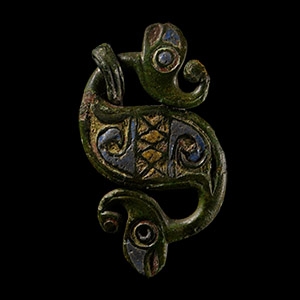
Very Large Celtic Enamelled Bronze Dragonesque Brooch
Sold for (Inc. bp): £4,420
S-shaped with scrolled flourishes to the dragon-head terminals, remains of inlaid blue and red enamelling to the stylised beast heads, wave and lozenge ornament to the body; free-running tongue with head coiled around the neck of one of the creatures; Romano-British. -
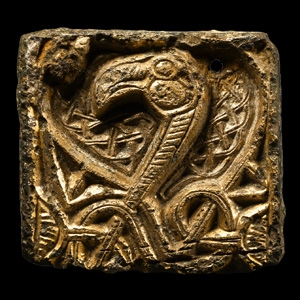
Anglo-Saxon Gilt Bronze Chip-Carved Beast Manuscript Mount
Sold for (Inc. bp): £3,380
With high-relief aviform head and wings and looped ornamental swags, knotwork panels in the field; two holes for mounting; possibly a book-mount, Hiberno-Saxon workmanship. -
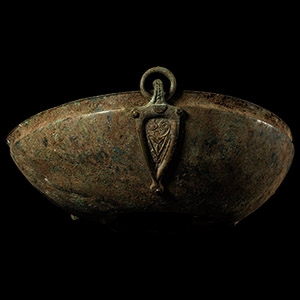
The High-Status 'Ryedale' Anglo-Saxon Bronze Hanging Bowl Complete with all Four Chip-Carved Mounts
Sold for (Inc. bp): £36,400
An excessively rare and almost complete copper-alloy hanging bowl and associated fittings comprising: (i) the bowl with three attached matching hooked escutcheons and suspension rings (ii) the basal disc (iii) a body fragment (or possible repair patch) (iv) a curved bronze fragment (ii) the basal disc with separate frame (iii) fragment of copper-alloy sheet, possibly forming part of a repair to the base of the bow (iv) a curved copper-alloy strip (iv) four skeletal fragments from a sheep or similar. -
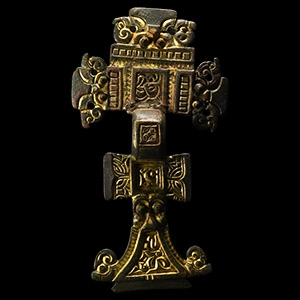
'The Scampton' Published Anglo-Saxon Gilt Bronze Florid Cruciform Brooch
Sold for (Inc. bp): £11,050
Of Martin's Group 4 with rectangular headplate and florid face-masks to the three edges and conical eyes, deep bow with with square central panel, footplate with square lateral lappets, triangular face-mask finial with conical eyes; pin-lug and catchplate to the reverse; gilded surface abraded. -
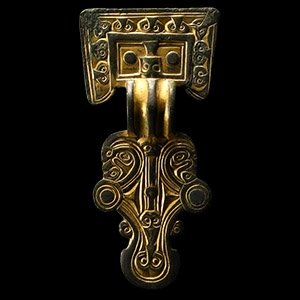
Superb Anglo-Saxon Gilt Bronze Great Square-Headed Brooch
Sold for (Inc. bp): £11,700
Of Hines's Group X with two discs on the headplate in a rectangular frame surrounded by a frieze of facing human masks, and another mask placed centrally above the junction with the bow; shallow bow with three ribs; curved horse-head lappets flanking a vertical shank with facing mask detailing, discoid lobes and an inverted mask below; pin-lugs to the reverse and solder-scar where the catchplate was attached. -
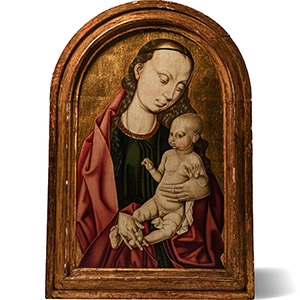
Medieval Virgin and Child by a Follower of Dirk Bouts
Sold for (Inc. bp): £11,700
Oil on board devotional panel in a gilt wooden frame; the Virgin in a bottle-green gown with gilt collar and cream undershift, crimson mantle; the naked Christ supported on his mother's left hip, his left foot clasped in the interleaved fingers of her right hand; textured gilt field; attributed to a follower of Dirk Bouts. -
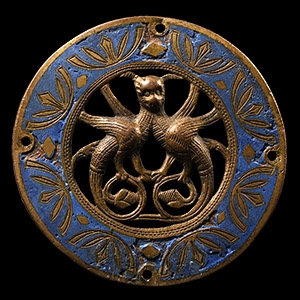
Medieval Limoges Bronze and Champleve Enamel Roundel with Fantastical Creature
Sold for (Inc. bp): £23,400
Openwork winged beast to the centre, its tails curling beneath the body creating the foliate tendrils on which it perches, broad outer roundel decorated with geometric plants alternating with lozenges, extensive remains of blue champlevé enamelling; engraved and chiselled; four attachment holes. -
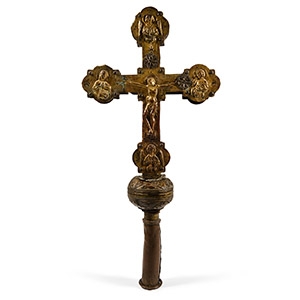
Medieval Gilt Bronze Processional Cross
Sold for (Inc. bp): £16,900
With wooden core to which the embossed sheets have been attached; the obverse with a central nimbate Corpus Christi, an applied rosette above and to the left arm; an angel to the finial of the upper and lower arm with Mary and St John the Evangelist to the side arms; the reverse with a central figure of Jesus holding the Gospel and making the sign of blessing; each finial of the arm with the symbols of the Evangelists (eagle, angel, lion and ox); the cross resting on a floral sphere with a socket below. -
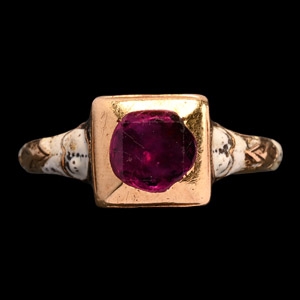
Baroque Gold, Ruby and Enamel Ring
Sold for (Inc. bp): £11,700
Composed of a slender hoop, expanding shoulders decorated with white enamelled foliage and black enamelled pea-pod ornament, repeated around the bezel, bezel with box setting holding a table-cut ruby, white and black enamelled floral design to the underside; minor loss of enamel; likely from France; accompanied by a 'Les Enluminures' hinged presentation box.
-
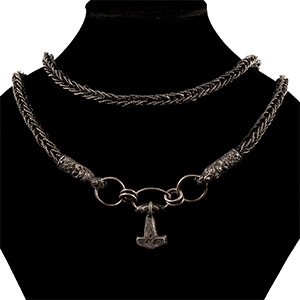
Viking Age Silver Thor's Hammer Necklace
10th-11th century A.D.Sold for (Inc. bp): £6,500
Comprising: an openwork trichinopoly chain with D-section beast-head terminals each with granule and filigree detailing, pierced at the lower end to accept a round-section hoop by two further rings to a hoop with free-running hollow silver Thor's hammer pendant with filigree ornament to the upper face. 116 grams, 76 cm long
Private collection formed in Europe in the 1980s. Westminster collection, central London, UK. Accompanied by a specialist metal analysis report. This lot has been checked against the Interpol Database of stolen works of art and is accompanied by search certificate no.11896-203749. -
The High-Status 'Ryedale' Anglo-Saxon Bronze Hanging Bowl Complete with all Four Chip-Carved Mounts
550-700 A.D.Sold for (Inc. bp): £36,400
An excessively rare and almost complete copper-alloy hanging bowl and associated fittings comprising: (i) the bowl with three attached matching hooked escutcheons and suspension rings (ii) the basal disc (iii) a body fragment (or possible repair patch) (iv) a curved bronze fragment (ii) the basal disc with separate frame (iii) fragment of copper-alloy sheet, possibly forming part of a repair to the base of the bow (iv) a curved copper-alloy strip (iv) four skeletal fragments from a sheep or similar. 381 grams total, 3.6-20 cm
Found whilst searching with a metal detector in Ryedale, North Yorkshire, UK, on Sunday 5th February 2023 by Chris Ulliott. Accompanied by a copy of the British Museum's Portable Antiquities Scheme report no.YORYM-59523A. Accompanied by a hand written signed letter from the finder explaining the circumstances of finding. This lot has been checked against the Interpol Database of stolen works of art and is accompanied by search certificate no.11897-207827.
Hanging-bowls are high-status vessels with origins in the Roman period which continued in use only in Britain and, later, in Ireland. They appear in burial contexts which date them to the sixth to late seventh century. The form of this example is paralleled by the bowl from Hadleigh Road, Ipswich, Suffolk (British Museum accession number 1984,0103.9) which has a similar shape and kite-shaped escutcheons secured by three rivets (Bruce-Mitford, 2005, Corpus No. 86). -
'The Scampton' Published Anglo-Saxon Gilt Bronze Florid Cruciform Brooch
6th century A.D.Sold for (Inc. bp): £11,050
Of Martin's Group 4 with rectangular headplate and florid face-masks to the three edges and conical eyes, deep bow with with square central panel, footplate with square lateral lappets, triangular face-mask finial with conical eyes; pin-lug and catchplate to the reverse; gilded surface abraded. 182 grams, 17 cm
Found Scampton, Lincolnshire, UK. From the private collection of Alan Harrison, circa 2000. This lot has been checked against the Interpol Database of stolen works of art and is accompanied by search certificate no.11898-204375.
The florid type of cruciform brooch stands at the end of the series and probably dates to the middle of the 6th century according to the most recent discussion (Martin, 2015). The present example has a close parallel in the find from Duston, Northamptonshire, which Martin assigns to his Type 4.7.1, among the very last (or most fully developed) group in the seriation. The headplate, bow and footplate each have a square panel of Style I zoomorphic ornament within a thick frame; the headplate features blocks of billeting to three edges and punched triangular ornament on the frame, which also appears on the lateral edges of the finial. The conical eyes on the facing masks are an unusual and very distinctive feature which would have made casting the brooch a technical challenge. There is some evidence for silvering on the flat rectangular surfaces (T-shaped on the headplate and rectangular on the lappets and finial). The openwork masks on the headplate develop into profile bird-heads. This brooch was recovered by a metal-detectorist in several pieces over a period of some years, and re-assembled. It was published by Leahy in his authoritative work on the Kingdom of Lindsey. -
Superb Anglo-Saxon Gilt Bronze Great Square-Headed Brooch
6th century A.D.Sold for (Inc. bp): £11,700
Of Hines's Group X with two discs on the headplate in a rectangular frame surrounded by a frieze of facing human masks, and another mask placed centrally above the junction with the bow; shallow bow with three ribs; curved horse-head lappets flanking a vertical shank with facing mask detailing, discoid lobes and an inverted mask below; pin-lugs to the reverse and solder-scar where the catchplate was attached. 128 grams, 14 cm
Found near Grimsby, Humberside, UK, circa 2010. This lot has been checked against the Interpol Database of stolen works of art and is accompanied by search certificate no.11899-204377.
The brooch has many of the characteristics of Hines's Group X but also bears a strong resemblance to an unclassified example from Barrington A, Cambridgeshire (Hines, 1997, pl.101). The frieze of facing masks which forms the border to the headplate has echoes of contemporary motifs found on the headplate of the brooch from Fridaythorpe (Hines, 1997, pl.8(b)) and the crests of helmets such as Valsgarde mounds 5 and 7 (Sweden) - see Mortimer, 2011, p.32-35). The inverted mask on the finial echoes the 7th century shield-fitting from Vall, Gotland (Franceschi et al, 2005, pl.209). The significance of the mask motifs has been discussed in the cited works of Franceschi et al and Mortimer. A link to generations of deified ancestors is one possibility. -
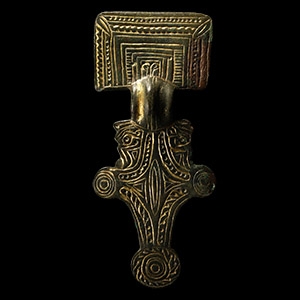
Anglo-Saxon Gilt Bronze Great Square-Headed Brooch
6th century A.D.Sold for (Inc. bp): £1,690
Of Hines's Group XX with square headplate bearing concentric bands of billets, undulating lines and punched points, with vesica motifs to the upper corners; thick shallow bow with central rib, isosceles triangle footplate with horse-head lappets and flanking lobes with concentric rings, ropework bands and central vesica, disc finial with ropework border; pin-lugs to the reverse and broad catch. 136 grams, 13.5 cm
Found near Grimsby, Humberside, UK, circa 2010.
The brooch shows a restrained use of low-relief detailing confined to largely geometric features other than the horse-heads at the shoulders and the single facing mask on the headplate above the junction with the bow. The bow itself is very thick and displays a prominent median rib with just a suggestion of outer ribs. The mineral deposits on the reverse bear the imprint of the textile to which the brooch was attached. -
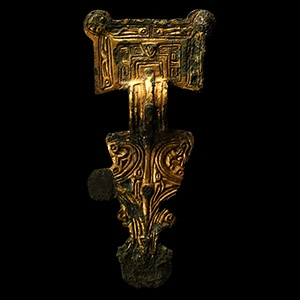
Anglo-Saxon Gilt Bronze Great Square-Headed Brooch
6th century A.D.Sold for (Inc. bp): £910
Of Hines's Group X with rectangular headplate featuring low-relief bird-heads and a raised piriform mask to each upper corner; shallow bow with raised ribs and a stud to the centre; triangular footplate with coiled horse-head lappets forming the shoulders, lateral lobes (one detached) with sheet-silver surface, inverted facing mask to the finial; remains of ferrous pin and catch to the reverse. 100 grams, 14.5 cm
Found near March, Cambridgeshire, UK, circa 2015.
A close match to the features of the March brooch is not recorded in Hines's corpus, but the very distinctive isosceles triangle footplate with sharp shoulders appears on the example from Little Wilbraham, Cambridgeshire (Hines's pl.33(b). The facing masks in the upper corners of the headplate also appear on an example from Driffield (Hines, 1997, pl.82(a). -
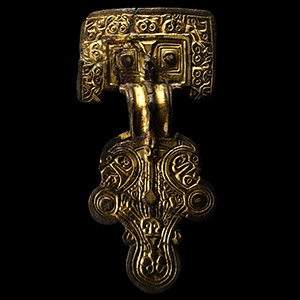
Published Anglo-Saxon Gilt Bronze Great Square-Headed Brooch
6th century A.D.Sold for (Inc. bp): £3,640
Of Hines's Group I with border of facing masks to the headplate, two discs within incised frames and raised mask between; shallow bow with three ribs, the median one with a central boss and extending to a small beast-head between the curled horse-head lappets; lozenge-shaped footplate with ropework border and facing bearded mask, lateral lobes and lobe finial with an inverted facing mask; applied silver-sheet detailing to the edges of the footplate; remains of pin-lugs and catch to the reverse. 114 grams, 14.5 cm
Found Scampton, Lincolnshire, UK. From the private collection of Alan Harrison, circa 2000. This lot has been checked against the Interpol Database of stolen works of art and is accompanied by search certificate no.11900-204376.
An exact parallel for the Scampton brooch is not known, as is typical for these hand-items made by lost-wax casting processes in one-piece moulds. The brooch falls within Hines's Group I and shares many features with an example from Bidford-on-Avon, Warwickshire (Hines, 1997, no.13) although the latter has a Style I panel on the headplate whereas the Scampton example features two raised discs within incised squares, a feature also found on finds from Duston (and Linton Heath (Hines, 1997, pl.11)). This brooch was recovered by a metal-detectorist in several pieces over a period of some years, and re-assembled. It was published by Leahy in his authoritative work on the Kingdom of Lindsey. -
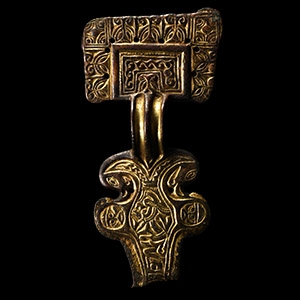
Anglo-Saxon Gilt Bronze Great Square-Headed Brooch
6th century A.D.Sold for (Inc. bp): £4,160
Of Hines's Group XIII with running scrolls on the headplate surrounded by a border of beast-masks, deep bow with raised ribs, curved horse-head lappets and lateral lobes with facing masks, median panel of Style I ornament; remains of ferrous pin to the reverse and deep catch; some silver detailing; finial absent. 77.9 grams, 11.5 cm
Found near Thetford, Norfolk, UK, circa 2010.
This brooch falls within Hines's Group XIII and shares many features with an example from Nassington, Northamptonshire. The headplate bears a raised rectangular frame (possibly silvered) separating the inner scroll motif from the outer band of animal-masks which are pierced along the inner edge; the lappets are also pierced at the point of junction with the footplate. The lateral lobes feature facing masks of a helmetted type similar to those featured on contemporary button brooches. -
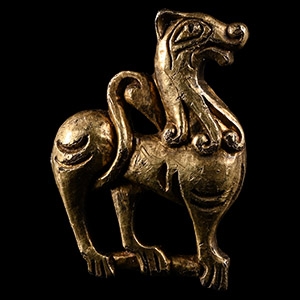
Norman Silver-Gilt Statant Beast Brooch
Circa 11th-12th century A.D.Sold for (Inc. bp): £2,106
Of Romanesque style with hollow reverse to the body, catch behind the neck and hinged pin to the reverse; modelled in the half-round. 8.3 grams, 28 mm
Acquired early 1990s. From an East Anglian private collection. -
.jpg)
Large Medieval Bronze Knight's Heraldic Seal Matrix of Count Robert in Full Armour
Circa 15th century A.D.Sold for (Inc. bp): £2,600
Featuring a large circular die face and hexagonal stem, with collars and pierced quatrefoil handle, incised orientation star to edge; the die bearing a knightly device of a helmet with chaplet on canted shield of arms bearing three bull's heads cabossed and chevron with surrounding ' LE * S * ROBERTI * LE CONTES' legend. 38.9 grams, 34 mm
Found near Stoke Ferry, Norfolk, circa 2008. This lot has been checked against the Interpol Database of stolen works of art and is accompanied by search certificate no.11901-204414.
'Sigillum Roberti le Contes ' is 'seal of Count Robert'. Three bulls' heads appear on the arms of the Beverley family. The chaplet or 'cap of maintenance' is a stylised fur-lined cap which appears in the heraldry of leading families; the helm of the Black Prince in Canterbury Cathedral is made with a chaplet and a lion standing on the rim. -
Medieval Virgin and Child by a Follower of Dirk Bouts
Southern Netherlands, circa 1490 A.D.Sold for (Inc. bp): £11,700
Oil on board devotional panel in a gilt wooden frame; the Virgin in a bottle-green gown with gilt collar and cream undershift, crimson mantle; the naked Christ supported on his mother's left hip, his left foot clasped in the interleaved fingers of her right hand; textured gilt field; attributed to a follower of Dirk Bouts. 2.8 kg, 57 cm high
Collection of Henri and Suzanne Paradis since circa 1967. From the sale of their collection at Deburaux, 4 July 2015, lot 19. Ex central London gallery. This lot has been checked against the Interpol Database of stolen works of art and is accompanied by search certificate no.11902-207281. -
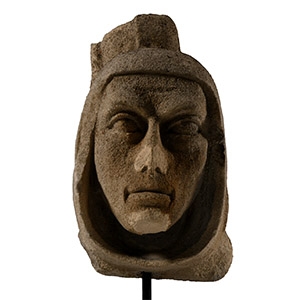
Medieval Limestone Corbel Head
Circa 14th century A.D.Sold for (Inc. bp): £780
The figure carved with naturalistic facial features, wearing a hooded cowl; remains of the hooded springer to the top of the head and reverse; mounted on a custom-made display stand. 4.65 kg, 28.5 cm including stand
Ex Simmons Gallery, London E11, UK. Ex London collection, 1980s-1990s.
