
Auction Highlights
-
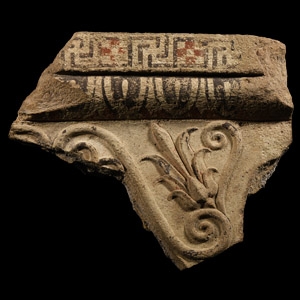
Etruscan Painted Terracotta Architectural Cornice
Sold for (Inc. bp): £3,900
A fragment of amorphous form, decorated in relief with scrolling tendrils and anthemion, painted egg-and-dart ornament above, surmounted by moulded bands and a frieze of meander and chequerboard panels; remains of red and black painted pigment. -
.jpg)
Roman Bronze Eros Cradling Goose Applique
Sold for (Inc. bp): £1,950
Formed as the bust of Eros looking upwards, stub wings to his shoulders, holding a goose to his chest; conical socket above each wing; eyes with silver inserts; old collector's label '1994 51.75' to the reverse; mounted on a custom-made stand; likely a socket base. -
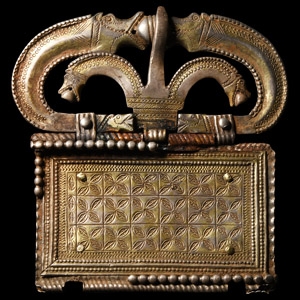
Roman Silver-Gilt Military Buckle for an Elite Imperial Officer
Sold for (Inc. bp): £7,800
Comprising a rectangular plate, richly decorated with embossed laurel leaves in a grid, framed with raised bosses, the buckle loop comprising opposing dragons with open mouths, holding a spherical tongue-rest, another pair of smaller dragon heads to base, the tongue with a smaller pair of punch-decorated dragon heads. -
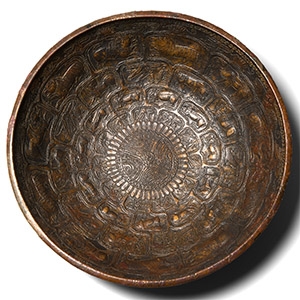
South Arabian Bronze Bowl with Mythical Animals
Sold for (Inc. bp): £5,850
Hemispherical in form, repoussé interior displaying graduated concentric registers of stylised and mythical animals within tessellating cartouches; a low relief mesomphalos decorated with rosette at centre; geometric ornament around the rim. -
.jpg)
Assyrian Bronze Relief Fragment
Sold for (Inc. bp): £16,900
Displaying a corrugated rim above and below; two advancing soldiers, each striding forwards over the headless body of a dead enemy, carrying a severed head in each hand; the soldiers shown bearded and each wearing a pointed and segmented helmet with a recess to accommodate the ears, a cuirass and thigh-length tunic, with a bow over one shoulder and a sword slung from a waist belt; mounted on a custom-made display stand. -
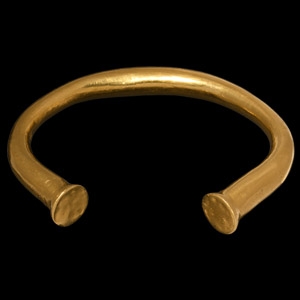
Bronze Age Gold Bracelet with Torc-Shaped Terminals
Sold for (Inc. bp): £11,440
Of penannular form with expanded sections at the centre and to both shoulders. -
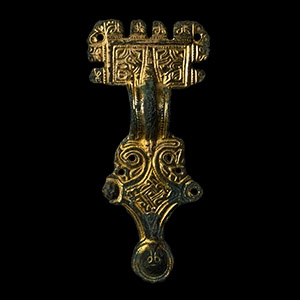
'The Oving' Anglo-Saxon Gilt Bronze Great Square-Headed Brooch
Sold for (Inc. bp): £4,160
Comprising a rectangular headplate with two panels of chip-carved Style I ornament, flanking a beast-head with triangular muzzle and two pellet eyes, raised three-sided frame and outer band of pellets above beast-heads with lentoid eyes; the shallow bow with raised median rib, flanges to the edges and punched pellet detailing; footplate with beast-head between curved pellet lines, pierced horse-head lappets, lozengiform central panel with knot of Style I limbs; two lateral discs, one pierced to accept a stud and the other with a domed stud in place; the finial a disc with human mask inverted; pin-lug and part of catch to the reverse. -
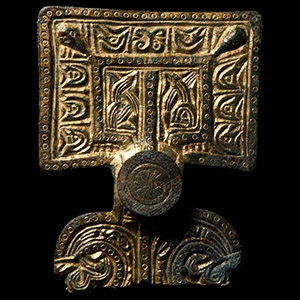
Anglo-Saxon Gilt Bronze Great Square-Headed Brooch
Sold for (Inc. bp): £3,900
Displaying chased panels populated with Style I zoomorphs and geometric forms, borders of annulets, raised masks to the upper corners of the headplate; applied discoid boss to bow decorated with a rosette, addorsed beast heads below; extensive remains of gilding; pin lug and catchplate to reverse and remains of ancient repair, lower part absent. -
.jpg)
'The Tenby' Hiberno-Norse Viking Penannular Brooch
Sold for (Inc. bp): £3,640
Comprising a round-section crescent with flared ends terminating in two curved spatulate flat panels, each with a ropework border surrounding a two-band knotwork motif; cleaned and conserved. -
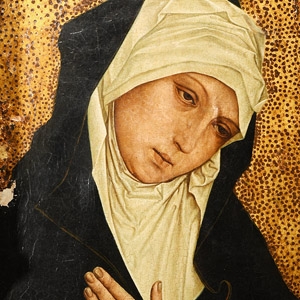
Medieval Oil Painting of Sorrowful Virgin
Sold for (Inc. bp): £9,100
The weeping Virgin with her head bowed to the left and hands raised to her chest on a dotted gilt background, an expression of pain on her delicately formed face; wearing a white veil and a black long-sleeved robe, the veil arranged as a headdress and covering her hair; on wood and mounted in a later carved wooden architectural frame. -
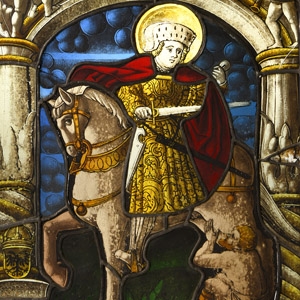
Medieval Stained Glass Panel With Saint Martin on Horseback
Sold for (Inc. bp): £2,080
Shown beneath an arcade, offering his cloak on the end of his sword to the beggar at his feet; polychrome detailing; repaired with lead cames and held in a wooden frame. -
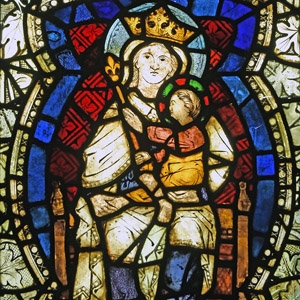
Medieval Stained Glass Panel with The Virgin and Child
Sold for (Inc. bp): £2,860
Composed from irregular painted panels bearing mainly foliage designs and figural elements; Mary crowned and enthroned with infant Jesus on her knee, in a lobed vesica-shaped panel held with lead cames; mounted in a wooden frame with modern replacements. -
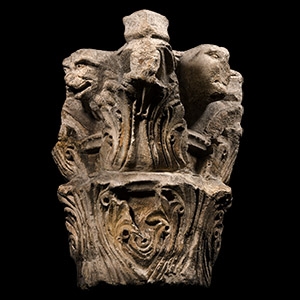
Medieval Stone Column Capital with Lion and Human Face
Sold for (Inc. bp): £1,950
Carved in the half-round with a frieze composed of interlaced foliage with two rows of acanthus leaves and foliage scrolls, framing a lion's head on one side and a human head on the other, remains of lion's mane to the third; drilled holes to the raised surfaces and sockets for the insertion of decorative stones. -
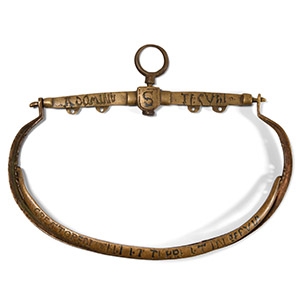
'The Kirkleavington' Medieval Bronze Inscribed Purse Frame
Sold for (Inc. bp): £3,640
The bar with central D-shaped block pierced vertically by a stud surmounted by the suspension loop, with four pierced flanges to the underside; the frame in two sections, the larger a U-shaped rod with pivot for the bar, the smaller pivoting within the inner face, both pierced on the inner face; the block inscribed to one face with capital S and to the other with intersecting Vs; the bar inscribed to one face in capitals 'A DOMINI TECVM' and to the other in coarsely incised capitals 'AVEMARIA G[R]ACIAPLE[NA]'; the smaller rod inscribed in capitals 'CREATOREN CELI ET TERRE ET IN [IES]VN'; the larger inscribed with a band of scrolled decoration and the text in Lombardic capitals 'SOLI DEO HONOR ET GLORIA'; the accompanying letter discusses the texts (1) Ave Maria G[r]acia ple[n]a Dominus Tecum 'Hail Mary full of grace, the Lord [is] with thee'; (2) Soli Deo Honor et Gloria 'Honour and glory to God alone'; (3) Creatorem celi et terrae et inferum 'creator of heaven and earth and in Jesus'. The intersecting Vs may form a monogram for A[ve] M[aria]; the 1847 letter describes the findspot as 'found at Kirkleavington near Yarm in the sill of a brook' in the North Riding of Yorkshire. -
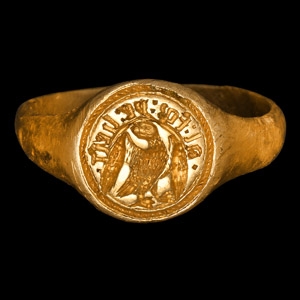
'The Roxwell' Medieval Gold Signet Ring of 'King's Serjeant William Skrene'
Sold for (Inc. bp): £23,400
Gold hoop and discoid bezel with incuse ropework border; incuse image of a bird of prey perching with wings spread and head turned; blackletter incuse and reversed inscription in an arc above the bird's head and pinions '·al : for : ye : best ·' (all for the best); repair to hoop. -
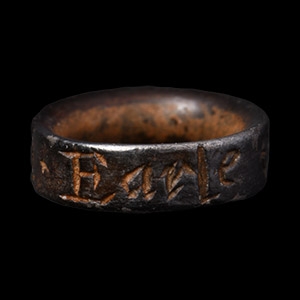
Medieval Silver 'Edmund Plantagenet, Earl of Rutland' Royal Hawking Vervel
Sold for (Inc. bp): £9,750
Or a leg ring inscribed '+Earle of Rutland' in derivative black letter script, for a female merlin or sparrow hawk (due to the youth of Edmund Plantagenet who died aged 17); the ring with a convex interior face. -
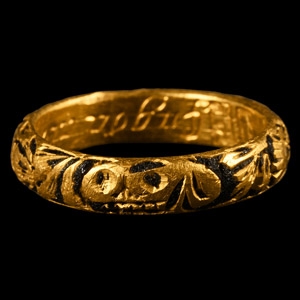
Post Medieval Gold Memento Mori Ring with Inscribed Posy 'In God Alone Wee Two Are One'
Sold for (Inc. bp): £4,680
Displaying large flower heads, foliage and a skull to the outer face, enhanced with black enamelling; interior inscribed in a cursive script 'In god alone wee two are one', together with possible maker's stamps 'D' and 'F' in two rectangular cartouches. -
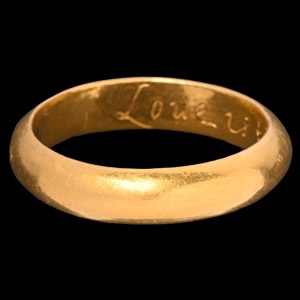
Heavy Post Medieval Gold 'Love Is The Bond Of Pease' Posy Ring
Sold for (Inc. bp): £2,860
Composed of a gently carinated hoop, the interior inscribed in cursive script 'Love is the bond of pease'. -
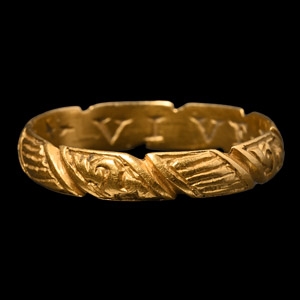
Post Medieval Gold 'Live Life to the Full' Decorated Posy Ring
Sold for (Inc. bp): £3,380
Composed of a decoratively notched hoop divided into chased rhomboidal panels displaying foliate tendrils and horizontal hatching alternately; the interior inscribed in Roman capitals with the Latin phrase: 'x x x x VIVE x VT x VIVAS'. -
![English Milled Coins - George VI - 1937 - Cased RM Proof Coronation Gold Set [4]](https://timelineauctions.com/upload/images/items/small/203351-s(2).jpg)
English Milled Coins - George VI - 1937 - Cased RM Proof Coronation Gold Set [4]
Sold for (Inc. bp): £11,700
Set comprising gold five pounds, two pounds, sovereign and half sovereign. Obvs: profile bust with GEORGIVS VI D G BR OMN REX F D IND IMP legends. Revs: St George and dragon; date in exergue; with original Royal Mint hinged red leatherette case of issue.
-
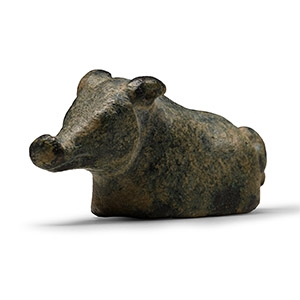
Iron Age Celtic Bronze Boar
1st century B.C.-1st century A.D.Sold for (Inc. bp): £780
Likely a finial or other fitting, formed as the upper body of a boar with semi-naturalistic anatomical detailing; recess to base. 57 grams, 54 mm
‘The Ancient Menagerie Collection’ formerly the property of a Cambridgeshire lady, collected since the 1990s and acquired from auctions and dealers throughout Europe and the USA, now ex London collection. -
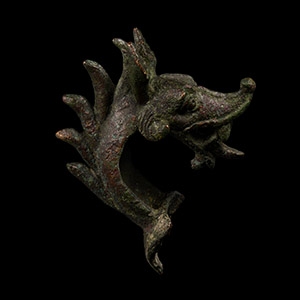
Anglo-Norman Bronze Dragon Head Finial
Mid-12th century A.D.Sold for (Inc. bp): £2,860
Formed with an arched D-section neck and triangular base, row of dorsal spines, pricked ears with notched rims, scooped muzzle with knop finial, open mouth with protruding tongue and teeth. 37.8 grams, 48 mm
‘The Ancient Menagerie Collection’ formerly the property of a Cambridgeshire lady, collected since the 1990s and acquired from auctions and dealers throughout Europe and the USA, now ex London collection. This lot has been checked against the Interpol Database of stolen works of art and is accompanied by search certificate number no.203519. -
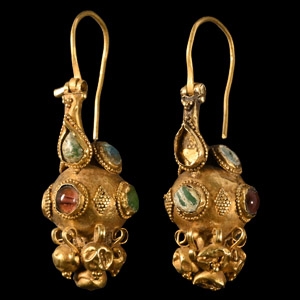
Byzantine Inlaid Gold Earrings
4th-9th century A.D.Sold for (Inc. bp): £910
Each composed of a large bulb, hinged hoop above adorned with three granulated cells set with glass (one insert absent); four circular cells to the equator set with stones of alternating blue and red colour, granulated lozenges between, pyramid bulbs below adorned with granule clusters, collar of suspension loops above; articulate hinges. 8.87 grams total, 42 mm each
Acquired 1980-2015. Ex Abelita family collection. -
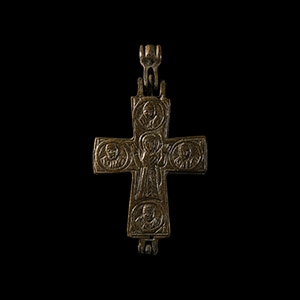
Byzantine Bronze Reliquary Cross
10th-11th century A.D.Sold for (Inc. bp): £624
Comprising two narrow hinged plates and articulated suspension loop with two vertical ribs; obverse with Jesus on the cross, dressed in a long robe with standing Virgin and Saint John on his side, Greek inscription 'ἴδε ὁ υἱός σου.Ἰδοὺ ἡ μήτηρ σου' (John 19:27-28: 'Here is your son. Here is your mother') under the arms; titulum, the sun and the moon above; on the tabula ansata of the titulum a Greek inscription 'Χ fur XΡΙΣΤΟΣ'; reverse with Theotokos (Mother of God) in orans pose and the four busts of the evangelists, at the four arms of the cross. 82 grams, 83 mm
Acquired on the German art market around 2000. From the collection of Surrey, UK, gentleman.
This enkolpion is a beautiful example of the type of pendant cross widespread in the 11th-12th centuries. Many variants of enkolpia reflected the new artistic fashions in vogue at Byzantium, influenced by the political and artistic vigour of the Macedonian dynasty. This enkolpion corresponds to type I of the Pitarakis classification. -
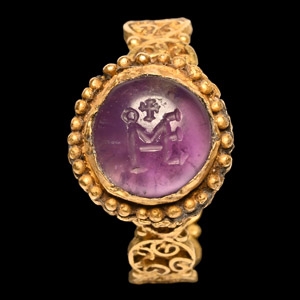
Byzantine Gold Filigree Ring with Monogram Amethyst Gemstone
5th-7th century A.D.Sold for (Inc. bp): £3,380
Composed of a delicate opus interrasile hoop, cup bezel with ribbed underside, granules to the rim, inset amethyst with monogram. 5.18 grams, 28.06 mm overall, 18.23 mm internal diameter (approximate size British N, USA 6 1/2, Europe 13.72, Japan 13)
Acquired 1970s-1980s. From the property of a deceased lady collector. This lot has been checked against the Interpol Database of stolen works of art and is accompanied by search certificate no.202957. -
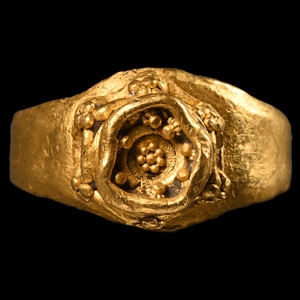
Byzantine Gold Architectural Ring
6th-8th century A.D.Sold for (Inc. bp): £936
Composed of a flat-section hoop with expanded centre, openwork bezel of six gusseted legs topped with pyramid granules and dished discoid centre adorned with granule clusters; Byzantine or Merovingian. 12.96 grams, 30.45 mm overall, 21.38 mm internal diameter (approximate size British W 1/2, USA 11 1/4, Europe 25.66, Japan 24)
Acquired 1990s-early 2000s. East Anglian private collection. -
.jpg)
Byzantine Marble Column Capital
Circa 6th century A.D.Sold for (Inc. bp): £4,160
Rectangular in plan with ornament to all four faces; Side A: facing bust in a stepped square recess, with band of textured short hair, broad face with fleshy features, below this a severe undercut with median D-section column supporting the frame formed as openwork vine-leaves with couchant stag and fawn flanked by two panels of flowering creepers; Side B: facing female bust with band of straight hair, some remains of raised border, deep recessed vertical slot below; Side C: upper panel largely absent, undercut with D-section column of vine-leaves and bunch of grapes flanked by scrollwork; Side D: facing female bust with band of straight hair, remains of fluted border to one side, deep recessed vertical slot below; upper face with one large drilled socket and two smaller; mounted on a custom-made stand. 72.7 kg total, 58.5 cm high including stand
Ex UK art market. Acquired London in 2009. Ex central London gallery. Accompanied by an academic report by Prof. Neritan Ceka. This lot has been checked against the Interpol Database of stolen works of art and is accompanied by search certificate no.202057.
The treatment of the hair on portraits with the hair combed straight and raised on the forehead, covering the ears, refers to the portraits of sculptures, mosaics, coins, or ivory plaques of Justinian period (527-568 A.D.) and namely to the portrait of Byzantine Empress Theodora (500-548 A.D.) in the Musei del Castello Sforzesco, Milan, Italy. The decorative sculpture of that period was relatively limited in the presentation of human portraits and our object takes on a special meaning in the framework of the anthropomorphic art of the early Byzantine period. -
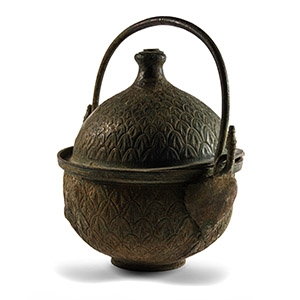
Byzantine Bronze Cooking Cauldron with Lidded Container for Steaming
5th-6th century A.D.Sold for (Inc. bp): £780
Composed of a hemispherical body and piriform lid with flange to the equator, hollow-formed lid and base with foot and removeable balustered finial with discoid cap to apex; body with two leaf-shaped plaques with loops to support the articulate round-section handle; body and lid decorated with dense feather or leaf detailing; very rare to find as complete. 406 grams, 16 cm high
cracked
Acquired 1969-1999. From the private collection of the late Mr S.M., London, UK, thence by descent. -
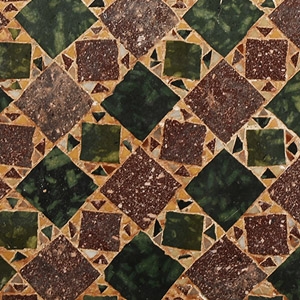
Byzantine Cosmatesque Marble Mosaic Panel
12th-13th century A.D.Sold for (Inc. bp): £9,100
Recalling workmanship similar to that found in the floor of the Sistine Chapel, comprising a large central panel with a design of alternating green and speckled porphyry lozenges, with interstitial green and porphyry squares flanked by a green or porphyry triangle on each edge; border of plain marble and outer band of green and porphyry roundels made up from vesica-shaped panels with inset squares and triangles. 23.5 kg, 53.5 cm
French gallery, Paris, 1990s. From a family collection. Accompanied by an academic report by Dr Raffaele D'Amato. This lot has been checked against the Interpol Database of stolen works of art and is accompanied by search certificate number no.203555.
The Cosmatesque style was a characteristic type of ornamentation of Eastern Roman origin (opus alexandrinum) used by post-Roman marble makers of the 12th and 13th centuries A.D. It embellishes the floors, ciboria and cloisters of churches by means of polychrome marble inlays of varied and imaginative geometric shapes. The wider use of this decoration began in the 12th century, at which time techniques were improved: the Cosmati floors were made with pieces of stone cut in various shapes and sizes, a property quite different from the mosaics in opus tessellatum, in which the motifs were made from small units all having the same size and shape, or from the opus sectile, intended to create representations with pieces of multi-coloured marble cut out and arranged for this purpose. The stones used by Cosmati artists were often material salvaged from the ruins of ancient Roman buildings. The composition of such mosaics recalls the floors of the most important churches of Rome; in addition to the floor of the Sistine Chapel (created probably in the 14th century for the previous building or Cappella Maggiore), one can cite that of Santa Maria Maggiore (1145-1153 A.D.), San Giovanni in Laterano (14th century A.D.), Saint Clement (1099-1120 A.D.), Santi Quattro Coronati (13th century A.D.), Santa Croce in Gerusalemme (12th century A.D.) and many others. The same technique (but differing in its design, materials and motifs) was used to create the Cosmati pavement in Westminster Abbey, where the king rests during the coronation ceremony. The pavement has undergone a major cleaning and conservation programme and was re-dedicated by the Dean at a service on 21st May 2010. -
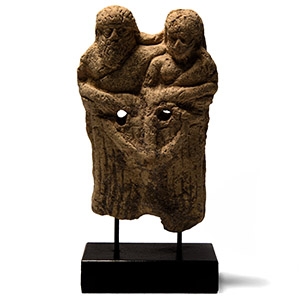
Old Babylonian Terracotta Couple
Circa 2000 B.C.Sold for (Inc. bp): £650
Modelled in the half-round as a mature male figure with full beard, his left arm around the shoulder of the female figure next to him, her garment covering one side of her chest and shoulder, each using one hand to grip a panel of fabric covering their lower bodies (perhaps a bed sheet); two piercings; mounted on a custom-made display stand. 285 grams total, 14.5 cm high including stand
Acquired 1969-1999. From the private collection of the late Mr S.M., London, UK, thence by descent. -
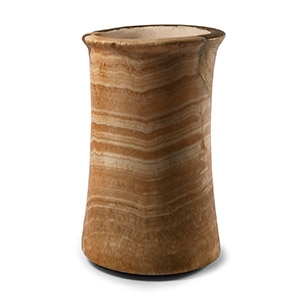
Western Asiatic Alabaster Vessel
2nd-1st millennium B.C.Sold for (Inc. bp): £845
Columnar in form with waisted profile and everted rim, restored. 2.1 kg total, 19.5 cm high
with a London, UK gallery 1971-early 2000s. -
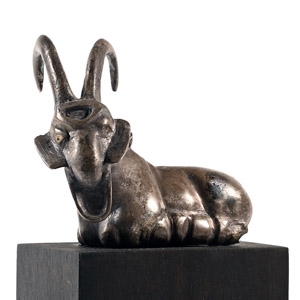
Proto-Elamite Silver Ibex Figurine
3rd millennium B.C.Sold for (Inc. bp): £7,800
Modelled in the round in a resting position with its legs folded underneath the body; the head turned to the left, large curving horns, applied glass paste for the eyes; small loop to the back; repaired and mounted on a custom-made display stand. 222 grams total, 14 cm (including base)
Ex private collection, 1960s-1970s. Accompanied by an academic report by Dr Raffaele D’Amato. Accompanied by a copy of metallurgic analytical results, written by metallurgist Dr Peter Northover (ex Department of Materials, Materials Science-Based Archaeology Group & Department of Materials, University of Oxford). This lot has been checked against the Interpol Database of stolen works of art and is accompanied by search certificate number no.11743-202215.
Like the silver-gilt mountain goat in the Boston Museum, it is possible that this figure originally had applied gilded elements.
