
Auction Highlights
-
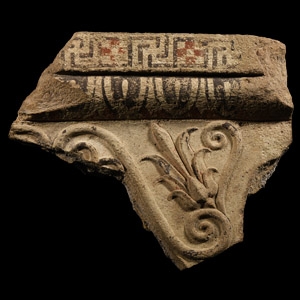
Etruscan Painted Terracotta Architectural Cornice
Sold for (Inc. bp): £3,900
A fragment of amorphous form, decorated in relief with scrolling tendrils and anthemion, painted egg-and-dart ornament above, surmounted by moulded bands and a frieze of meander and chequerboard panels; remains of red and black painted pigment. -
.jpg)
Roman Bronze Eros Cradling Goose Applique
Sold for (Inc. bp): £1,950
Formed as the bust of Eros looking upwards, stub wings to his shoulders, holding a goose to his chest; conical socket above each wing; eyes with silver inserts; old collector's label '1994 51.75' to the reverse; mounted on a custom-made stand; likely a socket base. -
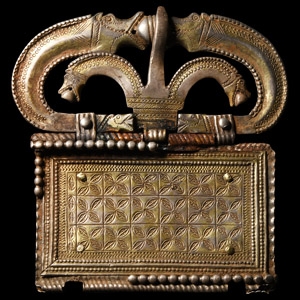
Roman Silver-Gilt Military Buckle for an Elite Imperial Officer
Sold for (Inc. bp): £7,800
Comprising a rectangular plate, richly decorated with embossed laurel leaves in a grid, framed with raised bosses, the buckle loop comprising opposing dragons with open mouths, holding a spherical tongue-rest, another pair of smaller dragon heads to base, the tongue with a smaller pair of punch-decorated dragon heads. -
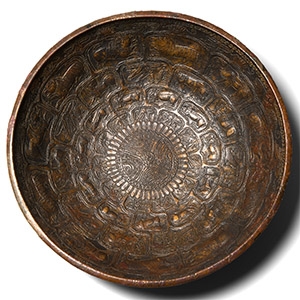
South Arabian Bronze Bowl with Mythical Animals
Sold for (Inc. bp): £5,850
Hemispherical in form, repoussé interior displaying graduated concentric registers of stylised and mythical animals within tessellating cartouches; a low relief mesomphalos decorated with rosette at centre; geometric ornament around the rim. -
.jpg)
Assyrian Bronze Relief Fragment
Sold for (Inc. bp): £16,900
Displaying a corrugated rim above and below; two advancing soldiers, each striding forwards over the headless body of a dead enemy, carrying a severed head in each hand; the soldiers shown bearded and each wearing a pointed and segmented helmet with a recess to accommodate the ears, a cuirass and thigh-length tunic, with a bow over one shoulder and a sword slung from a waist belt; mounted on a custom-made display stand. -
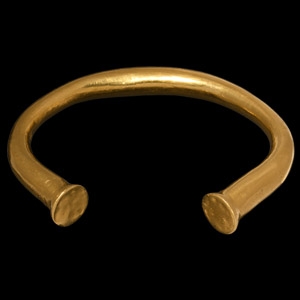
Bronze Age Gold Bracelet with Torc-Shaped Terminals
Sold for (Inc. bp): £11,440
Of penannular form with expanded sections at the centre and to both shoulders. -
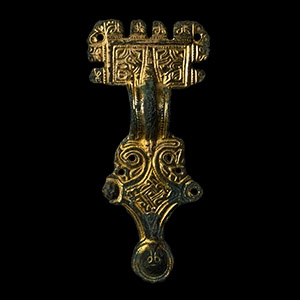
'The Oving' Anglo-Saxon Gilt Bronze Great Square-Headed Brooch
Sold for (Inc. bp): £4,160
Comprising a rectangular headplate with two panels of chip-carved Style I ornament, flanking a beast-head with triangular muzzle and two pellet eyes, raised three-sided frame and outer band of pellets above beast-heads with lentoid eyes; the shallow bow with raised median rib, flanges to the edges and punched pellet detailing; footplate with beast-head between curved pellet lines, pierced horse-head lappets, lozengiform central panel with knot of Style I limbs; two lateral discs, one pierced to accept a stud and the other with a domed stud in place; the finial a disc with human mask inverted; pin-lug and part of catch to the reverse. -
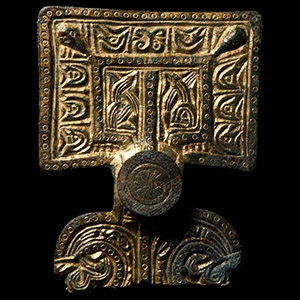
Anglo-Saxon Gilt Bronze Great Square-Headed Brooch
Sold for (Inc. bp): £3,900
Displaying chased panels populated with Style I zoomorphs and geometric forms, borders of annulets, raised masks to the upper corners of the headplate; applied discoid boss to bow decorated with a rosette, addorsed beast heads below; extensive remains of gilding; pin lug and catchplate to reverse and remains of ancient repair, lower part absent. -
.jpg)
'The Tenby' Hiberno-Norse Viking Penannular Brooch
Sold for (Inc. bp): £3,640
Comprising a round-section crescent with flared ends terminating in two curved spatulate flat panels, each with a ropework border surrounding a two-band knotwork motif; cleaned and conserved. -
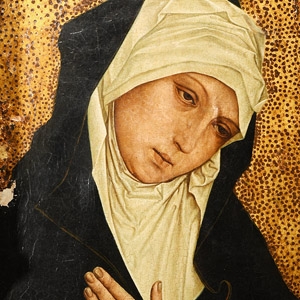
Medieval Oil Painting of Sorrowful Virgin
Sold for (Inc. bp): £9,100
The weeping Virgin with her head bowed to the left and hands raised to her chest on a dotted gilt background, an expression of pain on her delicately formed face; wearing a white veil and a black long-sleeved robe, the veil arranged as a headdress and covering her hair; on wood and mounted in a later carved wooden architectural frame. -
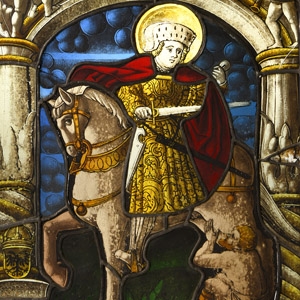
Medieval Stained Glass Panel With Saint Martin on Horseback
Sold for (Inc. bp): £2,080
Shown beneath an arcade, offering his cloak on the end of his sword to the beggar at his feet; polychrome detailing; repaired with lead cames and held in a wooden frame. -
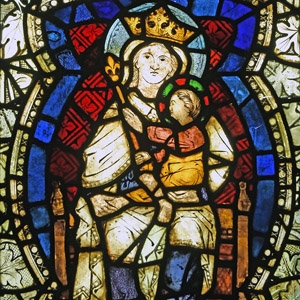
Medieval Stained Glass Panel with The Virgin and Child
Sold for (Inc. bp): £2,860
Composed from irregular painted panels bearing mainly foliage designs and figural elements; Mary crowned and enthroned with infant Jesus on her knee, in a lobed vesica-shaped panel held with lead cames; mounted in a wooden frame with modern replacements. -
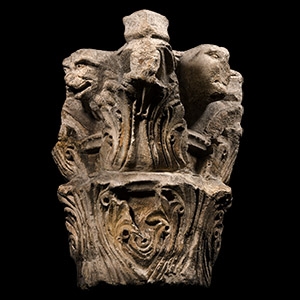
Medieval Stone Column Capital with Lion and Human Face
Sold for (Inc. bp): £1,950
Carved in the half-round with a frieze composed of interlaced foliage with two rows of acanthus leaves and foliage scrolls, framing a lion's head on one side and a human head on the other, remains of lion's mane to the third; drilled holes to the raised surfaces and sockets for the insertion of decorative stones. -
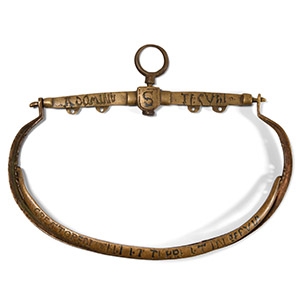
'The Kirkleavington' Medieval Bronze Inscribed Purse Frame
Sold for (Inc. bp): £3,640
The bar with central D-shaped block pierced vertically by a stud surmounted by the suspension loop, with four pierced flanges to the underside; the frame in two sections, the larger a U-shaped rod with pivot for the bar, the smaller pivoting within the inner face, both pierced on the inner face; the block inscribed to one face with capital S and to the other with intersecting Vs; the bar inscribed to one face in capitals 'A DOMINI TECVM' and to the other in coarsely incised capitals 'AVEMARIA G[R]ACIAPLE[NA]'; the smaller rod inscribed in capitals 'CREATOREN CELI ET TERRE ET IN [IES]VN'; the larger inscribed with a band of scrolled decoration and the text in Lombardic capitals 'SOLI DEO HONOR ET GLORIA'; the accompanying letter discusses the texts (1) Ave Maria G[r]acia ple[n]a Dominus Tecum 'Hail Mary full of grace, the Lord [is] with thee'; (2) Soli Deo Honor et Gloria 'Honour and glory to God alone'; (3) Creatorem celi et terrae et inferum 'creator of heaven and earth and in Jesus'. The intersecting Vs may form a monogram for A[ve] M[aria]; the 1847 letter describes the findspot as 'found at Kirkleavington near Yarm in the sill of a brook' in the North Riding of Yorkshire. -
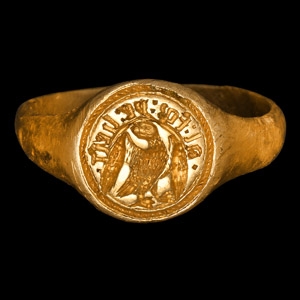
'The Roxwell' Medieval Gold Signet Ring of 'King's Serjeant William Skrene'
Sold for (Inc. bp): £23,400
Gold hoop and discoid bezel with incuse ropework border; incuse image of a bird of prey perching with wings spread and head turned; blackletter incuse and reversed inscription in an arc above the bird's head and pinions '·al : for : ye : best ·' (all for the best); repair to hoop. -
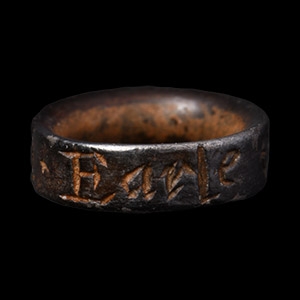
Medieval Silver 'Edmund Plantagenet, Earl of Rutland' Royal Hawking Vervel
Sold for (Inc. bp): £9,750
Or a leg ring inscribed '+Earle of Rutland' in derivative black letter script, for a female merlin or sparrow hawk (due to the youth of Edmund Plantagenet who died aged 17); the ring with a convex interior face. -
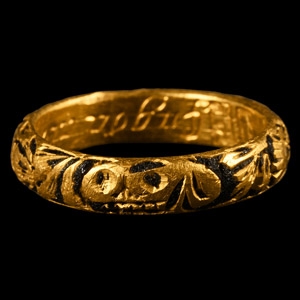
Post Medieval Gold Memento Mori Ring with Inscribed Posy 'In God Alone Wee Two Are One'
Sold for (Inc. bp): £4,680
Displaying large flower heads, foliage and a skull to the outer face, enhanced with black enamelling; interior inscribed in a cursive script 'In god alone wee two are one', together with possible maker's stamps 'D' and 'F' in two rectangular cartouches. -
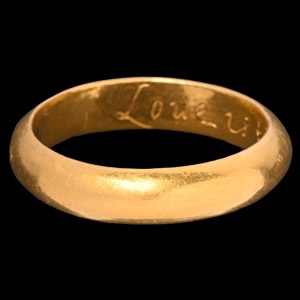
Heavy Post Medieval Gold 'Love Is The Bond Of Pease' Posy Ring
Sold for (Inc. bp): £2,860
Composed of a gently carinated hoop, the interior inscribed in cursive script 'Love is the bond of pease'. -
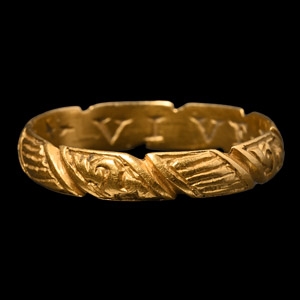
Post Medieval Gold 'Live Life to the Full' Decorated Posy Ring
Sold for (Inc. bp): £3,380
Composed of a decoratively notched hoop divided into chased rhomboidal panels displaying foliate tendrils and horizontal hatching alternately; the interior inscribed in Roman capitals with the Latin phrase: 'x x x x VIVE x VT x VIVAS'. -
![English Milled Coins - George VI - 1937 - Cased RM Proof Coronation Gold Set [4]](https://timelineauctions.com/upload/images/items/small/203351-s(2).jpg)
English Milled Coins - George VI - 1937 - Cased RM Proof Coronation Gold Set [4]
Sold for (Inc. bp): £11,700
Set comprising gold five pounds, two pounds, sovereign and half sovereign. Obvs: profile bust with GEORGIVS VI D G BR OMN REX F D IND IMP legends. Revs: St George and dragon; date in exergue; with original Royal Mint hinged red leatherette case of issue.
-
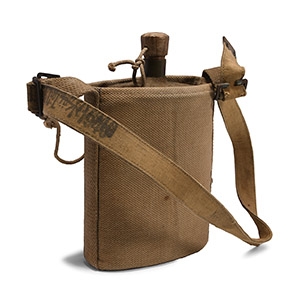
British WWII Water Bottle
Dated 1940 A.D.Sold for (Inc. bp): £39
Felt covered steel water bottle of oval cylindrical shape with wood plug stopper with cord retainer and fitted with canvas carry cover and shoulder strap with printed 'H S & CO Ltd ' maker name and War Department 'broad arrow' mark and date. 592 grams, bottle 23.5 cm high
The Kusmirek Collection, UK. -
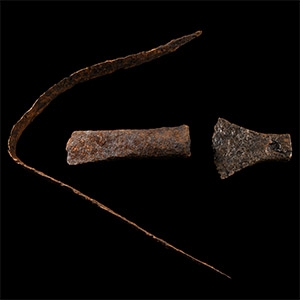
Iron Age Celtic Sacrificed Sword and Axehead Group
2nd century B.C.-1st century A.D.Sold for (Inc. bp): £312
Ritualistically bent in the middle of the blade; together with two socketted axeheads, one Roman, one Celtic. 1.25 kg total, 10-60 cm
Acquired 1990s-early 2000s. East Anglian private collection. -
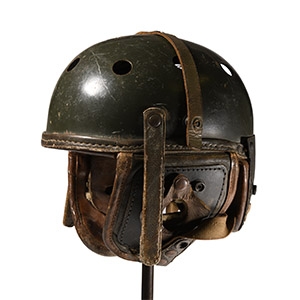
United States M38 Tank Crew Helmet
Circa 1940's A.D.Sold for (Inc. bp): £143
Rawling's pattern M38 composition tank crew helmet with neck protection plate and ear-flaps, fitted with leather lining with leather and fabric securing straps; finished dark green; with later inked 'CESARE' owner name and '1-5-79' date to liner. 613 grams, 27 cm high
Acquired from Czerny's Auction, lot 81515. The Kusmirek Collection, UK. Accompanied by copy of a previous invoice and lot description.
Possibly of Italian manufacture of the type used by US forces in WWII. -
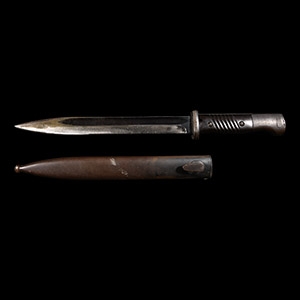
German M1884/98 Third Model Bayonet and Scabbard
Dated 1940 A.D.Sold for (Inc. bp): £55
Comprising a knife bayonet for use with the Second World War 8 mm Mauser Kar 98k rifle; fitted with resin grip scales and spring release button; scabbard with original throat and chape. 588 grams, 40.5 cm
Property of a Luton, UK gentleman, by inheritance.
The bayonet offered here is an example of the third pattern of bayonet manufactured in 1927-1930 and again in the period 1934-1935, with this specific example having been produced in 1935. In an attempt to keep their identities a secret, the makers of these weapons stamped the blades with a letter/number code, a practice they repeated for the scabbards. This scabbard bears the code for 1943, although it was double struck. Both blade and scabbard in this instance were produced by E. & F. Horster & Co. of Solingen, and the weapon is apparently a pre-war example that was captured and reworked in eastern Europe, likely Yugoslavia. The plastic grips such as those used on our bayonet, and typically found on M1884/98 III bayonets, are made from a phenolic resin. Owing to a shortage of such resin in Germany during WWII a substitute moulding compound known as type 41, which contained a much lower percentage of resin, was adopted in January 1943. -
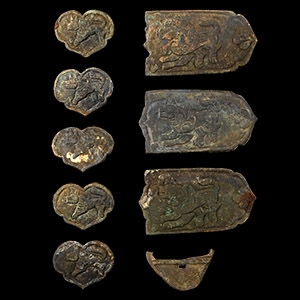
Volga Bulgar Bronze Lion Belt Mount Group
10th-12th century A.D.Sold for (Inc. bp): £195
Comprising three mounts with bounding lion motifs, five heart-shaped mounts also showing leaping lions and a plain semi-circular mount; all with mounting lugs to reverse. 67 grams total, 27-52 mm
From the collection of a North American gentleman, formed in the 1990s. -
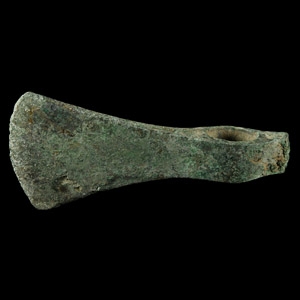
Large Western Asiatic Bronze Socketted Axehead
2nd-1st millennium B.C.Sold for (Inc. bp): £130
Featuring wedge-shaped cheeks, oval socket and narrow butt. 922 grams, 21 cm
Acquired 1980-2015. Ex Abelita family collection. -
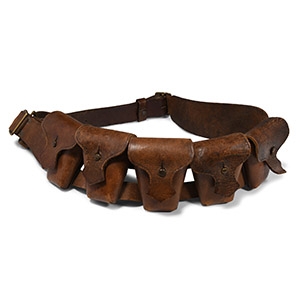
British Leather Ammunition Pouch Belt
1940s A.D.Sold for (Inc. bp): £26
A leather belt with brass buckles to which are rivetted five leather cartridge holders each with internal retaining strap and cover; the reverse of the belt stamped '2575665'. 591 grams, 90 cm long
The Kusmirek Collection, UK. -
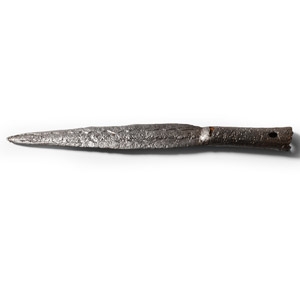
Viking Socketted Spearhead
10th-14th century A.D.Sold for (Inc. bp): £91
The leaf-shaped head with full-length midrib to both faces, tapering round-section socket with piercing for attachment to an organic shaft. 70 grams, 22 cm
Ex Surrey collection, formed 1990-2000. Acquired from TimeLine Auctions 2016, lot 162 (part). The Kusmirek Collection, UK. -
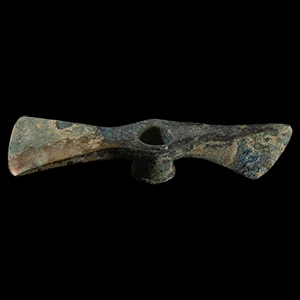
Large Western Asiatic Bronze Adze-Axehead
2nd-1st millennium B.C.Sold for (Inc. bp): £117
Composed of a central cylindrical socket with collar to base and gently triangular flanges to upper face, a wedge-shaped adze-head to one side and a wedge-shaped axe head to the other, both with gently convex cutting edges. 1.1 kg, 25 cm
Acquired 1980-2015. Ex Abelita family collection. -
.jpg)
Luristan Bronze Butted Axe
3rd-2nd millennium B.C.Sold for (Inc. bp): £312
The cylindrical shaft decorated with three bosses, blade with diverging edges, the upper sides of the hole and part of the blade decorated with a dotted pattern. 375 grams, 17.5 cm
Fine condition.
Acquired 1980-2015. Ex Abelita family collection.
The earliest Luristan bronze weapons, particularly daggers, axes, and adzes, share many similarities in form with Mesopotamian artefacts of the 3rd millennium BC. The unadorned weapons, especially the axes, adzes and picks, were made using simple clay or stone bivalve moulds with a core inserted into them to form the socket for the shaft. -
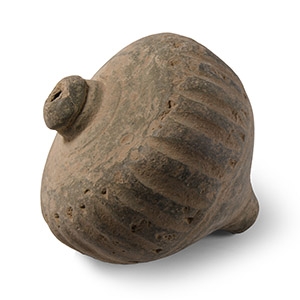
Byzantine 'Greek Fire' Fire Bomb or Hand Grenade
9th-11th century A.D.Sold for (Inc. bp): £143
Of squat piriform shape with shallow vertical dashes decorating the upper body, stamped triangles above and below. 579 grams, 10.4 cm
Family collection, acquired 1980-2015. Ex property of a North London gentleman. Accompanied by an academic paper by military specialist Dr Raffaele D'Amato, dated 15 July 2019 and titled 'Eastern Roman Empire - Greek Fire Bomb or Hand Grenade (μεσαίον kακάβιον) 9th-11th century AD'.
Apart from the use of siphons or manual flame-throwers called cheirosiphona, special corps of Roman soldiers employed terracotta grenades, in the form of small jars, abundantly evidenced in archaeological excavations. Such were the γανωτα, vessels (sometimes also of bronze) used for Greek fire. They were called μεσαία kακαβιά or κυτροκακάβια where the former had a bulbous shape and the latter a more cylindrical form. -
.jpg)
Post Medieval Horseman's Axe
Late 17th century A.D. or laterSold for (Inc. bp): £546
Featuring an openwork blade stamped with maker's marks on both faces: three punched starburst marks to one face, starburst and cross with two pellets to the reverse; later wooden shaft, collar and rivet. 740 grams, 67 cm
Acquired 1990s-early 2000s. East Anglian private collection.
