
Auction Highlights
-
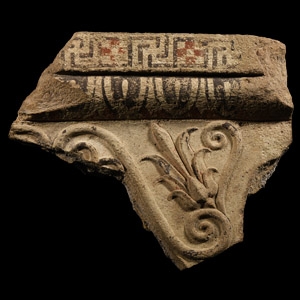
Etruscan Painted Terracotta Architectural Cornice
Sold for (Inc. bp): £3,900
A fragment of amorphous form, decorated in relief with scrolling tendrils and anthemion, painted egg-and-dart ornament above, surmounted by moulded bands and a frieze of meander and chequerboard panels; remains of red and black painted pigment. -
.jpg)
Roman Bronze Eros Cradling Goose Applique
Sold for (Inc. bp): £1,950
Formed as the bust of Eros looking upwards, stub wings to his shoulders, holding a goose to his chest; conical socket above each wing; eyes with silver inserts; old collector's label '1994 51.75' to the reverse; mounted on a custom-made stand; likely a socket base. -
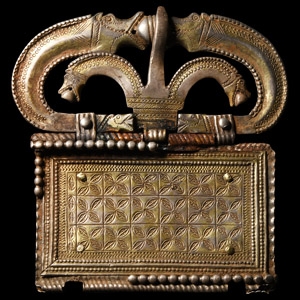
Roman Silver-Gilt Military Buckle for an Elite Imperial Officer
Sold for (Inc. bp): £7,800
Comprising a rectangular plate, richly decorated with embossed laurel leaves in a grid, framed with raised bosses, the buckle loop comprising opposing dragons with open mouths, holding a spherical tongue-rest, another pair of smaller dragon heads to base, the tongue with a smaller pair of punch-decorated dragon heads. -
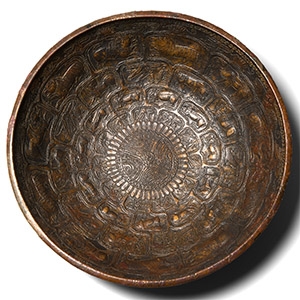
South Arabian Bronze Bowl with Mythical Animals
Sold for (Inc. bp): £5,850
Hemispherical in form, repoussé interior displaying graduated concentric registers of stylised and mythical animals within tessellating cartouches; a low relief mesomphalos decorated with rosette at centre; geometric ornament around the rim. -
.jpg)
Assyrian Bronze Relief Fragment
Sold for (Inc. bp): £16,900
Displaying a corrugated rim above and below; two advancing soldiers, each striding forwards over the headless body of a dead enemy, carrying a severed head in each hand; the soldiers shown bearded and each wearing a pointed and segmented helmet with a recess to accommodate the ears, a cuirass and thigh-length tunic, with a bow over one shoulder and a sword slung from a waist belt; mounted on a custom-made display stand. -
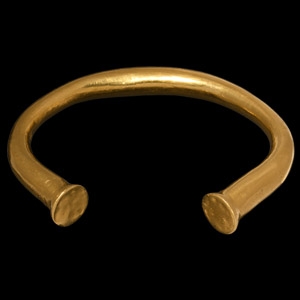
Bronze Age Gold Bracelet with Torc-Shaped Terminals
Sold for (Inc. bp): £11,440
Of penannular form with expanded sections at the centre and to both shoulders. -
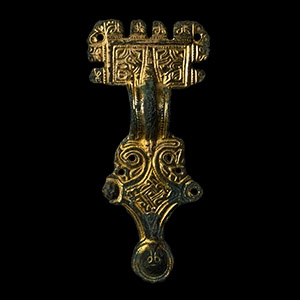
'The Oving' Anglo-Saxon Gilt Bronze Great Square-Headed Brooch
Sold for (Inc. bp): £4,160
Comprising a rectangular headplate with two panels of chip-carved Style I ornament, flanking a beast-head with triangular muzzle and two pellet eyes, raised three-sided frame and outer band of pellets above beast-heads with lentoid eyes; the shallow bow with raised median rib, flanges to the edges and punched pellet detailing; footplate with beast-head between curved pellet lines, pierced horse-head lappets, lozengiform central panel with knot of Style I limbs; two lateral discs, one pierced to accept a stud and the other with a domed stud in place; the finial a disc with human mask inverted; pin-lug and part of catch to the reverse. -
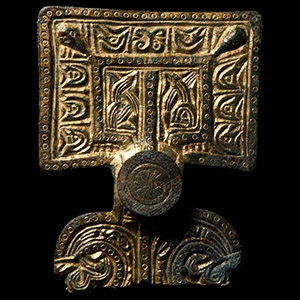
Anglo-Saxon Gilt Bronze Great Square-Headed Brooch
Sold for (Inc. bp): £3,900
Displaying chased panels populated with Style I zoomorphs and geometric forms, borders of annulets, raised masks to the upper corners of the headplate; applied discoid boss to bow decorated with a rosette, addorsed beast heads below; extensive remains of gilding; pin lug and catchplate to reverse and remains of ancient repair, lower part absent. -
.jpg)
'The Tenby' Hiberno-Norse Viking Penannular Brooch
Sold for (Inc. bp): £3,640
Comprising a round-section crescent with flared ends terminating in two curved spatulate flat panels, each with a ropework border surrounding a two-band knotwork motif; cleaned and conserved. -
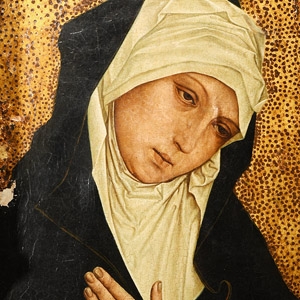
Medieval Oil Painting of Sorrowful Virgin
Sold for (Inc. bp): £9,100
The weeping Virgin with her head bowed to the left and hands raised to her chest on a dotted gilt background, an expression of pain on her delicately formed face; wearing a white veil and a black long-sleeved robe, the veil arranged as a headdress and covering her hair; on wood and mounted in a later carved wooden architectural frame. -
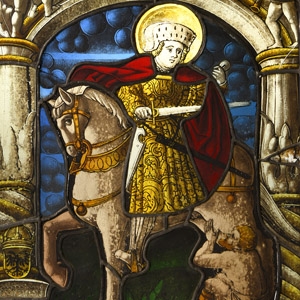
Medieval Stained Glass Panel With Saint Martin on Horseback
Sold for (Inc. bp): £2,080
Shown beneath an arcade, offering his cloak on the end of his sword to the beggar at his feet; polychrome detailing; repaired with lead cames and held in a wooden frame. -
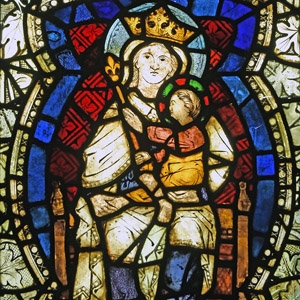
Medieval Stained Glass Panel with The Virgin and Child
Sold for (Inc. bp): £2,860
Composed from irregular painted panels bearing mainly foliage designs and figural elements; Mary crowned and enthroned with infant Jesus on her knee, in a lobed vesica-shaped panel held with lead cames; mounted in a wooden frame with modern replacements. -
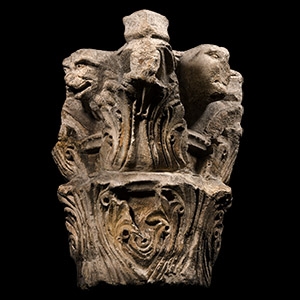
Medieval Stone Column Capital with Lion and Human Face
Sold for (Inc. bp): £1,950
Carved in the half-round with a frieze composed of interlaced foliage with two rows of acanthus leaves and foliage scrolls, framing a lion's head on one side and a human head on the other, remains of lion's mane to the third; drilled holes to the raised surfaces and sockets for the insertion of decorative stones. -
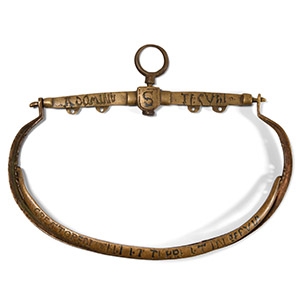
'The Kirkleavington' Medieval Bronze Inscribed Purse Frame
Sold for (Inc. bp): £3,640
The bar with central D-shaped block pierced vertically by a stud surmounted by the suspension loop, with four pierced flanges to the underside; the frame in two sections, the larger a U-shaped rod with pivot for the bar, the smaller pivoting within the inner face, both pierced on the inner face; the block inscribed to one face with capital S and to the other with intersecting Vs; the bar inscribed to one face in capitals 'A DOMINI TECVM' and to the other in coarsely incised capitals 'AVEMARIA G[R]ACIAPLE[NA]'; the smaller rod inscribed in capitals 'CREATOREN CELI ET TERRE ET IN [IES]VN'; the larger inscribed with a band of scrolled decoration and the text in Lombardic capitals 'SOLI DEO HONOR ET GLORIA'; the accompanying letter discusses the texts (1) Ave Maria G[r]acia ple[n]a Dominus Tecum 'Hail Mary full of grace, the Lord [is] with thee'; (2) Soli Deo Honor et Gloria 'Honour and glory to God alone'; (3) Creatorem celi et terrae et inferum 'creator of heaven and earth and in Jesus'. The intersecting Vs may form a monogram for A[ve] M[aria]; the 1847 letter describes the findspot as 'found at Kirkleavington near Yarm in the sill of a brook' in the North Riding of Yorkshire. -
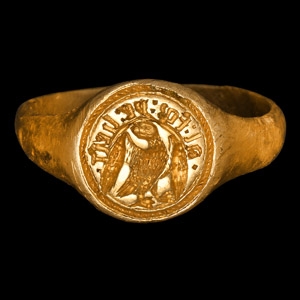
'The Roxwell' Medieval Gold Signet Ring of 'King's Serjeant William Skrene'
Sold for (Inc. bp): £23,400
Gold hoop and discoid bezel with incuse ropework border; incuse image of a bird of prey perching with wings spread and head turned; blackletter incuse and reversed inscription in an arc above the bird's head and pinions '·al : for : ye : best ·' (all for the best); repair to hoop. -
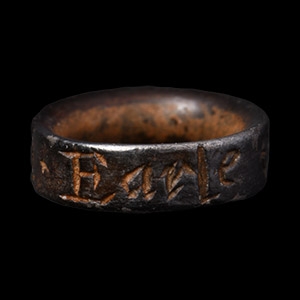
Medieval Silver 'Edmund Plantagenet, Earl of Rutland' Royal Hawking Vervel
Sold for (Inc. bp): £9,750
Or a leg ring inscribed '+Earle of Rutland' in derivative black letter script, for a female merlin or sparrow hawk (due to the youth of Edmund Plantagenet who died aged 17); the ring with a convex interior face. -
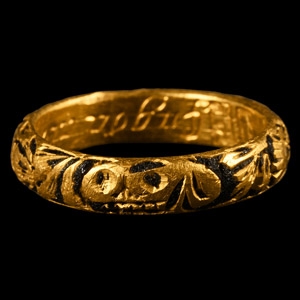
Post Medieval Gold Memento Mori Ring with Inscribed Posy 'In God Alone Wee Two Are One'
Sold for (Inc. bp): £4,680
Displaying large flower heads, foliage and a skull to the outer face, enhanced with black enamelling; interior inscribed in a cursive script 'In god alone wee two are one', together with possible maker's stamps 'D' and 'F' in two rectangular cartouches. -
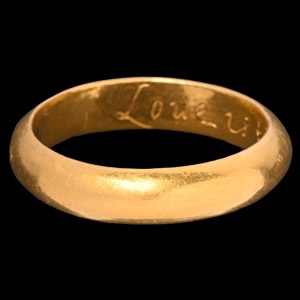
Heavy Post Medieval Gold 'Love Is The Bond Of Pease' Posy Ring
Sold for (Inc. bp): £2,860
Composed of a gently carinated hoop, the interior inscribed in cursive script 'Love is the bond of pease'. -
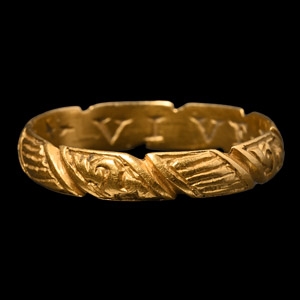
Post Medieval Gold 'Live Life to the Full' Decorated Posy Ring
Sold for (Inc. bp): £3,380
Composed of a decoratively notched hoop divided into chased rhomboidal panels displaying foliate tendrils and horizontal hatching alternately; the interior inscribed in Roman capitals with the Latin phrase: 'x x x x VIVE x VT x VIVAS'. -
![English Milled Coins - George VI - 1937 - Cased RM Proof Coronation Gold Set [4]](https://timelineauctions.com/upload/images/items/small/203351-s(2).jpg)
English Milled Coins - George VI - 1937 - Cased RM Proof Coronation Gold Set [4]
Sold for (Inc. bp): £11,700
Set comprising gold five pounds, two pounds, sovereign and half sovereign. Obvs: profile bust with GEORGIVS VI D G BR OMN REX F D IND IMP legends. Revs: St George and dragon; date in exergue; with original Royal Mint hinged red leatherette case of issue.
-
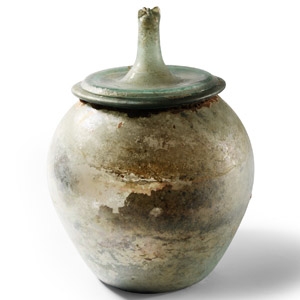
Large Roman Pale Green Glass Cinerary Urn
1st-2nd century A.D.Sold for (Inc. bp): £4,680
Of piriform shape with everted rim, gently chamfered upper lip and concave underside; lid with bevelled rim, gently dished upper face rising to a central dome and cylindrical handle with piecrust pleats; iridescent surfaces. 831 grams total, 29.5 cm high
Ex Sangiorgi collection, acquired in the 19th century. with Christie's, 3 June 1999, lot 121. The remains of a 19th/early 20th century label can be seen on the glass on one side. with Christie's, New York, 9 December 1999, lot 476. American private collection, Westchester, New York, acquired in 1999. with Bonhams, London, 30 September 2015, lot 91. Accompanied by an academic report by Dr Raffaele D'Amato. This lot has been checked against the Interpol Database of stolen works of art and is accompanied by search certificate no.203222.
A similar jar in the British Museum was found in Warwick Square, London, inside a lead canister, and was originally filled with bone ashes. The Romans often re-used glass jars, originally made for storing liquids and foodstuffs, as cremation vessels, but this kind of jar seems too fragile and was therefore probably purpose-made. The lead canister, which was found with the jar from London, protected the glass and bones. Georgio Sangiorgi is one of the most famous names associated with the field of ancient glass collecting. Working from the Galleria Sangiorgi in the Palazzo Borghese, Sangiorgi acquired the most magnificent collection of ancient glass, seeking only the finest examples. -
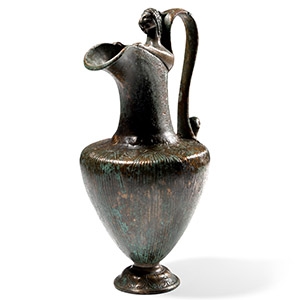
Roman Bronze Oinochoe with Lion Protome
1st century B.C.-1st century A.D.Sold for (Inc. bp): £4,680
The conical body decorated with overlapping petal-shaped panels, tapering neck with a wide spout, high arching handle with acanthus leaves, bust of a youthful male with long hair below (possibly Bacchus) the upper part terminating with a lion protome with the extended forelegs resting on the rim of the vessel, the high flaring foot possibly added later. 797 grams, 22.5 cm high
Excellent condition
Private collection, Rosenheim, Germany, 1960s. Accompanied by an academic report by Dr Raffaele D’Amato. This lot has been checked against the Interpol Database of stolen works of art and is accompanied by search certificate no.11734-201200.
Considering the primary function of oinochoe as drinking jugs, the images decorating them were often related to the god of wine, Bacchus, here probably represented as young Dionysus accompanied by a lion. -
.jpg)
Romano-British Bronze Adlocutio Type Repousse Brooch
2nd century A.D.Sold for (Inc. bp): £2,340
Imitating Hadrian's sestertius adlocutio, the emperor with a companion (or Castor and Pollux) on horseback, one of the horsemen holding a round shield; arrayed legions in front of them wearing crested helmets, raised spears and quadrangular shields; legionary eagle in the foreground; the scene enclosed within a rope border; pin lugs and catchplate to the reverse. 12.9 grams, 33 mm
From a Cambridgeshire, UK, collection, 1990s. This brooch is an extreme rarity and is believed to be the finest known example. Accompanied by an academic report by Dr Raffaele D'Amato. This lot has been checked against the Interpol Database of stolen works of art and is accompanied by search certificate number no.11747-202502.
These brooches were a mystery until one was excavated at Wiggonholt, Sussex, together with three other damaged specimens now in the Devizes Museum, all from Wiltshire (more precisely Cold Kitchen Hill). The image of the original coin was slightly modified. The local craftsman improved the coin type making his brooch more interesting, transforming the Emperor Hadrian on horseback into two cavalrymen, probably the sacred Dioscuri, while the Roman Aquila, symbol of the legions, was taken from the top of the signa and placed in the foreground. -
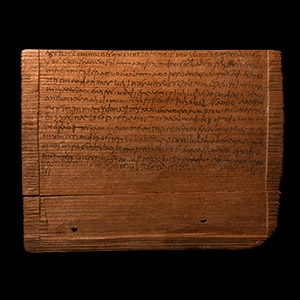
Roman Inked Wooden 'Will of Pomponius Maximinianus' Tablet
Circa 320 A.D.Sold for (Inc. bp): £5,200
Two adjoining parts of an inked wooden tablet, comprising 13 lines of text to the recessed upper face with two piercings to the lower edge; the reverse with an inked inscription reading 'TESTAMENTVUM / POMPONIMAXIMI' (the will of Pomponius Maximus); the 13 lines of inked cursive text following the grain of the wood, the text containing instructions from a will concerning the inheritance of fields on the Mustulo estate (fundus Mustulo), to a Iulius Dancharrus (son of the testator); a field with eight fig-trees, bought from a Iulius Castricius, and several sheep to 'my beloved daughter Zabullania'. 64 grams total, 19.5-20 cm wide
From an important London collection since 1975. This lot has been checked against the Interpol Database of stolen works of art and is accompanied by searcher certificate no. 200269.
The text is written in a very formulaic language typical of Roman legal-documents (among other things, familia testamenti faciundi erga emit Iul. Maianus: the entire possessions, in order to make a will, was bought by Iul. Maianus). -
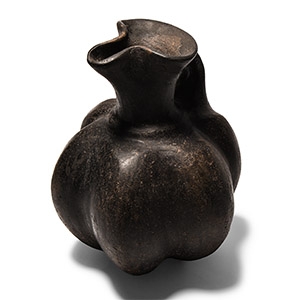
Late Roman Bucchero Jug
Circa 4th century A.D.Sold for (Inc. bp): £702
The ribbed body with gusseted strap handle and trefoil mouth. 428 grams, 15.5 cm high
with a London, UK gallery 1971-early 2000s. -
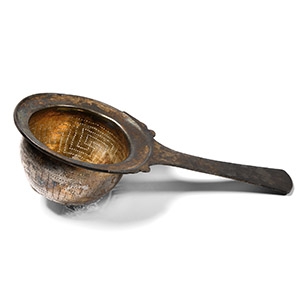
Roman Silver Wine Strainer
Circa 3rd century A.D.Sold for (Inc. bp): £2,210
Of bulbous form, with a broad everted rim, integral scallops at the neck and splayed handle, perforated floral motif to centre of bowl, scrolling waves around and Greek key pattern above; hole to bowl. 97 grams, 17.5 cm
Acquired 1990s-early 2000s. East Anglian private collection. This lot has been checked against the Interpol Database of stolen works of art and is accompanied by searcher certificate no. 200925.
Round-bowled strainers of various sizes occur in many late Roman hoards of domestic silver. They were used to strain the sediment from wine as it was poured into a drinking vessel. It is noteworthy that wine could have been a kind of gift from the Romans to the members of the foreign or provincial elite, often allies of the Roman leaders. Sets of bronze dishes (such as jars, scoops and strainers) along with glass horns (often with bronze fittings) and silver cups for drinking, usually placed in the so-called princely graves, confirm the wine consumption and indicate the area of its occurrence also outside the Empire. -
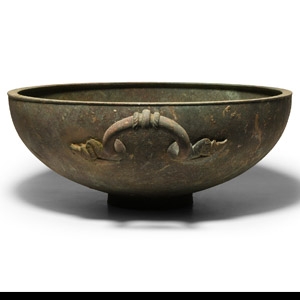
Large Roman Bronze Bowl with Handle
5th-6th century A.D.Sold for (Inc. bp): £2,600
Broad squat vessel with flat inturned rim, curved round-section handle with median collars, attachment plates formed as leaves and profile beast-heads; shallow basal ring. 1.97 kg, 33.5 cm wide
German private collection, 1980s. This lot has been checked against the Interpol Database of stolen works of art and is accompanied by search certificate no.201190. -
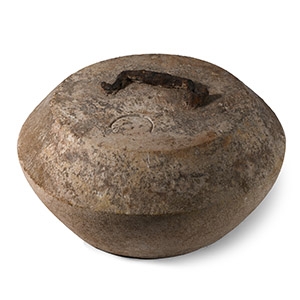
Large Roman Stone Centenarius Weight with Handle
2nd-3rd century A.D.Sold for (Inc. bp): £2,106
Of biconical form and bearing an engraved letter 'C' to the top face; slightly concave base; iron handle showing some corrosion. 30.3 kg, 35 cm wide
Ex Gorny & Mosch 11th July 2006, auction 150, lot 543. East Anglian private collection. This lot has been checked against the Interpol Database of stolen works of art and is accompanied by search certificate no.199905.
The letter C likely represents the Roman numeral Centenarius, or 100 Roman lbs. -
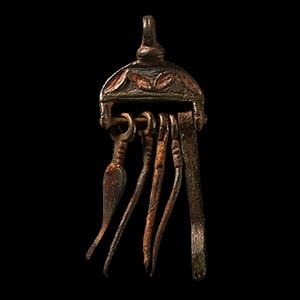
Romano-British Bronze Chatelaine Hanger with Toilet Implements
1st-3rd century A.D.Sold for (Inc. bp): £975
The crescent-shaped body decorated with champlevé enamel in pinkish red and blue, a suspension loop projecting from the upper edge and two perforated lugs projecting from each of the lower corners, attached bar with suspended tweezers, nail cleaner, ear spoon and pick. 30 grams, 81 mm
Ex Cambridgeshire, UK, collection, 1990s.
The champlevé enamel of this toilette hanger is a clear example of provincial Roman decorative patterns. Such enamelled chatelaine brooches, with toilet sets affixed, were a common female accoutrement, notably in Roman Britain. -
Roman Silver-Gilt Military Buckle for an Elite Imperial Officer
4th-5th century A.D.Sold for (Inc. bp): £7,800
Comprising a rectangular plate, richly decorated with embossed laurel leaves in a grid, framed with raised bosses, the buckle loop comprising opposing dragons with open mouths, holding a spherical tongue-rest, another pair of smaller dragon heads to base, the tongue with a smaller pair of punch-decorated dragon heads. 152 grams, 11.2 cm
Acquired before the 1970s. Ex J.L. collection, Surrey, U.K., thence by descent. This lot has been checked against the Interpol Database of stolen works of art and is accompanied by search certificate no.203881.
Most precious military buckles, like this one, were reserved for soldiers belonging to Legiones Palatinae, i.e. the legions forming part of the imperial Comitatus, accompanying the emperor in his military expeditions. -
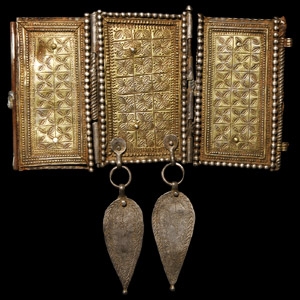
Roman Silver-Gilt Military Belt Plate Group for an Elite Imperial Officer
4th-5th century A.D.Sold for (Inc. bp): £4,160
Comprising three rectangular belt fittings: two with similar laurel leaf decoration and raised border, the third central plaque with two foliate pendants with punched decoration. 243 grams, 17 cm
Very fine, excellent condition
Acquired before the 1970s. Ex J.L. collection, Surrey, U.K., thence by descent.
Most precious military belts were reserved for soldiers belonging to Legiones Palatinae, i.e. the legions forming part of the imperial Comitatus, accompanying the emperor in his military expeditions. -
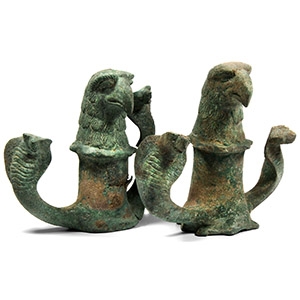
Roman Bronze Chariot Mount Pair with Eagle and Cobras
Circa 2nd-3rd century A.D.Sold for (Inc. bp): £6,110
Each protome composed of a gently tapering shallow octagonal body, the upper part formed as an eagle's head with semi-naturalistic hooked beak, eye and feather detailing, collar at the base of the neck decorated with crenelated borders; two upward curving arms terminating with stylised cobra heads; one with impact damage from a crash(?). 2.1 kg total, 13-13.7 cm
Regular green patina, in general very fine condition, except the broken head of one cobra.
Private collection, Rosenheim, Germany, 1960s. Accompanied by an academic report by Dr Raffaele D'Amato. This lot has been checked against the Interpol Database of stolen works of art and is accompanied by search certificate number no.11732-201194.
These chariot fittings were usually elements surmounting the axle, a sort of sheath allowing the suspension from the body of the cart to the wagon box using belts. The chariot (currus) which these fittings adorned may have been used for transporting wealthy and aristocratic individuals, although most probably it was a tensa, i.e. a triumphal chariot or a ceremonial vehicle upon which images and symbols of divinities were placed.
