
Auction Highlights
-
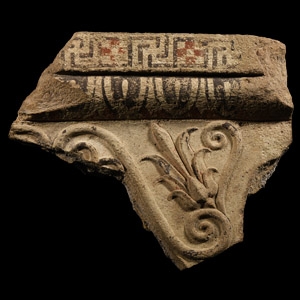
Etruscan Painted Terracotta Architectural Cornice
Sold for (Inc. bp): £3,900
A fragment of amorphous form, decorated in relief with scrolling tendrils and anthemion, painted egg-and-dart ornament above, surmounted by moulded bands and a frieze of meander and chequerboard panels; remains of red and black painted pigment. -
.jpg)
Roman Bronze Eros Cradling Goose Applique
Sold for (Inc. bp): £1,950
Formed as the bust of Eros looking upwards, stub wings to his shoulders, holding a goose to his chest; conical socket above each wing; eyes with silver inserts; old collector's label '1994 51.75' to the reverse; mounted on a custom-made stand; likely a socket base. -
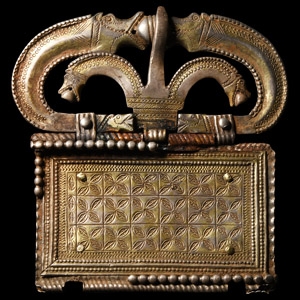
Roman Silver-Gilt Military Buckle for an Elite Imperial Officer
Sold for (Inc. bp): £7,800
Comprising a rectangular plate, richly decorated with embossed laurel leaves in a grid, framed with raised bosses, the buckle loop comprising opposing dragons with open mouths, holding a spherical tongue-rest, another pair of smaller dragon heads to base, the tongue with a smaller pair of punch-decorated dragon heads. -
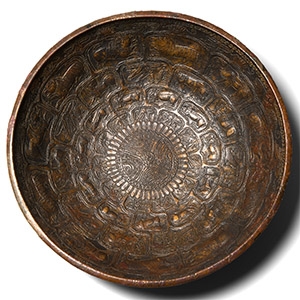
South Arabian Bronze Bowl with Mythical Animals
Sold for (Inc. bp): £5,850
Hemispherical in form, repoussé interior displaying graduated concentric registers of stylised and mythical animals within tessellating cartouches; a low relief mesomphalos decorated with rosette at centre; geometric ornament around the rim. -
.jpg)
Assyrian Bronze Relief Fragment
Sold for (Inc. bp): £16,900
Displaying a corrugated rim above and below; two advancing soldiers, each striding forwards over the headless body of a dead enemy, carrying a severed head in each hand; the soldiers shown bearded and each wearing a pointed and segmented helmet with a recess to accommodate the ears, a cuirass and thigh-length tunic, with a bow over one shoulder and a sword slung from a waist belt; mounted on a custom-made display stand. -
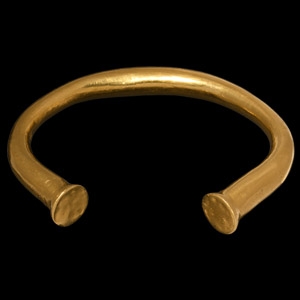
Bronze Age Gold Bracelet with Torc-Shaped Terminals
Sold for (Inc. bp): £11,440
Of penannular form with expanded sections at the centre and to both shoulders. -
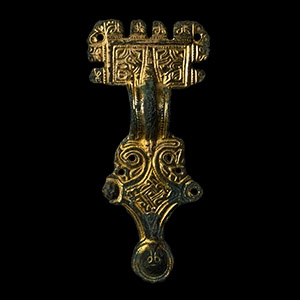
'The Oving' Anglo-Saxon Gilt Bronze Great Square-Headed Brooch
Sold for (Inc. bp): £4,160
Comprising a rectangular headplate with two panels of chip-carved Style I ornament, flanking a beast-head with triangular muzzle and two pellet eyes, raised three-sided frame and outer band of pellets above beast-heads with lentoid eyes; the shallow bow with raised median rib, flanges to the edges and punched pellet detailing; footplate with beast-head between curved pellet lines, pierced horse-head lappets, lozengiform central panel with knot of Style I limbs; two lateral discs, one pierced to accept a stud and the other with a domed stud in place; the finial a disc with human mask inverted; pin-lug and part of catch to the reverse. -
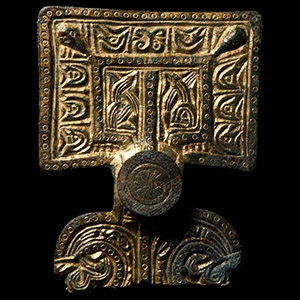
Anglo-Saxon Gilt Bronze Great Square-Headed Brooch
Sold for (Inc. bp): £3,900
Displaying chased panels populated with Style I zoomorphs and geometric forms, borders of annulets, raised masks to the upper corners of the headplate; applied discoid boss to bow decorated with a rosette, addorsed beast heads below; extensive remains of gilding; pin lug and catchplate to reverse and remains of ancient repair, lower part absent. -
.jpg)
'The Tenby' Hiberno-Norse Viking Penannular Brooch
Sold for (Inc. bp): £3,640
Comprising a round-section crescent with flared ends terminating in two curved spatulate flat panels, each with a ropework border surrounding a two-band knotwork motif; cleaned and conserved. -
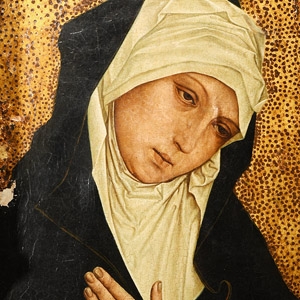
Medieval Oil Painting of Sorrowful Virgin
Sold for (Inc. bp): £9,100
The weeping Virgin with her head bowed to the left and hands raised to her chest on a dotted gilt background, an expression of pain on her delicately formed face; wearing a white veil and a black long-sleeved robe, the veil arranged as a headdress and covering her hair; on wood and mounted in a later carved wooden architectural frame. -
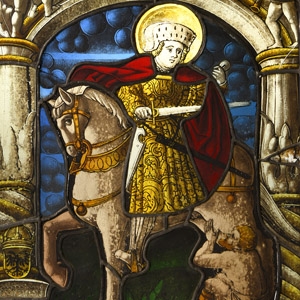
Medieval Stained Glass Panel With Saint Martin on Horseback
Sold for (Inc. bp): £2,080
Shown beneath an arcade, offering his cloak on the end of his sword to the beggar at his feet; polychrome detailing; repaired with lead cames and held in a wooden frame. -
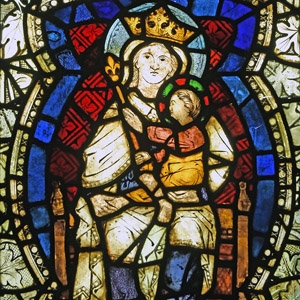
Medieval Stained Glass Panel with The Virgin and Child
Sold for (Inc. bp): £2,860
Composed from irregular painted panels bearing mainly foliage designs and figural elements; Mary crowned and enthroned with infant Jesus on her knee, in a lobed vesica-shaped panel held with lead cames; mounted in a wooden frame with modern replacements. -
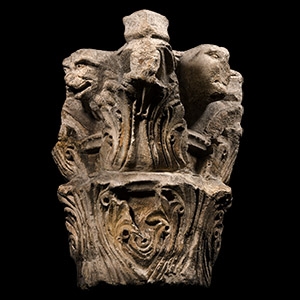
Medieval Stone Column Capital with Lion and Human Face
Sold for (Inc. bp): £1,950
Carved in the half-round with a frieze composed of interlaced foliage with two rows of acanthus leaves and foliage scrolls, framing a lion's head on one side and a human head on the other, remains of lion's mane to the third; drilled holes to the raised surfaces and sockets for the insertion of decorative stones. -
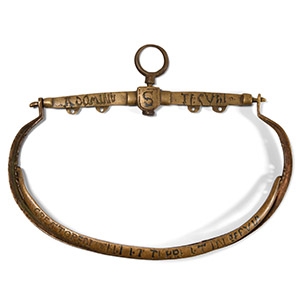
'The Kirkleavington' Medieval Bronze Inscribed Purse Frame
Sold for (Inc. bp): £3,640
The bar with central D-shaped block pierced vertically by a stud surmounted by the suspension loop, with four pierced flanges to the underside; the frame in two sections, the larger a U-shaped rod with pivot for the bar, the smaller pivoting within the inner face, both pierced on the inner face; the block inscribed to one face with capital S and to the other with intersecting Vs; the bar inscribed to one face in capitals 'A DOMINI TECVM' and to the other in coarsely incised capitals 'AVEMARIA G[R]ACIAPLE[NA]'; the smaller rod inscribed in capitals 'CREATOREN CELI ET TERRE ET IN [IES]VN'; the larger inscribed with a band of scrolled decoration and the text in Lombardic capitals 'SOLI DEO HONOR ET GLORIA'; the accompanying letter discusses the texts (1) Ave Maria G[r]acia ple[n]a Dominus Tecum 'Hail Mary full of grace, the Lord [is] with thee'; (2) Soli Deo Honor et Gloria 'Honour and glory to God alone'; (3) Creatorem celi et terrae et inferum 'creator of heaven and earth and in Jesus'. The intersecting Vs may form a monogram for A[ve] M[aria]; the 1847 letter describes the findspot as 'found at Kirkleavington near Yarm in the sill of a brook' in the North Riding of Yorkshire. -
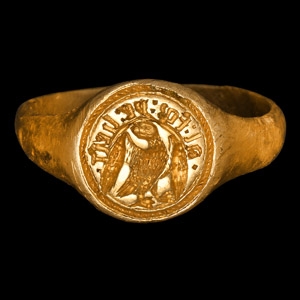
'The Roxwell' Medieval Gold Signet Ring of 'King's Serjeant William Skrene'
Sold for (Inc. bp): £23,400
Gold hoop and discoid bezel with incuse ropework border; incuse image of a bird of prey perching with wings spread and head turned; blackletter incuse and reversed inscription in an arc above the bird's head and pinions '·al : for : ye : best ·' (all for the best); repair to hoop. -
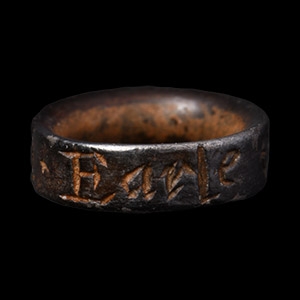
Medieval Silver 'Edmund Plantagenet, Earl of Rutland' Royal Hawking Vervel
Sold for (Inc. bp): £9,750
Or a leg ring inscribed '+Earle of Rutland' in derivative black letter script, for a female merlin or sparrow hawk (due to the youth of Edmund Plantagenet who died aged 17); the ring with a convex interior face. -
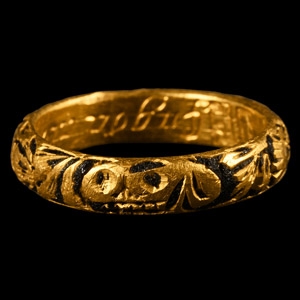
Post Medieval Gold Memento Mori Ring with Inscribed Posy 'In God Alone Wee Two Are One'
Sold for (Inc. bp): £4,680
Displaying large flower heads, foliage and a skull to the outer face, enhanced with black enamelling; interior inscribed in a cursive script 'In god alone wee two are one', together with possible maker's stamps 'D' and 'F' in two rectangular cartouches. -
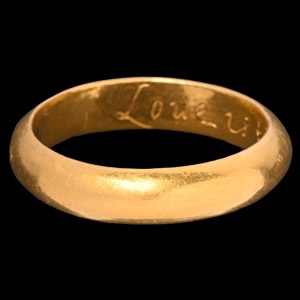
Heavy Post Medieval Gold 'Love Is The Bond Of Pease' Posy Ring
Sold for (Inc. bp): £2,860
Composed of a gently carinated hoop, the interior inscribed in cursive script 'Love is the bond of pease'. -
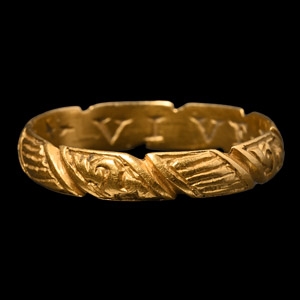
Post Medieval Gold 'Live Life to the Full' Decorated Posy Ring
Sold for (Inc. bp): £3,380
Composed of a decoratively notched hoop divided into chased rhomboidal panels displaying foliate tendrils and horizontal hatching alternately; the interior inscribed in Roman capitals with the Latin phrase: 'x x x x VIVE x VT x VIVAS'. -
![English Milled Coins - George VI - 1937 - Cased RM Proof Coronation Gold Set [4]](https://timelineauctions.com/upload/images/items/small/203351-s(2).jpg)
English Milled Coins - George VI - 1937 - Cased RM Proof Coronation Gold Set [4]
Sold for (Inc. bp): £11,700
Set comprising gold five pounds, two pounds, sovereign and half sovereign. Obvs: profile bust with GEORGIVS VI D G BR OMN REX F D IND IMP legends. Revs: St George and dragon; date in exergue; with original Royal Mint hinged red leatherette case of issue.
-
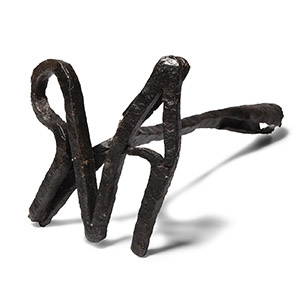
Late Roman Iron Branding Signaculum
Circa 3rd-6th century A.D.Sold for (Inc. bp): £13
Displaying a monogram composed of Latin letters A and R; tapering round-section socket. 233 grams, 20.2 cm
Acquired 1990s-early 2000s. East Anglian private collection.
The signacula used for branding were distinguished primarily by the presence of a relatively long metal arm, which could reach a length of 50 cm. This arm could sometimes be hollow to allow the insertion of a wooden handle. The presence of the long arm constitutes the main indication for the use of these signacula in the context of branding. Its length allowed the user to keep a safe distance from the source of heat. -
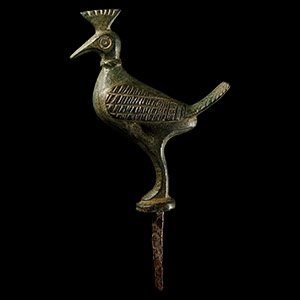
Late Roman Bronze Bird Terminal
4th-6th century A.D.Sold for (Inc. bp): £234
Modelled in the round with stylised wing, tail and eye detailing, notched tuft to head, standing on a discoid base with tapering square-section lug below. 80 grams, 95 mm high
From the collection of an EU gentleman formed in the early 2000s. Acquired on the UK market. -
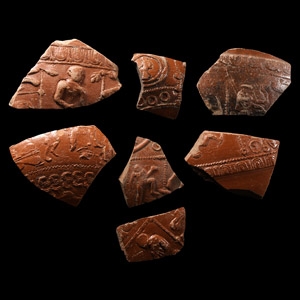
Roman 'Thames' Decorated Samian Ware Pottery Collection with Figures
Circa 2nd century A.D.Sold for (Inc. bp): £72
Mainly from vessel bowls, each displaying a design in relief, including figures, architectural elements and foliage. 120 grams, 4.5 - 7.5 cm
Found Billingsgate spoil from the Thames foreshore, London, UK. -
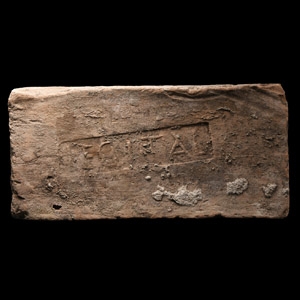
Roman Ceramic Brick with Military Stamp for Legio I Italica
1st-4th century A.D.Sold for (Inc. bp): £494
Of rectangular form, a recessed stamp to one face bearing letters in relief 'LEG I ITAL' for First Italic Legion. 2.5 kg, 27.5 x 13 cm
Acquired 1960s-1990s. Late Alison Barker collection, a retired London barrister.
The Legio I Italica ('of Italy') was a Roman legion formed by Nero on September 20, 66 or 67 A.D. and it was active until the 5th-6th century AD. The emblems of the legion were a running boar and sometimes a bull. Troops of this legion appear on Trajan's Column bridging a river. The main camp of the Legio was Novae, modern Bulgaria, but it operated in most of the imperial provinces, including Britain, where a vexillatio fought in the wars of Septimius Severus between 202 and 204 A.D. -
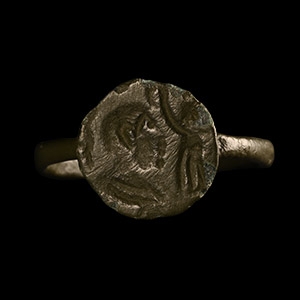
Roman Bronze Ring with Profile Bust
2nd-4th century A.D.Sold for (Inc. bp): £46
Trumpet-shaped bezel with incuse profile bust and drape. 2.97 grams, 24.96 mm overall, 16.93 mm internal diameter (approximate size British M 1/2, USA 6 1/4, Europe 13.09, Japan 12)
Private collection formed since the 1940s. UK art market. Property of an Essex gentleman. -
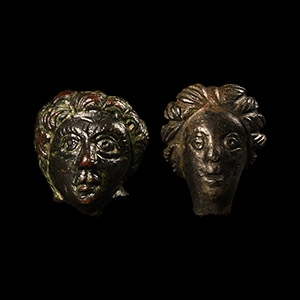
Roman Bronze Goddess Statuette Heads
Circa 1st-3rd century A.D.Sold for (Inc. bp): £312
Comprising: a female with hair held in a chignon at the nape; figure with hair dressed in short wavy tufts, large eyes with exaggerated eyelashes. 71 grams total, 23-25 mm
Acquired before 2000. From the collection of a European gentleman living in the UK.
Bronze statuettes representing Roman gods and goddesses were widespread all around the empire, and are also known as far as archaeological sites of Jutland and the islands. The two heads represent probably tutela divinities of the home, like Vesta and Juno (Greek Hera). -
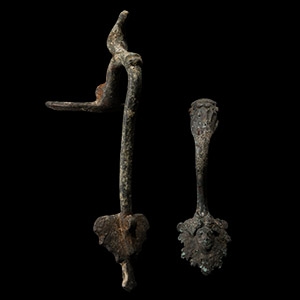
Roman Bronze Tankard Handle Group
Circa 2nd-4th century A.D.Sold for (Inc. bp): £59
Comprising two differently sized handles: one featuring a leaf plaque to base with head of Bacchus(?) in relief, fluting and a second head to the top; one with a leaf plaque to base and swan head in relief, collars and thumb pad to top. 605 grams total, 16-24 cm
Acquired 1990s-early 2000s. East Anglian private collection. -
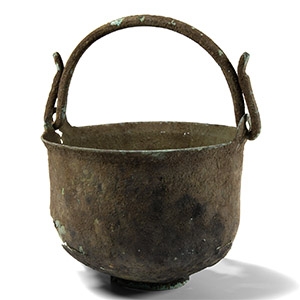
Roman Bronze Situla
1st century B.C.-1st century A.D.Sold for (Inc. bp): £182
Comprising a bell-shaped bowl, everted rim, shallow foot and round-section articulate handle; split, base absent. 560 grams, 20 cm wide
Acquired 1990s-early 2000s. East Anglian private collection.
Situla (plural situlae), from the Latin word for bucket or pail, is the term in archaeology and art history for a variety of elaborate bucket-shaped vessels from the Iron Age to the Middle Ages, usually with a handle at the top. Roman styles favoured a simple shape curving from the base, becoming vertical at the top, with a wide mouth and no shoulder, but sometimes with a projecting rim. These had a variety of uses, including aiding with washing and bathing. -
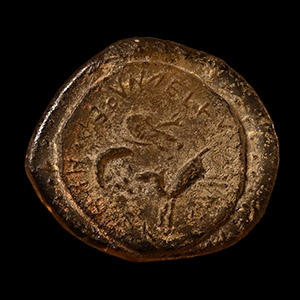
Roman Glass Weight with Animals and Inscription
1st-6th century A.D.Sold for (Inc. bp): £130
Amber-coloured glass disc with irregular flange, low-relief horse, human and crescent, retrograde Greek text. 5.4 grams, 30 mm
From the Robin Symes Gallery, stock number 91-321 on label, inventory number 185. -
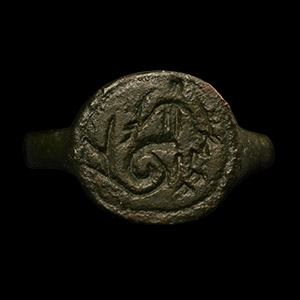
Roman Bronze Ring with Merman
2nd-4th century A.D.Sold for (Inc. bp): £72
Trumpet bezel with incuse Triton figure. 4.38 grams, 23.80 mm overall, 18.82 mm internal diameter (approximate size British Q 1/2, USA 8 1/4, Europe 18.12, Japan 17)
Private collection formed since the 1940s. UK art market. Property of an Essex gentleman. -
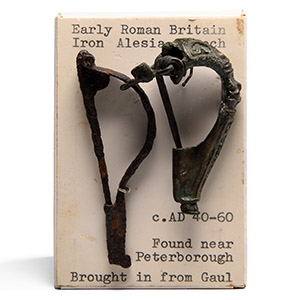
Roman Bronze Hattatt Collection Brooch Group
1st century B.C.-1st century A.D.Sold for (Inc. bp): £182
Comprising: an iron Alesia-type brooch with deep tapering bow, long foot with recurved integral knop, curled hinge; the type of Gaulish origin; mounted on a custom-made display panel stand with Hattatt collection description and further information on a label to the reverse; inked collection number to the reverse of the bow; the other a bronze trumpet brooch with moulded arc decorations on the head, sprung pin moving freely, tapering body with acanthus motif; horizontal ribbing and zigzag motifs, plain underfoot; retaining swivel chain loop with traces of red enamel; collection number to the reverse of the bow. 25.6 grams total, 63-70 mm (82 grams total, 85 mm high including stand)
Alesia type found near Peterborough, Cambridgeshire, UK; trumpet type found in Northamptonshire, UK.
Hattatt remarks of the Alesia brooch: 'In remarkably fine condition for iron, this could well have been worn by one of the Roman invaders.' -
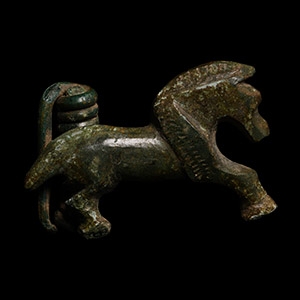
Roman Bronze Horse Brooch
2nd-3rd century A.D.Sold for (Inc. bp): £130
Retaining its spring pin and catchplate, the horse modelled galloping right, with simple mane detailing; complete. 10.6 grams, 30 mm
From the collection of a North American gentleman, formed in the 1990s.
