
Auction Highlights
-
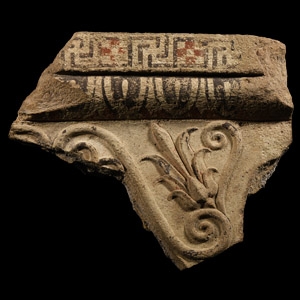
Etruscan Painted Terracotta Architectural Cornice
Sold for (Inc. bp): £3,900
A fragment of amorphous form, decorated in relief with scrolling tendrils and anthemion, painted egg-and-dart ornament above, surmounted by moulded bands and a frieze of meander and chequerboard panels; remains of red and black painted pigment. -
.jpg)
Roman Bronze Eros Cradling Goose Applique
Sold for (Inc. bp): £1,950
Formed as the bust of Eros looking upwards, stub wings to his shoulders, holding a goose to his chest; conical socket above each wing; eyes with silver inserts; old collector's label '1994 51.75' to the reverse; mounted on a custom-made stand; likely a socket base. -
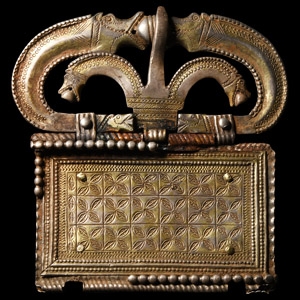
Roman Silver-Gilt Military Buckle for an Elite Imperial Officer
Sold for (Inc. bp): £7,800
Comprising a rectangular plate, richly decorated with embossed laurel leaves in a grid, framed with raised bosses, the buckle loop comprising opposing dragons with open mouths, holding a spherical tongue-rest, another pair of smaller dragon heads to base, the tongue with a smaller pair of punch-decorated dragon heads. -
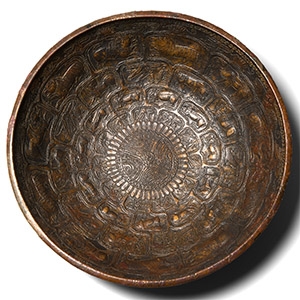
South Arabian Bronze Bowl with Mythical Animals
Sold for (Inc. bp): £5,850
Hemispherical in form, repoussé interior displaying graduated concentric registers of stylised and mythical animals within tessellating cartouches; a low relief mesomphalos decorated with rosette at centre; geometric ornament around the rim. -
.jpg)
Assyrian Bronze Relief Fragment
Sold for (Inc. bp): £16,900
Displaying a corrugated rim above and below; two advancing soldiers, each striding forwards over the headless body of a dead enemy, carrying a severed head in each hand; the soldiers shown bearded and each wearing a pointed and segmented helmet with a recess to accommodate the ears, a cuirass and thigh-length tunic, with a bow over one shoulder and a sword slung from a waist belt; mounted on a custom-made display stand. -
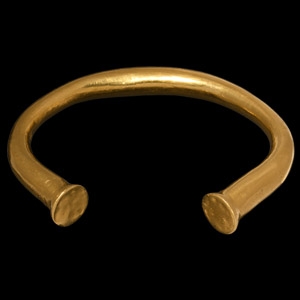
Bronze Age Gold Bracelet with Torc-Shaped Terminals
Sold for (Inc. bp): £11,440
Of penannular form with expanded sections at the centre and to both shoulders. -
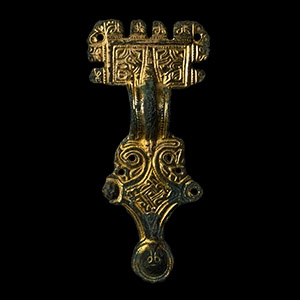
'The Oving' Anglo-Saxon Gilt Bronze Great Square-Headed Brooch
Sold for (Inc. bp): £4,160
Comprising a rectangular headplate with two panels of chip-carved Style I ornament, flanking a beast-head with triangular muzzle and two pellet eyes, raised three-sided frame and outer band of pellets above beast-heads with lentoid eyes; the shallow bow with raised median rib, flanges to the edges and punched pellet detailing; footplate with beast-head between curved pellet lines, pierced horse-head lappets, lozengiform central panel with knot of Style I limbs; two lateral discs, one pierced to accept a stud and the other with a domed stud in place; the finial a disc with human mask inverted; pin-lug and part of catch to the reverse. -
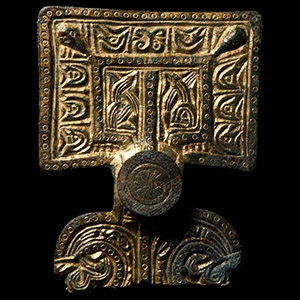
Anglo-Saxon Gilt Bronze Great Square-Headed Brooch
Sold for (Inc. bp): £3,900
Displaying chased panels populated with Style I zoomorphs and geometric forms, borders of annulets, raised masks to the upper corners of the headplate; applied discoid boss to bow decorated with a rosette, addorsed beast heads below; extensive remains of gilding; pin lug and catchplate to reverse and remains of ancient repair, lower part absent. -
.jpg)
'The Tenby' Hiberno-Norse Viking Penannular Brooch
Sold for (Inc. bp): £3,640
Comprising a round-section crescent with flared ends terminating in two curved spatulate flat panels, each with a ropework border surrounding a two-band knotwork motif; cleaned and conserved. -
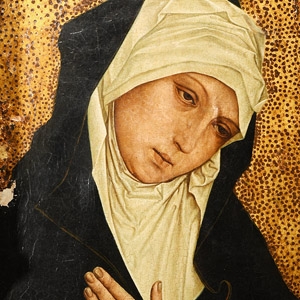
Medieval Oil Painting of Sorrowful Virgin
Sold for (Inc. bp): £9,100
The weeping Virgin with her head bowed to the left and hands raised to her chest on a dotted gilt background, an expression of pain on her delicately formed face; wearing a white veil and a black long-sleeved robe, the veil arranged as a headdress and covering her hair; on wood and mounted in a later carved wooden architectural frame. -
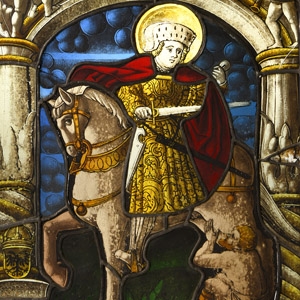
Medieval Stained Glass Panel With Saint Martin on Horseback
Sold for (Inc. bp): £2,080
Shown beneath an arcade, offering his cloak on the end of his sword to the beggar at his feet; polychrome detailing; repaired with lead cames and held in a wooden frame. -
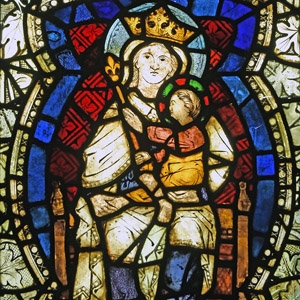
Medieval Stained Glass Panel with The Virgin and Child
Sold for (Inc. bp): £2,860
Composed from irregular painted panels bearing mainly foliage designs and figural elements; Mary crowned and enthroned with infant Jesus on her knee, in a lobed vesica-shaped panel held with lead cames; mounted in a wooden frame with modern replacements. -
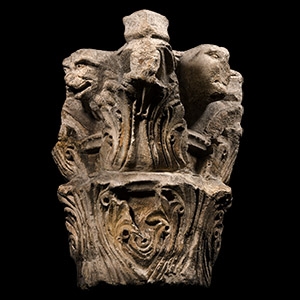
Medieval Stone Column Capital with Lion and Human Face
Sold for (Inc. bp): £1,950
Carved in the half-round with a frieze composed of interlaced foliage with two rows of acanthus leaves and foliage scrolls, framing a lion's head on one side and a human head on the other, remains of lion's mane to the third; drilled holes to the raised surfaces and sockets for the insertion of decorative stones. -
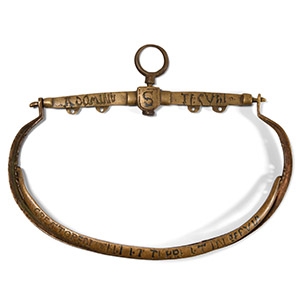
'The Kirkleavington' Medieval Bronze Inscribed Purse Frame
Sold for (Inc. bp): £3,640
The bar with central D-shaped block pierced vertically by a stud surmounted by the suspension loop, with four pierced flanges to the underside; the frame in two sections, the larger a U-shaped rod with pivot for the bar, the smaller pivoting within the inner face, both pierced on the inner face; the block inscribed to one face with capital S and to the other with intersecting Vs; the bar inscribed to one face in capitals 'A DOMINI TECVM' and to the other in coarsely incised capitals 'AVEMARIA G[R]ACIAPLE[NA]'; the smaller rod inscribed in capitals 'CREATOREN CELI ET TERRE ET IN [IES]VN'; the larger inscribed with a band of scrolled decoration and the text in Lombardic capitals 'SOLI DEO HONOR ET GLORIA'; the accompanying letter discusses the texts (1) Ave Maria G[r]acia ple[n]a Dominus Tecum 'Hail Mary full of grace, the Lord [is] with thee'; (2) Soli Deo Honor et Gloria 'Honour and glory to God alone'; (3) Creatorem celi et terrae et inferum 'creator of heaven and earth and in Jesus'. The intersecting Vs may form a monogram for A[ve] M[aria]; the 1847 letter describes the findspot as 'found at Kirkleavington near Yarm in the sill of a brook' in the North Riding of Yorkshire. -
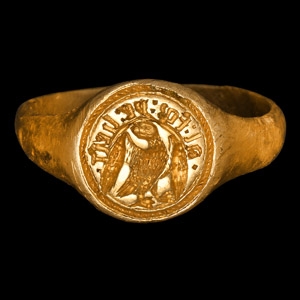
'The Roxwell' Medieval Gold Signet Ring of 'King's Serjeant William Skrene'
Sold for (Inc. bp): £23,400
Gold hoop and discoid bezel with incuse ropework border; incuse image of a bird of prey perching with wings spread and head turned; blackletter incuse and reversed inscription in an arc above the bird's head and pinions '·al : for : ye : best ·' (all for the best); repair to hoop. -
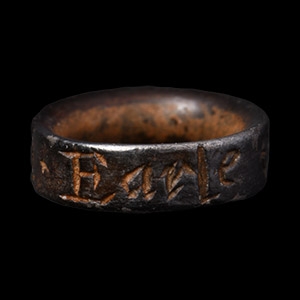
Medieval Silver 'Edmund Plantagenet, Earl of Rutland' Royal Hawking Vervel
Sold for (Inc. bp): £9,750
Or a leg ring inscribed '+Earle of Rutland' in derivative black letter script, for a female merlin or sparrow hawk (due to the youth of Edmund Plantagenet who died aged 17); the ring with a convex interior face. -
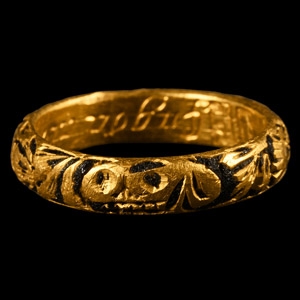
Post Medieval Gold Memento Mori Ring with Inscribed Posy 'In God Alone Wee Two Are One'
Sold for (Inc. bp): £4,680
Displaying large flower heads, foliage and a skull to the outer face, enhanced with black enamelling; interior inscribed in a cursive script 'In god alone wee two are one', together with possible maker's stamps 'D' and 'F' in two rectangular cartouches. -
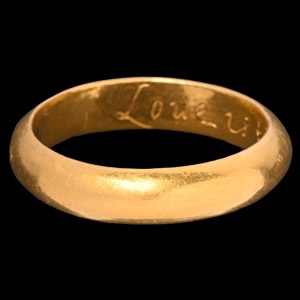
Heavy Post Medieval Gold 'Love Is The Bond Of Pease' Posy Ring
Sold for (Inc. bp): £2,860
Composed of a gently carinated hoop, the interior inscribed in cursive script 'Love is the bond of pease'. -
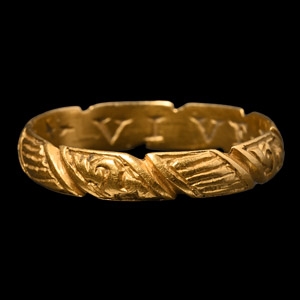
Post Medieval Gold 'Live Life to the Full' Decorated Posy Ring
Sold for (Inc. bp): £3,380
Composed of a decoratively notched hoop divided into chased rhomboidal panels displaying foliate tendrils and horizontal hatching alternately; the interior inscribed in Roman capitals with the Latin phrase: 'x x x x VIVE x VT x VIVAS'. -
![English Milled Coins - George VI - 1937 - Cased RM Proof Coronation Gold Set [4]](https://timelineauctions.com/upload/images/items/small/203351-s(2).jpg)
English Milled Coins - George VI - 1937 - Cased RM Proof Coronation Gold Set [4]
Sold for (Inc. bp): £11,700
Set comprising gold five pounds, two pounds, sovereign and half sovereign. Obvs: profile bust with GEORGIVS VI D G BR OMN REX F D IND IMP legends. Revs: St George and dragon; date in exergue; with original Royal Mint hinged red leatherette case of issue.
-
Medieval Stone Column Capital with Lion and Human Face
Spain or Southern France, late 12th century A.D.Sold for (Inc. bp): £1,950
Carved in the half-round with a frieze composed of interlaced foliage with two rows of acanthus leaves and foliage scrolls, framing a lion's head on one side and a human head on the other, remains of lion's mane to the third; drilled holes to the raised surfaces and sockets for the insertion of decorative stones. 30 kg, 33.5 cm
Acquired from Antoine Boccador-Lieveaux, 2005. Ex central London gallery. Accompanied by an academic report by Dr Raffaele D’Amato. This lot has been checked against the Interpol Database of stolen works of art and is accompanied by search certificate no.11739-202053.
The iconography of this capital is probably associated with the biblical story of Daniel in the lion's den. Capitals like this were part of an extensive decorative program which characterised Spanish and the French churches especially in the late 12th century A.D., with the advent of the Cistercian style. Foliate capitals ornamented the churches of Las Claustrillas, Aguilar, Gama, and other Christian sites of Southern France and Northern Spain. Capitals decorated with similar acanthus foliage can be found in churches in Burgundy, for instance at Avallon, Vezelay, and Donzy-le-Pré. However, figurative elements of the old Romanesque art also persisted. -
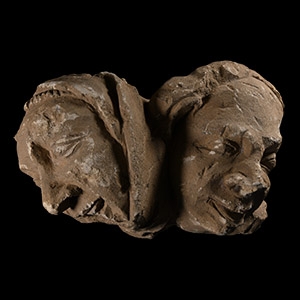
Medieval Limestone Corbel with Jester Heads
15th century A.D.Sold for (Inc. bp): £650
Wearing frivolous expressions with their hands around each other's shoulders, their faces and period garments rendered with semi-naturalistic detailing. 13 kg, 32 cm
Acquired 1990s-early 2000s. East Anglian private collection. -
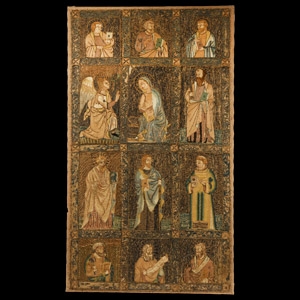
Medieval Embroidered Panel Composed of Sections of Dalmatic Garment
Florence, Italy, circa 1440-1460 A.D.Sold for (Inc. bp): £2,470
Comprising twelve sections, the top row with three Evangelists, each holding a gospel; the next row with the Annunciation scene with Archangel Gabriel, Mary and Saint Paul holding a raised sword and a book; Saint Augustine and Saint Thomas Aquinas flanking the standing figure of Jesus; the bottom row with Saint Peter holding keys and a book, Moses and probably Saint Andrew; each figure framed with embroidered foliage; sewn to a linen background stretched over a wooden frame. 1.55 kg, 84.5 cm
French private collection. with Jean-Charles D'Ornano, 16 January 2022, lot 233. Ex central London gallery. Accompanied by an academic report by Dr Raffaele D’Amato. This lot has been checked against the Interpol Database of stolen works of art and is accompanied by search certificate no.11749-202077.
The dalmatic (liturgical vestment derived from the Late Roman garment with the same name) was worn by the deacons in Latin Catholic Church. This dress, mainly used in the Holy Liturgy, was often decorated in silk and gold embroidery, and splendid specimens were realised by the Italian workshops of the Florentine Republic, one of the richest Italian states of the Renaissance. -
'The Kirkleavington' Medieval Bronze Inscribed Purse Frame
15th-16th century A.D.Sold for (Inc. bp): £3,640
The bar with central D-shaped block pierced vertically by a stud surmounted by the suspension loop, with four pierced flanges to the underside; the frame in two sections, the larger a U-shaped rod with pivot for the bar, the smaller pivoting within the inner face, both pierced on the inner face; the block inscribed to one face with capital S and to the other with intersecting Vs; the bar inscribed to one face in capitals 'A DOMINI TECVM' and to the other in coarsely incised capitals 'AVEMARIA G[R]ACIAPLE[NA]'; the smaller rod inscribed in capitals 'CREATOREN CELI ET TERRE ET IN [IES]VN'; the larger inscribed with a band of scrolled decoration and the text in Lombardic capitals 'SOLI DEO HONOR ET GLORIA'; the accompanying letter discusses the texts (1) Ave Maria G[r]acia ple[n]a Dominus Tecum 'Hail Mary full of grace, the Lord [is] with thee'; (2) Soli Deo Honor et Gloria 'Honour and glory to God alone'; (3) Creatorem celi et terrae et inferum 'creator of heaven and earth and in Jesus'. The intersecting Vs may form a monogram for A[ve] M[aria]; the 1847 letter describes the findspot as 'found at Kirkleavington near Yarm in the sill of a brook' in the North Riding of Yorkshire. 183 grams, 20.7 cm
Found at Kirkleavington near Yarm, North Riding of Yorkshire, UK, in 1847. Accompanying label describes it as ‘found in constructing the Leeds and Thirsk Railway, near Kirkleavington, Co. York. Communicated by John Bourne, Esq. Engineer to the Company, Leeds’. Accompanied by a manuscript letter of September 17th 1847 from Mr Histon Longstaffe discussing the text, with later amendments date 1854. This lot has been checked against the Interpol Database of stolen works of art and is accompanied by searcher certificate no. 200593.
Metal purse frames of this type were a luxury personal accessory of late Middle Ages and early Renaissance period (about 1450-1500). They were decorated with niello. In this technique the metalworker engraved a pattern or design onto highly polished metal and filled the incised lines with a hard black alloy. Religious inscriptions were incised to invoke the divine protection. A fragmentary purse-frame in the MOL [ID 4452] containing this same portion of the Apostles Creed enables us to correct the 19C reading INFERVN to IN IESVN ('in Jesus') -
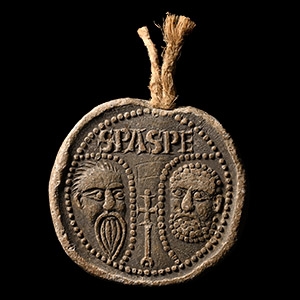
Medieval Lead Papal Bulla Seal of Pope Alexander IV
1254-1261 A.D.Sold for (Inc. bp): £520
(Rinaldo Di Segni); First Type, obverse with facing busts of Saints Paul and Peter with 'SPA SPE' inscription above and long cross between; reverse with 'ALE XANDER PP IIII' inscription in three lines. 49 grams, 39 mm
Ex 6th Earl of Arran (Sir Arthur Gore), 1920. -
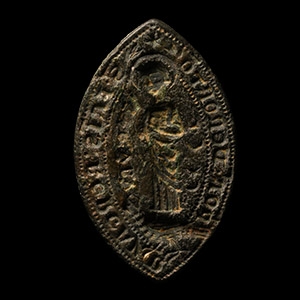
Large Medieval Bronze Ecclesiastical Seal Matrix
14th century A.D.Sold for (Inc. bp): £260
Depicting a female saint at the centre, standing right on a bird, uncertain inscription in right field, enigmatic surrounding legend: 'S : FRIS : ROPOAYM POR : DE NORTOR/E'; suspension loop and rib to reverse; accompanied by a museum-quality impression. 16.8 grams, 41 mm
Found by eye in Widford Parish in the 1970s, next to the old Salt Way to the Royal Parish of Bampton, Oxfordshire, UK. Accompanied by a print out about Widford and the church of St. Oswald, Oxon. -
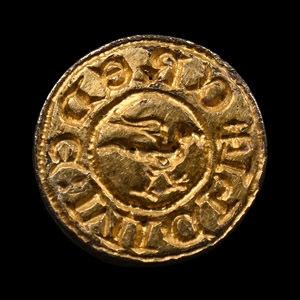
Medieval Silver-Gilt 'Believe Me' Seal Matrix Cap
14th-15th century A.D.Sold for (Inc. bp): £1,300
Displaying an embossed bird within a roundel, Latin inscription '+ CREDE : MIChI' ('Believe Me') surrounding; the side edge inscribed 'GRADEMARI[A]'. 0.95 grams, 12 mm
Acquired from a London gallery in 1990. Ex property of a North London gentleman.
A wide range of people would have used a seal, from the monarch to small landowners and tradespeople, anyone with a need for business or legal documents. Individuals had personal seals, but seals were also used by official bodies such as town corporations, trade and religious guilds, cathedrals, abbeys and monasteries, having religious inscriptions like in this one. -
.jpg)
'The Bossingham' Medieval Gold Ring with Cabochon Garnet
13th century A.D.Sold for (Inc. bp): £1,820
Composed of a delicate hoop, carinated shoulders and biconical bezel, elliptical in plan with inset polished cabochon garnet. 1.86 grams, 25.44 mm overall, 19.84 mm internal diameter (approximate size British R 1/2, USA 8 3/4, Europe 19.38, Japan 18)
Found while searching with a metal detector in Bossingham, Kent, UK, by Alan John Punyer on 14 September 2000. Disclaimed under the Treasure Act with reference no. M&ME 297. Accompanied by a copy of page 61 of the Treasure Annual Report 2000, where this ring is published as number 92. -
.jpg)
Medieval Gold Ring with Cabochon
12th-14th century A.D.Sold for (Inc. bp): £650
Composed of a slender round-section hoop and oval bezel with green glass cabochon in claw setting. 3.29 grams, 21.64 mm overall, 18.38 mm internal diameter (approximate size British L 1/2, USA 6, Europe 11.87, Japan 11)
Acquired 1990s-early 2000s. East Anglian private collection. -
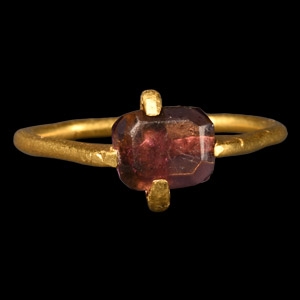
Medieval Gold Ring with Amethyst Gemstone
12th-14th century A.D.Sold for (Inc. bp): £910
Stirrup-shaped hoop with four claws holding a cut and polished amethyst. 2.69 grams, 23.40 mm overall, 17.95 mm internal diameter (approximate size British O, USA 7, Europe 14.98, Japan 14)
Acquired 1990s-early 2000s. East Anglian private collection. -
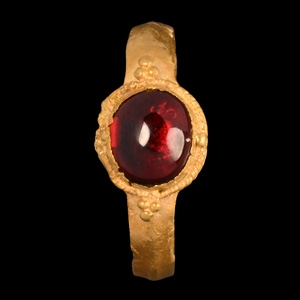
Medieval Gold Ring with Garnet
14th-16th century A.D.Sold for (Inc. bp): £598
Carinated hoop with granules to the shoulders, ropework collar to the bezel with inset replaced garnet cabochon. 3.94 grams, 24.80 mm overall, 19.72 mm internal diameter (approximate size British T, USA 9 1/2, Europe 21.26, Japan 20)
Purchased at the Cumberland Hotel Fair, 1987. Property of a Kent gentleman. -
'The Roxwell' Medieval Gold Signet Ring of 'King's Serjeant William Skrene'
14th-15th century A.D.Sold for (Inc. bp): £23,400
Gold hoop and discoid bezel with incuse ropework border; incuse image of a bird of prey perching with wings spread and head turned; blackletter incuse and reversed inscription in an arc above the bird's head and pinions '·al : for : ye : best ·' (all for the best); repair to hoop. 8.01 grams, 25.00 mm overall, 20.49 mm internal diameter (approximate size British V 1/2, USA 10 3/4, Europe 24.4, Japan 23)
Found while searching with a metal detector near Roxwell, Essex, UK, by Albert Robert Taylor on 4th September 2021. Accompanied by a copy of the British Museum's Portable Antiquities Scheme (PAS) report no.ESS-CD68AE. Accompanied by a copy of the report for H M Coroner on find of potential treasure with reference no.2022 T920. Accompanied by a copy of a letter from the British Museum disclaiming the Crown's interest in the find. Accompanied by a copy of the Treasure Act receipt. Accompanied by copies of the relevant pages on an article about finding this ring in Treasure Hunting Magazine, August 2022, p.13.
The ring's find location is close to an estate which was owned in the 14th century by the Skrene family and which included among their number a senior barrister and sergeant-at-law named William Skrene who was an Irish-born barrister and judge. The family name lives on to the present day at Roxwell with Skreens Park and for local road names nearby. Wiiliam spent his professional life in England, being appointed King's Serjeant and a judge of assize, as well as Chief Baron of the Irish Exchequer in 1395-7. In addition to the estate at Roxwell, he acquired various lands in Essex, including at Writtle, Great Finborough and Stanford Rivers. William died in 1419-20 and left sons and a daughter; his heir, also called William, married Alice Tyrrell, widow of Hamo Strange, and daughter of John Tyrrell, who was Speaker of the House of Commons of England for three terms. The exact combination of motto and crest or badge has eluded researches thus far. However, the ring was found near Roxwell, Essex, and evidently belonged to a person of some wealth and status given the quantity of gold used in its manufacture and the quality of the workmanship. The style of the ring is close in appearance to a number of early 15th century examples, which began to appear with the badge and motto rather than the full armorial bearings, so it is very possible that this is the personal signet ring of William Skrene, or possibly of his sons, William or Thomas.
