
Auction Highlights
-
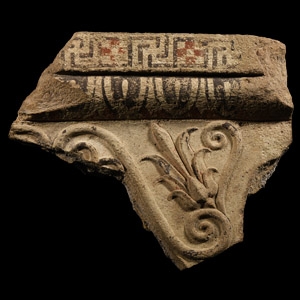
Etruscan Painted Terracotta Architectural Cornice
Sold for (Inc. bp): £3,900
A fragment of amorphous form, decorated in relief with scrolling tendrils and anthemion, painted egg-and-dart ornament above, surmounted by moulded bands and a frieze of meander and chequerboard panels; remains of red and black painted pigment. -
.jpg)
Roman Bronze Eros Cradling Goose Applique
Sold for (Inc. bp): £1,950
Formed as the bust of Eros looking upwards, stub wings to his shoulders, holding a goose to his chest; conical socket above each wing; eyes with silver inserts; old collector's label '1994 51.75' to the reverse; mounted on a custom-made stand; likely a socket base. -
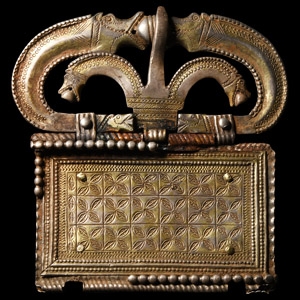
Roman Silver-Gilt Military Buckle for an Elite Imperial Officer
Sold for (Inc. bp): £7,800
Comprising a rectangular plate, richly decorated with embossed laurel leaves in a grid, framed with raised bosses, the buckle loop comprising opposing dragons with open mouths, holding a spherical tongue-rest, another pair of smaller dragon heads to base, the tongue with a smaller pair of punch-decorated dragon heads. -
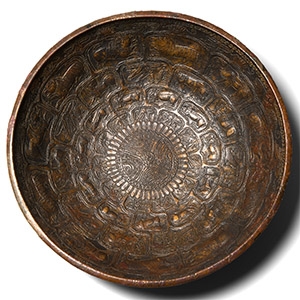
South Arabian Bronze Bowl with Mythical Animals
Sold for (Inc. bp): £5,850
Hemispherical in form, repoussé interior displaying graduated concentric registers of stylised and mythical animals within tessellating cartouches; a low relief mesomphalos decorated with rosette at centre; geometric ornament around the rim. -
.jpg)
Assyrian Bronze Relief Fragment
Sold for (Inc. bp): £16,900
Displaying a corrugated rim above and below; two advancing soldiers, each striding forwards over the headless body of a dead enemy, carrying a severed head in each hand; the soldiers shown bearded and each wearing a pointed and segmented helmet with a recess to accommodate the ears, a cuirass and thigh-length tunic, with a bow over one shoulder and a sword slung from a waist belt; mounted on a custom-made display stand. -
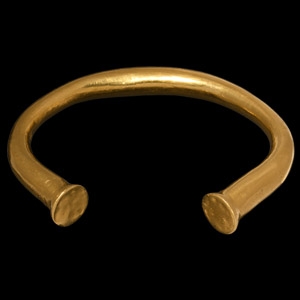
Bronze Age Gold Bracelet with Torc-Shaped Terminals
Sold for (Inc. bp): £11,440
Of penannular form with expanded sections at the centre and to both shoulders. -
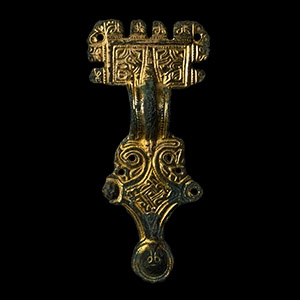
'The Oving' Anglo-Saxon Gilt Bronze Great Square-Headed Brooch
Sold for (Inc. bp): £4,160
Comprising a rectangular headplate with two panels of chip-carved Style I ornament, flanking a beast-head with triangular muzzle and two pellet eyes, raised three-sided frame and outer band of pellets above beast-heads with lentoid eyes; the shallow bow with raised median rib, flanges to the edges and punched pellet detailing; footplate with beast-head between curved pellet lines, pierced horse-head lappets, lozengiform central panel with knot of Style I limbs; two lateral discs, one pierced to accept a stud and the other with a domed stud in place; the finial a disc with human mask inverted; pin-lug and part of catch to the reverse. -
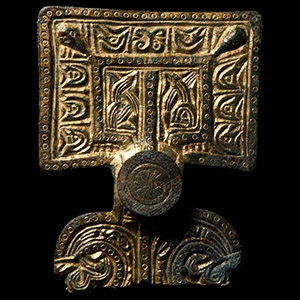
Anglo-Saxon Gilt Bronze Great Square-Headed Brooch
Sold for (Inc. bp): £3,900
Displaying chased panels populated with Style I zoomorphs and geometric forms, borders of annulets, raised masks to the upper corners of the headplate; applied discoid boss to bow decorated with a rosette, addorsed beast heads below; extensive remains of gilding; pin lug and catchplate to reverse and remains of ancient repair, lower part absent. -
.jpg)
'The Tenby' Hiberno-Norse Viking Penannular Brooch
Sold for (Inc. bp): £3,640
Comprising a round-section crescent with flared ends terminating in two curved spatulate flat panels, each with a ropework border surrounding a two-band knotwork motif; cleaned and conserved. -
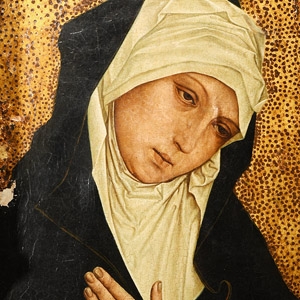
Medieval Oil Painting of Sorrowful Virgin
Sold for (Inc. bp): £9,100
The weeping Virgin with her head bowed to the left and hands raised to her chest on a dotted gilt background, an expression of pain on her delicately formed face; wearing a white veil and a black long-sleeved robe, the veil arranged as a headdress and covering her hair; on wood and mounted in a later carved wooden architectural frame. -
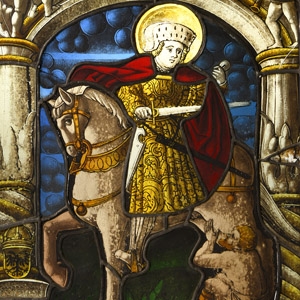
Medieval Stained Glass Panel With Saint Martin on Horseback
Sold for (Inc. bp): £2,080
Shown beneath an arcade, offering his cloak on the end of his sword to the beggar at his feet; polychrome detailing; repaired with lead cames and held in a wooden frame. -
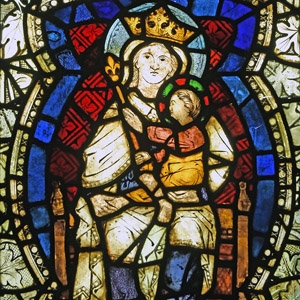
Medieval Stained Glass Panel with The Virgin and Child
Sold for (Inc. bp): £2,860
Composed from irregular painted panels bearing mainly foliage designs and figural elements; Mary crowned and enthroned with infant Jesus on her knee, in a lobed vesica-shaped panel held with lead cames; mounted in a wooden frame with modern replacements. -
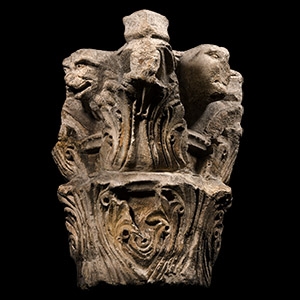
Medieval Stone Column Capital with Lion and Human Face
Sold for (Inc. bp): £1,950
Carved in the half-round with a frieze composed of interlaced foliage with two rows of acanthus leaves and foliage scrolls, framing a lion's head on one side and a human head on the other, remains of lion's mane to the third; drilled holes to the raised surfaces and sockets for the insertion of decorative stones. -
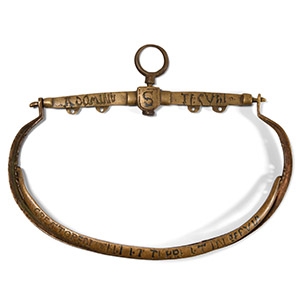
'The Kirkleavington' Medieval Bronze Inscribed Purse Frame
Sold for (Inc. bp): £3,640
The bar with central D-shaped block pierced vertically by a stud surmounted by the suspension loop, with four pierced flanges to the underside; the frame in two sections, the larger a U-shaped rod with pivot for the bar, the smaller pivoting within the inner face, both pierced on the inner face; the block inscribed to one face with capital S and to the other with intersecting Vs; the bar inscribed to one face in capitals 'A DOMINI TECVM' and to the other in coarsely incised capitals 'AVEMARIA G[R]ACIAPLE[NA]'; the smaller rod inscribed in capitals 'CREATOREN CELI ET TERRE ET IN [IES]VN'; the larger inscribed with a band of scrolled decoration and the text in Lombardic capitals 'SOLI DEO HONOR ET GLORIA'; the accompanying letter discusses the texts (1) Ave Maria G[r]acia ple[n]a Dominus Tecum 'Hail Mary full of grace, the Lord [is] with thee'; (2) Soli Deo Honor et Gloria 'Honour and glory to God alone'; (3) Creatorem celi et terrae et inferum 'creator of heaven and earth and in Jesus'. The intersecting Vs may form a monogram for A[ve] M[aria]; the 1847 letter describes the findspot as 'found at Kirkleavington near Yarm in the sill of a brook' in the North Riding of Yorkshire. -
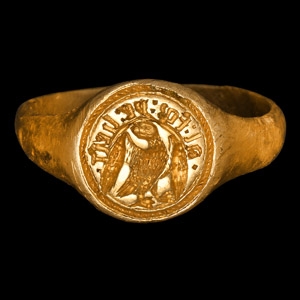
'The Roxwell' Medieval Gold Signet Ring of 'King's Serjeant William Skrene'
Sold for (Inc. bp): £23,400
Gold hoop and discoid bezel with incuse ropework border; incuse image of a bird of prey perching with wings spread and head turned; blackletter incuse and reversed inscription in an arc above the bird's head and pinions '·al : for : ye : best ·' (all for the best); repair to hoop. -
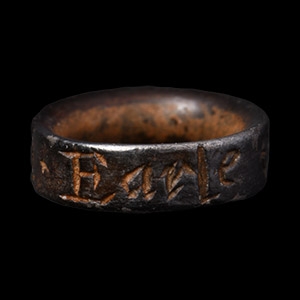
Medieval Silver 'Edmund Plantagenet, Earl of Rutland' Royal Hawking Vervel
Sold for (Inc. bp): £9,750
Or a leg ring inscribed '+Earle of Rutland' in derivative black letter script, for a female merlin or sparrow hawk (due to the youth of Edmund Plantagenet who died aged 17); the ring with a convex interior face. -
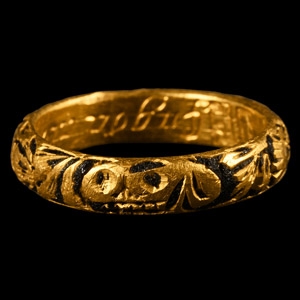
Post Medieval Gold Memento Mori Ring with Inscribed Posy 'In God Alone Wee Two Are One'
Sold for (Inc. bp): £4,680
Displaying large flower heads, foliage and a skull to the outer face, enhanced with black enamelling; interior inscribed in a cursive script 'In god alone wee two are one', together with possible maker's stamps 'D' and 'F' in two rectangular cartouches. -
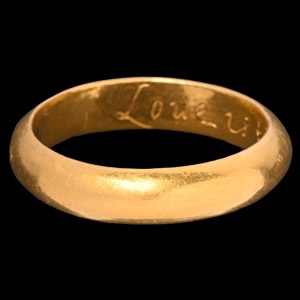
Heavy Post Medieval Gold 'Love Is The Bond Of Pease' Posy Ring
Sold for (Inc. bp): £2,860
Composed of a gently carinated hoop, the interior inscribed in cursive script 'Love is the bond of pease'. -
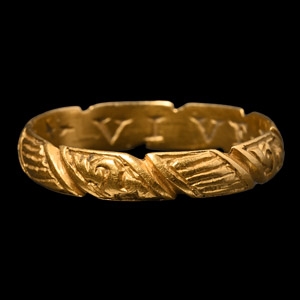
Post Medieval Gold 'Live Life to the Full' Decorated Posy Ring
Sold for (Inc. bp): £3,380
Composed of a decoratively notched hoop divided into chased rhomboidal panels displaying foliate tendrils and horizontal hatching alternately; the interior inscribed in Roman capitals with the Latin phrase: 'x x x x VIVE x VT x VIVAS'. -
![English Milled Coins - George VI - 1937 - Cased RM Proof Coronation Gold Set [4]](https://timelineauctions.com/upload/images/items/small/203351-s(2).jpg)
English Milled Coins - George VI - 1937 - Cased RM Proof Coronation Gold Set [4]
Sold for (Inc. bp): £11,700
Set comprising gold five pounds, two pounds, sovereign and half sovereign. Obvs: profile bust with GEORGIVS VI D G BR OMN REX F D IND IMP legends. Revs: St George and dragon; date in exergue; with original Royal Mint hinged red leatherette case of issue.
-
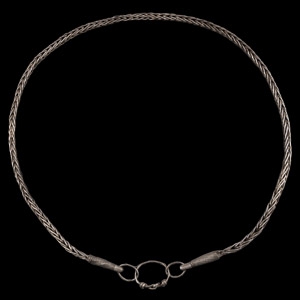
Viking Age Silver Chain Necklace
10th-11th century A.D.Sold for (Inc. bp): £1,430
Composed of openwork links, coiled filigree collars and a central hoop with intertwined bezel and coiled sleeves. 134 grams, 80 cm long
From the collection of a North American gentleman, formed in the 1990s. -
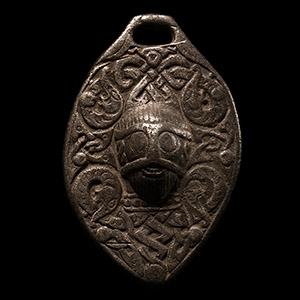
Viking Silver Urnes Style Rattle Pendant
9th century A.D.Sold for (Inc. bp): £2,600
Formed from a hollow vesica-shaped silver mount which rattles when shaken, probably a horse-harness fitting; with Urnes style interlaced dragons in low relief surrounding a facing bearded mask with large staring eyes (Thor?). 67 grams, 73 mm
Formerly acquired on the German art market in the early 1980s. Previously in a European collection in the 1990s. From an important central London collection. This lot has been checked against the Interpol Database of stolen works of art and is accompanied by searcher certificate no. 200377.
The last phase of Viking art is the Urnes style from about 1050-1150. The Urnes style has gracefully curved lines of different width - swelling, tapering - but always in a curve. The tendril clusters from the Ringerike style are abandoned. The Urnes style developed shortly before the middle of the 11th century. -
.jpg)
Viking Gilt Gotland-Type Fish Pendant
9th-10th century A.D.Sold for (Inc. bp): £494
Composed of a tapering, round-section body with flat base and inverted triangular mouth holding a moveable bar, suspended on a ring with twisted wire coils and stamped with small circles repeated on the bar below; the fish body decorated with four panels of low-relief Mammen Style interlacing with remains of gilding; two circular piercings to each side of the body. 23.2 grams, 72 mm high
Fine condition.
Private collection formed in Europe in the 1980s. Ex Westminster collection, central London, UK.
Originally produced as a necklace element, refashioned at an unspecified point in antiquity into a pendant, possibly as early as the 9th-10th century A.D. Pendants of this type were worn strung together in groups, the tapering profile allowing them to sit comfortably as a collar below the neck. They were often worn suspended between two zoomorphic brooches. This example has been taken from a necklace and mounted on a suspension ring for use as an amuletic pendant. -
'The Tenby' Hiberno-Norse Viking Penannular Brooch
8th-9th century A.D.Sold for (Inc. bp): £3,640
Comprising a round-section crescent with flared ends terminating in two curved spatulate flat panels, each with a ropework border surrounding a two-band knotwork motif; cleaned and conserved. 10.55 grams, 62 mm wide
Fine condition, cleaned and conserved.
Found whilst searching with a metal detector on a beach, probably having been washed out of a Viking burial from an overlooking cliff near Tenby, Pembrokeshire, UK, on Thursday 7th April 2016 by Kelvin Maddocks. Recorded with the Portable Antiquities Scheme (PAS) with reference number NMGW-DA579E. Accompanied by a copy of the PAS report including a museum drawing of the object, a copy of report number NMWPA 2016.43 sent to the finder. Accompanied by copies of the relevant Treasure Hunting Magazine pages where it has been published. -
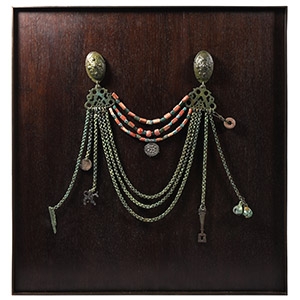
Viking Bronze Tortoise Brooch Necklace Set with Pendants
9th century A.D.Sold for (Inc. bp): £1,950
Comprising: two oval brooches, each domed with raised ornament, wide flange, ferrous remains of the pin to the reverse; suspended from the lower edge of each brooch a triangular openwork spacer plate with three tiers of red and green glass tubular beads, the lower tier with a discoid pendant plaque with bands of raised pellets; three double-link chains running between the plates; three more chains from each plate with an amuletic or decorative pendant comprising a bronze model knife in its sheath, a silver(?) Dirhem coin, an iron model dog with punched decoration, a latch-lifter key, a pair of bronze crotal bells, a stone disc or spindle whorl; displayed on a large high-quality custom-made display stand by Colin Bowles Limited. 7.7 kg total, 56 x 54 cm including display frame
Fine condition, cleaned and conserved.
Family collection formed after World War II; thence by descent. Ex London collection since 2016.
Women's display jewellery in the Viking age comprised both utilitarian and symbolic items. The brooches were worn high on the chest, supporting an apron-type overdress (hangerok) with the beads and chains strung between them and various small items attached. The pendants probably symbolised the authority of the female in the domestic sphere (key, coin, spindle whorl), and in husbandry (model animal, crotal bells, model knife). -
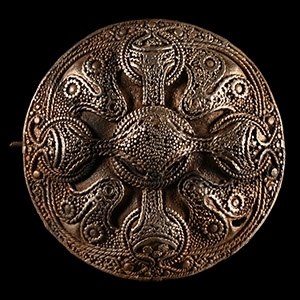
Viking Silver Filigree Brooch with Cross and Beast Heads
10th century A.D.Sold for (Inc. bp): £4,160
Composed of a sheet-silver domed discoid body with bands of applied filigree and granule detailing, cruciform design with interstitial facing masks, reeded strip detailing to reverse and hinged pin. 14.2 grams, 44 mm
Acquired in Germany in the 1990s. Formerly the property of a European gentleman living in Germany. Ex West London, UK, collection. Accompanied by an academic report by Dr Raffaele D’Amato. This lot has been checked against the Interpol Database of stolen works of art and is accompanied by search certificate number no.11730-200376.
The gradual spreading of Christianity among the Danish Vikings can be seen in certain pieces of jewellery, as here, where a cross is clearly traced among the filigree ornaments. Pagan amulets - such as Thor's hammer - were first combined with cross motifs and finally completely replaced by crucifixes. -
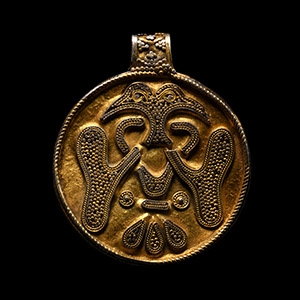
Viking Age Silver-Gilt Filigree Pendant with Conjoined Ravens
9th-11th century A.D.Sold for (Inc. bp): £5,460
The upper face decorated with a two-headed filigree raven, raised ropework border, suspension loop with pyramids of granules continuing onto the reverse. 6.26 grams, 42 mm
Private collection formed in Europe in the 1980s. Westminster collection, central London, UK. This lot has been checked against the Interpol Database of stolen works of art and is accompanied by search certificate no.203746.
Pairs of ravens were considered auspicious in medieval Scandinavian society. In pre-Christian times, two such birds were the informants of the god Odin, who relayed news of the deeds of men. They were also carrion birds, frequenting battlefields to feast on the bodies of fallen warriors. -
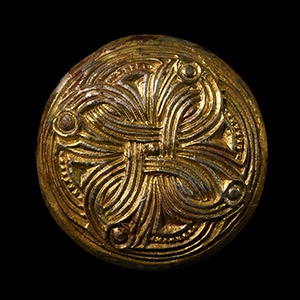
Viking Age Silver-Gilt Disc Brooch with Entwined Heads
9th-11th century A.D.Sold for (Inc. bp): £1,300
Domed brooch with gilding to the obverse, raised design of four bird-heads with billets to the neck, enmeshed beaks and other parts, pellet eyes; chamfered rim; reverse with catch, pin-lugs and loop for attachment of a chain. 25.6 grams, 45 mm
Private collection formed in Europe in the 1980s. Westminster collection, central London, UK. -
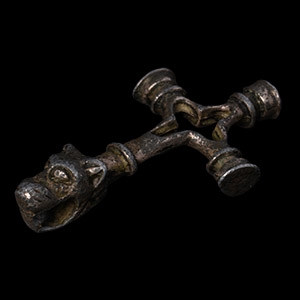
Viking Age Silver-Gilt Cross Pendant with Head of a Beast
11th-12th century A.D.Sold for (Inc. bp): £1,170
In Romanesque style, cruciform with openwork cross at centre, three oval terminals and a fourth modelled as a hound's head, the beast's mouth forming the suspension loop. 5.4 grams, 40 mm
From the family collection of a Hertfordshire, UK, gentleman since the 1970s. with Bonhams, London, Sale 17880, 7 December 2010, lot 6. Accompanied by a copy of the online Bonhams catalogue page, and the original lot ticket.
The original function of this rare and unusual pendant remains elusive. The use of expensive materials and the fine and detailed casting indicate that it would have been a highly prized object. The fusion of Christian and pagan religious motifs is typical of Iceland where the worship of the old gods continued into the 11th century. The Christian cross was used as a symbol of the new faith but the pendant also includes elements of pre-Christian ideas. Comparable objects appeared in an exhibition of English Romanesque Art 1066-1200, held at the Hayward Gallery, London, 5 April - 8 July 1984. The catalogue for this exhibition illustrates numerous small metal and gilded articles with similar grotesque terminals- No. 254 illustrated a late 12th century finial from a shrine, which is in the Victoria and Albert Museum (M.25 1962). -
.jpg)
Large Late Medieval Wooden Spread Eagle Lectern Figure
Flanders, 16th century A.D.Sold for (Inc. bp): £3,900
Painted and carved in the round as an imposing eagle standing atop a globe, wings half-spread, semi-naturalistic detailing and remains of gilding; accompanied by its (likely) original wrought iron tripod stand with facetted and collared shaft; also accompanied by a modern custom-made display stand. 15.3 kg total, 1.75 m high including stand
Ex Mayer collection. Private collection, South West France. with SVV Prunier, 11 October 2020, lot 79. Ex central London gallery. This lot has been checked against the Interpol Database of stolen works of art and is accompanied by search certificate number no.202075.
Possibly used as a lectern at some point and modified for this purpose with a transverse ledge cut into the rear of the tail. -
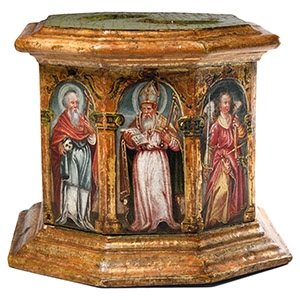
Renaissance Gilt Wooden Octagonal Socle with Paintings of Saints
South Germany, probably Augsburg, circa 1500-1520 A.D.Sold for (Inc. bp): £1,950
Intended for a religious statue, with foot-shaped recesses to the top face; the left side with a painted polychrome scene comprising Saint Jerome and Saint Ambrose with Saint Michael holding a sword and scales for weighing souls; the right side painted with a scene comprising Saint Gregory the Great, Saint Augustine and Saint John the Evangelist; both scenes set with gilt architectural frame; the reverse with the Holy Spirit depicted as a dove. 1.95 kg, 16.5 cm high
Very fine condition.
Ex Julius Böhler Ltd, Munich, Germany, 2000. Ex central London gallery. Accompanied by an academic report by Dr Raffaele D’Amato. This lot has been checked against the Interpol Database of stolen works of art and is accompanied by search certificate no.11741-202052.
The base probably housed a statue of Christ. The painting, although mannerist, reflects the style of the Germanic Renaissance. The saints surrounding the dove are easily recognisable by their attributes. St Jerome as a penitent was often represented in front of a crucifix, next to him the hourglass and the skull, symbolising fleeing time leading to death. St Ambrose is represented with his whip, defending people from the enemies of the faith. St Michael is holding the sword and balance and St Augustine is represented with the child who appeared to him on the seashore admonishing him. Many representations from the Middle Ages show Pope St Gregory the Great (of a noble family and pontiff from 590 to 604) with the Dove of the Holy Spirit perched on his shoulder. St John the Evangelist is represented here according to the golden legend of Jacopo da Varazze, with a snake and a chalice. -
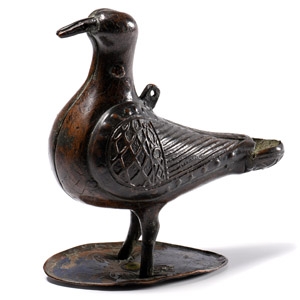
Medieval Bronze Limoges Eucharistic Dove
Circa 1200-1230 A.D. or laterSold for (Inc. bp): £2,860
Modelled in the round, hollow formed with stylised geometric detailing to the wings rendered in raised relief, incised detailing to the breast and head, pierced lug to neck, bowl at tail; base displaying floral scrolls with remains of blue, red and yellow Limoges enamelling; standing on a later elliptical base. 662 grams, 17.5 cm
Ex central London gallery. Accompanied by an academic report by Dr Raffaele D’Amato. This lot has been checked against the Interpol Database of stolen works of art and is accompanied by search certificate no.11740-202076.
Champlevé enamels were made at Limoges and in the valleys of the Rhine and Meuse from the 11th to the 14th centuries. Limoges workshops manufactured Eucharistic doves, which would have been hung over an altar as an evocation of the Holy Spirit. They were portable tabernacles, containing consecrated hosts.
