
Auction Highlights
-
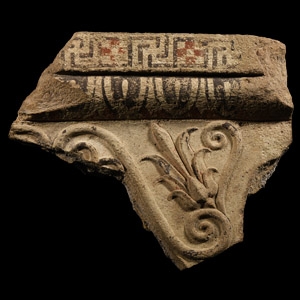
Etruscan Painted Terracotta Architectural Cornice
Sold for (Inc. bp): £3,900
A fragment of amorphous form, decorated in relief with scrolling tendrils and anthemion, painted egg-and-dart ornament above, surmounted by moulded bands and a frieze of meander and chequerboard panels; remains of red and black painted pigment. -
.jpg)
Roman Bronze Eros Cradling Goose Applique
Sold for (Inc. bp): £1,950
Formed as the bust of Eros looking upwards, stub wings to his shoulders, holding a goose to his chest; conical socket above each wing; eyes with silver inserts; old collector's label '1994 51.75' to the reverse; mounted on a custom-made stand; likely a socket base. -
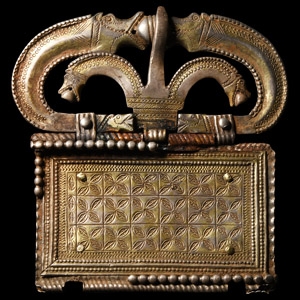
Roman Silver-Gilt Military Buckle for an Elite Imperial Officer
Sold for (Inc. bp): £7,800
Comprising a rectangular plate, richly decorated with embossed laurel leaves in a grid, framed with raised bosses, the buckle loop comprising opposing dragons with open mouths, holding a spherical tongue-rest, another pair of smaller dragon heads to base, the tongue with a smaller pair of punch-decorated dragon heads. -
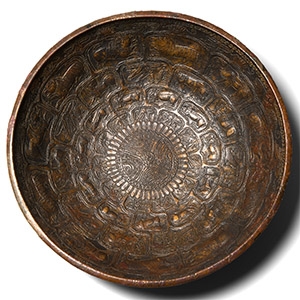
South Arabian Bronze Bowl with Mythical Animals
Sold for (Inc. bp): £5,850
Hemispherical in form, repoussé interior displaying graduated concentric registers of stylised and mythical animals within tessellating cartouches; a low relief mesomphalos decorated with rosette at centre; geometric ornament around the rim. -
.jpg)
Assyrian Bronze Relief Fragment
Sold for (Inc. bp): £16,900
Displaying a corrugated rim above and below; two advancing soldiers, each striding forwards over the headless body of a dead enemy, carrying a severed head in each hand; the soldiers shown bearded and each wearing a pointed and segmented helmet with a recess to accommodate the ears, a cuirass and thigh-length tunic, with a bow over one shoulder and a sword slung from a waist belt; mounted on a custom-made display stand. -
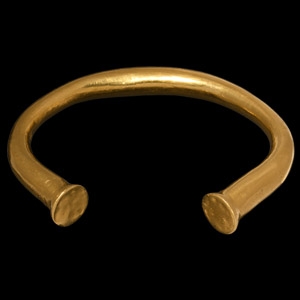
Bronze Age Gold Bracelet with Torc-Shaped Terminals
Sold for (Inc. bp): £11,440
Of penannular form with expanded sections at the centre and to both shoulders. -
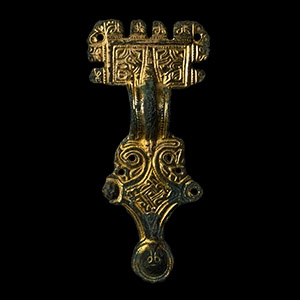
'The Oving' Anglo-Saxon Gilt Bronze Great Square-Headed Brooch
Sold for (Inc. bp): £4,160
Comprising a rectangular headplate with two panels of chip-carved Style I ornament, flanking a beast-head with triangular muzzle and two pellet eyes, raised three-sided frame and outer band of pellets above beast-heads with lentoid eyes; the shallow bow with raised median rib, flanges to the edges and punched pellet detailing; footplate with beast-head between curved pellet lines, pierced horse-head lappets, lozengiform central panel with knot of Style I limbs; two lateral discs, one pierced to accept a stud and the other with a domed stud in place; the finial a disc with human mask inverted; pin-lug and part of catch to the reverse. -
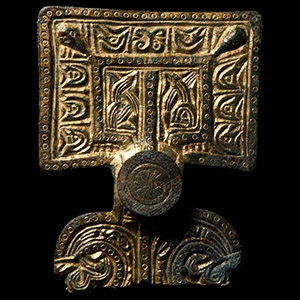
Anglo-Saxon Gilt Bronze Great Square-Headed Brooch
Sold for (Inc. bp): £3,900
Displaying chased panels populated with Style I zoomorphs and geometric forms, borders of annulets, raised masks to the upper corners of the headplate; applied discoid boss to bow decorated with a rosette, addorsed beast heads below; extensive remains of gilding; pin lug and catchplate to reverse and remains of ancient repair, lower part absent. -
.jpg)
'The Tenby' Hiberno-Norse Viking Penannular Brooch
Sold for (Inc. bp): £3,640
Comprising a round-section crescent with flared ends terminating in two curved spatulate flat panels, each with a ropework border surrounding a two-band knotwork motif; cleaned and conserved. -
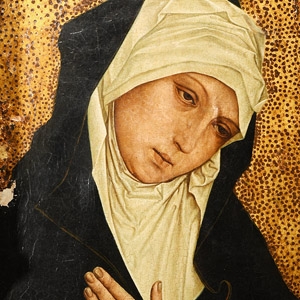
Medieval Oil Painting of Sorrowful Virgin
Sold for (Inc. bp): £9,100
The weeping Virgin with her head bowed to the left and hands raised to her chest on a dotted gilt background, an expression of pain on her delicately formed face; wearing a white veil and a black long-sleeved robe, the veil arranged as a headdress and covering her hair; on wood and mounted in a later carved wooden architectural frame. -
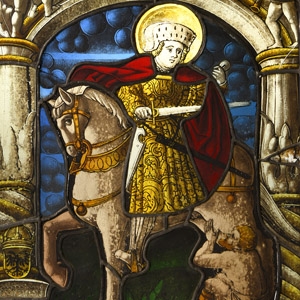
Medieval Stained Glass Panel With Saint Martin on Horseback
Sold for (Inc. bp): £2,080
Shown beneath an arcade, offering his cloak on the end of his sword to the beggar at his feet; polychrome detailing; repaired with lead cames and held in a wooden frame. -
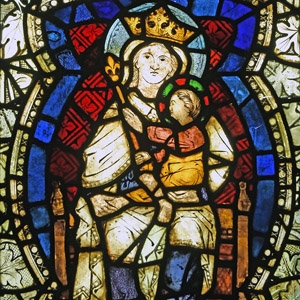
Medieval Stained Glass Panel with The Virgin and Child
Sold for (Inc. bp): £2,860
Composed from irregular painted panels bearing mainly foliage designs and figural elements; Mary crowned and enthroned with infant Jesus on her knee, in a lobed vesica-shaped panel held with lead cames; mounted in a wooden frame with modern replacements. -
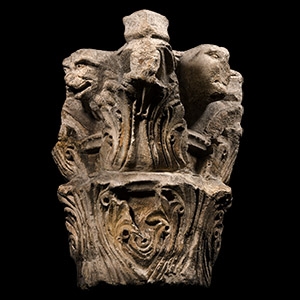
Medieval Stone Column Capital with Lion and Human Face
Sold for (Inc. bp): £1,950
Carved in the half-round with a frieze composed of interlaced foliage with two rows of acanthus leaves and foliage scrolls, framing a lion's head on one side and a human head on the other, remains of lion's mane to the third; drilled holes to the raised surfaces and sockets for the insertion of decorative stones. -
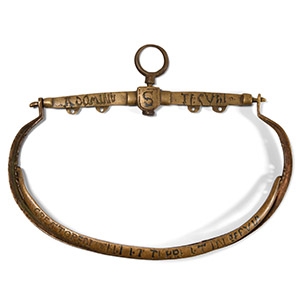
'The Kirkleavington' Medieval Bronze Inscribed Purse Frame
Sold for (Inc. bp): £3,640
The bar with central D-shaped block pierced vertically by a stud surmounted by the suspension loop, with four pierced flanges to the underside; the frame in two sections, the larger a U-shaped rod with pivot for the bar, the smaller pivoting within the inner face, both pierced on the inner face; the block inscribed to one face with capital S and to the other with intersecting Vs; the bar inscribed to one face in capitals 'A DOMINI TECVM' and to the other in coarsely incised capitals 'AVEMARIA G[R]ACIAPLE[NA]'; the smaller rod inscribed in capitals 'CREATOREN CELI ET TERRE ET IN [IES]VN'; the larger inscribed with a band of scrolled decoration and the text in Lombardic capitals 'SOLI DEO HONOR ET GLORIA'; the accompanying letter discusses the texts (1) Ave Maria G[r]acia ple[n]a Dominus Tecum 'Hail Mary full of grace, the Lord [is] with thee'; (2) Soli Deo Honor et Gloria 'Honour and glory to God alone'; (3) Creatorem celi et terrae et inferum 'creator of heaven and earth and in Jesus'. The intersecting Vs may form a monogram for A[ve] M[aria]; the 1847 letter describes the findspot as 'found at Kirkleavington near Yarm in the sill of a brook' in the North Riding of Yorkshire. -
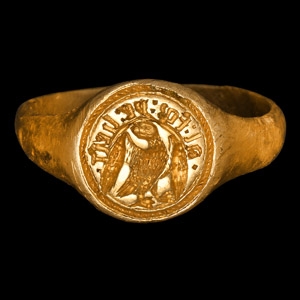
'The Roxwell' Medieval Gold Signet Ring of 'King's Serjeant William Skrene'
Sold for (Inc. bp): £23,400
Gold hoop and discoid bezel with incuse ropework border; incuse image of a bird of prey perching with wings spread and head turned; blackletter incuse and reversed inscription in an arc above the bird's head and pinions '·al : for : ye : best ·' (all for the best); repair to hoop. -
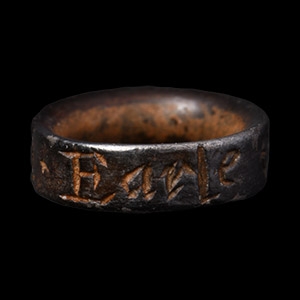
Medieval Silver 'Edmund Plantagenet, Earl of Rutland' Royal Hawking Vervel
Sold for (Inc. bp): £9,750
Or a leg ring inscribed '+Earle of Rutland' in derivative black letter script, for a female merlin or sparrow hawk (due to the youth of Edmund Plantagenet who died aged 17); the ring with a convex interior face. -
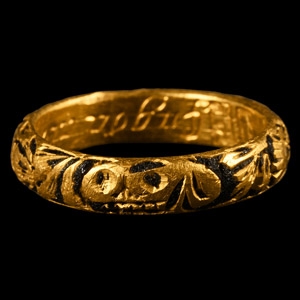
Post Medieval Gold Memento Mori Ring with Inscribed Posy 'In God Alone Wee Two Are One'
Sold for (Inc. bp): £4,680
Displaying large flower heads, foliage and a skull to the outer face, enhanced with black enamelling; interior inscribed in a cursive script 'In god alone wee two are one', together with possible maker's stamps 'D' and 'F' in two rectangular cartouches. -
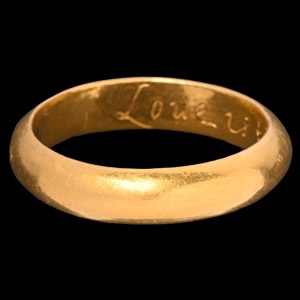
Heavy Post Medieval Gold 'Love Is The Bond Of Pease' Posy Ring
Sold for (Inc. bp): £2,860
Composed of a gently carinated hoop, the interior inscribed in cursive script 'Love is the bond of pease'. -
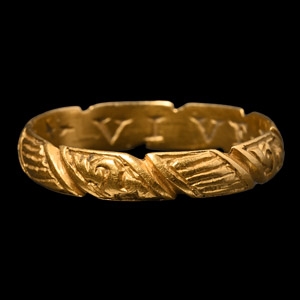
Post Medieval Gold 'Live Life to the Full' Decorated Posy Ring
Sold for (Inc. bp): £3,380
Composed of a decoratively notched hoop divided into chased rhomboidal panels displaying foliate tendrils and horizontal hatching alternately; the interior inscribed in Roman capitals with the Latin phrase: 'x x x x VIVE x VT x VIVAS'. -
![English Milled Coins - George VI - 1937 - Cased RM Proof Coronation Gold Set [4]](https://timelineauctions.com/upload/images/items/small/203351-s(2).jpg)
English Milled Coins - George VI - 1937 - Cased RM Proof Coronation Gold Set [4]
Sold for (Inc. bp): £11,700
Set comprising gold five pounds, two pounds, sovereign and half sovereign. Obvs: profile bust with GEORGIVS VI D G BR OMN REX F D IND IMP legends. Revs: St George and dragon; date in exergue; with original Royal Mint hinged red leatherette case of issue.
-
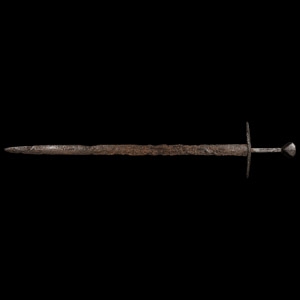
Medieval Iron Hand-And-A-Half Sword
Circa 14th-15th century A.D.Sold for (Inc. bp): £1,820
Of Oakeshott type XVIIIa or b with a strongly tapering blade of flattened diamond-section without fullers; the lower guard gently curving towards the blade, long grip; pommel of style T1 in the form of a truncated wedge. 1.35 kg, 1.07 m
Acquired 1971-1972. From the collection of the vendor's father. Property of a London, UK, collector. Accompanied by an academic report by Dr Raffaele D'Amato. This lot has been checked against the Interpol Database of stolen works of art and is accompanied by searcher certificate number no.11759-202773. -
.jpg)
Cromwellian Pikeman's Pot Helmet
1642-1651 A.D.Sold for (Inc. bp): £2,340
Of Morion Cabasset Type, the iron bowl composed of two rivetted parts with a crest; plume holder to the rear; wide sloping brim with smooth border and rivets; repaired. 1.16 kg, 35 cm
Ex Michael D Long Ltd, UK. The Kusmirek Collection, UK. Accompanied by an academic report by Dr Raffaele D'Amato. This lot has been checked against the Interpol Database of stolen works of art and is accompanied by search certificate number no.11769-204122.
A complete set of pikeman's armour consisted of a gorget, back and breast plates, and tassets. With the outbreak of the Civil War, obsolete equipment which had been stored in the Tower of London or in private armouries was brought into service together with more modern equipment. Helmets of this type were often furnished of cheek-pieces made of horizontal rows of blades. -
.jpg)
English Cuirassier Single Bar Burgonet
Circa 1620 A.D.Sold for (Inc. bp): £4,680
Iron fronted with visor, nasal guard bar and front and back gorget plates, the lifting visor marked with parallel lines; the front and back plates secured with a single hook. 2.25 kg, 34.5 cm high
Acquired on the UK art market. The Kusmirek Collection, UK. Accompanied by an academic report by Dr Raffaele D'Amato. This lot has been checked against the Interpol Database of stolen works of art and is accompanied by search certificate number no. 11766-203985.
During the latter half of the 16th century, the heavy 'knightly' lance gradually fell out of use, possibly because of the widespread adoption of the infantry pike. Also, the lance required a great amount of practice to perfect its use, whilst proficiency in the use of firearms was considerably more easily acquired. The lancer or demi-lancer, when he had abandoned his lance, became the pistol-armed cuirassier or reiter. The adoption of the pistol as the primary weapon led to the development of the stately caracole tactic, where cuirassiers fired their pistols at the enemy, then retired to reload whilst their comrades advanced in turn to maintain firing. Following some initial successes, this tactic proved to be extremely ineffective, as infantry, with superior firearms and numbers, could easily outgun the cuirassiers. The change from cavalry being reliant on firearms, to shock-capable close combat cavalry, reliant mainly on the sword, was attributed to Gustavus Adolphus of Sweden in the 1620s and 1630s, but was actually already widely practiced throughout Europe since the invention of pistol-armed heavy cavalrymen in the late 16th century. -
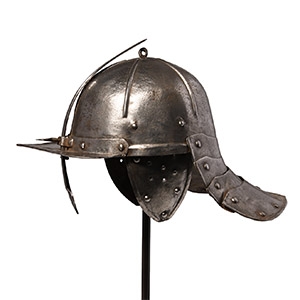
English Civil War Helmet
Mid 17th century A.D.Sold for (Inc. bp): £1,690
Of Dutch lobster-tailed pot type, the neck-guard composed of four articulated sections; wide brim with a movable nasal-guard; tongue-shaped cheekpieces with ventilation rosettes and five bosses around the raised perimeter; the cheek-pieces re-attached. 1.54 kg, 26 cm
with Peter Bunting Antiques. The Kusmirek Collection, UK. Accompanied by a copy of Peter Bunting invoice.
The capeline or taschetto (capeline in English, derived from the word that in French indicates the hat) was a particular type of helmet widespread in Western Europe in the 17th century. It was a variant of the szyszak helmet used by the cavalry forces of the Ottoman Empire and Muscovy, as well as by the winged hussars of the Polish-Lithuanian Commonwealth in the post-Renaissance era. The helmet was mainly used by armoured cavalrymen in various European armies of the 17th century, and it was one of the typical helmets of the Thirty Years' War. -
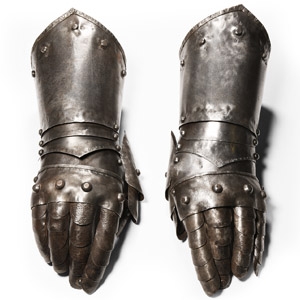
European Articulated Gauntlet Pair
Circa 1600 A.D.Sold for (Inc. bp): £1,690
Each with nail detailing to the thumb and sprays of dashes decorating the edges, ridges and rivets of certain plates; leather lining possibly not original and rivets possibly re-fitted. 1.35 kg total, 35 cm each
Acquired from Peter Bunting Antiques. The Kusmirek Collection, UK. Accompanied by copies of an invoice and previous listing. -
.jpg)
German Closed Iron Helm
Circa 1560 A.D.Sold for (Inc. bp): £4,940
An armet with rounded one-piece skull raising to a roped medial comb, visor, prow shaped upper bevor and bevor attached by common pivots, each secured at the right side by a spring-catch, the visor with stepped centrally divided visor-slit and two gorget-plates. 2 kg, 31 cm high
Acquired on the European art market. The Kusmirek Collection, UK. Accompanied by a copy of an invoice. Accompanied by an academic report by Dr Raffaele D'Amato This lot has been checked against the Interpol Database of stolen works of art and is accompanied by search certificate number no.11767-203981.
The term armet is generally used to denote a visored helmet of particular construction, one in which large cheekpieces are hinged to the base of the bowl just above the ears and close in front of the chin. From about 1515 A.D., the Germans produced a variant armet where the downward extension of the skull was made much wider, reaching as far forward as the ears. The cheekpieces on this type of helmet opened sideways, on vertical hinges on the edges of this wider neck element. -
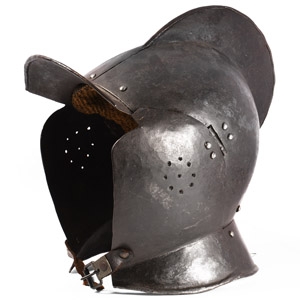
South German Burgonet Helm
Circa 1580-1610 A.D.Sold for (Inc. bp): £2,340
The rounded two-piece skull joined along the crest with a high medial comb, internally fitted with a quilted canvas lining sewn to a leather lining-band, the brow with a fixed rounded peak, outward-flanged rear edge with a matching one-piece neck guard, hinged cheek-pieces flanged outwards at the lower edge to serve as a continuation of the neck-guard. 1.7 kg, 29 cm
with Thomas Del Mar Ltd, 7th December 2017, lot 542. The Kusmirek Collection, UK. Accompanied by a copy of the Thomas Del Mar invoice. Accompanied by an academic report by Dr Raffaele D'Amato. This lot has been checked against the Interpol Database of stolen works of art and is accompanied by search certificate number no.11762-203983.
The burgonet (Italian borgognotta) had developed at the beginning of the 16th century from the sallet and soon became a very popular helmet worn in many parts of Europe (especially in Germany and Northern Italy) by infantry and later cavalry units. A clear advantage of this helmet was the unifying a good protective function against cut and thrust weapons with a unhindered field of sight, good ventilation and user comfort due to the small weight and the fact it could be worn independently without an armour. -
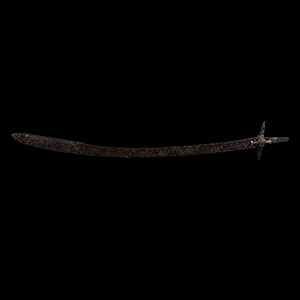
Turkish Iron Sabre
15th century A.D.Sold for (Inc. bp): £585
Comprising a cross-shaped hand guard, the blade with a slight curvature widening towards the point; mounted on a custom-made wall mount. 1.35 kg total, 95 cm including stand
Still-homogenous blade structure, pitting and traces of surface material losses due to the permanence in water; presence of many battle nicks on the cutting part of the blade.
Private collection, Munich, Germany, 1970s. Private collection, London, UK, 2014, acquired from the above.
The Turkish sabres from 15th century, had hilts similar to Omayyad and Abbasid's swords. The blades were long and heavy and were most probably used for swinging cuts, and were particularly convenient for point-thrusts when fighting on foot. -
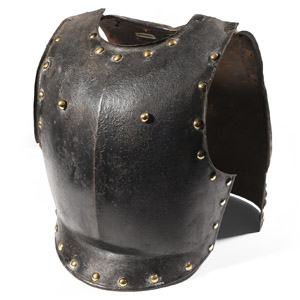
Post Medieval Spanish 'Conquistador' Cuirass Set
17th century A.D.Sold for (Inc. bp): £3,510
The breastplate with pronounced vertical rib and two rivets to front, roll at neck and splay at base with rivets to full perimeter, with inked accession numbers '21238A' (crossed through) and 'SDM - EW1' above '1931 - 30 - 6, a' and inked handwritten paper label reading 'Old Spanish Armour (Conquistador) / Found with remains of Spanish Galleon on / the estate of Leakin family (Georgia) coast. / about 1870. Refer to Trinity College Hertford Ct. / for information in Leakin family. / Given originally to Mrs Mark Howden (Hartford Ct.) / [ ] when I was 7 years old. / Luke W Lee 1944' in eight lines and also with chalked 'Old Spanish Armour / from Georgia 1944' inscription in two lines; the backplate generally matching but with vertical groove at centre and no splay at base, with inked accession numbers '31238B' (crossed through) and 'SDM - EW1' above '1951 - 30 - 6, b'. 3.3 kg, 42.5 cm high
From a Southern Californian museum, with accession numbers. Ex American collector. Acquired from TimeLine Auctions, UK, 2018, lot 181. The Kusmirek Collection, UK. This lot has been checked against the Interpol Database of stolen works of art and is accompanied by search certificate no.204020.
Trinity College, Hartford was founded in 1823; further research in their archives could provide more information on this cuirass set and the site of the 'Spanish galleon' shipwreck discovered in about 1870. -
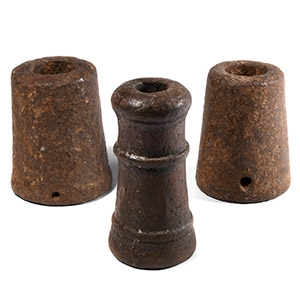
Medieval Iron Hand Cannon Collection
15th century A.D.Sold for (Inc. bp): £572
Each comprising a touch hole to base. 5.6 kg total. 9.5-12 cm
Acquired 1990s-early 2000s. East Anglian private collection.
At the beginning of the 14th century, among the infantry troops of the Western Middle Ages, developed the use of manual cannons (such as the Italian schioppetti, spingarde, and the German Fusstbusse). The new weapon had, compared to the bow and the crossbow, the advantage of not needing any particular care, of being manufactured more quickly and of being cheaper. -
.jpg)
George IV Inniskilling Dragoons Heavy Cavalry Officer's Sword
19th century A.D.Sold for (Inc. bp): £624
1821 Pattern, composed of a slightly curved blade marked with crown over GRIV monograms and 'The Iniskilling Dragoons'; fitted with wire-bound ray skin hilt and openwork basket guard, lion's head pommel; complete with original steel scabbard. 907 grams, 1.06 m
Acquired from MDL Historic Military Antiques, UK. The Kusmirek Collection, UK. Accompanied by a copy of the purchase invoice and regiment details.
This pattern sword would have been in use during the Crimean War period and the regiment served at Balaclava as part of the Heavy Brigade. -
.jpg)
British 1796 Pattern Light Cavalry Officer's Sword
19th century A.D.Sold for (Inc. bp): £1,040
Composed of a curved blade with broad fuller, facetted steel stirrup hilt and grip retaining its original wire-bound leather; accompanied by the sword's steel scabbard. 1.7 kg, 1.01 m
Acquired from Military Swords Ltd, UK, 2015. The Kusmirek Collection, UK. Accompanied by a copy of the purchase invoice and item details.
