
Auction Highlights
-
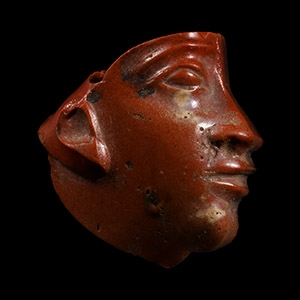
Egyptian Red Glass Face Inlay
Sold for (Inc. bp): £3,640
A red glass insert of a profile face with remains of a pharaonic crown to the forehead. -
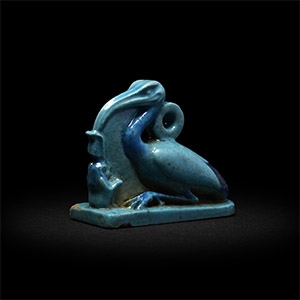
Egyptian Thoth as an Ibis with Maat
Sold for (Inc. bp): £6,500
A blue-glazed composition amulet in the form of an ibis (representing the god Thoth) seated on a wedge-shaped base, facing a figure of Maat appearing as a diminutive stooping female with an ostrich feather; some details to both figures rendered in a darker blue glaze; suspension loop to the rear of the bird's neck. -
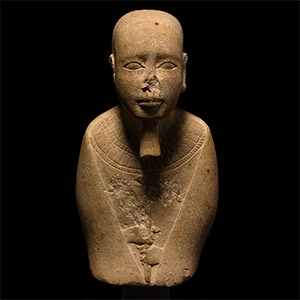
Egyptian Bust of Ptah
Sold for (Inc. bp): £13,000
A white limestone figure of the god Ptah with false beard, wearing an enveloping cloak and a broad wesekh-collar, holding the shaft of a was sceptre; serene, oval face with almond-shaped eyes and fleshy lips; remnants of dorsal pillar to reverse; mounted on a custom-made display stand. -
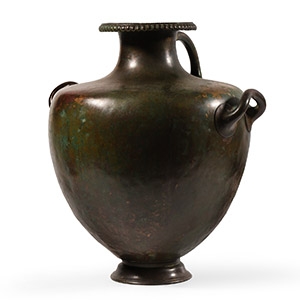
Large Greek Hydria with Egg-and-Dart Motifs
Sold for (Inc. bp): £9,525
A spectacular bronze hydria composed of a tapering body, broad shoulder and waisted neck, the everted rim decorated with egg-and-dart motifs, three round-section handles and tiered, ogival foot; professionally restored. -
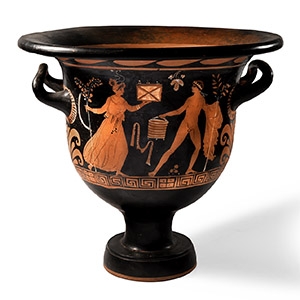
Large Greek Apulian Red-Figure Bell-Krater
Sold for (Inc. bp): £28,600
A red-figure terracotta bell-krater displaying polychrome figural panels between a laurel wreath and a band of Greek key motifs; side a) two robed male figures holding staffs, wearing a taenia or a band around the head, standing facing a central altar; side b) a woman wearing a chiton and holding a casket and olive sprig in her outstretched hands, advancing right towards a nude man standing right, his head turned towards her, holding a bucket and olive sprig, a cloak draped over his arm, elaborate volute palmettes beneath both handles; restored. -
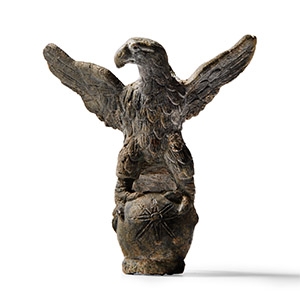
Roman Military Eagle Staff Terminal
Sold for (Inc. bp): £11,050
A free-standing bronze imperial or military eagle terminal from a staff or a sceptre, modelled in the round in a dynamic pose standing on a globe, wings spread, head turned to the right, semi-naturalistic anatomical and feather detailing; the globe bearing an incised eight-armed stylised Macedonian star; sub-triangular lug to back of the neck; collar to globe with hollow underside. -
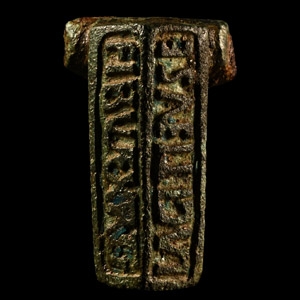
'The Castleford Military Garrison' Romano-British 'Regio Lagitiensis' Inscribed Brooch
Sold for (Inc. bp): £4,940
The best example of only three examples of this type known, a copper-alloy knee brooch composed of a rectangular-section body, spring pin within bow plate and remains of catchplate to reverse; both sides of the body with two panels of Latin lettering moulded in relief: 'FIBUL[A] EX REG LAGITIENSE', translating to 'Brooch from the Regio Lagitiensis' (Roman Castleford); remains of blue glass enamelling to the recessed fields. -
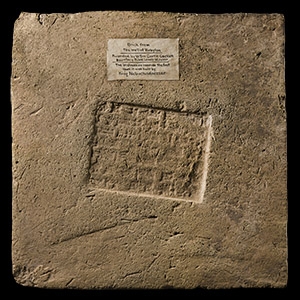
Large 'King Nebuchadnezzar the Great' Brick from the Wall of Babylon
Sold for (Inc. bp): £5,980
A large fired clay brick from the Wall of Babylon bearing six lines of stamped Babylonian cuneiform inscription to one face which reads: 'AG - ku -dur-ri-URU' / 'LUGAL ba-bi-lu' / 'za-ni-nu é-sag-ila' / 'u e-zi-da IBILA' / 'SAG.KAL. sa AG-IBILA-URU' / 'LUGAL ba-bi-lu ana-ku', which translates: 'Nebuchadnezzar, king of Babylon, who provides for Esagila and Ezida, the eldest son of Nabopolassar, king of Babylon, am I'; traces of bitumen on the blank side; accompanied by an old label which reads: 'Brick from the Wall of Babylon / Presented by W.Bro. Gentle-Cackett Secretary Bible Lands Mission / The impression records the fact that it was built by King Nebuchadnezzar [II]'. -
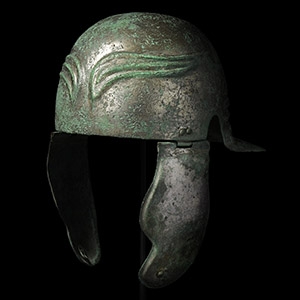
Roman Legionary Helmet with Wings of Jupiter
Sold for (Inc. bp): £52,000
A tinned sheet-bronze legionary helmet of Imperial Gallic Type A with deep rounded bowl, simple C-shaped cut-outs for the ears, integral flared neck-guard extending some way along the sides, corrugated ribs to the occipital area at the rear and corrugated 'wings' or eyebrows (Russel-Robinson's Type E) above the brow; small stud the rear of the neck-guard attaching suspension loops to the underside; hinged bracket at each temple for a deeply curved cheek-guard with gently flared rim, bearing a loop to the inner face to accept an vinculum fastening strap; accompanied by a custom-made display stand. -
.jpg)
Anglo-Saxon Gilt Chip-Carved Mount with Interlaced Panels
Sold for (Inc. bp): £6,240
A gilt copper-alloy mount composed of a broad annular body with slightly domed profile, the body quartered with each cell displaying a chip-carved interlace motif configured A:B:A:B; rim, edges and central cell with raised rim; rivet and flat-section mounting bar to reverse. -
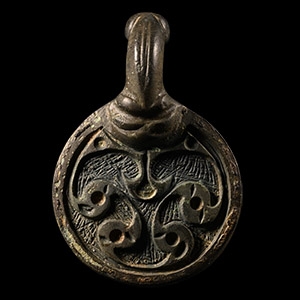
'The Pershore' Anglo-Saxon Hanging Bowl Mount with Horse-Head
Sold for (Inc. bp): £7,150
A bronze bowl mount or escutcheon comprising a discoid panel with gently curved profile and zoomorphic hook; the panel with reserved La Tène comma-leaf decoration on a pounced field (intended to receive enamel fill); the hook with median gusset to the outer face, horse-head finial, bulbous La Tène ornament at the base. -
.jpg)
'The Siddington' Impressive Anglo-Saxon Chip-Carved Saucer Brooch Pair
Sold for (Inc. bp): £24,700
A pair of large Early Anglo-Saxon gilt copper-alloy saucer brooches each comprising a broad (13mm+) angled flange surrounding a central disc with carinated border; outer zone comprising four arches subdivided by hatching to the inner edge and four C-shaped panels with triangular separators, inner zone separated by a carinated border, central disc with four radiating bilinear crescents; pin-lugs and catch to the reverse with traces of mineralised fabric. -
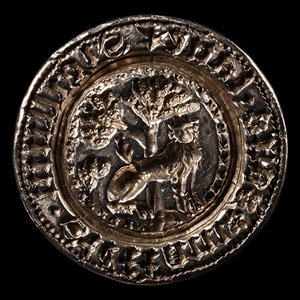
English Medieval Silver Chessman Type Seal Matrix for Stephen of Ale Lane
Sold for (Inc. bp): £3,510
A silver chessman-type seal matrix with pierced trefoil head and knop above; central motif of a leopard statant gardant before a tree, pelletted border and blackletter legend '* sigillum [lozenge] steffani [cinquefoil cinquefoil] ale [cinquefoil lozenge] lane' (for 'seal of Stephen [at?] ale lane'). -
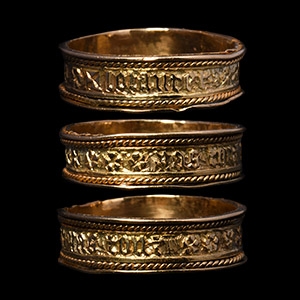
'The Bettiscombe' Medieval Gold 'Loyalty is Everything' Posy Ring
Sold for (Inc. bp): £4,160
An annular gold band with everted upper and lower lip, filigree ropework above and below each rim, with circumferential inscription to the recessed exterior face; of the five separate bands, the central one accommodating an applied strip of paler gold bearing a Medieval French blackletter inscription in relief, reading: '+loiautet (5 five cinquefoils) pas tout (5 five cinquefoils)', or 'Loyalty Passes All'; the inscription band may once have been enamelled; plain interior; the outer rim and twisted band on one edge are slightly bent; cleaned and repaired. -
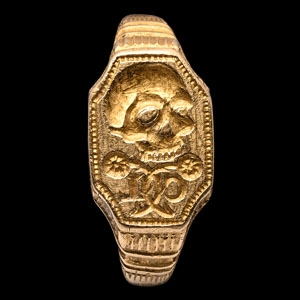
Stuart Period Gold Renaissance Memento Mori Signet Ring with C.L. and Skull
Sold for (Inc. bp): £19,500
A substantial gold signet ring composed of a lentoid-section hoop, expanding capital style shaped shoulders and irregular octagonal bezel engraved with a skull, two flowers below separating the reversed initials in capitals: 'CL', framed by a beaded border. -
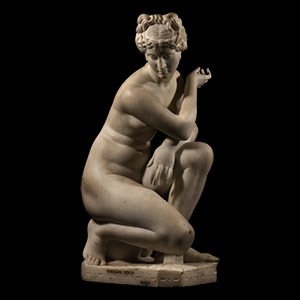
Marble Statue of Kneeling Venus
Sold for (Inc. bp): £14,950
A marble copy of the kneeling Venus (original in the Vatican Museums), crouching on an octagonal base; the arms raised in expressive pose, head tilted, hair drawn up in a chignon; lettering to base 'KNEELING VENUS' and 'ROME'.
-
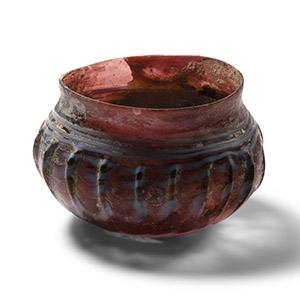
Roman Aubergine and Blue Marbled Glass Bowl
1st-2nd century A.D.Sold for (Inc. bp): £650
An aubergine-coloured glass bowl with a gently carinated and squat body, broad neck, medial raised ribs and decorative white trails. 54 grams, 81 mm wide
Acquired early 1990s. Ex private American collection; thence by descent. Private collection since 1998. -
.jpg)
Large Byzantine Cosmatesque Mosaic Panel
12th-13th century A.D.Sold for (Inc. bp): £10,400
A rectangular marble floor panel recalling similar workmanship to the floor of the Sistine Chapel, comprising a large central panel with a chequerboard design of alternating geometric floral motifs with speckled porphyry squares, surrounded by seven green and porphyry roundels, each with a bicolour border composed of interlocking triangles and lozenges; each corner with an L-shaped panel displaying a unique geometric design composed of alternating square, lozenge-shaped and small rectangular tiles. 57 kg, 80cm
French gallery, Paris, 1990s. From a family collection. Accompanied by an academic report by Dr Raffaele D'Amato. This lot has been checked against the Interpol Database of stolen works of art and is accompanied by search certificate no.11586-199348.
The Cosmatesque Style was a characteristic type of ornamentation of Eastern Roman origin (opus alexandrinum) used by the post-Roman marble makers of the 12th and 13th centuries A.D. It embellishes floors, ciboriums and cloisters of churches by means of polychrome marble inlays of varied and imaginative geometric shapes. The wider use of this decoration began in the 12th century, at which time techniques were improved: the Cosmati floors were made with pieces of stone cut in various shapes and sizes, a property quite different from the mosaics in opus tessellatum, in which the motifs were made from small units all having the same size and shape, or from the opus sectile, intended to create representations with pieces of multi-coloured marble cut out and arranged for this purpose. The stones used by Cosmati artists were often material salvaged from the ruins of ancient Roman buildings. The composition of such mosaics recalls the floors of the most important churches of Rome; in addition to the floor of the Sistine Chapel (created probably in the 14th century for the previous building or Cappella Maggiore), one can cite that of Santa Maria Maggiore (1145-1153 A.D.), San Giovanni in Laterano (14th century A.D.), Saint Clement (1099-1120 A.D.), Santi Quattro Coronati (13th century A.D.), Santa Croce in Gerusalemme (12th century A.D.) and many others. -
Large 'King Nebuchadnezzar the Great' Brick from the Wall of Babylon
604-562 B.C.Sold for (Inc. bp): £5,980
A large fired clay brick from the Wall of Babylon bearing six lines of stamped Babylonian cuneiform inscription to one face which reads: 'AG - ku -dur-ri-URU' / 'LUGAL ba-bi-lu' / 'za-ni-nu é-sag-ila' / 'u e-zi-da IBILA' / 'SAG.KAL. sa AG-IBILA-URU' / 'LUGAL ba-bi-lu ana-ku', which translates: 'Nebuchadnezzar, king of Babylon, who provides for Esagila and Ezida, the eldest son of Nabopolassar, king of Babylon, am I'; traces of bitumen on the blank side; accompanied by an old label which reads: 'Brick from the Wall of Babylon / Presented by W.Bro. Gentle-Cackett Secretary Bible Lands Mission / The impression records the fact that it was built by King Nebuchadnezzar [II]'. 13.6 kg, 33.5 x 33 cm
Ex Reverend Samuel W. Gentle-Cackett (1871-1943), in the 1930s. Gentle-Cackett was the secretary of the Bible Lands Missions’ Aid Society, 76 The Strand, London, WC2 (1904-1943), author of Palestine Portrayed, 1936, and Worshipful Brother of the Lodge of Sincerity 174. This brick formed part of an old collection of Masonic ephemera, and is believed to have originated from the Lodge of Sincerity 174. Property of a Sussex, UK, teacher. Accompanied by a copy of the book Palestine Portrayed, 1936, written by S.W. Gentle-Cackett. Accompanied by copies of the relevant pages from the book They Wrote on Clay, showing similar bricks in situ.
Genesis 11:3: "And they said to one another, 'Come, let us make bricks, and burn them thoroughly', and they had brick for stone and bitumen for mortar." In the 1920s, Cackett read reports of Christian Armenians being orphaned as a result of attacks from Turks and in response he set up a refuge in Bedfont, where he was able to rehome 1500 children. -
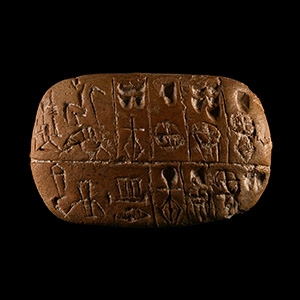
Mesopotamian Pictographic Administrative Tablet
Uruk III, circa 3000 B.C.Sold for (Inc. bp): £4,940
A bifacial, lentoid-section rectangular clay tablet with rounded corners and short sides, medial horizontal line to each face, with hand-drawn pictographs above and below, a count of sheep and caprids. 42 grams, 66 mm wide
Specialised collection of cuneiform texts, the property of a London gentleman and housed in London before 1992. Thence by descent to family members. Examined by Professor Wilfrid George Lambert FBA (1926-2011), historian, archaeologist, and specialist in Assyriology and Near Eastern archaeology, in the late 1980s and early 1990s. The collection is exceptional for the variety of types, including some very rare and well preserved examples. This lot has been checked against the Interpol Database of stolen works of art and is accompanied by search certificate no.11637-198551.
Early writing was used primarily as a means of recording economic data; this tablet likely records deliveries and distributions of grain. At the end of the 4th millennium B.C., written language developed in Mesopotamia as pictographs, later evolving into abstract forms called cuneiform. Pictographs were drawn in the clay with a pointed implement. Circular impressions alongside the pictographs represented numerical symbols. Cuneiform (meaning wedge-shaped) script was written by pressing a reed pen or stylus with a wedge-shaped tip into a clay tablet. -
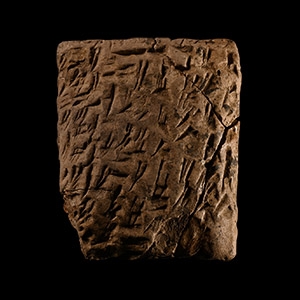
Neo-Babylonian Cuneiform Administrative Tablet from the Reign of Artaxerxes I, Achaemenid King of Persia
465-424 B.C.Sold for (Inc. bp): £910
A pillow-shaped administrative clay tablet bearing cuneiform text to both principal faces, relating to a barley debt; Aramaic graffiti to one edge. 114 grams, 67 mm wide
Specialised collection of cuneiform texts, the property of a London gentleman and housed in London before 1992. Thence by descent to family members. Examined by Professor Wilfrid George Lambert FBA (1926-2011), historian, archaeologist, and specialist in Assyriology and Near Eastern archaeology, in the late 1980s and early 1990s. The collection is exceptional for the variety of types, including some very rare and well preserved examples.
The tablet records a promissory note of a typical kind to pay for barley. It concludes with the names of witnesses, town and date. The Aramaic script transcribes the cuneiform name of the debtor into Aramaic script, making it easier for scribes to identify who each tablet refers to. It dates to the Achaemenid period, to the reign of Artaxerxes I (465-424 B.C.). Such late administrative tablets are typically carelessly written, as is apparent on our example as some script has been rendered slanting sharply downwards. -
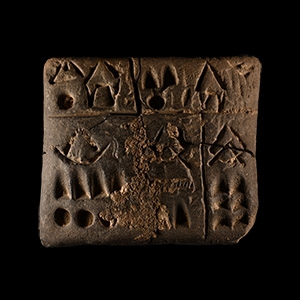
Mesopotamian Pictographic Tablet Relating to Cattle
Uruk III, circa 3000 B.C.Sold for (Inc. bp): £3,120
A bifacial pillow-shaped clay tablet bearing pictographs relating to cattle to both principal faces; repaired. 130 grams, 56 mm wide
Specialised collection of cuneiform texts, the property of a London gentleman and housed in London before 1992. Thence by descent to family members. Examined by Professor Wilfrid George Lambert FBA (1926-2011), historian, archaeologist, and specialist in Assyriology and Near Eastern archaeology, in the late 1980s and early 1990s. The collection is exceptional for the variety of types, including some very rare and well preserved examples.
Early writing was used primarily as a means of recording economic data. At the end of the 4th millennium B.C., written language developed in Mesopotamia as pictographs, later evolving into abstract forms called cuneiform. Pictographs were drawn in the clay with a pointed implement. Circular impressions alongside the pictographs represented numerical symbols. Cuneiform (meaning wedge-shaped) script was written by pressing a reed pen or stylus with a wedge-shaped tip into a clay tablet. -
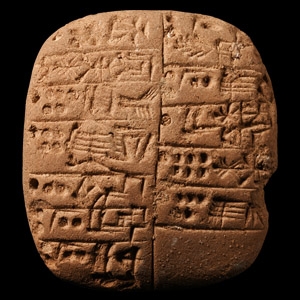
Old Babylonian Pictographic Tablet
2600-2400 B.C.Sold for (Inc. bp): £1,300
A roughly pillow-shaped clay tablet bearing pictographs to one face. 47 grams, 50 mm
Acquired early 1990s. Ex private American collection; thence by descent. Private Swiss collection since 1998. -
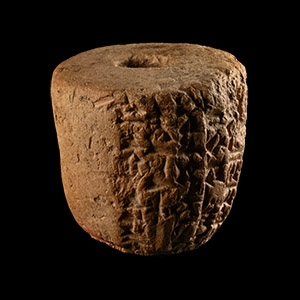
Babylonian Cuneiform Cylinder with Akkadian Inscription Relating to the Planting of a Cedar Hedge
Circa 2nd millennium B.C.Sold for (Inc. bp): £845
A hollow cylinder bearing an inscription in Akkadian, relating to the planting of a cedar hedge to protect the orchard of Ili-tukulti from the wind: 'At (the edge of) a bare orchard, against the north wind, near six watering holes, Yamhad cedars were planted in the orchard of Ilī-tukultī.' 60 grams, 39 mm
Acquired before 1992. Ex gentleman's family collection, London, UK. -
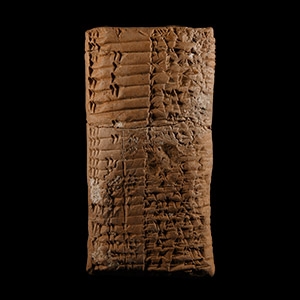
Cuneiform Accounting Tablet Listing a Distribution to a Series of Babylonian Soldiers
Mid 2nd millennium B.C.Sold for (Inc. bp): £1,105
A bifacial rectangular tablet with lentoid cross-section, the two principal faces bearing cuneiform text relating to a distribution for several individuals whose names are recorded in the left-hand column (Sîn-bēl-ilī Masitum, Sinatum, etc.), probably Babylonian soldiers, the document dates to the end of the first Babylonian dynasty; repaired. 353 grams, 13 cm wide
Specialised collection of cuneiform texts, the property of a London gentleman and housed in London before 1992. Thence by descent to family members. Examined by Professor Wilfrid George Lambert FBA (1926-2011), historian, archaeologist, and specialist in Assyriology and Near Eastern archaeology, in the late 1980s and early 1990s. The collection is exceptional for the variety of types, including some very rare and well preserved examples. -
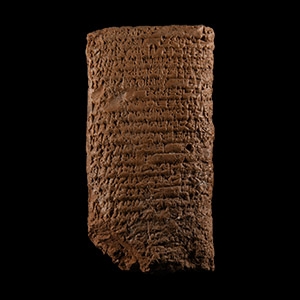
Old Babylonian Cuneiform Tablet, a Letter from Šamaš-nasir to Iluni King of Ešnunna Concerning the People of Zibbatum
Circa 1730-1720 B.C.Sold for (Inc. bp): £1,690
A clay tablet of broadly rectangular form, a letter from Šamaš-naṣir (a provincial governor) to his lord, Iluni king of Ešnunna (Tell Asmar), the king passed orders to mobilise the men of Ida-Maraṣ, the name of the country of Ešnunna, to provide grain transport, but the men of the city Zibbatum did not respond to the call despite the governor's request to generals, the people of Zibbatum became apiru, that is, wandering groups; this is a social category well known from the second millennium (notably in the Canaanite texts of El-Amarna) which has sometimes been compared to the Hebrews of the Bible; the tablet reading: 'According to the mission of my Lord, I said to Arahum thus: 'Are not the people of Zibbatum the soldiers of your lord? Why did you make them Apirum?' This is what I said to him and Arahum blamed me, since that time Ibnatum does not cease to be insolent before me and does not cease to hide his troop from me. Yesterday, when I came to my lord, I wanted to inspect him but his troop was not present. I sent one of my servants to the city of Urula, one of my servants to the interior of the country and one of my servants to the city of Labi, his city, in order to (re)lead his troop and himself and until now they have not brought me any news. As soon as they have brought them back to me my lord will hear the punishment I intend to inflict on him. In such a large country as the one my lord has entrusted to me, I...' 183 grams, 10.2 cm wide
Specialised collection of cuneiform texts, the property of a London gentleman and housed in London before 1992. Thence by descent to family members. Examined by Professor Wilfrid George Lambert FBA (1926-2011), historian, archaeologist, and specialist in Assyriology and Near Eastern archaeology, in the late 1980s and early 1990s. The collection is exceptional for the variety of types, including some very rare and well preserved examples. -
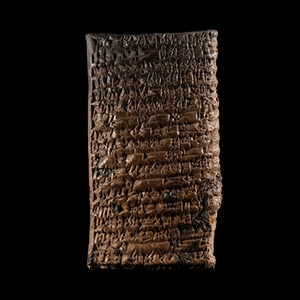
Old Babylonian Cuneiform Letter from King Illuni to Inzuršakšu King of Niqqum About Being Attacked by the Elamites
Circa 1730-1720 B.C.Sold for (Inc. bp): £5,200
A rectangular bifacial clay tablet bearing cuneiform text to both principal faces and two side edges; a letter from Iluni, king of Ešnunna, to Inzuršakšu, king of Niqqum; Iluni answered to a letter from his ally who accused him of not having respected their agreements by not sending him an army as he had asked in a letter; he says he is attacked by the Elamites (neighbors of Niqqum), Iluni defends himself and considers that it is on the contrary Inzuršakšu who is in his wrong, he accuses him indeed not only of being the aggressor, but also of wanting to push him to enter in conflict with the Elamites, whom he was indeed himself a vassal, an incomplete draft of this letter was already known; excerpts: 'About the Elamite troop which rose against my country I had written to you to send me a reinforcement troop but you did not send me any troop. You have therefore violated your divine oath (...). This is what you have just written to me. It is you who have just violated your divine oath! Now you are willing to do bad things to this country and you want me to be angry with the Elamites. (...)' 179 grams, 94 mm wide
Specialised collection of cuneiform texts, the property of a London gentleman and housed in London before 1992. Thence by descent to family members. Examined by Professor Wilfrid George Lambert FBA (1926-2011), historian, archaeologist, and specialist in Assyriology and Near Eastern archaeology, in the late 1980s and early 1990s. The collection is exceptional for the variety of types, including some very rare and well preserved examples.
A draft of this message was already known but the present one gives a more complete version. -
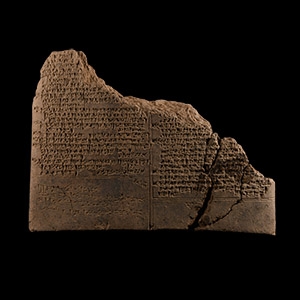
Large Babylonian Cuneiform Tablet Fragment Concerning the Study of the Sacrificial Liver
Late 2nd millennium B.C.Sold for (Inc. bp): £3,120
A large clay tablet fragment bearing panels of cuneiform text to the principal face, separated by plain parallel lines; remains of cuneiform text to the reverse; a Babylonian treatise concerning the study of the liver of a sacrificial lamb; repaired. 533 grams, 15.6 cm wide
Specialised collection of cuneiform texts, the property of a London gentleman and housed in London before 1992. Thence by descent to family members. Examined by Professor Wilfrid George Lambert FBA (1926-2011), historian, archaeologist, and specialist in Assyriology and Near Eastern archaeology, in the late 1980s and early 1990s. The collection is exceptional for the variety of types, including some very rare and well preserved examples.
The prophetic practise of hepatoscopy, was called in Akkadian barûtu, the art of divination. It is a collection of omens in standard Akkadian (including many sumerograms) each composed of a protasis (description of the configuration of the organ at the time of observation by the diviner) followed by the apodosis giving the omen itself. The fragment preserves the beginning of the treaty on the face and the end on the reverse. Among the various omens is a so-called historical one concerning King Sargon of Akkad (ca. 2350 BCE). A colophon indicates that the text is a copy of an ancient original. The name of the scribe is Mudammiq-Adad. His work was verified by Ur-Nintinuga, a Sumerian name from the Cassite period.
