
Auction Highlights
-
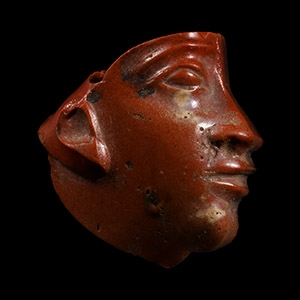
Egyptian Red Glass Face Inlay
Sold for (Inc. bp): £3,640
A red glass insert of a profile face with remains of a pharaonic crown to the forehead. -
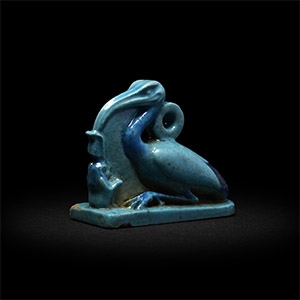
Egyptian Thoth as an Ibis with Maat
Sold for (Inc. bp): £6,500
A blue-glazed composition amulet in the form of an ibis (representing the god Thoth) seated on a wedge-shaped base, facing a figure of Maat appearing as a diminutive stooping female with an ostrich feather; some details to both figures rendered in a darker blue glaze; suspension loop to the rear of the bird's neck. -
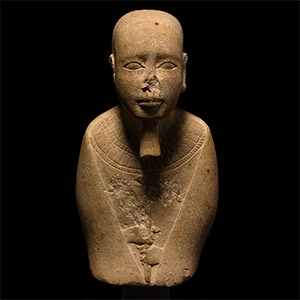
Egyptian Bust of Ptah
Sold for (Inc. bp): £13,000
A white limestone figure of the god Ptah with false beard, wearing an enveloping cloak and a broad wesekh-collar, holding the shaft of a was sceptre; serene, oval face with almond-shaped eyes and fleshy lips; remnants of dorsal pillar to reverse; mounted on a custom-made display stand. -
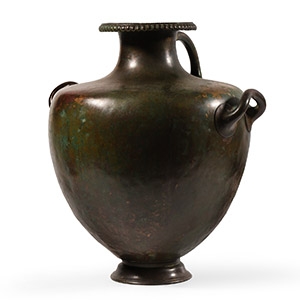
Large Greek Hydria with Egg-and-Dart Motifs
Sold for (Inc. bp): £9,525
A spectacular bronze hydria composed of a tapering body, broad shoulder and waisted neck, the everted rim decorated with egg-and-dart motifs, three round-section handles and tiered, ogival foot; professionally restored. -
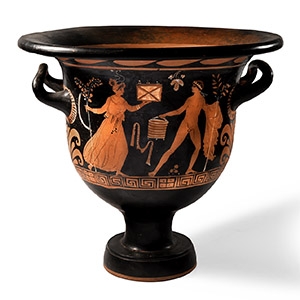
Large Greek Apulian Red-Figure Bell-Krater
Sold for (Inc. bp): £28,600
A red-figure terracotta bell-krater displaying polychrome figural panels between a laurel wreath and a band of Greek key motifs; side a) two robed male figures holding staffs, wearing a taenia or a band around the head, standing facing a central altar; side b) a woman wearing a chiton and holding a casket and olive sprig in her outstretched hands, advancing right towards a nude man standing right, his head turned towards her, holding a bucket and olive sprig, a cloak draped over his arm, elaborate volute palmettes beneath both handles; restored. -
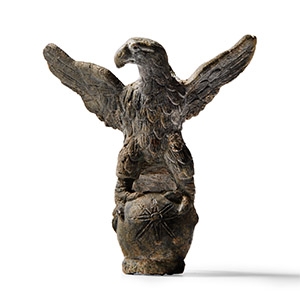
Roman Military Eagle Staff Terminal
Sold for (Inc. bp): £11,050
A free-standing bronze imperial or military eagle terminal from a staff or a sceptre, modelled in the round in a dynamic pose standing on a globe, wings spread, head turned to the right, semi-naturalistic anatomical and feather detailing; the globe bearing an incised eight-armed stylised Macedonian star; sub-triangular lug to back of the neck; collar to globe with hollow underside. -
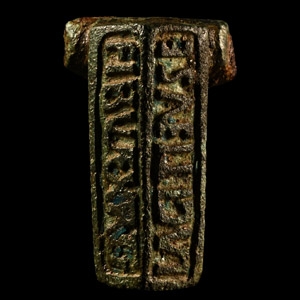
'The Castleford Military Garrison' Romano-British 'Regio Lagitiensis' Inscribed Brooch
Sold for (Inc. bp): £4,940
The best example of only three examples of this type known, a copper-alloy knee brooch composed of a rectangular-section body, spring pin within bow plate and remains of catchplate to reverse; both sides of the body with two panels of Latin lettering moulded in relief: 'FIBUL[A] EX REG LAGITIENSE', translating to 'Brooch from the Regio Lagitiensis' (Roman Castleford); remains of blue glass enamelling to the recessed fields. -
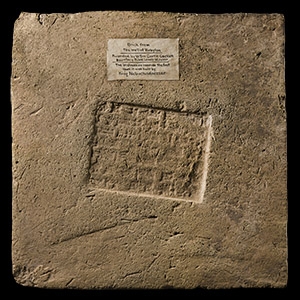
Large 'King Nebuchadnezzar the Great' Brick from the Wall of Babylon
Sold for (Inc. bp): £5,980
A large fired clay brick from the Wall of Babylon bearing six lines of stamped Babylonian cuneiform inscription to one face which reads: 'AG - ku -dur-ri-URU' / 'LUGAL ba-bi-lu' / 'za-ni-nu é-sag-ila' / 'u e-zi-da IBILA' / 'SAG.KAL. sa AG-IBILA-URU' / 'LUGAL ba-bi-lu ana-ku', which translates: 'Nebuchadnezzar, king of Babylon, who provides for Esagila and Ezida, the eldest son of Nabopolassar, king of Babylon, am I'; traces of bitumen on the blank side; accompanied by an old label which reads: 'Brick from the Wall of Babylon / Presented by W.Bro. Gentle-Cackett Secretary Bible Lands Mission / The impression records the fact that it was built by King Nebuchadnezzar [II]'. -
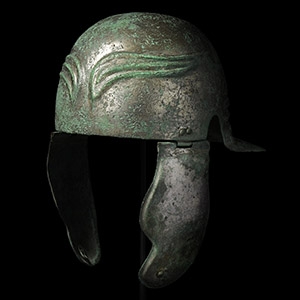
Roman Legionary Helmet with Wings of Jupiter
Sold for (Inc. bp): £52,000
A tinned sheet-bronze legionary helmet of Imperial Gallic Type A with deep rounded bowl, simple C-shaped cut-outs for the ears, integral flared neck-guard extending some way along the sides, corrugated ribs to the occipital area at the rear and corrugated 'wings' or eyebrows (Russel-Robinson's Type E) above the brow; small stud the rear of the neck-guard attaching suspension loops to the underside; hinged bracket at each temple for a deeply curved cheek-guard with gently flared rim, bearing a loop to the inner face to accept an vinculum fastening strap; accompanied by a custom-made display stand. -
.jpg)
Anglo-Saxon Gilt Chip-Carved Mount with Interlaced Panels
Sold for (Inc. bp): £6,240
A gilt copper-alloy mount composed of a broad annular body with slightly domed profile, the body quartered with each cell displaying a chip-carved interlace motif configured A:B:A:B; rim, edges and central cell with raised rim; rivet and flat-section mounting bar to reverse. -
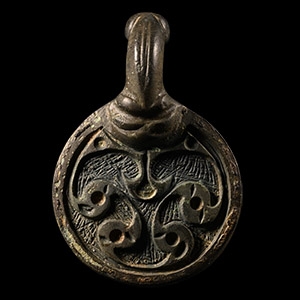
'The Pershore' Anglo-Saxon Hanging Bowl Mount with Horse-Head
Sold for (Inc. bp): £7,150
A bronze bowl mount or escutcheon comprising a discoid panel with gently curved profile and zoomorphic hook; the panel with reserved La Tène comma-leaf decoration on a pounced field (intended to receive enamel fill); the hook with median gusset to the outer face, horse-head finial, bulbous La Tène ornament at the base. -
.jpg)
'The Siddington' Impressive Anglo-Saxon Chip-Carved Saucer Brooch Pair
Sold for (Inc. bp): £24,700
A pair of large Early Anglo-Saxon gilt copper-alloy saucer brooches each comprising a broad (13mm+) angled flange surrounding a central disc with carinated border; outer zone comprising four arches subdivided by hatching to the inner edge and four C-shaped panels with triangular separators, inner zone separated by a carinated border, central disc with four radiating bilinear crescents; pin-lugs and catch to the reverse with traces of mineralised fabric. -
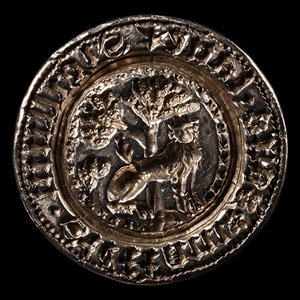
English Medieval Silver Chessman Type Seal Matrix for Stephen of Ale Lane
Sold for (Inc. bp): £3,510
A silver chessman-type seal matrix with pierced trefoil head and knop above; central motif of a leopard statant gardant before a tree, pelletted border and blackletter legend '* sigillum [lozenge] steffani [cinquefoil cinquefoil] ale [cinquefoil lozenge] lane' (for 'seal of Stephen [at?] ale lane'). -
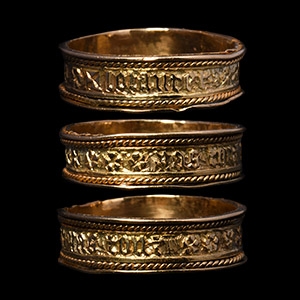
'The Bettiscombe' Medieval Gold 'Loyalty is Everything' Posy Ring
Sold for (Inc. bp): £4,160
An annular gold band with everted upper and lower lip, filigree ropework above and below each rim, with circumferential inscription to the recessed exterior face; of the five separate bands, the central one accommodating an applied strip of paler gold bearing a Medieval French blackletter inscription in relief, reading: '+loiautet (5 five cinquefoils) pas tout (5 five cinquefoils)', or 'Loyalty Passes All'; the inscription band may once have been enamelled; plain interior; the outer rim and twisted band on one edge are slightly bent; cleaned and repaired. -
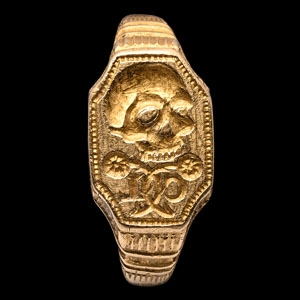
Stuart Period Gold Renaissance Memento Mori Signet Ring with C.L. and Skull
Sold for (Inc. bp): £19,500
A substantial gold signet ring composed of a lentoid-section hoop, expanding capital style shaped shoulders and irregular octagonal bezel engraved with a skull, two flowers below separating the reversed initials in capitals: 'CL', framed by a beaded border. -
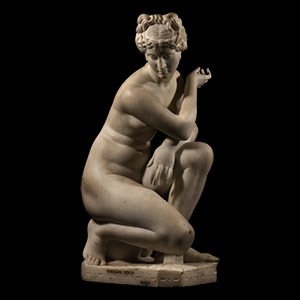
Marble Statue of Kneeling Venus
Sold for (Inc. bp): £14,950
A marble copy of the kneeling Venus (original in the Vatican Museums), crouching on an octagonal base; the arms raised in expressive pose, head tilted, hair drawn up in a chignon; lettering to base 'KNEELING VENUS' and 'ROME'.
-
.jpg)
Roman Statuette of Attis
1st-2nd century A.D.Sold for (Inc. bp): £702
A bronze figure of Attis standing wearing the distinctive Phrygian cap, advancing wearing a flounced tunic and cloak, holding a falx in the left hand; right arm absent; mounted on a custom-made stand. 117 grams total, 97 mm high including stand
German art market, 1990s. Mr A.H., a North American collector living in the UK. -
Roman Military Eagle Staff Terminal
2nd-3rd century A.D.Sold for (Inc. bp): £11,050
A free-standing bronze imperial or military eagle terminal from a staff or a sceptre, modelled in the round in a dynamic pose standing on a globe, wings spread, head turned to the right, semi-naturalistic anatomical and feather detailing; the globe bearing an incised eight-armed stylised Macedonian star; sub-triangular lug to back of the neck; collar to globe with hollow underside. 166 grams, 88 mm high
with Bonham's, London, Knightsbridge, UK, 16 May 2002, lot 301. Accompanied by a copy of the relevant Bonhams catalogue pages. Accompanied by an academic report by Dr Raffaele D'Amato. This lot has been checked against the Interpol Database of stolen works of art and is accompanied by search certificate number no.11582-198947
In the Roman world, the eagle was associated with the god Jupiter or Zeus, king of the Olympian gods, and was seen as ‘the symbol and agent of apotheosis after death’. An eagle was released from the top of an emperor’s funeral pyre to signal the journey of the soul towards heaven. A sacred attribute of Jupiter, this eagle terminal may have been attached to a sceptre of the statue of the god. Eagles were also the principal standard of the legions, and became the military symbol for excellence. -
'The Castleford Military Garrison' Romano-British 'Regio Lagitiensis' Inscribed Brooch
Late 2nd-early 3rd century A.D.Sold for (Inc. bp): £4,940
The best example of only three examples of this type known, a copper-alloy knee brooch composed of a rectangular-section body, spring pin within bow plate and remains of catchplate to reverse; both sides of the body with two panels of Latin lettering moulded in relief: 'FIBUL[A] EX REG LAGITIENSE', translating to 'Brooch from the Regio Lagitiensis' (Roman Castleford); remains of blue glass enamelling to the recessed fields. 11 grams, 30 mm wide
Found whilst searching with a metal detector near Wickham Market, Suffolk, UK, on 24th September 2022. Accompanied by a copy of the British Museum's Portable Antiquities Scheme (PAS) report with record number: SF-F57791. Accompanied by a copy of an article on Castleford Vicus and a similar brooch found in the Alford area of Lincolnshire, UK.
Castleford is known to have been a regiones, an administrative centre for lands owned directly by the Emperor. Other known regiones in Britain were Bath, Carlisle and Ribchester. Regiones appear to have been administered by military officers of centurion rank. Crucially for our item, Castleford’s status as one of the regiones is known from the separate finds of two metal brooches with the same inscriptions discovered by metal detectorists; one from North Lincolnshire, the other from an unknown find-spot, now our third example, found in Suffolk. The third brooch, offered for sale here, is the best known example of the Castleford (Lagentium) vicus brooch, and the only complete example of the three known to exist. These brooches are seemingly unique amongst Roman artefacts in incorporating the name of their place of production into their decorative scheme. A vicus is the civilian settlement located outside the Roman fort. The triangular-section brooch body possibly alludes to the pitched and tiled roof of a military building. Roman Castleford began life in circa 71 A.D. as a fort constructed as part of the conquest of northern England. The garrison attracted local traders and a small settlement grew nearby. Excavation of this settlement suggests that the inhabitants were making and repairing military equipment for the soldiers, and it is likely that these workshops continued to profit when the fort was abandoned around 100 A.D; Castleford is unusual in this respect, since the Roman army typically demolished their forts once the area had been pacified, at which point, any associated settlements usually disappeared too. At Castleford in contrast, the town remained and continued to prosper, likely because of its port location which facilitated trade with the wider Empire, together with its location on the main road between London and York. -
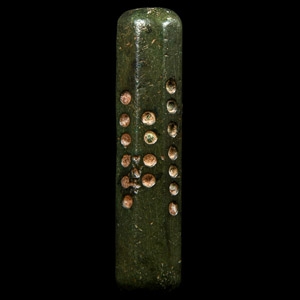
'The Uttoxeter' Roman Octagonal Rolling Dice
1st-4th century A.D.Sold for (Inc. bp): £3,120
An octagonal bronze 'Stabwuerfel' rolling dice with rounded terminals, drilled dot numbering rotating the rod clockwise: 1; 4-4; 3; 5; 2; 7; 4; 6; an additional single dimple to the end face of one terminal; all numbers are drilled at the centre of the rod with the exception of the number 8, which is split into two groups of 4, located at either end. 58 grams, 54 mm
Found whilst searching with a metal detector rear North Uttoxeter, East Staffordshire, UK, on Saturday 11th March 2017, by Martin Colclough. Accompanied by a copy of the British Museum's Portable Antiquities Scheme (PAS) report no. LANCUM-E6101C where it states: 'Stabwuerfel (germ. rod dice) are very rare in this country and this is the first one recorded on this database...This die will be marked a Find of Note for the area...and has been designated: Potential for inclusion in Britannia.'
The PAS report describes this find of note as being 'in extremely good condition'. The dots may once have had an enamel fill. -
.jpg)
Roman Gold Ring with Hermes Gemstone
Late 2nd-early 3rd century A.D.Sold for (Inc. bp): £650
A hollow-formed gold finger ring with inset jasper intaglio of Mercury (Hermes) standing wearing a cloak, holding a caduceus in one hand and a coin-purse in the other. 3.88 grams, 25.81 mm overall, 16.69 mm internal diameter (approximate size British H 1/2, USA 4, Europe 6.81, Japan 6)
Swiss private collection. with Geneve Encheres, Switzerland, 14 December 2017, lot 853. English private collection. -
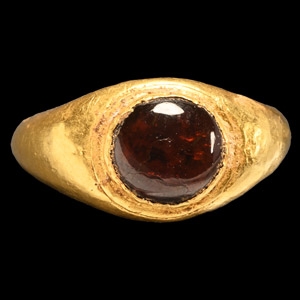
Roman Gold Ring with Garnet Cabochon
1st century A.D.Sold for (Inc. bp): £780
A hollow-formed gold finger ring with inset cabochon garnet. 2.11 grams, 21.42 mm overall, 16.92 mm internal diameter (approximate size British L, USA 5 3/4, Europe 11.24, Japan 10)
Acquired early 1990s. Ex private American collection; thence by descent. Private Swiss collection since 1998. -
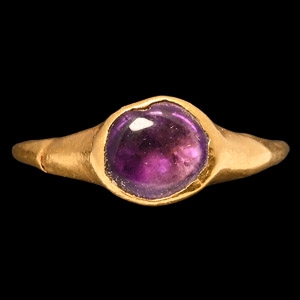
Roman Gold Ring with Gemstone
Circa 2nd-3rd century A.D.Sold for (Inc. bp): £650
A slender gold finger ring with ellipsoid cell and inset cabochon amethyst. 1.07 grams, 19.64 mm overall, 15.84 mm internal diameter (approximate size British H 1/2, USA 4, Europe 6.81, Japan 6)
UK private collection, since 1956. Formed in the 1950s by by Mr and Mrs S. Broukal, thence by decent. with Bonham's, London, New Bond Street, 30 November 2016, lot 155 [Part]. English private collection. -
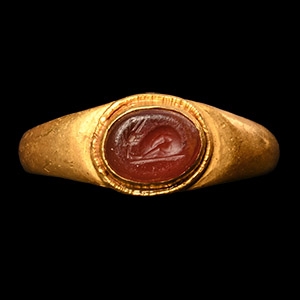
Roman Gold Ring with Dolphin Gemstone
1st-3rd century A.D.Sold for (Inc. bp): £845
A gold ring composed of a hoop with expanded shoulders and raised oval bezel with filigree collar, set with a carnelian intaglio engraved with a dolphin. 3.66 grams, 21.43 mm overall, 18.93 mm internal diameter (approximate size British N 1/2, USA 6 3/4, Europe 14.35, Japan 13)
Acquired before 2000. From the collection of a European gentleman living in the UK. -
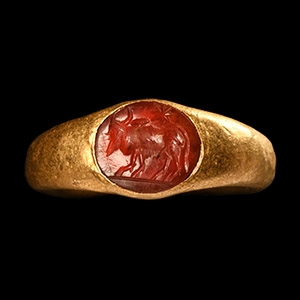
Roman Gold Ring with Cult of Jupiter Dolichenus Bull Gemstone
2nd century A.D.Sold for (Inc. bp): £1,105
A solid, smooth gold ring with D-shaped hoop, oval carnelian intaglio with a bull surmounted by a star; repaired. 4.41 grams, 26.31 mm overall, 18.49 mm internal diameter (approximate size British Q 1/2, USA 8 1/4, Europe 18.12, Japan 17)
repaired
Acquired 1970-2000s. Ex Abelita family collection.
The bull, symbol of thunder and fertility, was an important component of the cult of Jupiter Dolichenus, to which this ring is probably connected. The god is usually represented as standing on a bull holding an axe in his upraised right hand and a bolt of lightning in the left. This bull perpetuated the connection with storms, a frequent and rather obvious identification of power and ferocity. This was a Hittite concept inherited from the Anatolians and then by the Romans. -
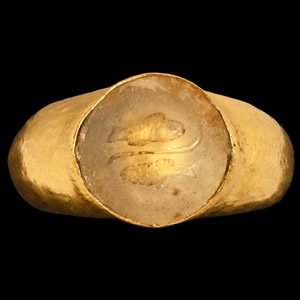
Roman Gold Ring with Fish Gemstone
3rd-4th century A.D.Sold for (Inc. bp): £1,170
A hollow-formed gold finger ring with inset glass intaglio of two fishes placed tête-bêche; the astrological symbol for the Pisces constellation. 6.11 grams, 26.55 mm overall, 20.73 mm internal diameter (approximate size British W 1/2, USA 11 1/4, Europe 25.6, Japan 24)
English private collection. -
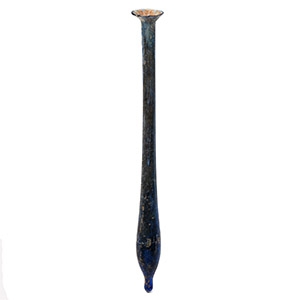
Large Roman Blue Long Neck Vessel
1st-4th century A.D.Sold for (Inc. bp): £293
A blue fusiform glass vessel composed of an everted rim, elongated tubular neck with short expanded body and integral foot; iridescent surfaces; repaired. 29 grams, 20.7 cm high
Acquired early 1990s. Ex private American collection; thence by descent. Private collection since 1998. -
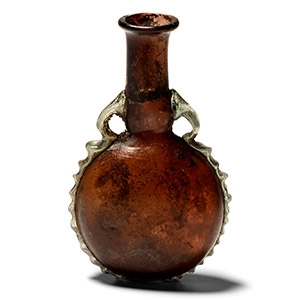
Roman Miniature Glass Flask
1st-3rd century A.D.Sold for (Inc. bp): £585
An aubergine-coloured glass flask with tubular neck and rolled rim, applied clear glass handles and wavy trail to circumference; iridescent surfaces; repaired. 30 grams, 97 mm high
French collection, 1960s-early 2000s. From an important Paris gallery, France.
