
Auction Highlights
-
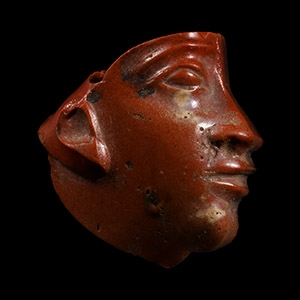
Egyptian Red Glass Face Inlay
Sold for (Inc. bp): £3,640
A red glass insert of a profile face with remains of a pharaonic crown to the forehead. -
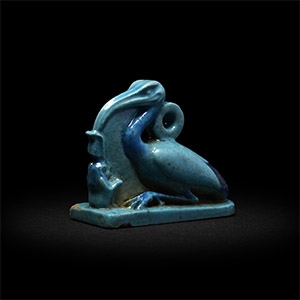
Egyptian Thoth as an Ibis with Maat
Sold for (Inc. bp): £6,500
A blue-glazed composition amulet in the form of an ibis (representing the god Thoth) seated on a wedge-shaped base, facing a figure of Maat appearing as a diminutive stooping female with an ostrich feather; some details to both figures rendered in a darker blue glaze; suspension loop to the rear of the bird's neck. -
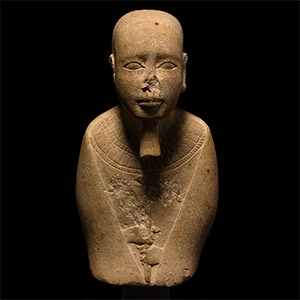
Egyptian Bust of Ptah
Sold for (Inc. bp): £13,000
A white limestone figure of the god Ptah with false beard, wearing an enveloping cloak and a broad wesekh-collar, holding the shaft of a was sceptre; serene, oval face with almond-shaped eyes and fleshy lips; remnants of dorsal pillar to reverse; mounted on a custom-made display stand. -
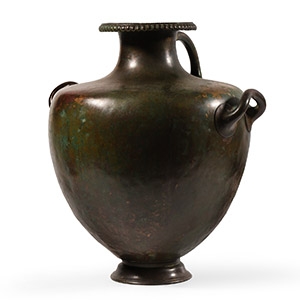
Large Greek Hydria with Egg-and-Dart Motifs
Sold for (Inc. bp): £9,525
A spectacular bronze hydria composed of a tapering body, broad shoulder and waisted neck, the everted rim decorated with egg-and-dart motifs, three round-section handles and tiered, ogival foot; professionally restored. -
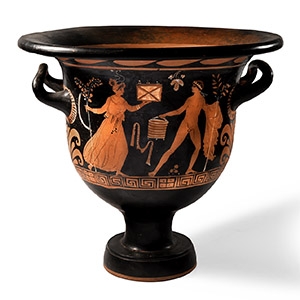
Large Greek Apulian Red-Figure Bell-Krater
Sold for (Inc. bp): £28,600
A red-figure terracotta bell-krater displaying polychrome figural panels between a laurel wreath and a band of Greek key motifs; side a) two robed male figures holding staffs, wearing a taenia or a band around the head, standing facing a central altar; side b) a woman wearing a chiton and holding a casket and olive sprig in her outstretched hands, advancing right towards a nude man standing right, his head turned towards her, holding a bucket and olive sprig, a cloak draped over his arm, elaborate volute palmettes beneath both handles; restored. -
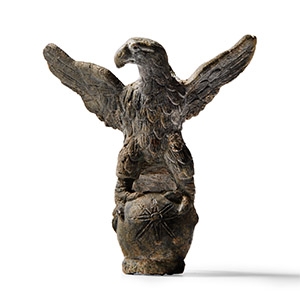
Roman Military Eagle Staff Terminal
Sold for (Inc. bp): £11,050
A free-standing bronze imperial or military eagle terminal from a staff or a sceptre, modelled in the round in a dynamic pose standing on a globe, wings spread, head turned to the right, semi-naturalistic anatomical and feather detailing; the globe bearing an incised eight-armed stylised Macedonian star; sub-triangular lug to back of the neck; collar to globe with hollow underside. -
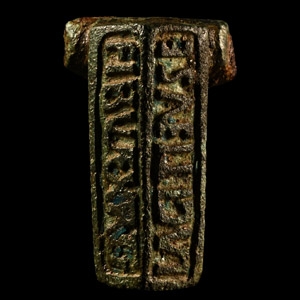
'The Castleford Military Garrison' Romano-British 'Regio Lagitiensis' Inscribed Brooch
Sold for (Inc. bp): £4,940
The best example of only three examples of this type known, a copper-alloy knee brooch composed of a rectangular-section body, spring pin within bow plate and remains of catchplate to reverse; both sides of the body with two panels of Latin lettering moulded in relief: 'FIBUL[A] EX REG LAGITIENSE', translating to 'Brooch from the Regio Lagitiensis' (Roman Castleford); remains of blue glass enamelling to the recessed fields. -
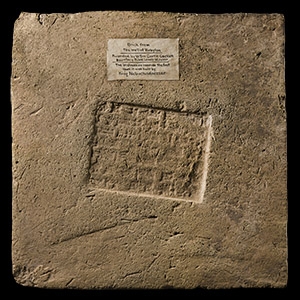
Large 'King Nebuchadnezzar the Great' Brick from the Wall of Babylon
Sold for (Inc. bp): £5,980
A large fired clay brick from the Wall of Babylon bearing six lines of stamped Babylonian cuneiform inscription to one face which reads: 'AG - ku -dur-ri-URU' / 'LUGAL ba-bi-lu' / 'za-ni-nu é-sag-ila' / 'u e-zi-da IBILA' / 'SAG.KAL. sa AG-IBILA-URU' / 'LUGAL ba-bi-lu ana-ku', which translates: 'Nebuchadnezzar, king of Babylon, who provides for Esagila and Ezida, the eldest son of Nabopolassar, king of Babylon, am I'; traces of bitumen on the blank side; accompanied by an old label which reads: 'Brick from the Wall of Babylon / Presented by W.Bro. Gentle-Cackett Secretary Bible Lands Mission / The impression records the fact that it was built by King Nebuchadnezzar [II]'. -
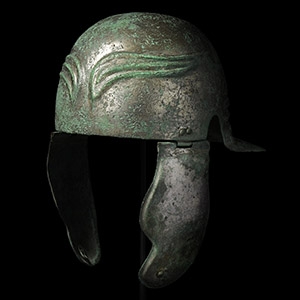
Roman Legionary Helmet with Wings of Jupiter
Sold for (Inc. bp): £52,000
A tinned sheet-bronze legionary helmet of Imperial Gallic Type A with deep rounded bowl, simple C-shaped cut-outs for the ears, integral flared neck-guard extending some way along the sides, corrugated ribs to the occipital area at the rear and corrugated 'wings' or eyebrows (Russel-Robinson's Type E) above the brow; small stud the rear of the neck-guard attaching suspension loops to the underside; hinged bracket at each temple for a deeply curved cheek-guard with gently flared rim, bearing a loop to the inner face to accept an vinculum fastening strap; accompanied by a custom-made display stand. -
.jpg)
Anglo-Saxon Gilt Chip-Carved Mount with Interlaced Panels
Sold for (Inc. bp): £6,240
A gilt copper-alloy mount composed of a broad annular body with slightly domed profile, the body quartered with each cell displaying a chip-carved interlace motif configured A:B:A:B; rim, edges and central cell with raised rim; rivet and flat-section mounting bar to reverse. -
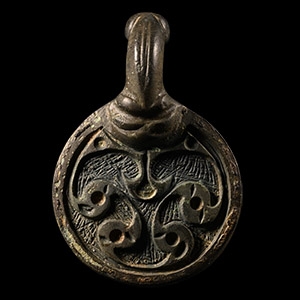
'The Pershore' Anglo-Saxon Hanging Bowl Mount with Horse-Head
Sold for (Inc. bp): £7,150
A bronze bowl mount or escutcheon comprising a discoid panel with gently curved profile and zoomorphic hook; the panel with reserved La Tène comma-leaf decoration on a pounced field (intended to receive enamel fill); the hook with median gusset to the outer face, horse-head finial, bulbous La Tène ornament at the base. -
.jpg)
'The Siddington' Impressive Anglo-Saxon Chip-Carved Saucer Brooch Pair
Sold for (Inc. bp): £24,700
A pair of large Early Anglo-Saxon gilt copper-alloy saucer brooches each comprising a broad (13mm+) angled flange surrounding a central disc with carinated border; outer zone comprising four arches subdivided by hatching to the inner edge and four C-shaped panels with triangular separators, inner zone separated by a carinated border, central disc with four radiating bilinear crescents; pin-lugs and catch to the reverse with traces of mineralised fabric. -
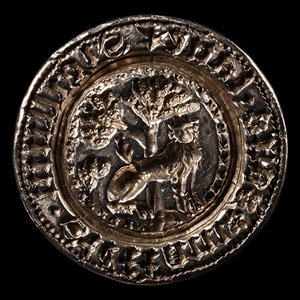
English Medieval Silver Chessman Type Seal Matrix for Stephen of Ale Lane
Sold for (Inc. bp): £3,510
A silver chessman-type seal matrix with pierced trefoil head and knop above; central motif of a leopard statant gardant before a tree, pelletted border and blackletter legend '* sigillum [lozenge] steffani [cinquefoil cinquefoil] ale [cinquefoil lozenge] lane' (for 'seal of Stephen [at?] ale lane'). -
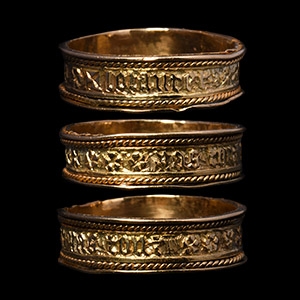
'The Bettiscombe' Medieval Gold 'Loyalty is Everything' Posy Ring
Sold for (Inc. bp): £4,160
An annular gold band with everted upper and lower lip, filigree ropework above and below each rim, with circumferential inscription to the recessed exterior face; of the five separate bands, the central one accommodating an applied strip of paler gold bearing a Medieval French blackletter inscription in relief, reading: '+loiautet (5 five cinquefoils) pas tout (5 five cinquefoils)', or 'Loyalty Passes All'; the inscription band may once have been enamelled; plain interior; the outer rim and twisted band on one edge are slightly bent; cleaned and repaired. -
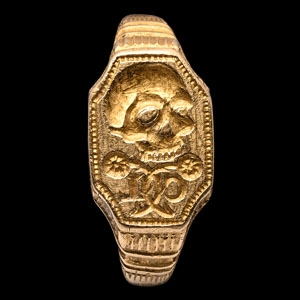
Stuart Period Gold Renaissance Memento Mori Signet Ring with C.L. and Skull
Sold for (Inc. bp): £19,500
A substantial gold signet ring composed of a lentoid-section hoop, expanding capital style shaped shoulders and irregular octagonal bezel engraved with a skull, two flowers below separating the reversed initials in capitals: 'CL', framed by a beaded border. -
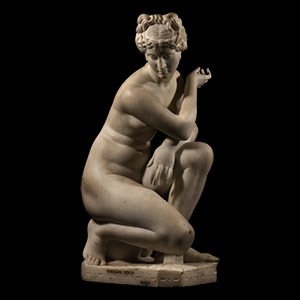
Marble Statue of Kneeling Venus
Sold for (Inc. bp): £14,950
A marble copy of the kneeling Venus (original in the Vatican Museums), crouching on an octagonal base; the arms raised in expressive pose, head tilted, hair drawn up in a chignon; lettering to base 'KNEELING VENUS' and 'ROME'.
-
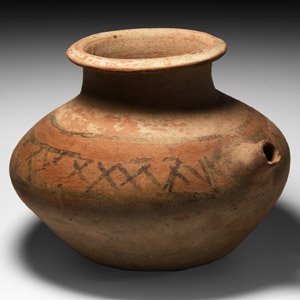
Western Asiatic Painted Spouted Vessel
2nd-1st millennium B.C.Sold for (Inc. bp): £46
A ceramic vessel with rounded underside, biconvex body, trumpet-shaped mouth with raised internal rim; spout to the shoulder; painted band of decoration to the shoulder. 724 grams, 21 cm wide
Acquired 1980-2015. Ex Abelita family collection. -
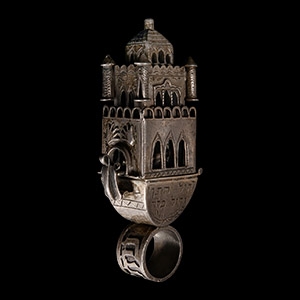
Jewish Silver Architectural Wedding Ring
19th-20th century A.D.Sold for (Inc. bp): £598
An architectural silver wedding ring composed of a rectangular-section hoop bearing the words ‘mazel tov’ (good fortune) in Hebrew characters; roughly cushion-shaped bezel with large openwork building above, likely representing Solomon’s temple or a synagogue, hinge and clasp at the base, opening to a model of what is likely a representation of the marriage contract which lifts out of its setting to reveal a void; incised stylised detailing to the building with two handprints placed over the arched doorway; Hebrew text to both principal faces of the bezel with wreaths below reading 'קול חתן וקול כלה' to one side and 'קול ששון וקול שמחה' to the other, together forming a quotation from Jeremiah 33:10-11: 'The voice of joy and the voice of gladness, the voice of the bridegroom and the voice of the bride'. 107 grams, 10.4 cm overall, 19.08 mm internal diameter (approximate size British S, USA 9, Europe 20, Japan 19)
From a UK private collection.
A Jewish wedding consists of the signing of a marriage contract (ketubah) and the gift of a token, usually a ring. The ring was generally worn only during the ceremony and is often made in the form of a miniature building, signifying the new household as well as the Temple in Jerusalem. Traditionally, the ring had to belong to the groom and to be made of a precious metal not set with any gemstones. The Earliest Jewish wedding rings were found in the medieval treasure hoards of Erfurt in Germany and Colmar in France. The description of a wedding in 1400 by Rabbi Jakob hal Lewi Mölln (or Mishagin) made the importance of the ring clear: 'After the blessing, the Rabbi called two witnesses. He showed them the wedding ring and made them bear witness that it was worth at least a heller. Then he enjoined them to make sure that the groom fulfilled his marriage vow by saying the words 'By this ring let thou be given to me by the laws of Moses and of Israel'. He then put the ring on the bride's finger next to the thumb.' -
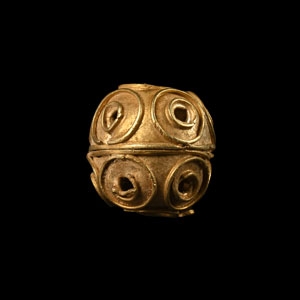
Western Asiatic Gold Filigree Bead
11th-12th century A.D.Sold for (Inc. bp): £72
An ovoid gold bead with filigree gold wire to the equator, five piercings to each hemisphere, each enclosed by concentric gold wire circlets, repeated at both terminals; hollow-formed. 0.82 grams, 10 mm
Acquired 1969-1999. London collection of the late Mr S.M., thence by descent. -
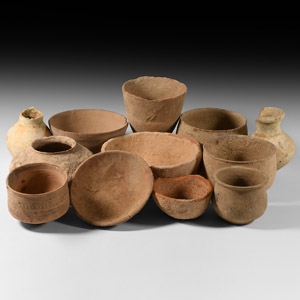
Western Asiatic Ceramic Vessel Collection
1st millennium B.C.Sold for (Inc. bp): £234
A mixed group of ceramic vessels including bowls, jars and cups, including examples painted with geometric motifs. 2.5 kg total, 7.9-15 cm
Acquired 1980-2015. Ex Abelita family collection. -
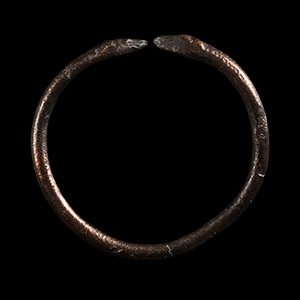
Western Asiatic Copper Bracelet with Animal Terminals
Circa 1st millennium B.C.Sold for (Inc. bp): £52
A copper zoomorphic bracelet with round-section penannular hoop, terminals formed as opposed animal heads, possibly rams with curled horns, with remains of facial detailing. 33.5 grams, 71 mm
Acquired before the early 1970s. Ex London, UK, gallery. Property of a London gentleman. -
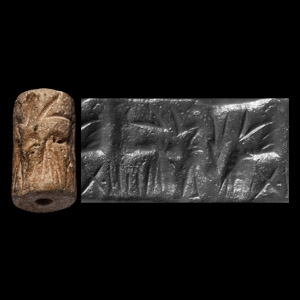
Sumerian Cylinder Seal with Banqueting Scene
26th-24th century B.C.Sold for (Inc. bp): £191
A chalk cylinder seal with frieze; accompanied by an old scholarly note, handwritten and signed by W.G. Lambert, late Professor of Assyriology, University of Birmingham, 1970-1993, which states: 'Cylinder seal of white stone, 28x17 mm. Two facing seated drinkers, wearing long robes and holding up cups. Standing servant in short clothes between them. Vessel with pointed base and two straws in it. Mesopotamian, c.2600-2400 B.C.. Top of seal damaged, but design deep and clear.' In a different hand beneath 'Sumerian seal; early Dynastic Period III. Banquet scene. Manuscript of Prof. W.G. Lambert' and further notation to the reverse; accompanied by a museum-quality impression. 7.2 grams, 28 mm
Fine condition.
From the private collection of Emilio Bacarani, Valbonne, France, 1950-1988. Acquired in 1988. From the collection of G.M.R.H., London, UK. Accompanied by an original handwritten unsigned scholarly note by Professor Wilfrid George Lambert FBA. -
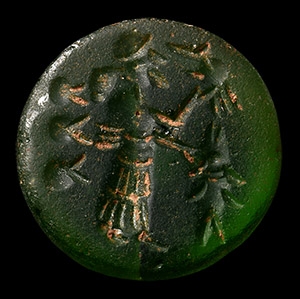
Western Asiatic Glass Stamp Seal with Master of Animals
Mid 1st millennium B.C.Sold for (Inc. bp): £191
A green glass stamp seal pierced through the handle for suspension, circular matrix with incuse Master of Animals figure standing right, a bird perched on one hand, other animals surrounding him in the field. 8.5 grams, 21 mm high
Fine condition.
Acquired 1969-1979. London collection of the late Mr S.M., thence by descent. -
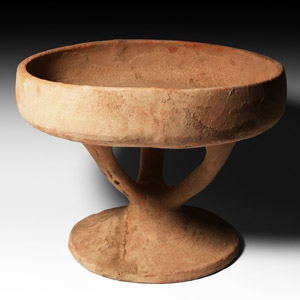
Western Asiatic Large Terracotta Chalice
1st millennium B.C.Sold for (Inc. bp): £117
A large terracotta chalice comprising a broad shallow bowl supported by three short arms on a conical base. 1.8 kg, 26.5 cm wide
Acquired 1980-2015. Ex Abelita family collection. -
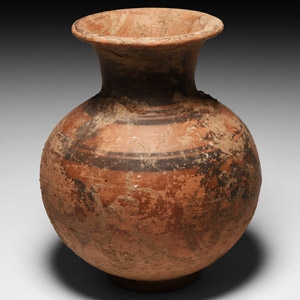
Western Asiatic Bichrome Vessel
1st millennium B.C.Sold for (Inc. bp): £26
A bulbous ceramic vessel with trumpet-style neck and rim, bichrome decorative design incorporating plain circumferential bands of varying width, with concentric roundels to the equator, repaired. 366 grams, 15.2 cm high
Acquired 1990s. English private collection. Property of an Essex gentleman. -
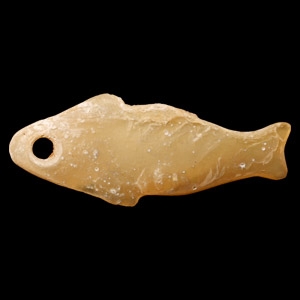
Sumerian Fish Amulet
3rd-2nd millennium B.C.Sold for (Inc. bp): £195
A mother of pearl fish amulet, pierced eye also serving as a suspension loop. 0.87 grams, 28 mm
Acquired 1969-1999. London collection of the late Mr S.M., thence by descent. -
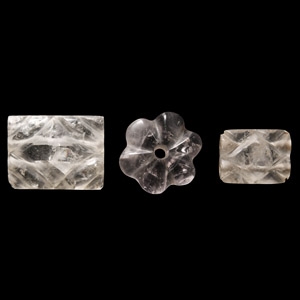
Babylonian Large Rock Crystal Bead Group
1st millennium B.C.Sold for (Inc. bp): £338
A trio of large rock crystal beads: two similar pillow-shaped beads with a lozenge to both faces, drilled twice for suspension; a stylised flower head with central hole for suspension. 68 grams total, 30-42 mm
Acquired in the 1980s. From the collection of a West London, UK, gentleman. -
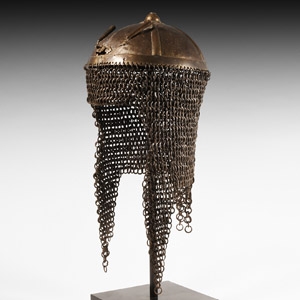
Indo-Persian Iron Helmet with Gilt Calligraphy
17th-19th century A.D.Sold for (Inc. bp): £286
A steel helmet comprising a domed cap and mail curtain; the cap with five radiating applied ribs from the central bronze rosette with hollow bulb finial, applied brow-band, pair of applied plume-holders and bracket for a falling nasal guard; curtain of substantial (1.83-195mm thick) rings forming a mail curtain with triangular extensions flanking the face and protecting the rear of the neck. 1.6 kg, 40 cm high
Some damage to the rear including cracking and deformation, probably due to battle damage.
UK private collection before 2000. UK art market. Property of a London gentleman.
The plume-holders are placed beside two pairs of holes, possibly replacing a previous pair which were removed. Attachment of the mail to the browband is by means of smaller rings which are placed intermittently round the lower edge (or possibly some rings have been lost due to wear-and-tear).
