
Auction Highlights
-
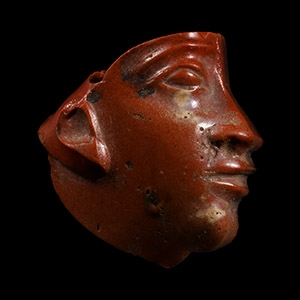
Egyptian Red Glass Face Inlay
Sold for (Inc. bp): £3,640
A red glass insert of a profile face with remains of a pharaonic crown to the forehead. -
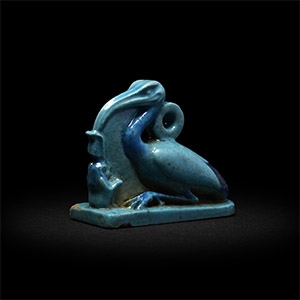
Egyptian Thoth as an Ibis with Maat
Sold for (Inc. bp): £6,500
A blue-glazed composition amulet in the form of an ibis (representing the god Thoth) seated on a wedge-shaped base, facing a figure of Maat appearing as a diminutive stooping female with an ostrich feather; some details to both figures rendered in a darker blue glaze; suspension loop to the rear of the bird's neck. -
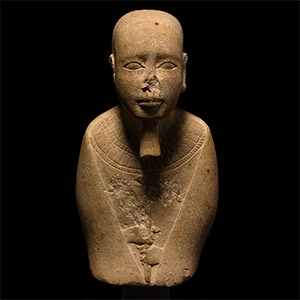
Egyptian Bust of Ptah
Sold for (Inc. bp): £13,000
A white limestone figure of the god Ptah with false beard, wearing an enveloping cloak and a broad wesekh-collar, holding the shaft of a was sceptre; serene, oval face with almond-shaped eyes and fleshy lips; remnants of dorsal pillar to reverse; mounted on a custom-made display stand. -
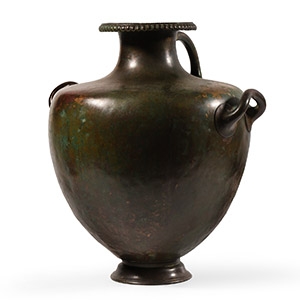
Large Greek Hydria with Egg-and-Dart Motifs
Sold for (Inc. bp): £9,525
A spectacular bronze hydria composed of a tapering body, broad shoulder and waisted neck, the everted rim decorated with egg-and-dart motifs, three round-section handles and tiered, ogival foot; professionally restored. -
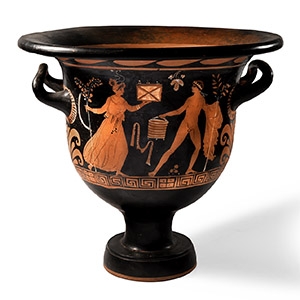
Large Greek Apulian Red-Figure Bell-Krater
Sold for (Inc. bp): £28,600
A red-figure terracotta bell-krater displaying polychrome figural panels between a laurel wreath and a band of Greek key motifs; side a) two robed male figures holding staffs, wearing a taenia or a band around the head, standing facing a central altar; side b) a woman wearing a chiton and holding a casket and olive sprig in her outstretched hands, advancing right towards a nude man standing right, his head turned towards her, holding a bucket and olive sprig, a cloak draped over his arm, elaborate volute palmettes beneath both handles; restored. -
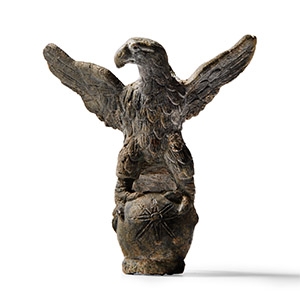
Roman Military Eagle Staff Terminal
Sold for (Inc. bp): £11,050
A free-standing bronze imperial or military eagle terminal from a staff or a sceptre, modelled in the round in a dynamic pose standing on a globe, wings spread, head turned to the right, semi-naturalistic anatomical and feather detailing; the globe bearing an incised eight-armed stylised Macedonian star; sub-triangular lug to back of the neck; collar to globe with hollow underside. -
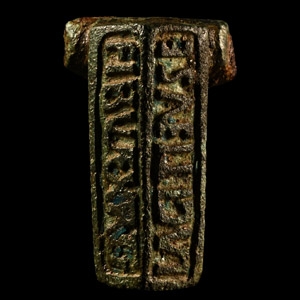
'The Castleford Military Garrison' Romano-British 'Regio Lagitiensis' Inscribed Brooch
Sold for (Inc. bp): £4,940
The best example of only three examples of this type known, a copper-alloy knee brooch composed of a rectangular-section body, spring pin within bow plate and remains of catchplate to reverse; both sides of the body with two panels of Latin lettering moulded in relief: 'FIBUL[A] EX REG LAGITIENSE', translating to 'Brooch from the Regio Lagitiensis' (Roman Castleford); remains of blue glass enamelling to the recessed fields. -
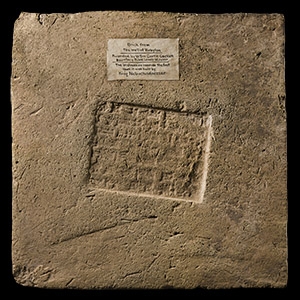
Large 'King Nebuchadnezzar the Great' Brick from the Wall of Babylon
Sold for (Inc. bp): £5,980
A large fired clay brick from the Wall of Babylon bearing six lines of stamped Babylonian cuneiform inscription to one face which reads: 'AG - ku -dur-ri-URU' / 'LUGAL ba-bi-lu' / 'za-ni-nu é-sag-ila' / 'u e-zi-da IBILA' / 'SAG.KAL. sa AG-IBILA-URU' / 'LUGAL ba-bi-lu ana-ku', which translates: 'Nebuchadnezzar, king of Babylon, who provides for Esagila and Ezida, the eldest son of Nabopolassar, king of Babylon, am I'; traces of bitumen on the blank side; accompanied by an old label which reads: 'Brick from the Wall of Babylon / Presented by W.Bro. Gentle-Cackett Secretary Bible Lands Mission / The impression records the fact that it was built by King Nebuchadnezzar [II]'. -
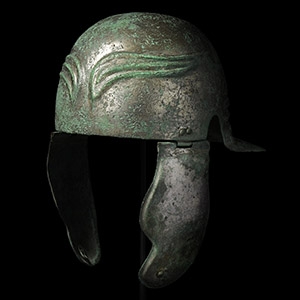
Roman Legionary Helmet with Wings of Jupiter
Sold for (Inc. bp): £52,000
A tinned sheet-bronze legionary helmet of Imperial Gallic Type A with deep rounded bowl, simple C-shaped cut-outs for the ears, integral flared neck-guard extending some way along the sides, corrugated ribs to the occipital area at the rear and corrugated 'wings' or eyebrows (Russel-Robinson's Type E) above the brow; small stud the rear of the neck-guard attaching suspension loops to the underside; hinged bracket at each temple for a deeply curved cheek-guard with gently flared rim, bearing a loop to the inner face to accept an vinculum fastening strap; accompanied by a custom-made display stand. -
.jpg)
Anglo-Saxon Gilt Chip-Carved Mount with Interlaced Panels
Sold for (Inc. bp): £6,240
A gilt copper-alloy mount composed of a broad annular body with slightly domed profile, the body quartered with each cell displaying a chip-carved interlace motif configured A:B:A:B; rim, edges and central cell with raised rim; rivet and flat-section mounting bar to reverse. -
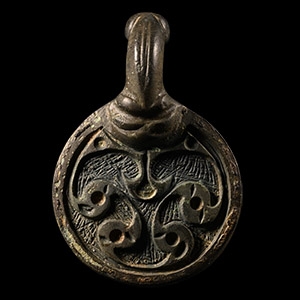
'The Pershore' Anglo-Saxon Hanging Bowl Mount with Horse-Head
Sold for (Inc. bp): £7,150
A bronze bowl mount or escutcheon comprising a discoid panel with gently curved profile and zoomorphic hook; the panel with reserved La Tène comma-leaf decoration on a pounced field (intended to receive enamel fill); the hook with median gusset to the outer face, horse-head finial, bulbous La Tène ornament at the base. -
.jpg)
'The Siddington' Impressive Anglo-Saxon Chip-Carved Saucer Brooch Pair
Sold for (Inc. bp): £24,700
A pair of large Early Anglo-Saxon gilt copper-alloy saucer brooches each comprising a broad (13mm+) angled flange surrounding a central disc with carinated border; outer zone comprising four arches subdivided by hatching to the inner edge and four C-shaped panels with triangular separators, inner zone separated by a carinated border, central disc with four radiating bilinear crescents; pin-lugs and catch to the reverse with traces of mineralised fabric. -
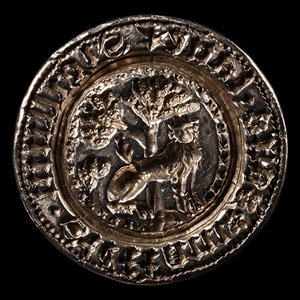
English Medieval Silver Chessman Type Seal Matrix for Stephen of Ale Lane
Sold for (Inc. bp): £3,510
A silver chessman-type seal matrix with pierced trefoil head and knop above; central motif of a leopard statant gardant before a tree, pelletted border and blackletter legend '* sigillum [lozenge] steffani [cinquefoil cinquefoil] ale [cinquefoil lozenge] lane' (for 'seal of Stephen [at?] ale lane'). -
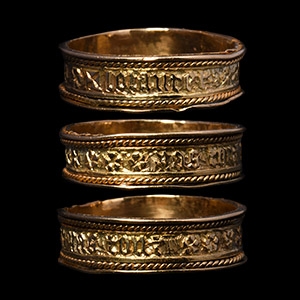
'The Bettiscombe' Medieval Gold 'Loyalty is Everything' Posy Ring
Sold for (Inc. bp): £4,160
An annular gold band with everted upper and lower lip, filigree ropework above and below each rim, with circumferential inscription to the recessed exterior face; of the five separate bands, the central one accommodating an applied strip of paler gold bearing a Medieval French blackletter inscription in relief, reading: '+loiautet (5 five cinquefoils) pas tout (5 five cinquefoils)', or 'Loyalty Passes All'; the inscription band may once have been enamelled; plain interior; the outer rim and twisted band on one edge are slightly bent; cleaned and repaired. -
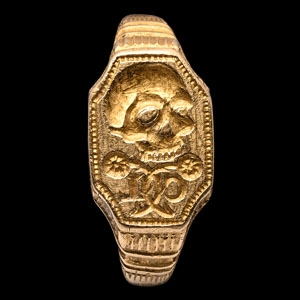
Stuart Period Gold Renaissance Memento Mori Signet Ring with C.L. and Skull
Sold for (Inc. bp): £19,500
A substantial gold signet ring composed of a lentoid-section hoop, expanding capital style shaped shoulders and irregular octagonal bezel engraved with a skull, two flowers below separating the reversed initials in capitals: 'CL', framed by a beaded border. -
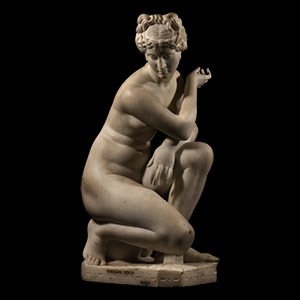
Marble Statue of Kneeling Venus
Sold for (Inc. bp): £14,950
A marble copy of the kneeling Venus (original in the Vatican Museums), crouching on an octagonal base; the arms raised in expressive pose, head tilted, hair drawn up in a chignon; lettering to base 'KNEELING VENUS' and 'ROME'.
-
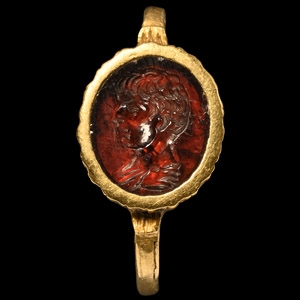
Roman Ring with Imperial Portrait
2nd century A.D. or laterSold for (Inc. bp): £2,470
A gold finger ring with narrow hoop, disc bezel with fluted rim, inset garnet intaglio male bust with Julian hairstyle. 4.68 grams, 25.34 mm overall, 23.40 mm internal diameter (approximate size British P 1/2, USA 7 3/4, Europe 16.86, Japan 16)
Acquired 1980-2015. Ex Abelita family collection. This lot has been checked against the Interpol Database of stolen works of art and is accompanied by search certificate no.11620-199234. -
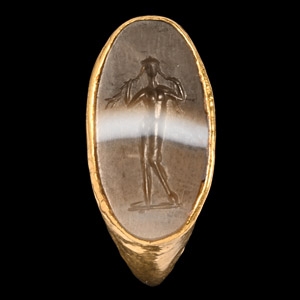
Roman Gold Ring with Venus Gemstone
2nd-1st century B.C.Sold for (Inc. bp): £845
A hollow-formed gold finger ring with inset sardonyx intaglio of Venus (Aphrodite) standing nude dressing her hair, hoop split. 3.25 grams, 22.33 mm overall, 15.67 mm internal diameter (approximate size British K, USA 5 1/4, Europe 9.95, Japan 9)
Ex Zurigo, Max Kopp collection (1891-1984). English private collection. -
.jpg)
Roman Jupiter Holding Victory Gemstone in Gold Ring
2nd century A.D.Sold for (Inc. bp): £1,170
An onyx cabochon with intaglio image of Jupiter holding a miniature icon of Victory, set into a later gold ring. 4.05 grams, 24.06 mm overall, 18.78 mm internal diameter (approximate size British R 1/2, USA 8 3/4, Europe 19.38, Japan 18)
English private collection. -
.jpg)
Roman Gold Ring with Ewer Gemstone
2nd century A.D.Sold for (Inc. bp): £728
A gold finger ring with inset carnelian intaglio of a ewer or wine-jar. 3.96 grams, 19.00 mm overall, 15.95 mm internal diameter (approximate size British G 1/2, USA 3 1/2, Europe 5.55, Japan 5)
UK private collection, since 1956. Formed in the 1950s by Mr and Mrs S. Broukal, thence by decent. with Bonhams, London, New Bond Street, 30 November 2016, lot 155 [Part]. English private collection. -
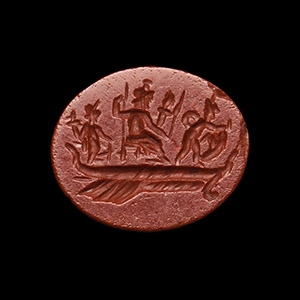
Roman Gemstone with Zeus Serapis and Isis
2nd-3rd century A.D. or laterSold for (Inc. bp): £442
A gem with a representation of Zeus Serapis enthroned, modius on his head, sceptre and eagle by his side, Isis Gubernatrix to his right and Isis sail-bearer to his left, all three figures riding a galley or cargo ship. 0.28 grams, 10 mm
Acquired before 1988. Ex family collection, by descent, Geneva.
This triad formed by Serapis and the two aspects of Isis (Gubernatrix and sail-bearer) aboard a ship, appears in several examples of Alexandrian coinage and gemstones. This imagery is linked to the image of Isis, goddess of the sea, and Serapis, god of vegetation and protector of the sailors. -
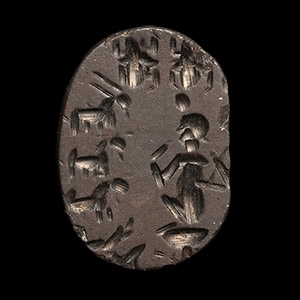
Gnostic Epigraphic Gemstone
3rd-5th century A.D.Sold for (Inc. bp): £468
An engraved gemstone with a stylised image of Harpocrates, depicted as a naked child with a finger raised on his mouth, seated on a lotus flower in a boat, groups of wild animals arranged in threes surrounding; the other side with a magic inscription in Greek letters 'I, E, A, P, Φ, K, Ο, Γ'. 1.25 grams, 14 mm
Acquired before 1988. Ex family collection, by descent, Geneva.
Egyptian deities are often represented on magical gems. One of the most interesting figures is the image of Harpocrates seated on a lotus flower, called ‘the young sun’. This figure had a solar nature and a protective function. -
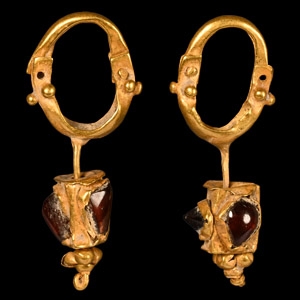
Roman Gold Earring Pair
1st-3rd century A.D.Sold for (Inc. bp): £546
A matched pair of gold earrings, each a substantial hoop with hinged closure and granule detailing, columnar sleeve with applied cells and inset carnelian cloisons, granule cluster finial. 3.45 grams total, 31 mm each
Acquired early 1990s. Ex private American collection; thence by descent. Private collection since 1998. -
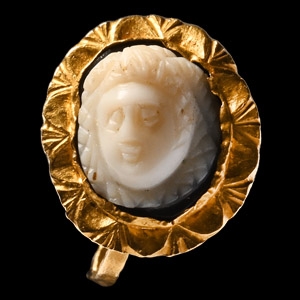
Roman Gold Ring with Medusa Cameo
2nd-3rd century A.D.Sold for (Inc. bp): £1,690
A gold finger ring with large cell forming the bezel, foliage detailing to the flared rim, inset cameo female mask in three-quarter view, hoop split. 2.15 grams, 20.20 mm overall, 12.55 mm internal diameter
UK private collection. with Bertolami Fine Art, London, 22 April 2022, lot 197. English private collection. -
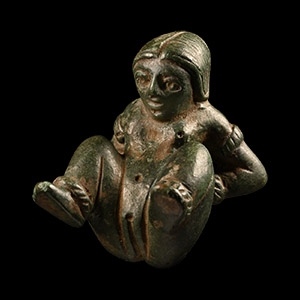
Roman Nude Crouching Woman Gaming Piece
3rd century A.D.Sold for (Inc. bp): £1,755
A bronze figure or gaming piece of a nude female in crouching pose with hands placed on the hips, possibly giving birth; the hair shown drawn up in a bun, segmented armband to each upper arm. 30.4 grams, 28 mm high
Private Swiss collection, acquired 2002.
The dice features six attitudes on which it could land when rolled, one of which includes the figure's head. The earliest concrete historical evidence of games played with dice originated from ancient Egypt, circa 3000 B.C., although it is generally believed by historians that dice pre-dated the ancient Egyptian civilisation. The Romans played two games using dice: Tali and Tesserae. The former originated in Greece and features four animal bones. The aim was to roll in such a way that each die displayed a different number-the higher the combined number, the greater the score. The latter was played using three dice, the goal being to roll triple six, or to achieve the highest combined numbers out of the contestants; it was a game of chance and the most common street and tavern gambling game in ancient Rome. ‘Dogs’ referred to poor scores and ‘Venus’ to high ones. Roman players rolled dice from a special cup called a fritillium onto wood, bronze, or marble boards, depending on their class and wealth. Roman elites boasted ornate boards inscribed with their names. The gambling which ensued from dice games caused extreme social issues in Roman society, leading the government to eventually outlaw dice games, although these laws were largely ignored. -
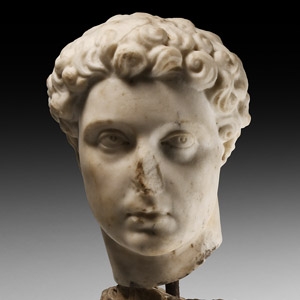
Roman Marble Head on Corinthian Capital Section
2nd-3rd century A.D. or laterSold for (Inc. bp): £3,900
A 2nd-3rd century A.D. Roman marble Corinthian capital fragment carved with acanthus leaves; together with a 16th-17th century A.D. reworked male head modelled in the round with naturalistic detailing. 16.2 kg total, 44 cm high including stand
Acquired on the UK art market. English private collection. This lot has been checked against the Interpol Database of stolen works of art and is accompanied by search certificate no.11623-199751. -
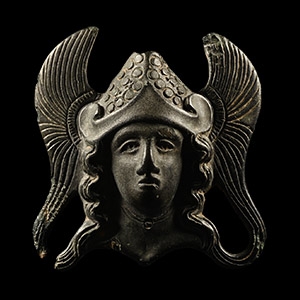
Roman Head of Minerva with Helm Appliqué
2nd-4th century A.D.Sold for (Inc. bp): £1,300
A bronze appliqué formed as the head of Minerva (Greek Athena) wearing a tall helmet with scooped brow-band and lobed ends developing to wings with radiating feather detailing; facing mask with finely detailed eyes and mouth, hanks of flowing hair connecting to the ends of the wings. 23.2 grams, 39 mm
Acquired early 1990s. Ex private American collection; thence by descent. Private Swiss collection since 1998. This lot has been checked against the Interpol Database of stolen works of art and is accompanied by search certificate no.11626-199003. -
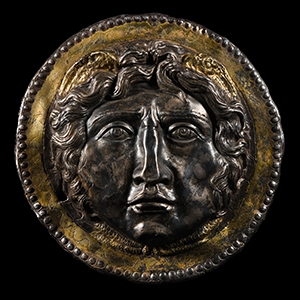
Roman Gilt-Silver Phalera with Winged Head of Medusa
1st-2nd century A.D.Sold for (Inc. bp): £5,720
A substantial ornamental silver armour phalera with gilt detailing, embossed face of the Gorgon, Medusa, to the centre with detailed eyes, eyebrows and mouth, strong nasal ridge extending towards the forehead, furrowed brow with a pair of wings emerging from the curly hair framing the face, a pair of snakes knotted beneath the chin; wide edge with beaded rim and wavy pointillé decoration; accompanied by a discoid bronze sheet to which the fastening pins were attached to. 113 grams total, 8.8-12.5 cm
Cracked
Acquired in 1970. with Coins and Antiquities, formerly known as D.J. Crowther Ltd, Mayfair, London, UK. Private collection of a London antiquarian. English private collection. Accompanied by an academic report by Dr Raffaele D’Amato. This lot has been checked against the Interpol Database of stolen works of art and is accompanied by search certificate number no.10623-174245.
Discoid military decorations usually depicted the heads of the gods, spirits of the underworld, birds and lions, Medusa being the most popular subject. Sets of phalerae, similar to those shown on monuments dedicated to Marcus Caelius, Quintus Sertorius Festus and Celer Allius, were found in Neuss, Lauersfort and Newstead. Our phalera finds parallel in similar examples from the magnificent Lauersfort set, echoing the decoration visible on the gravestone of centurion Caelius from Bonn, depicted with a corona civica on his head, the best-known silver military decorations of the early Imperial Age. The higher officers in the Roman army had the custom of wearing such rich suits of phalerae with the straps attached directly to leather garments or doublets, worn over their armour. One such example can be seen on the gravestone of the Aquilifer G. Musius (Jahn, 1860, taf.II; D’Amato, 2018, p.54), where the phalerae are worn over a leather structure like a doublet over the subarmalis. Wearing a double-padded armour under the doublet provided twice as much protection to the warrior and enhanced the phalerae worn over the doublet. These decorations were awarded in sets, commonly of nine, although the sources confirm that this was not an absolute rule. They were worn in a similar fashion to medals on the chest, attached to a leather harness of straps, which ran straight around and up and down the front of the chest, and continued over the shoulders and around the back where they were fastened with buckles (Maxfield, 1981, pp.92-93).
