
Auction Highlights
-
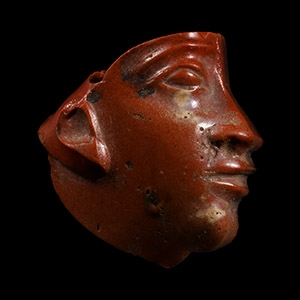
Egyptian Red Glass Face Inlay
Sold for (Inc. bp): £3,640
A red glass insert of a profile face with remains of a pharaonic crown to the forehead. -
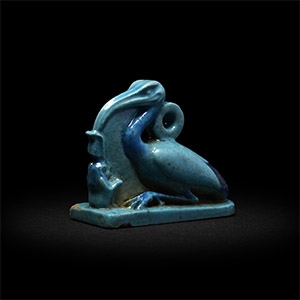
Egyptian Thoth as an Ibis with Maat
Sold for (Inc. bp): £6,500
A blue-glazed composition amulet in the form of an ibis (representing the god Thoth) seated on a wedge-shaped base, facing a figure of Maat appearing as a diminutive stooping female with an ostrich feather; some details to both figures rendered in a darker blue glaze; suspension loop to the rear of the bird's neck. -
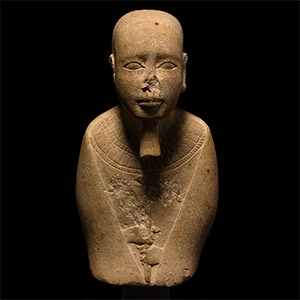
Egyptian Bust of Ptah
Sold for (Inc. bp): £13,000
A white limestone figure of the god Ptah with false beard, wearing an enveloping cloak and a broad wesekh-collar, holding the shaft of a was sceptre; serene, oval face with almond-shaped eyes and fleshy lips; remnants of dorsal pillar to reverse; mounted on a custom-made display stand. -
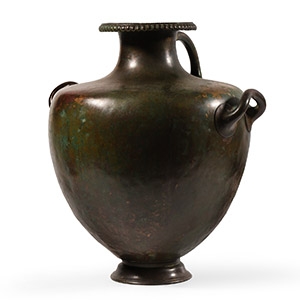
Large Greek Hydria with Egg-and-Dart Motifs
Sold for (Inc. bp): £9,525
A spectacular bronze hydria composed of a tapering body, broad shoulder and waisted neck, the everted rim decorated with egg-and-dart motifs, three round-section handles and tiered, ogival foot; professionally restored. -
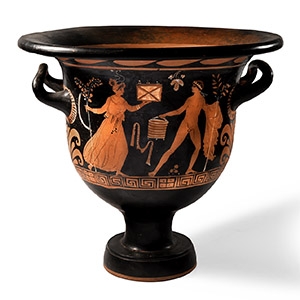
Large Greek Apulian Red-Figure Bell-Krater
Sold for (Inc. bp): £28,600
A red-figure terracotta bell-krater displaying polychrome figural panels between a laurel wreath and a band of Greek key motifs; side a) two robed male figures holding staffs, wearing a taenia or a band around the head, standing facing a central altar; side b) a woman wearing a chiton and holding a casket and olive sprig in her outstretched hands, advancing right towards a nude man standing right, his head turned towards her, holding a bucket and olive sprig, a cloak draped over his arm, elaborate volute palmettes beneath both handles; restored. -
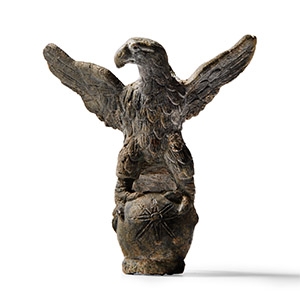
Roman Military Eagle Staff Terminal
Sold for (Inc. bp): £11,050
A free-standing bronze imperial or military eagle terminal from a staff or a sceptre, modelled in the round in a dynamic pose standing on a globe, wings spread, head turned to the right, semi-naturalistic anatomical and feather detailing; the globe bearing an incised eight-armed stylised Macedonian star; sub-triangular lug to back of the neck; collar to globe with hollow underside. -
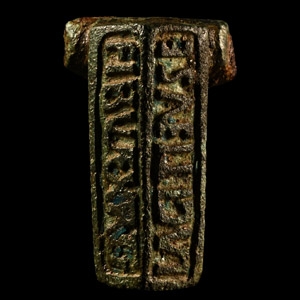
'The Castleford Military Garrison' Romano-British 'Regio Lagitiensis' Inscribed Brooch
Sold for (Inc. bp): £4,940
The best example of only three examples of this type known, a copper-alloy knee brooch composed of a rectangular-section body, spring pin within bow plate and remains of catchplate to reverse; both sides of the body with two panels of Latin lettering moulded in relief: 'FIBUL[A] EX REG LAGITIENSE', translating to 'Brooch from the Regio Lagitiensis' (Roman Castleford); remains of blue glass enamelling to the recessed fields. -
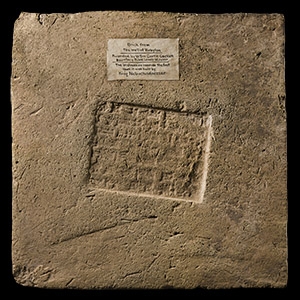
Large 'King Nebuchadnezzar the Great' Brick from the Wall of Babylon
Sold for (Inc. bp): £5,980
A large fired clay brick from the Wall of Babylon bearing six lines of stamped Babylonian cuneiform inscription to one face which reads: 'AG - ku -dur-ri-URU' / 'LUGAL ba-bi-lu' / 'za-ni-nu é-sag-ila' / 'u e-zi-da IBILA' / 'SAG.KAL. sa AG-IBILA-URU' / 'LUGAL ba-bi-lu ana-ku', which translates: 'Nebuchadnezzar, king of Babylon, who provides for Esagila and Ezida, the eldest son of Nabopolassar, king of Babylon, am I'; traces of bitumen on the blank side; accompanied by an old label which reads: 'Brick from the Wall of Babylon / Presented by W.Bro. Gentle-Cackett Secretary Bible Lands Mission / The impression records the fact that it was built by King Nebuchadnezzar [II]'. -
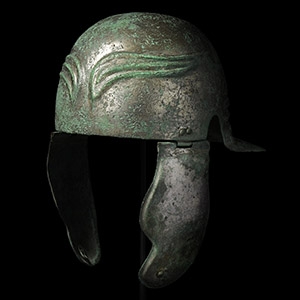
Roman Legionary Helmet with Wings of Jupiter
Sold for (Inc. bp): £52,000
A tinned sheet-bronze legionary helmet of Imperial Gallic Type A with deep rounded bowl, simple C-shaped cut-outs for the ears, integral flared neck-guard extending some way along the sides, corrugated ribs to the occipital area at the rear and corrugated 'wings' or eyebrows (Russel-Robinson's Type E) above the brow; small stud the rear of the neck-guard attaching suspension loops to the underside; hinged bracket at each temple for a deeply curved cheek-guard with gently flared rim, bearing a loop to the inner face to accept an vinculum fastening strap; accompanied by a custom-made display stand. -
.jpg)
Anglo-Saxon Gilt Chip-Carved Mount with Interlaced Panels
Sold for (Inc. bp): £6,240
A gilt copper-alloy mount composed of a broad annular body with slightly domed profile, the body quartered with each cell displaying a chip-carved interlace motif configured A:B:A:B; rim, edges and central cell with raised rim; rivet and flat-section mounting bar to reverse. -
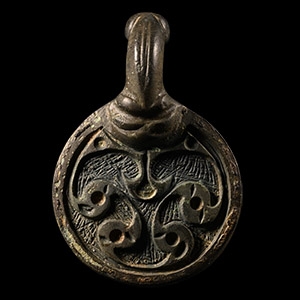
'The Pershore' Anglo-Saxon Hanging Bowl Mount with Horse-Head
Sold for (Inc. bp): £7,150
A bronze bowl mount or escutcheon comprising a discoid panel with gently curved profile and zoomorphic hook; the panel with reserved La Tène comma-leaf decoration on a pounced field (intended to receive enamel fill); the hook with median gusset to the outer face, horse-head finial, bulbous La Tène ornament at the base. -
.jpg)
'The Siddington' Impressive Anglo-Saxon Chip-Carved Saucer Brooch Pair
Sold for (Inc. bp): £24,700
A pair of large Early Anglo-Saxon gilt copper-alloy saucer brooches each comprising a broad (13mm+) angled flange surrounding a central disc with carinated border; outer zone comprising four arches subdivided by hatching to the inner edge and four C-shaped panels with triangular separators, inner zone separated by a carinated border, central disc with four radiating bilinear crescents; pin-lugs and catch to the reverse with traces of mineralised fabric. -
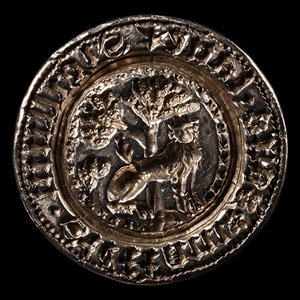
English Medieval Silver Chessman Type Seal Matrix for Stephen of Ale Lane
Sold for (Inc. bp): £3,510
A silver chessman-type seal matrix with pierced trefoil head and knop above; central motif of a leopard statant gardant before a tree, pelletted border and blackletter legend '* sigillum [lozenge] steffani [cinquefoil cinquefoil] ale [cinquefoil lozenge] lane' (for 'seal of Stephen [at?] ale lane'). -
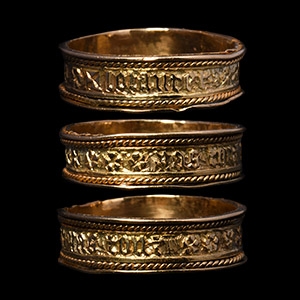
'The Bettiscombe' Medieval Gold 'Loyalty is Everything' Posy Ring
Sold for (Inc. bp): £4,160
An annular gold band with everted upper and lower lip, filigree ropework above and below each rim, with circumferential inscription to the recessed exterior face; of the five separate bands, the central one accommodating an applied strip of paler gold bearing a Medieval French blackletter inscription in relief, reading: '+loiautet (5 five cinquefoils) pas tout (5 five cinquefoils)', or 'Loyalty Passes All'; the inscription band may once have been enamelled; plain interior; the outer rim and twisted band on one edge are slightly bent; cleaned and repaired. -
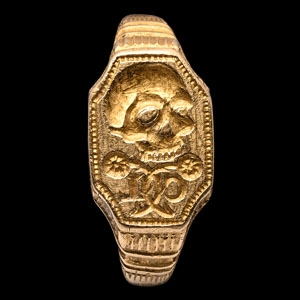
Stuart Period Gold Renaissance Memento Mori Signet Ring with C.L. and Skull
Sold for (Inc. bp): £19,500
A substantial gold signet ring composed of a lentoid-section hoop, expanding capital style shaped shoulders and irregular octagonal bezel engraved with a skull, two flowers below separating the reversed initials in capitals: 'CL', framed by a beaded border. -
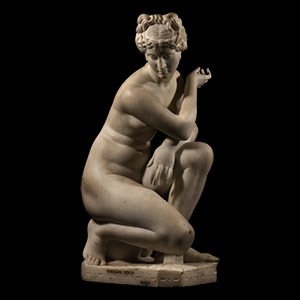
Marble Statue of Kneeling Venus
Sold for (Inc. bp): £14,950
A marble copy of the kneeling Venus (original in the Vatican Museums), crouching on an octagonal base; the arms raised in expressive pose, head tilted, hair drawn up in a chignon; lettering to base 'KNEELING VENUS' and 'ROME'.
-
Large Greek Hydria with Egg-and-Dart Motifs
Early 5th century B.C.Sold for (Inc. bp): £9,525
A spectacular bronze hydria composed of a tapering body, broad shoulder and waisted neck, the everted rim decorated with egg-and-dart motifs, three round-section handles and tiered, ogival foot; professionally restored. 4.7 kg, 39.5 cm
Fine condition, professionally restored. A spectacular display piece.
Acquired circa 1989-1990. Private collection of N.A., Niedersachsen. Accompanied by an original French cultural passport number 226773 dated 3 June 2021. Accompanied by an academic report by Dr Raffaele D'Amato. This lot has been checked against the Interpol Database of stolen works of art and is accompanied by search certificate no.11306-190969.
Whilst such vessels were originally produced for holding water, hydriai were often re-purposed. From the 5th century B.C. onwards, they also had a funerary function, used in the cult of the dead and the underworld. Appearing as grave deposits, they were sometimes used as funerary urns, receptacles for the ashes of the deceased (see the MET hydria from Galaxidi, found with the bones still inside). Hydriai were also commonly associated with rituals relating to the cults of the gods. They have been found in temples and public buildings and have been recorded as prizes in athletic games. It has also been suggested that the more lavish examples were gifted to brides. -
Large Greek Apulian Red-Figure Bell-Krater
4th century B.C.Sold for (Inc. bp): £28,600
A red-figure terracotta bell-krater displaying polychrome figural panels between a laurel wreath and a band of Greek key motifs; side a) two robed male figures holding staffs, wearing a taenia or a band around the head, standing facing a central altar; side b) a woman wearing a chiton and holding a casket and olive sprig in her outstretched hands, advancing right towards a nude man standing right, his head turned towards her, holding a bucket and olive sprig, a cloak draped over his arm, elaborate volute palmettes beneath both handles; restored. 4 kg, 41 cm wide
Private collection, Neuchâtel, Switzerland. Ex collection H.& P. Payot, Clarens, by descent. Accompanied by an original thermoluminescence analysis report no.QED2237/SG-0201 from QED Laboratoire. Accompanied by an academic report by Dr Raffaele D’Amato. This lot has been checked against the Interpol Database of stolen works of art and is accompanied by search certificate number no.11580-199029.
Wide-mouthed bell kraters like this one were specifically designed for holding large quantities of liquid and to work as mixing bowls, as it was considered barbaric for wine to be drunk neat (a privilege only enjoyed by Dionysus and his entourage who could handle such a level of intoxication). Wine would be mixed with water, usually one part to three, or even more, as described by Homer regarding the wine offered to the giant Polyphemus (Odyssey, IX, 206-211). As such, kraters provided an ideal large surface area for decoration, and as wine was of utmost importance at the symposium, kraters would usually take centre place, and the decoration of such vessels were geared towards such gatherings attempting to provide subject matter for philosophical debate, like the ones described in Athenaeus’ Deipnosophistae. -
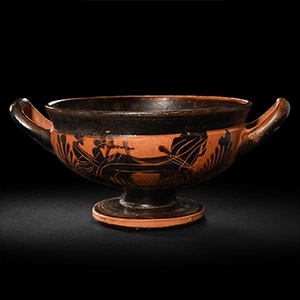
Large Greek Attic Black Figure Kylix with Chariot Scene
5th century B.C.Sold for (Inc. bp): £1,950
A terracotta kylix with broad flat foot, short stem, broad bowl with carination at the shoulder, glared mouth and two square strap handles; frieze of black-painted decoration including two scenes of a chariot yoked to two centaurs, one with sgraffito markings, between palmettes; restored. 566 grams, 25.5 cm wide
Restored.; fine condition, repaired.
Cambridgeshire collection, 1990s-2000s. Ex property of a Sussex gentleman. Accompanied by an academic report by Raffaele D’Amato. This lot has been checked against the Interpol Database of stolen works of art and is accompanied by search certificate number no.11579-198944.
These Attic kylikes were usually presented with a stemmed base, a deep bowl and twin, upturned loop handles, all upon a concave base. The exterior walls were decorated with black-figure technique on red background, here in a style remarkably similar to that of the Haimon Painter, especially in the rendering of facial features, and feet. The imagery on the exterior of these kylikes, used in the symposia, varied a lot. Just as the cup could be a mask (in the so-called typology of the Attic black-figure eye cups) to transform the drinker, to give a “complex painted character”. Daily life scenes, or fantasies like the chariot here pulled by centaurs, were among the various subjects. -
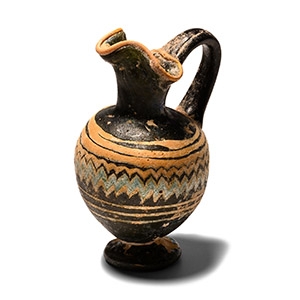
Greek Glass Trefoil Oinochoe
6th-3rd century B.C.Sold for (Inc. bp): £1,560
An opaque blue glass oinochoe with trefoil mouth, handle and discoid foot, polychrome bands and chevrons around the body and plain yellow band to lip; iridescent surfaces. 45 grams, 75 mm high
French collection, 1960s-early 2000s. From an important Paris gallery, France. -
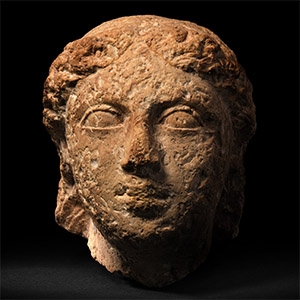
Greek Stone Head of a Female
4th-3rd century B.C.Sold for (Inc. bp): £2,340
A carved stone head modelled with semi-naturalistic facial features and dressed hair falling down the neck in tight curls. 4.2 kg, 17 cm high
Acquired early 1990s. Ex private American collection; thence by descent. Private Swiss collection since 1998. This lot has been checked against the Interpol Database of stolen works of art and is accompanied by search certificate no.11613-198981. -
.jpg)
Campanian Red-Figure Bail Amphora from a Cumae Workshop
330-300 B.C.Sold for (Inc. bp): £4,680
A ceramic red-figure bail amphora with round-section strap handle and pierced lug at the apex, tall waisted neck with vertical rib detailing, rounded shoulder with running wave pattern ornament, tapering body with figural designs of standing females wearing a himation and a stephane in red and white on black ground, one figure holding a thyrsus and the other an ear of corn, with accessories in the field; flared base; from a workshop in Cumae. 862 grams, 37 cm high
Ex collection H.& P. Payot, Clarens, by descent. Accompanied by an academic report by Dr Raffaele D’Amato. This lot has been checked against the Interpol Database of stolen works of art and is accompanied by search certificate number no.11577-199027. Accompanied by an original thermoluminescence analysis report no.QED2223/SG0-0105 from QED Laboratoire.
The bail amphora, named for the tall handle arching over the mouth, was a shape made primarily in Campania, where red-figure vases were produced at both Capua and Cumae in the 4th century B.C. The decoration offered a remarkable range of subjects associated not only with mythological images, but with representations of the local life, costumes and customs. The simple, single figure compositions decorating each side of this vase are also characteristic of the style, which tended to avoid complex mythological scenes often found on much larger vessels like volute craters, favouring representation of the daily life of south Italic people. -
.jpg)
Greek Marble Head of a Female
4th-1st century B.C.Sold for (Inc. bp): £715
A head of a female carved in white marble, modelled in the round with semi-naturalistic facial features and hair tied back into a chignon at the nape of the neck. 163 grams, 59 mm high
Acquired early 1990s. Ex private American collection; thence by descent. Private collection since 1998. -
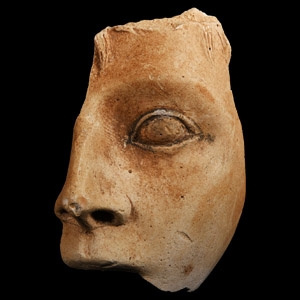
Etruscan Terracotta Fragment of a Face
6th century B.C.Sold for (Inc. bp): £780
An amorphous fragment from a terracotta face, retaining the left eye, nose, partial upper lip and fringes of hair, rendered with semi-naturalistic detailing. 125 grams, 13 cm high
Private Swiss collection, acquired 2002. -
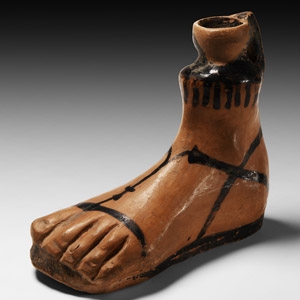
Greek Terracotta Foot-Shaped Aryballos
6th century B.C.Sold for (Inc. bp): £2,210
A ceramic vessel shaped as a human foot with sandal; cup-shaped mouth above the ankle with strap to the rear, painted strap detailing; restored. 118 grams, 10.8 cm
Ex Léon Rodrigues-Ely (1924-1973), Marseille, France. with Christie's, Paris, Collection of Léon Rodrigues-Ely-Joseph Soustiel et à Divers, 6 May 2015, lot 32. Accompanied by a copy of a French cultural passport no.163295. -
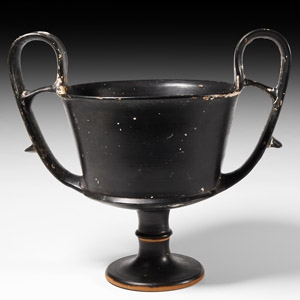
Greek Black Ware Kantharos
5th century B.C.Sold for (Inc. bp): £5,200
A black-glazed terracotta kantharos with two integral ear-shaped handles with internal bridges and ledges to the exterior, collar to stem and discoid foot; possibly Boeotian. 565 grams, 23 cm wide
Acquired 1980s-1990s. H.N. collection, Milton Keynes, UK.
A kantharos is a drinking cup with two handles. -
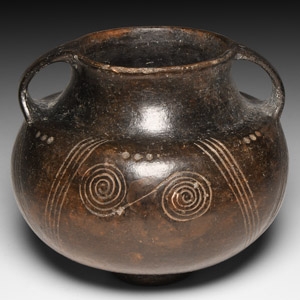
Villanovan Two-Handled Jar
7th century B.C.Sold for (Inc. bp): £1,820
A terracotta amphora composed of a squat bulbous body and rounded shoulder, waisted neck, integral loop handles and integral foot, decorated with scrolling S-motifs, clusters of dots and combed chevrons. 145 grams, 10.5 cm wide
Ex collection of P. Linders, Herrliberg, Zurich, Switzerland. with Galleria Serodine SA, Ascona, Switzerland, 12 November 2008. -
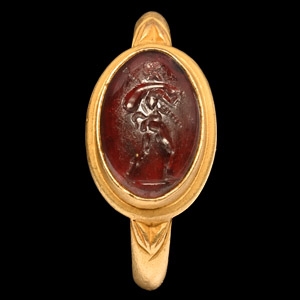
Roman Satyr Traveller Gemstone in Gold Ring
1st-3rd century A.D.Sold for (Inc. bp): £4,940
A garnet cabochon with intaglio satyr traveller advancing with staff and pouch over his shoulder, set into a later gold finger ring. 8.22 grams, 27.20 mm overall, 22.95 mm internal diameter (approximate size British O, USA 7, Europe 14.98, Japan 14)
Acquired 1960s-1990s. Late Alison Barker collection, a retired London barrister. This lot has been checked against the Interpol Database of stolen works of art and is accompanied by search certificate no.11619-199018.
The subject was popular on Roman gems: Silenus and the satyrs, grotesque hedonists, unrestrained in their desire for sex and wine, and yet immortal companions of Dionysus, were considered ‘cruder than men and yet somehow wiser, combining mischief with wisdom, lewdness with skill in music, animalism with divinity'. The counterpoint of the divine and the atavistic appealed to the Roman sense of moral superiority.
