
Auction Highlights
-
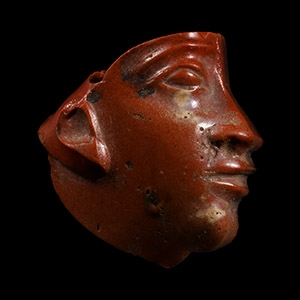
Egyptian Red Glass Face Inlay
Sold for (Inc. bp): £3,640
A red glass insert of a profile face with remains of a pharaonic crown to the forehead. -
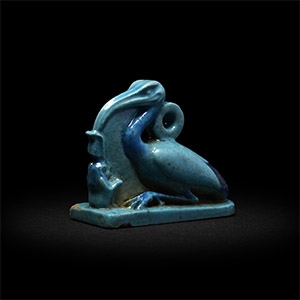
Egyptian Thoth as an Ibis with Maat
Sold for (Inc. bp): £6,500
A blue-glazed composition amulet in the form of an ibis (representing the god Thoth) seated on a wedge-shaped base, facing a figure of Maat appearing as a diminutive stooping female with an ostrich feather; some details to both figures rendered in a darker blue glaze; suspension loop to the rear of the bird's neck. -
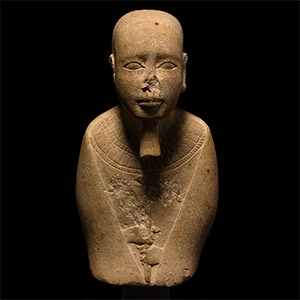
Egyptian Bust of Ptah
Sold for (Inc. bp): £13,000
A white limestone figure of the god Ptah with false beard, wearing an enveloping cloak and a broad wesekh-collar, holding the shaft of a was sceptre; serene, oval face with almond-shaped eyes and fleshy lips; remnants of dorsal pillar to reverse; mounted on a custom-made display stand. -
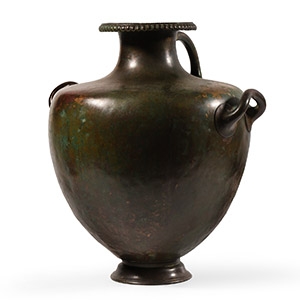
Large Greek Hydria with Egg-and-Dart Motifs
Sold for (Inc. bp): £9,525
A spectacular bronze hydria composed of a tapering body, broad shoulder and waisted neck, the everted rim decorated with egg-and-dart motifs, three round-section handles and tiered, ogival foot; professionally restored. -
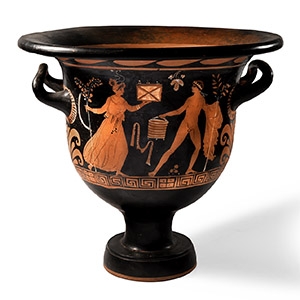
Large Greek Apulian Red-Figure Bell-Krater
Sold for (Inc. bp): £28,600
A red-figure terracotta bell-krater displaying polychrome figural panels between a laurel wreath and a band of Greek key motifs; side a) two robed male figures holding staffs, wearing a taenia or a band around the head, standing facing a central altar; side b) a woman wearing a chiton and holding a casket and olive sprig in her outstretched hands, advancing right towards a nude man standing right, his head turned towards her, holding a bucket and olive sprig, a cloak draped over his arm, elaborate volute palmettes beneath both handles; restored. -
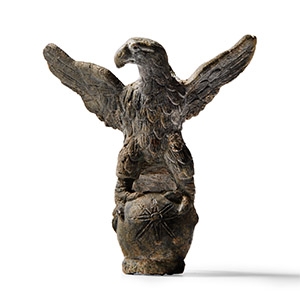
Roman Military Eagle Staff Terminal
Sold for (Inc. bp): £11,050
A free-standing bronze imperial or military eagle terminal from a staff or a sceptre, modelled in the round in a dynamic pose standing on a globe, wings spread, head turned to the right, semi-naturalistic anatomical and feather detailing; the globe bearing an incised eight-armed stylised Macedonian star; sub-triangular lug to back of the neck; collar to globe with hollow underside. -
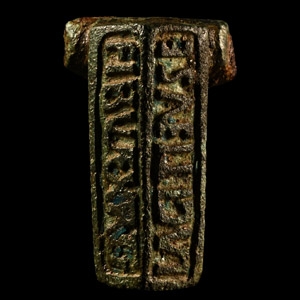
'The Castleford Military Garrison' Romano-British 'Regio Lagitiensis' Inscribed Brooch
Sold for (Inc. bp): £4,940
The best example of only three examples of this type known, a copper-alloy knee brooch composed of a rectangular-section body, spring pin within bow plate and remains of catchplate to reverse; both sides of the body with two panels of Latin lettering moulded in relief: 'FIBUL[A] EX REG LAGITIENSE', translating to 'Brooch from the Regio Lagitiensis' (Roman Castleford); remains of blue glass enamelling to the recessed fields. -
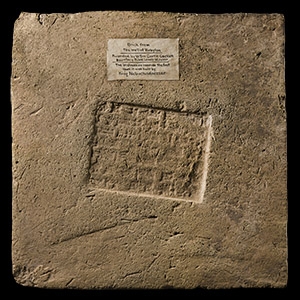
Large 'King Nebuchadnezzar the Great' Brick from the Wall of Babylon
Sold for (Inc. bp): £5,980
A large fired clay brick from the Wall of Babylon bearing six lines of stamped Babylonian cuneiform inscription to one face which reads: 'AG - ku -dur-ri-URU' / 'LUGAL ba-bi-lu' / 'za-ni-nu é-sag-ila' / 'u e-zi-da IBILA' / 'SAG.KAL. sa AG-IBILA-URU' / 'LUGAL ba-bi-lu ana-ku', which translates: 'Nebuchadnezzar, king of Babylon, who provides for Esagila and Ezida, the eldest son of Nabopolassar, king of Babylon, am I'; traces of bitumen on the blank side; accompanied by an old label which reads: 'Brick from the Wall of Babylon / Presented by W.Bro. Gentle-Cackett Secretary Bible Lands Mission / The impression records the fact that it was built by King Nebuchadnezzar [II]'. -
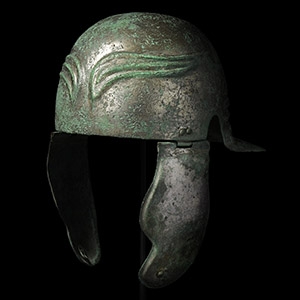
Roman Legionary Helmet with Wings of Jupiter
Sold for (Inc. bp): £52,000
A tinned sheet-bronze legionary helmet of Imperial Gallic Type A with deep rounded bowl, simple C-shaped cut-outs for the ears, integral flared neck-guard extending some way along the sides, corrugated ribs to the occipital area at the rear and corrugated 'wings' or eyebrows (Russel-Robinson's Type E) above the brow; small stud the rear of the neck-guard attaching suspension loops to the underside; hinged bracket at each temple for a deeply curved cheek-guard with gently flared rim, bearing a loop to the inner face to accept an vinculum fastening strap; accompanied by a custom-made display stand. -
.jpg)
Anglo-Saxon Gilt Chip-Carved Mount with Interlaced Panels
Sold for (Inc. bp): £6,240
A gilt copper-alloy mount composed of a broad annular body with slightly domed profile, the body quartered with each cell displaying a chip-carved interlace motif configured A:B:A:B; rim, edges and central cell with raised rim; rivet and flat-section mounting bar to reverse. -
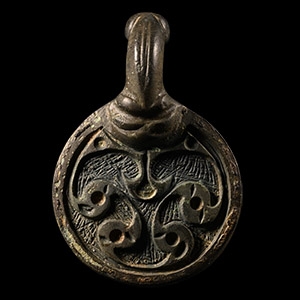
'The Pershore' Anglo-Saxon Hanging Bowl Mount with Horse-Head
Sold for (Inc. bp): £7,150
A bronze bowl mount or escutcheon comprising a discoid panel with gently curved profile and zoomorphic hook; the panel with reserved La Tène comma-leaf decoration on a pounced field (intended to receive enamel fill); the hook with median gusset to the outer face, horse-head finial, bulbous La Tène ornament at the base. -
.jpg)
'The Siddington' Impressive Anglo-Saxon Chip-Carved Saucer Brooch Pair
Sold for (Inc. bp): £24,700
A pair of large Early Anglo-Saxon gilt copper-alloy saucer brooches each comprising a broad (13mm+) angled flange surrounding a central disc with carinated border; outer zone comprising four arches subdivided by hatching to the inner edge and four C-shaped panels with triangular separators, inner zone separated by a carinated border, central disc with four radiating bilinear crescents; pin-lugs and catch to the reverse with traces of mineralised fabric. -
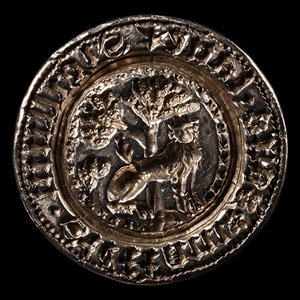
English Medieval Silver Chessman Type Seal Matrix for Stephen of Ale Lane
Sold for (Inc. bp): £3,510
A silver chessman-type seal matrix with pierced trefoil head and knop above; central motif of a leopard statant gardant before a tree, pelletted border and blackletter legend '* sigillum [lozenge] steffani [cinquefoil cinquefoil] ale [cinquefoil lozenge] lane' (for 'seal of Stephen [at?] ale lane'). -
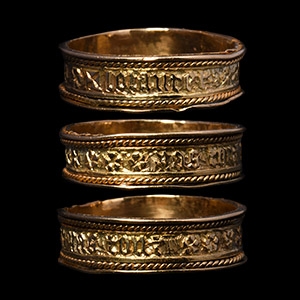
'The Bettiscombe' Medieval Gold 'Loyalty is Everything' Posy Ring
Sold for (Inc. bp): £4,160
An annular gold band with everted upper and lower lip, filigree ropework above and below each rim, with circumferential inscription to the recessed exterior face; of the five separate bands, the central one accommodating an applied strip of paler gold bearing a Medieval French blackletter inscription in relief, reading: '+loiautet (5 five cinquefoils) pas tout (5 five cinquefoils)', or 'Loyalty Passes All'; the inscription band may once have been enamelled; plain interior; the outer rim and twisted band on one edge are slightly bent; cleaned and repaired. -
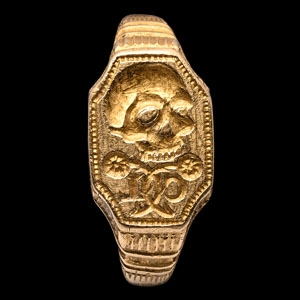
Stuart Period Gold Renaissance Memento Mori Signet Ring with C.L. and Skull
Sold for (Inc. bp): £19,500
A substantial gold signet ring composed of a lentoid-section hoop, expanding capital style shaped shoulders and irregular octagonal bezel engraved with a skull, two flowers below separating the reversed initials in capitals: 'CL', framed by a beaded border. -
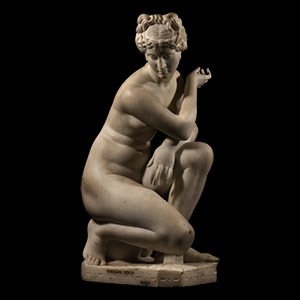
Marble Statue of Kneeling Venus
Sold for (Inc. bp): £14,950
A marble copy of the kneeling Venus (original in the Vatican Museums), crouching on an octagonal base; the arms raised in expressive pose, head tilted, hair drawn up in a chignon; lettering to base 'KNEELING VENUS' and 'ROME'.
-
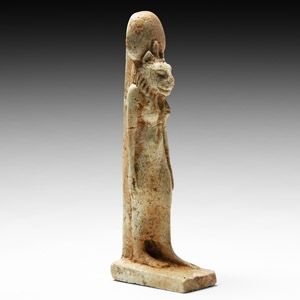
Egyptian Faience Figure of Sekhmet
Late New Kingdom, 1350-1070 B.C.Sold for (Inc. bp): £975
A glazed composition figure of the goddess Sekhmet advancing with feline head and sun-disc headdress; dorsal pillar and rectangular base; repaired. 19.8 grams, 86 mm high
Acquired early 1990s. Ex private American collection; thence by descent. Private Swiss collection since 1998. -
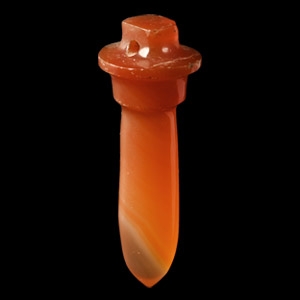
Egyptian Carnelian Papyrus Amulet
New Kingdom, 19th Dynasty, 1296-1186 B.C.Sold for (Inc. bp): £572
A carnelian amuletic papyrus stalk pendant, colour graduated along the stem. 2.4 grams, 29 mm
Private collection, acquired 1999. -
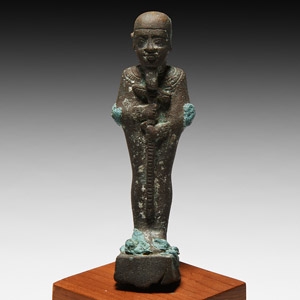
Egyptian Bronze Figure of Ptah
Late Period-Ptolemaic Period, 664-30 B.C.Sold for (Inc. bp): £936
A bronze statuette of the god Ptah, wearing a tight-fitting mummiform garment and cap, standing on a rectangular base, detailing to his face, straight false beard and broad collar, his arms held in front of his chest, holding the was sceptre; lug to base; accompanied by a custom-made wooden display base. 160 grams total, 13.5 cm including stand
Acquired 1980s. Private collection of L.H., Staffordshire, UK. Property of a Sussex, UK, teacher.
Ptah was the god of Egypt's capital city Memphis and master craftsman of the gods, known for his benevolent and approachable character. -
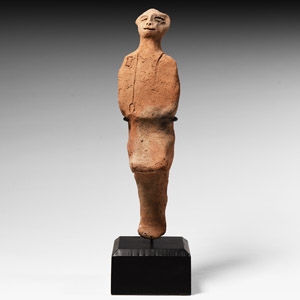
Egyptian Terracotta Overseer Shabti
Ptolemaic Period, circa 3rd century B.C. or earlierSold for (Inc. bp): £826
A rare example of a terracotta shabti depicting an overseer wearing a civil kilt, incised whip over his right shoulder; stylised facial features with pinched profile and incised eyes, nostrils and mouth; incised stripe to the left shoulder; accompanied by a custom-made stand. 303 grams, 22.5 cm (465 grams total, 28 cm including stand)
Fine condition.
Acquired 1979-1999. London collection of the late Mr S.M., thence by descent. Accompanied by a copy of a previous cataloguing slip. Accompanied by an original thermoluminescence analysis report no.N122j43, from Oxford Authentication.
Many crude clay shabtis are known from provincial sites such as Deir Rifeh and Abydos, with dates ranging from the Late New Kingdom - Ptolemaic Period. This overseer figure would favour a dating closer to the earlier date, when overseer shabtis were a common feature. -
Egyptian Red Glass Face Inlay
Ptolemaic Period, circa 332-32 B.C.Sold for (Inc. bp): £3,640
A red glass insert of a profile face with remains of a pharaonic crown to the forehead. 16.7 grams, 31 mm wide
Ex Joseph Altounian (1889-1954), Paris and Macon, thence by decent. with Christie's, London, 3 July 2018, lot 29. English private collection. This lot has been checked against the Interpol Database of stolen works of art and is accompanied by search certificate no.11603-199738.
Joseph Altounian opened his shop in 1906 in Paris and then relocated to Mâcon in 1924 when he was joined by his wife Henriette Lorbet. They specialised in Egyptian and Greek art, medieval sculpture and decorative arts, selling to major museums both in Europe and in the United States. At his death in 1954 the business was taken over by his daughter, Jacqueline Altounian-Lorbet, and her husband Bernard Rousset, who then specialised in antique furniture. -
Egyptian Thoth as an Ibis with Maat
Ptolemaic Period, 332-30 B.C.Sold for (Inc. bp): £6,500
A blue-glazed composition amulet in the form of an ibis (representing the god Thoth) seated on a wedge-shaped base, facing a figure of Maat appearing as a diminutive stooping female with an ostrich feather; some details to both figures rendered in a darker blue glaze; suspension loop to the rear of the bird's neck. 9.15 grams, 37 mm
Acquired from Dr Jan Beekmans, circa 1984. UK private collection.
Maat and the moon god Thoth, husband and wife, together embody wisdom and cosmic order. As a divine couple, they served the sun god, Re. Like Thoth, the ancient Egyptians connected the ibis with the moon, owing to its crescent moon-shaped beak. The ibis was well known in antiquity for its refusal to drink unhealthy and poisoned water, or to kill poisonous reptiles, and set mankind an example of cleanliness; thus, like the god Thoth, the ibis offered protection against dangerous forces and served as a model for purity and good sense. Maat embodies the order that Thoth protects. Her symbol, an ostrich feather, references a bird that inhabits desert and savannah habitats, although it must never wander too far away from rivers and lakes. The ostrich cannot fly, but it is a fast runner and a strong fighter. -
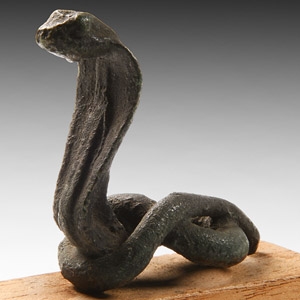
Egyptian Cobra Statuette
3rd-1st century B.C.Sold for (Inc. bp): £2,470
A lead-alloy figurine of the sacred uraeus with coiled body, head raised and hood expanded ready to strike; mounted on a custom-made display stand. 42.9 grams total, 61 mm
Ex collection of Louis-Gabriel Bellon (1819-1899), France. -
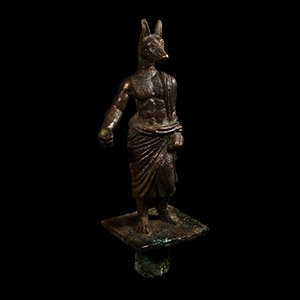
Egyptian Anubis Staff Terminal
1st century B.C.- 2nd century A.D.Sold for (Inc. bp): £7,150
A bronze staff or sceptre terminal formed as a priest of Anubis with jackal's head and human body, standing and wearing a tightly-draped toga with right hand extended in a fist; square base and socket to the underside. 223 grams, 12.7 cm high
Private collection, since 1989. This lot has been checked against the Interpol Database of stolen works of art and is accompanied by search certificate no.11604-199678.
Anubis was the ancient Egyptian god of the dead - represented in jackal form or in the form of a jackal-headed man - and one of ancient Egypt's most iconic deities. Originally god of the underworld, he was eventually associated more specifically with the embalming process and funerary rites. His fur was generally depicted as black owing to the association of that colour with fertility and beliefs regarding rebirth in the afterlife. -
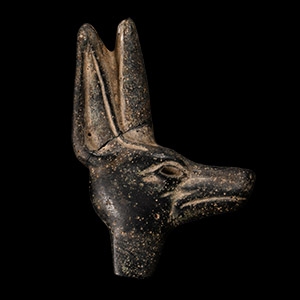
Egyptian Glass Anubis Head Inlay
Late Period, 664-332 B.C.Sold for (Inc. bp): £572
An opaque black glass inlay in the form of the head of Anubis in jackal form; repaired. 19.2 grams, 58 mm high
French collection, 1960s-early 2000s. From an important Paris gallery, France. -
Egyptian Bust of Ptah
Late Period, 26th-30th Dynasty, circa 664-343 B.C.Sold for (Inc. bp): £13,000
A white limestone figure of the god Ptah with false beard, wearing an enveloping cloak and a broad wesekh-collar, holding the shaft of a was sceptre; serene, oval face with almond-shaped eyes and fleshy lips; remnants of dorsal pillar to reverse; mounted on a custom-made display stand. 1.39 kg total, 22.3 cm high including stand
Ex private Belgium collection, 1960s. with Vanderkindere Auctions, Brussels, Belgium, 26 February 2013, lot 261. English private collection. This lot has been checked against the Interpol Database of stolen works of art and is accompanied by search certificate no.11605-199743. Accompanied by a scholarly note by Egyptologist Paul Whelan.
Ptah is attested from the beginning of ancient Egypt’s dynastic history and was a creator god, a god of craftsmen, and the patron deity of the Memphite region. The principal temple of the god was located in the city of Memphis. The fragmentary back pillar on this statuette indicates that it was most probably a temple offering, originally inscribed with an invocation to Ptah together with the donor’s name. Such votive figurines with back pillars naming the god and the dedicator occur in various materials, including faience and stone. -
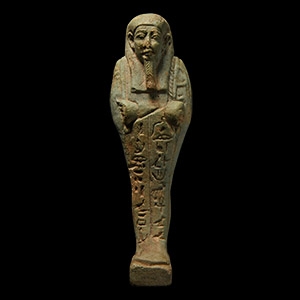
Egyptian Pale Blue Shabti for an Imy-Khent Priest
Late Period, 30th Dynasty, circa 380-343 B.C.Sold for (Inc. bp): £1,820
A pale blue glazed mummiform shabti for an Imy-Khent priest, modelled standing on a rectangular base, arms crossed over the chest and holding a pick and a hoe, seed bag over the left shoulder, wearing a tripartite wig and false beard; two vertical columns of hieroglyphs to the front of the body, plain dorsal pillar; some of the hieroglyphs spelling the owner's name are poorly rendered, but appears to be Ba-ankh-sa-sobeky. 99 grams, 13.5 cm high
From a Worcester deceased estate. Property of a Cambridgeshire gentleman. Accompanied by an academic report by Egyptologist Paul Whelan.
Although the name of the shabti’s owner and, in particular, that of his parent, are rather unclear, the titles are clearly written and inform us that Ba-ankh-sa-sobeky served as an ‘Imy-khent priest’ associated with the Delta city of Mendes, where the principal deity was the sacred ram god Ba-neb-djedet (meaning ‘Ram, lord of Djedet’). The hieroglyph of the standing ram (Ba) forms the first part of the priest’s name. From the Late Period onwards the priestly title of the nearby city of Hermopolis Parva, ‘One who Separates the Two Gods’, also appears in Mendesian title strings, perhaps indicating that Hermopolis Parva and its religious cults had come under the control of Mendes; indeed, Mendes is thought to have been the capital of Egypt during the 29th Dynasty. The crocodile god Sobek was also worshipped at Mendes in later periods and Ba-ankh-sa-sobeky’s name appears to reflect both this reptilian deity and the traditional ram god of the city. -
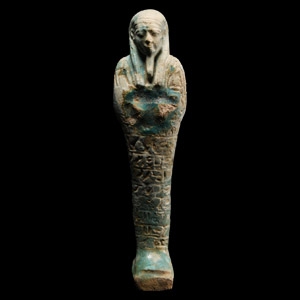
Egyptian Faience Shabti with Hieroglyphic Text
7th-1st century B.C.Sold for (Inc. bp): £910
A glazed composition shabti with square base and plain dorsal pillar, tripartite wig and false beard, arms folded across the chest holding agricultural tools and a seed bag to the left shoulder; nine horizontal bands of worn hieroglyphic text from Chapter Six of the Book of the Dead to the lower body. 212 grams, 19.5 cm high
Acquired early 1990s. Ex private American collection; thence by descent. Private Swiss collection since 1998.
