
Auction Highlights
-
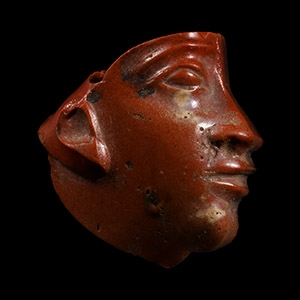
Egyptian Red Glass Face Inlay
Sold for (Inc. bp): £3,640
A red glass insert of a profile face with remains of a pharaonic crown to the forehead. -
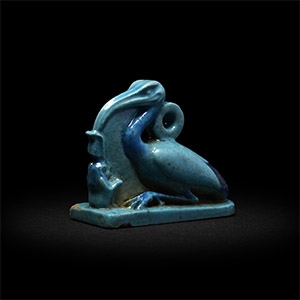
Egyptian Thoth as an Ibis with Maat
Sold for (Inc. bp): £6,500
A blue-glazed composition amulet in the form of an ibis (representing the god Thoth) seated on a wedge-shaped base, facing a figure of Maat appearing as a diminutive stooping female with an ostrich feather; some details to both figures rendered in a darker blue glaze; suspension loop to the rear of the bird's neck. -
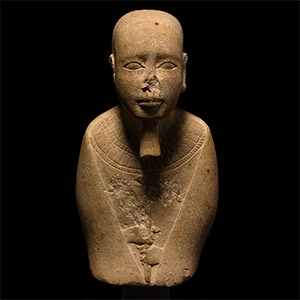
Egyptian Bust of Ptah
Sold for (Inc. bp): £13,000
A white limestone figure of the god Ptah with false beard, wearing an enveloping cloak and a broad wesekh-collar, holding the shaft of a was sceptre; serene, oval face with almond-shaped eyes and fleshy lips; remnants of dorsal pillar to reverse; mounted on a custom-made display stand. -
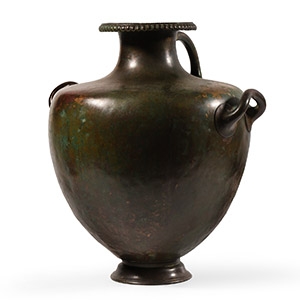
Large Greek Hydria with Egg-and-Dart Motifs
Sold for (Inc. bp): £9,525
A spectacular bronze hydria composed of a tapering body, broad shoulder and waisted neck, the everted rim decorated with egg-and-dart motifs, three round-section handles and tiered, ogival foot; professionally restored. -
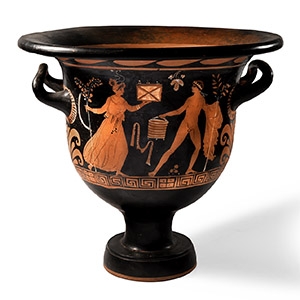
Large Greek Apulian Red-Figure Bell-Krater
Sold for (Inc. bp): £28,600
A red-figure terracotta bell-krater displaying polychrome figural panels between a laurel wreath and a band of Greek key motifs; side a) two robed male figures holding staffs, wearing a taenia or a band around the head, standing facing a central altar; side b) a woman wearing a chiton and holding a casket and olive sprig in her outstretched hands, advancing right towards a nude man standing right, his head turned towards her, holding a bucket and olive sprig, a cloak draped over his arm, elaborate volute palmettes beneath both handles; restored. -
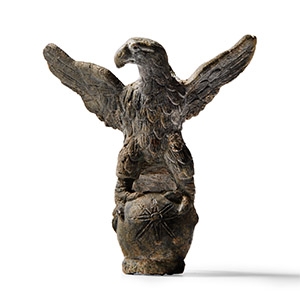
Roman Military Eagle Staff Terminal
Sold for (Inc. bp): £11,050
A free-standing bronze imperial or military eagle terminal from a staff or a sceptre, modelled in the round in a dynamic pose standing on a globe, wings spread, head turned to the right, semi-naturalistic anatomical and feather detailing; the globe bearing an incised eight-armed stylised Macedonian star; sub-triangular lug to back of the neck; collar to globe with hollow underside. -
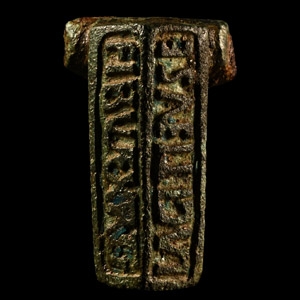
'The Castleford Military Garrison' Romano-British 'Regio Lagitiensis' Inscribed Brooch
Sold for (Inc. bp): £4,940
The best example of only three examples of this type known, a copper-alloy knee brooch composed of a rectangular-section body, spring pin within bow plate and remains of catchplate to reverse; both sides of the body with two panels of Latin lettering moulded in relief: 'FIBUL[A] EX REG LAGITIENSE', translating to 'Brooch from the Regio Lagitiensis' (Roman Castleford); remains of blue glass enamelling to the recessed fields. -
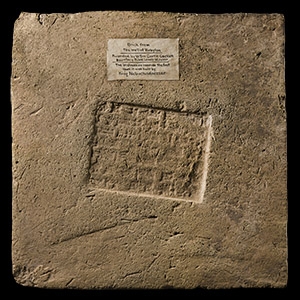
Large 'King Nebuchadnezzar the Great' Brick from the Wall of Babylon
Sold for (Inc. bp): £5,980
A large fired clay brick from the Wall of Babylon bearing six lines of stamped Babylonian cuneiform inscription to one face which reads: 'AG - ku -dur-ri-URU' / 'LUGAL ba-bi-lu' / 'za-ni-nu é-sag-ila' / 'u e-zi-da IBILA' / 'SAG.KAL. sa AG-IBILA-URU' / 'LUGAL ba-bi-lu ana-ku', which translates: 'Nebuchadnezzar, king of Babylon, who provides for Esagila and Ezida, the eldest son of Nabopolassar, king of Babylon, am I'; traces of bitumen on the blank side; accompanied by an old label which reads: 'Brick from the Wall of Babylon / Presented by W.Bro. Gentle-Cackett Secretary Bible Lands Mission / The impression records the fact that it was built by King Nebuchadnezzar [II]'. -
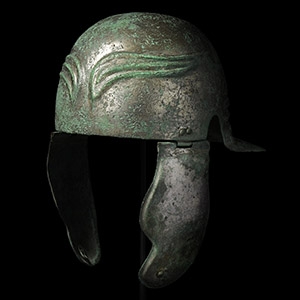
Roman Legionary Helmet with Wings of Jupiter
Sold for (Inc. bp): £52,000
A tinned sheet-bronze legionary helmet of Imperial Gallic Type A with deep rounded bowl, simple C-shaped cut-outs for the ears, integral flared neck-guard extending some way along the sides, corrugated ribs to the occipital area at the rear and corrugated 'wings' or eyebrows (Russel-Robinson's Type E) above the brow; small stud the rear of the neck-guard attaching suspension loops to the underside; hinged bracket at each temple for a deeply curved cheek-guard with gently flared rim, bearing a loop to the inner face to accept an vinculum fastening strap; accompanied by a custom-made display stand. -
.jpg)
Anglo-Saxon Gilt Chip-Carved Mount with Interlaced Panels
Sold for (Inc. bp): £6,240
A gilt copper-alloy mount composed of a broad annular body with slightly domed profile, the body quartered with each cell displaying a chip-carved interlace motif configured A:B:A:B; rim, edges and central cell with raised rim; rivet and flat-section mounting bar to reverse. -
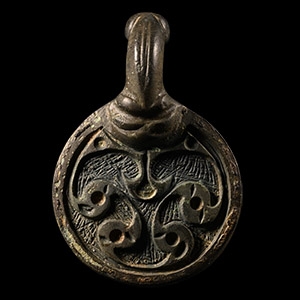
'The Pershore' Anglo-Saxon Hanging Bowl Mount with Horse-Head
Sold for (Inc. bp): £7,150
A bronze bowl mount or escutcheon comprising a discoid panel with gently curved profile and zoomorphic hook; the panel with reserved La Tène comma-leaf decoration on a pounced field (intended to receive enamel fill); the hook with median gusset to the outer face, horse-head finial, bulbous La Tène ornament at the base. -
.jpg)
'The Siddington' Impressive Anglo-Saxon Chip-Carved Saucer Brooch Pair
Sold for (Inc. bp): £24,700
A pair of large Early Anglo-Saxon gilt copper-alloy saucer brooches each comprising a broad (13mm+) angled flange surrounding a central disc with carinated border; outer zone comprising four arches subdivided by hatching to the inner edge and four C-shaped panels with triangular separators, inner zone separated by a carinated border, central disc with four radiating bilinear crescents; pin-lugs and catch to the reverse with traces of mineralised fabric. -
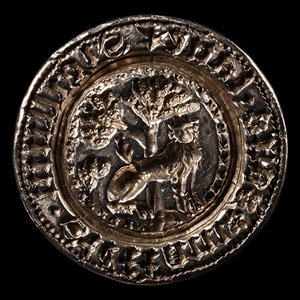
English Medieval Silver Chessman Type Seal Matrix for Stephen of Ale Lane
Sold for (Inc. bp): £3,510
A silver chessman-type seal matrix with pierced trefoil head and knop above; central motif of a leopard statant gardant before a tree, pelletted border and blackletter legend '* sigillum [lozenge] steffani [cinquefoil cinquefoil] ale [cinquefoil lozenge] lane' (for 'seal of Stephen [at?] ale lane'). -
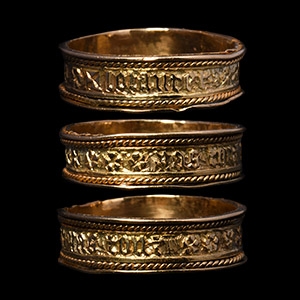
'The Bettiscombe' Medieval Gold 'Loyalty is Everything' Posy Ring
Sold for (Inc. bp): £4,160
An annular gold band with everted upper and lower lip, filigree ropework above and below each rim, with circumferential inscription to the recessed exterior face; of the five separate bands, the central one accommodating an applied strip of paler gold bearing a Medieval French blackletter inscription in relief, reading: '+loiautet (5 five cinquefoils) pas tout (5 five cinquefoils)', or 'Loyalty Passes All'; the inscription band may once have been enamelled; plain interior; the outer rim and twisted band on one edge are slightly bent; cleaned and repaired. -
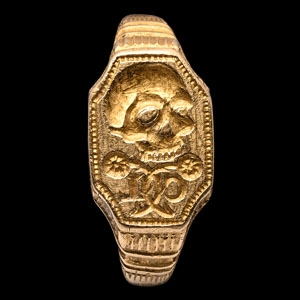
Stuart Period Gold Renaissance Memento Mori Signet Ring with C.L. and Skull
Sold for (Inc. bp): £19,500
A substantial gold signet ring composed of a lentoid-section hoop, expanding capital style shaped shoulders and irregular octagonal bezel engraved with a skull, two flowers below separating the reversed initials in capitals: 'CL', framed by a beaded border. -
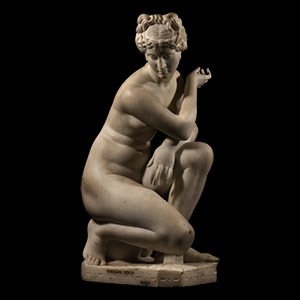
Marble Statue of Kneeling Venus
Sold for (Inc. bp): £14,950
A marble copy of the kneeling Venus (original in the Vatican Museums), crouching on an octagonal base; the arms raised in expressive pose, head tilted, hair drawn up in a chignon; lettering to base 'KNEELING VENUS' and 'ROME'.
-
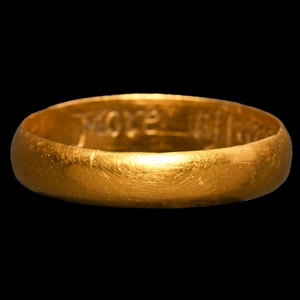
Post Medieval Gold 'More Assured then Professed' Posy Ring
Circa 18th century A.D.Sold for (Inc. bp): £1,040
A gold posy ring with D-section band, inscribed internally with 'More assured then professed' with long S's in lower case with small foliate scroll after. 2.42 grams, 18.46 mm overall, 16.65 mm internal diameter (approximate size British L, USA 5 3/4, Europe 11.24, Japan 10)
Acquired on the UK antiques market between 1974-1985. Albert Ward collection, Essex, UK. -
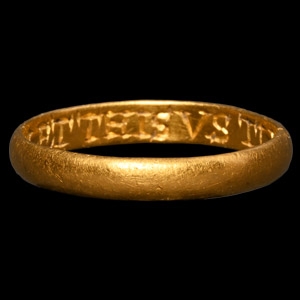
Post Medieval Gold 'Let This Vs Tie Vntil We Die' Posy Ring
Circa 18th century A.D.Sold for (Inc. bp): £1,040
A gold posy ring with D-section band, inscribed internally with 'LET THIS VS TI VNTIL WE DI' inscription (let this us tie until we die). 1.66 grams, 17.36 mm overall, 15.61 mm internal diameter (approximate size British I 1/2, USA 4 1/2, Europe 8.07, Japan 7)
Acquired on the UK antiques market between 1974-1985. Albert Ward collection, Essex, UK. -
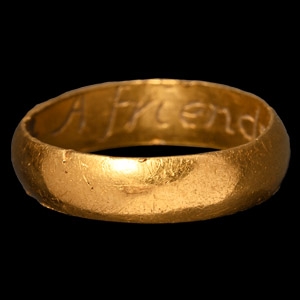
Post Medieval Gold 'A Friends Gift' Posy Ring
Circa 18th century A.D.Sold for (Inc. bp): £312
A gold posy ring with D-section band inscribed internally 'A friends gift' in lower case with initials 'I M' added after; with 'crown over T H' maker's punch. 1.94 grams, 15.23 mm overall, 12.85 mm internal diameter
Acquired on the UK antiques market between 1974-1985. Albert Ward collection, Essex, UK. -
.jpg)
Georgian 'In Unity Lets Live & Die' Gold Posy Ring
18th century A.D.Sold for (Inc. bp): £780
A slender annular gold band inscribed in cursive hand to the interior: 'In Unity lets live & die', followed by maker's mark 'JK' within a rectangular cartouche. 1.37 grams, 19.64 mm overall, 17.97 mm internal diameter (approximate size British P 1/2, USA 7 3/4, Europe 16.86, Japan 16)
Found Romney Marsh area, Kent, UK. Property of a Kent gentleman. -
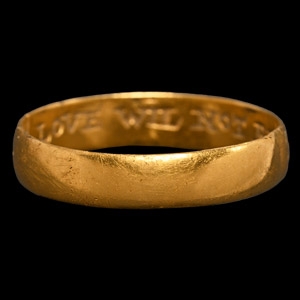
Post Medieval Gold 'Godlye Love Wil Not Remove' Posy Ring
Circa 18th century A.D.Sold for (Inc. bp): £715
A large gold posy ring with D-section hoop inscribed internally 'GODLYE LOVE WILL NOT REMOVE' in Roman capitals 2.95 grams, 21.16 mm overall, 19.37 mm internal diameter (approximate size British S 1/2, USA 9 1/4, Europe 20.63, Japan 19)
Acquired on the UK antiques market between 1974-1985. Albert Ward collection, Essex, UK. -
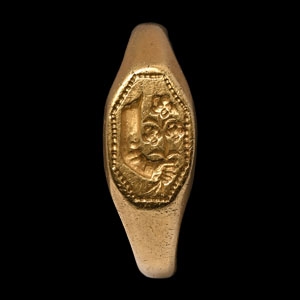
Stuart Period Large Gold Signet Ring with Arm and Floral Spray
17th century A.D.Sold for (Inc. bp): £13,000
A gold signet ring composed of a D-section hoop and facetted oval bezel, engraved with crest depicting a forearm and hand oriented right, holding a floral spray composed of three five-petalled flowers and four leaves, set within a beaded octagonal border. 9.78 grams, 24.40 mm overall, 20.51 mm internal diameter (approximate size British V, USA 10 1/2, Europe 23.77, Japan 22)
Acquired in the 1980s. Property of a London gentleman. This lot has been checked against the Interpol Database of stolen works of art and is accompanied by search certificate no.11663-197588.
Signet rings were jewellery items serving practical functions, and were pressed into hot wax to seal letters and packets. Personal seals or secreta acted as a legal safeguard, since they were used to witness wills, loans, commercial, personal and other documents. Such rings were often engraved with a coat of arms, initials, merchant's mark or some other personal symbol. Painted portraits of this period portray the wearer with the signet ring on the thumb or forefinger, allowing for practical use. -
Stuart Period Gold Renaissance Memento Mori Signet Ring with C.L. and Skull
17th century A.D.Sold for (Inc. bp): £19,500
A substantial gold signet ring composed of a lentoid-section hoop, expanding capital style shaped shoulders and irregular octagonal bezel engraved with a skull, two flowers below separating the reversed initials in capitals: 'CL', framed by a beaded border. 15.65 grams, 27.14 mm overall, 22.68 mm internal diameter (approximate size British X, USA 11 1/2, Europe 26.29, Japan 25)
Acquired in the 1980s. Property of a London gentleman. This lot has been checked against the Interpol Database of stolen works of art and is accompanied by search certificate no.11664-197587.
Signet rings were jewellery items serving practical functions, and were pressed into hot wax to seal letters and packets. Personal seals or secreta acted as a legal safeguard, since they were used to witness wills, loans, commercial, personal and other documents. Such rings were often engraved with a coat of arms, initials, merchant's mark or some other personal symbol. Painted portraits of this period portray the wearer with the signet ring on the thumb or forefinger, allowing for practical use. Skulls on rings were potent symbols of mortality. 'Memento mori' or 'remember that you must die' imagery served as a reminder to the Christian of the need to keep their soul in good order for the final judgment. -
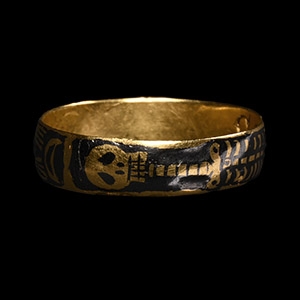
Early Georgian Gold Enamelled Memento Mori Skeleton Ring for 'S N'
Dated 1717 A.D.Sold for (Inc. bp): £4,420
A gold George I period memento mori ring decorated around the exterior with a stylised human skeleton against a black enamelled field, the body featuring an elongated neck, exaggerated numbers of ribs and disproportionately short legs, with a crescent at the base of the feet; interior engraved 'SN 17.17'. 3.15 grams, 20.76 mm overall, 18.77 mm internal diameter (approximate size British Q 1/2, USA 8 1/4, Europe 18.12, Japan 17)
Acquired in the late 1990s-2000. Property of an East London gentleman. -
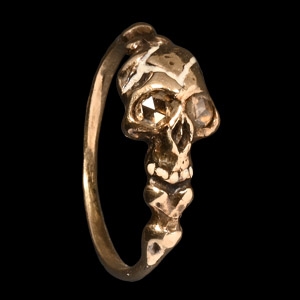
Gold, Enamel, and Diamond-Set Skull Ring
Circa 1700 A.D.Sold for (Inc. bp): £4,212
A Queen Anne period gold ring composed of a slender hoop with expanding shoulders formed as the ball-joints of long bones; bezel formed as an elongated stylised skull featuring large eye-sockets set with facetted diamonds; white enamelled teeth and head detailing; accompanied by a vintage ring box. 2.82 grams, 19.54 mm overall,17.22 mm internal diameter (approximate size British J 1/2, USA 5, Europe 9.32, Japan 9)
Acquired from Berganza, Hatton Garden, London, 2016. Property of an East Sussex collector. Accompanied by a copy of the Berganza invoice. This lot has been checked against the Interpol Database of stolen works of art and is accompanied by search certificate no.11665-197583.
Likely a ring of the memento mori genre. The V & A Museum states that during the 'Renaissance, the ring developed from the simple forms of the medieval period into a miniature work of art, combining the skills of the chaser, engraver and enameller as well as the stone cutter.' -
.jpg)
Georgian Gold Poison Ring
18th-19th century A.D.Sold for (Inc. bp): £5,720
A Georgian-era 15 carat gold and silver 'poison' ring, composed of a slender hoop of scrolls and crescents with a plain panel at the base, expanding shoulders formed as openwork foliate flourishes set with small stones; oval cluster bezel set with a central cushion-cut emerald weighing approximately 4.06 cts, held in a pierced setting with twisted gold wire collar, and surrounded by rose-cut diamonds; hinged bezel revealing a secret compartment beneath, the reverse domed and engraved with a stylised shell motif. 10.02 grams, 28.41 mm overall, 17.91 mm internal diameter (approximate size British O, USA 7, Europe 14.98, Japan 14)
Acquired from Platt Boutique Jewelry, Inc., West Hollywood, California, USA, 2016. Property of an East Sussex collector. Accompanied by a copy of the Platt Boutique Jewelry invoice. This lot has been checked against the Interpol Database of stolen works of art and is accompanied by search certificate no.11668-197586.
'Poison rings' became popular in Europe during the 16th century, and Lucrezia Borgia is popularly believed to have used one. The compartment within the bezel was used to conceal poison, a lock of hair or other substances. -
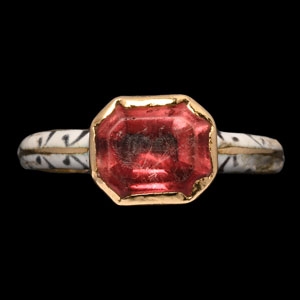
Stuart Period Gold, Rock Crystal and White Enamel Ring
17th century A.D.Sold for (Inc. bp): £4,420
A gold ring composed of a slender hoop embellished with tapering, white enamelled shoulders with black enamelled flourishes, fluted box collet setting, set with a pink foil back and table-cut rock crystal; accompanied by a vintage ring box. 1.89 grams, 21.50 mm overall, 16.63 mm internal diameter (approximate size British L 1/2, USA 6, Europe 11.87, Japan 11)
Valued by Bentley & Skinner, Piccadilly, London W1, 2016. Property of an East Sussex collector. Accompanied by a copy of the Bentley & Skinner insurance valuation. This lot has been checked against the Interpol Database of stolen works of art and is accompanied by search certificate no.11669-197584.
The V & A Museum explains that during the '...Renaissance, the ring developed from the simple forms of the medieval period into a miniature work of art, combining the skills of the chaser, engraver and enameller as well as the stone cutter. -
.jpg)
Renaissance Gold Ring with Ruby and Enamelling
Late 16th century A.D.Sold for (Inc. bp): £14,300
A classic, Renaissance era gold ring composed of a slender D-section hoop, widening at the shoulders, fashioned as architectural capitals with strapwork and elaborate projecting scrolls in opaque white and blue enamel, embellished with red and green enamelled detailing; square bezel with box setting set with a table-cut ruby, pairs of blue enamelled cusplets to each of the four faces, stepped base below ornamented with a black enamelled bead moulded collar, bezel reverse of flat inverted pyramidal form and divided into four triangles, two with black enamelled hatching; retaining the majority of the original enamelling; accompanied by a Les Enluminures presentation box. 4.66 grams, 22.94 mm overall, 16.90 mm internal diameter (approximate size British H, USA 3 3/4, Europe 6.18, Japan 6)
Acquired from Les Enluminures Ltd, Illinois, USA, 2016. Property of an East Sussex collector. Accompanied by a Les Enluminures certificate of authenticity. Accompanied by a copy of the Les Enluminures invoice. This lot has been checked against the Interpol Database of stolen works of art and is accompanied by search certificate no.11670-197580.
Rubies were a potent symbol of status and social distinction in later medieval Europe, frequently adorning royal crowns. In the Renaissance, however, they conveyed a personal, more intimate message, their red colour, like the rose, emblematic of love. The intensity of the red colour was often enhanced with a foil lining to the setting and were popular as betrothal and wedding rings. It is believed that rubies symbolised the virtues of marriage and eternal matrimonial love. Such rings held an international appeal, making attribution to specific workshops or countries very difficult. The V & A Museum explains that 'Renaissance, the ring developed from the simple forms of the medieval period into a miniature work of art, combining the skills of the chaser, engraver and enameller as well as the stone cutter.'
