
Auction Highlights
-
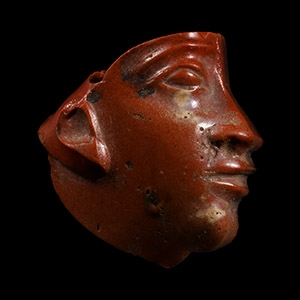
Egyptian Red Glass Face Inlay
Sold for (Inc. bp): £3,640
A red glass insert of a profile face with remains of a pharaonic crown to the forehead. -
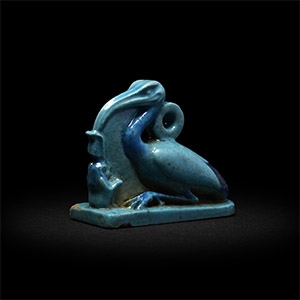
Egyptian Thoth as an Ibis with Maat
Sold for (Inc. bp): £6,500
A blue-glazed composition amulet in the form of an ibis (representing the god Thoth) seated on a wedge-shaped base, facing a figure of Maat appearing as a diminutive stooping female with an ostrich feather; some details to both figures rendered in a darker blue glaze; suspension loop to the rear of the bird's neck. -
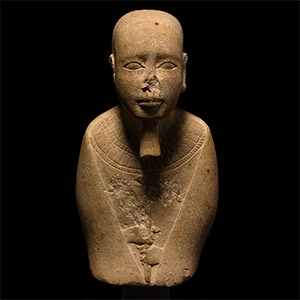
Egyptian Bust of Ptah
Sold for (Inc. bp): £13,000
A white limestone figure of the god Ptah with false beard, wearing an enveloping cloak and a broad wesekh-collar, holding the shaft of a was sceptre; serene, oval face with almond-shaped eyes and fleshy lips; remnants of dorsal pillar to reverse; mounted on a custom-made display stand. -
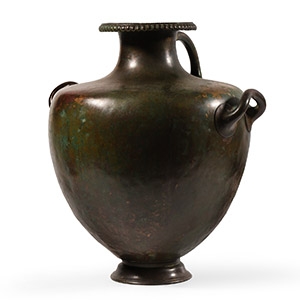
Large Greek Hydria with Egg-and-Dart Motifs
Sold for (Inc. bp): £9,525
A spectacular bronze hydria composed of a tapering body, broad shoulder and waisted neck, the everted rim decorated with egg-and-dart motifs, three round-section handles and tiered, ogival foot; professionally restored. -
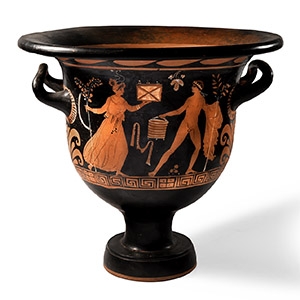
Large Greek Apulian Red-Figure Bell-Krater
Sold for (Inc. bp): £28,600
A red-figure terracotta bell-krater displaying polychrome figural panels between a laurel wreath and a band of Greek key motifs; side a) two robed male figures holding staffs, wearing a taenia or a band around the head, standing facing a central altar; side b) a woman wearing a chiton and holding a casket and olive sprig in her outstretched hands, advancing right towards a nude man standing right, his head turned towards her, holding a bucket and olive sprig, a cloak draped over his arm, elaborate volute palmettes beneath both handles; restored. -
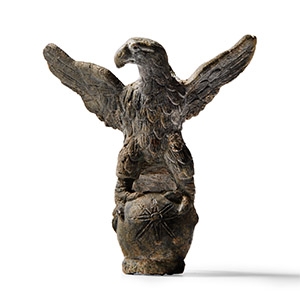
Roman Military Eagle Staff Terminal
Sold for (Inc. bp): £11,050
A free-standing bronze imperial or military eagle terminal from a staff or a sceptre, modelled in the round in a dynamic pose standing on a globe, wings spread, head turned to the right, semi-naturalistic anatomical and feather detailing; the globe bearing an incised eight-armed stylised Macedonian star; sub-triangular lug to back of the neck; collar to globe with hollow underside. -
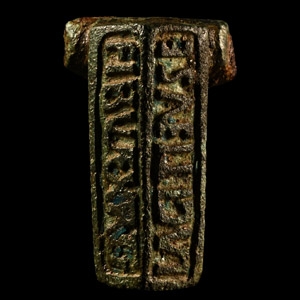
'The Castleford Military Garrison' Romano-British 'Regio Lagitiensis' Inscribed Brooch
Sold for (Inc. bp): £4,940
The best example of only three examples of this type known, a copper-alloy knee brooch composed of a rectangular-section body, spring pin within bow plate and remains of catchplate to reverse; both sides of the body with two panels of Latin lettering moulded in relief: 'FIBUL[A] EX REG LAGITIENSE', translating to 'Brooch from the Regio Lagitiensis' (Roman Castleford); remains of blue glass enamelling to the recessed fields. -
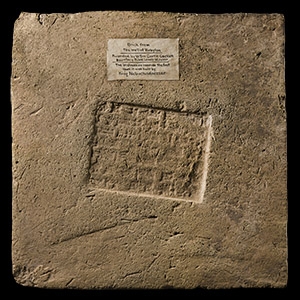
Large 'King Nebuchadnezzar the Great' Brick from the Wall of Babylon
Sold for (Inc. bp): £5,980
A large fired clay brick from the Wall of Babylon bearing six lines of stamped Babylonian cuneiform inscription to one face which reads: 'AG - ku -dur-ri-URU' / 'LUGAL ba-bi-lu' / 'za-ni-nu é-sag-ila' / 'u e-zi-da IBILA' / 'SAG.KAL. sa AG-IBILA-URU' / 'LUGAL ba-bi-lu ana-ku', which translates: 'Nebuchadnezzar, king of Babylon, who provides for Esagila and Ezida, the eldest son of Nabopolassar, king of Babylon, am I'; traces of bitumen on the blank side; accompanied by an old label which reads: 'Brick from the Wall of Babylon / Presented by W.Bro. Gentle-Cackett Secretary Bible Lands Mission / The impression records the fact that it was built by King Nebuchadnezzar [II]'. -
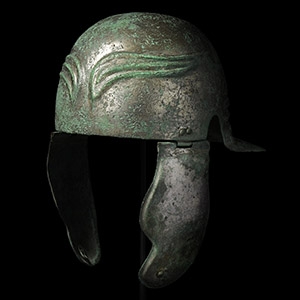
Roman Legionary Helmet with Wings of Jupiter
Sold for (Inc. bp): £52,000
A tinned sheet-bronze legionary helmet of Imperial Gallic Type A with deep rounded bowl, simple C-shaped cut-outs for the ears, integral flared neck-guard extending some way along the sides, corrugated ribs to the occipital area at the rear and corrugated 'wings' or eyebrows (Russel-Robinson's Type E) above the brow; small stud the rear of the neck-guard attaching suspension loops to the underside; hinged bracket at each temple for a deeply curved cheek-guard with gently flared rim, bearing a loop to the inner face to accept an vinculum fastening strap; accompanied by a custom-made display stand. -
.jpg)
Anglo-Saxon Gilt Chip-Carved Mount with Interlaced Panels
Sold for (Inc. bp): £6,240
A gilt copper-alloy mount composed of a broad annular body with slightly domed profile, the body quartered with each cell displaying a chip-carved interlace motif configured A:B:A:B; rim, edges and central cell with raised rim; rivet and flat-section mounting bar to reverse. -
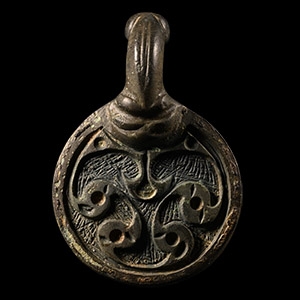
'The Pershore' Anglo-Saxon Hanging Bowl Mount with Horse-Head
Sold for (Inc. bp): £7,150
A bronze bowl mount or escutcheon comprising a discoid panel with gently curved profile and zoomorphic hook; the panel with reserved La Tène comma-leaf decoration on a pounced field (intended to receive enamel fill); the hook with median gusset to the outer face, horse-head finial, bulbous La Tène ornament at the base. -
.jpg)
'The Siddington' Impressive Anglo-Saxon Chip-Carved Saucer Brooch Pair
Sold for (Inc. bp): £24,700
A pair of large Early Anglo-Saxon gilt copper-alloy saucer brooches each comprising a broad (13mm+) angled flange surrounding a central disc with carinated border; outer zone comprising four arches subdivided by hatching to the inner edge and four C-shaped panels with triangular separators, inner zone separated by a carinated border, central disc with four radiating bilinear crescents; pin-lugs and catch to the reverse with traces of mineralised fabric. -
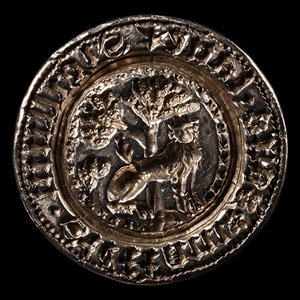
English Medieval Silver Chessman Type Seal Matrix for Stephen of Ale Lane
Sold for (Inc. bp): £3,510
A silver chessman-type seal matrix with pierced trefoil head and knop above; central motif of a leopard statant gardant before a tree, pelletted border and blackletter legend '* sigillum [lozenge] steffani [cinquefoil cinquefoil] ale [cinquefoil lozenge] lane' (for 'seal of Stephen [at?] ale lane'). -
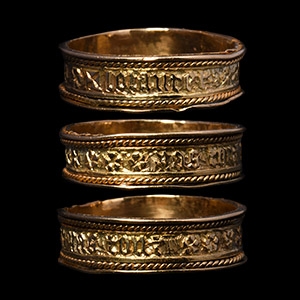
'The Bettiscombe' Medieval Gold 'Loyalty is Everything' Posy Ring
Sold for (Inc. bp): £4,160
An annular gold band with everted upper and lower lip, filigree ropework above and below each rim, with circumferential inscription to the recessed exterior face; of the five separate bands, the central one accommodating an applied strip of paler gold bearing a Medieval French blackletter inscription in relief, reading: '+loiautet (5 five cinquefoils) pas tout (5 five cinquefoils)', or 'Loyalty Passes All'; the inscription band may once have been enamelled; plain interior; the outer rim and twisted band on one edge are slightly bent; cleaned and repaired. -
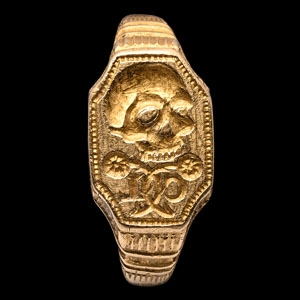
Stuart Period Gold Renaissance Memento Mori Signet Ring with C.L. and Skull
Sold for (Inc. bp): £19,500
A substantial gold signet ring composed of a lentoid-section hoop, expanding capital style shaped shoulders and irregular octagonal bezel engraved with a skull, two flowers below separating the reversed initials in capitals: 'CL', framed by a beaded border. -
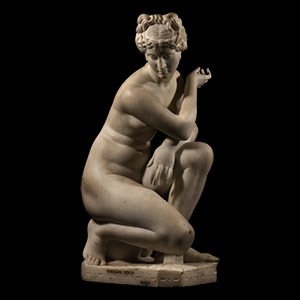
Marble Statue of Kneeling Venus
Sold for (Inc. bp): £14,950
A marble copy of the kneeling Venus (original in the Vatican Museums), crouching on an octagonal base; the arms raised in expressive pose, head tilted, hair drawn up in a chignon; lettering to base 'KNEELING VENUS' and 'ROME'.
-
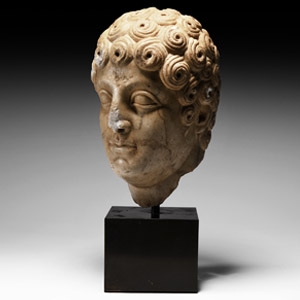
Medieval Marble Bust of Emperor Constantine
14th-16th century A.D. and laterSold for (Inc. bp): £4,940
A marble bust of Emperor Constantine with the hair formed as large lank curls; narrow face with large almond-shaped eyes and broad mouth; face reworked from an earlier late medieval head; mounted on a custom-made stand. 6.3 kg total, 30 cm high including stand
French collection, 1960s-early 2000s. From an important Paris gallery, France. This lot has been checked against the Interpol Database of stolen works of art and is accompanied by search certificate no.11660-199347. -
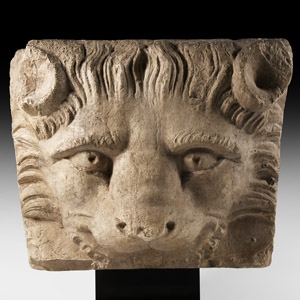
Medieval Block with Lion Relief
Venice, 15th-16th century A.D.Sold for (Inc. bp): £3,900
A stylised lion's face and mane carved in relief in stone; likely part of a frieze; mounted on a custom-made display stand. 23.2 kg total, 30 cm high including stand
with Hotel Des Ventes De Monte, Monaco, 14 December 2021, lot 13. English private collection. This lot has been checked against the Interpol Database of stolen works of art and is accompanied by search certificate no.11661-199833. -
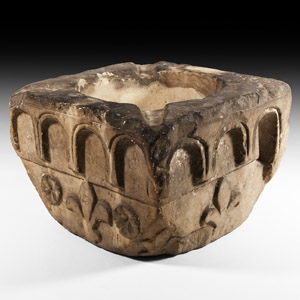
Medieval Sandstone Font with Arches
13th-14th century A.D.Sold for (Inc. bp): £2,340
A square-section sandstone font with carinated sidewall, carved with arcading around the upper body, non-identical fleurs and plant forms to the centre of the side faces and to one of four chamfered corners; channels to three of the four corners of the upper face; circular drainage hole to interior base. 30.4 kg, 30 x 30 cm
English private collection, 1980s. This lot has been checked against the Interpol Database of stolen works of art and is accompanied by search certificate no.11662-199832. -
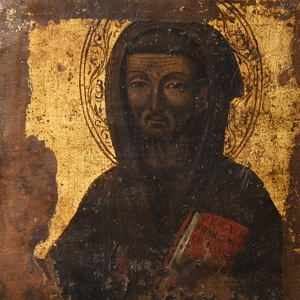
Cretan Icon of Saint Francis of Assisi
15th century A.D.Sold for (Inc. bp): £1,170
An icon from a possible triptych of Veneto-Cretan School depicting nimbate Saint Francis of Assisi, wearing the brown habit of the Franciscan order, fitted with a hood, facing towards the right, a red book in his left hand with the inscription Vera S. Francisci effigies(true portrait of Saint Francis); mounted in a perspex display frame. 152 grams, 20 cm high
Property of a London lady, part of her family's collection.
With the conquest of Crete by the Venetians, Latin saints were introduced to Byzantine iconography. Saint Francis was one of the most beloved Latin saints among the Cretan faithful, depicted in the iconography of Cretan Orthodox churches, including the Panaghia Kera of Kritsa (13th-14th century A.D.). This figure was probably part of a triptych, having at the centre the image of the Mother of God with the Child, or a Desis. The placement of Francis in this icon would suggests the owner’s strong affiliation with the Franciscan order, which had a strong presence on Crete from the 13th century onwards. It was believed that Saint Francis himself stopped on the island on his way to the Holy Land in 1219. -
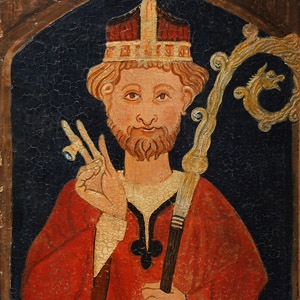
Medieval Icon of Pope Benedict XI
14th century A.D. or laterSold for (Inc. bp): £1,235
A rectangular wooden icon of Pope Benedict XI (papacy: 22 October 1303-7 July 1304) standing facing within an arch; elaborate crozier to the left hand with returned horse-head finial and scrolled spurs to the outer edge; right hand extended in the gesture of benediction with large gem-set finger ring carefully displayed; mitre with jewelled headband, simple red vestment with white undergarment and black trim; heavily overpainted; mounted in a gilt wooden frame with hatched lower panel. 1.6 kg, 50.5 x 37.5 cm
Ex Richard Philp, London, UK. with W.E. Tristram (1882-1952). Acquired from Patrick Reijgerberg, Holland March, 2003. UK private collection. -
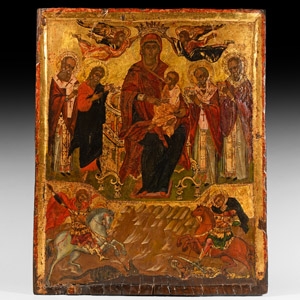
Greek Icon with Virgin and Saints George and Demetrius on Horseback
17th century A.D.Sold for (Inc. bp): £2,860
An exquisite tempera with gold ground on wood icon depicting Mary surrounded by saints and holding the Divine Child in her arms; Mary seated on an elaborate throne and crowned as the Queen of the Universe with two angels supporting her crown, Greek inscription 'MP' and 'ΘΥ' for Mother of God to each side of the crown, wearing a scarlet red maphorion embroidered with gold and a long dark blue tunica talaris; Jesus dressed in a linen tunic and a yellow cloak, affectionately gazing up and making the sign of blessing with his right hand; four saints flanking the throne, three of whom dressed in Bishop's attire, far left Saint Basil with his name written in Greek, and the others possibly saints Elias, Nicholas and Gregorius Nazianzus; the lower part of the icon with Saint George on horseback killing the dragon and Saint Demetrius on horseback killing the king of Avars, both saints dressed in pseudo-Roman armour and armed with a spear. 2.4 kg, 44 x 35 cm
Property of a London lady, part of her family's collection. Accompanied by an academic report by Dr Raffaele D’Amato. This lot has been checked against the Interpol Database of stolen works of art and is accompanied by search certificate number no.11570-198597.
The representation of the icon is centred on the image of the Mother of God as ‘The Sovereign’ (Vasilissa, Queen of the Universe). Here, Mary assumes the function of the protector of the believers, reinforced by the presence of the angels. Due to her earthly origin, Mary always maintained an intermediary position in the heavenly realms, becoming an indispensable intercessor on behalf of humans before the Lord. The protection offered by her is reinforced by the presence of the two major protectors of the humans against evil: Saint George and Saint Demetrius. -
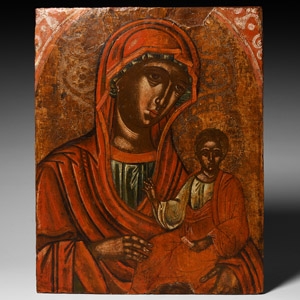
Greek Virgin and Child Hodegetria Icon
17th century A.D.Sold for (Inc. bp): £1,170
A tempera on wood icon depicting the Mother of God supporting the Child with her left forearm, his right hand raised and making the sign of blessing, left hand holding a scroll; the Virgin wearing a red maphorion with a light green veil and a blue chiton; both figures nimbate, the haloes tooled with foliate designs, gilt background with a red and white arch above. 520 grams, 27.5 x 21.5 cm
The lighter areas of the flesh further highlighted with fine white brushstrokes. The gilding of the background lost, minor losses, minimally restored
Property of a London lady, part of her family's collection.
The layout of the composition clearly indicates the icon's close link with Hodegetria type, the most typical iconography of the Mother of God in Byzantium since the 10th century. However, the type also recalls the iconography of the Virgin Psychosostria, i.e. 'Health of Souls'. -
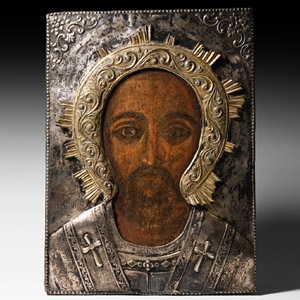
Greek Icon with Bust of Saint Eleutherios
18th century A.D.Sold for (Inc. bp): £702
A wooden painted icon of Saint Eleutherios with a repoussé silver oklad that covers all but the face, embossed in rich priestly robes, representing the priest's omophorion decorated with crosses, over an embroidered robe or sticharion, the nimbus gilded and embossed with foliage and rays over a silver background, Greek inscription 'O AΓΙΟΣ ΕΛΕΥΘΕΡΙΟΣ' (Saint Eleutherios) to the sides. 1.9 kg, 37.5 x 28.7 cm
Property of a London lady, part of her family's collection.
As bishop in Illyricum, Eleutherios promoted the cause of at a time when the persecutions not only made it difficult to win and hold converts, but also at a time when the gravest danger was in being a high-ranking prelate of the Church. Oblivious to this threat, he was acclaimed in the inner circle of Christianity as the brightest luminary of Christian Rome since the apostles. His immense popularity grew and thereby became more dangerous to the state. He was finally brought to the attention of Emperor Hadrian, who ordered his arrest, and then cast into prison, tortured, and put to death on December 15th. -
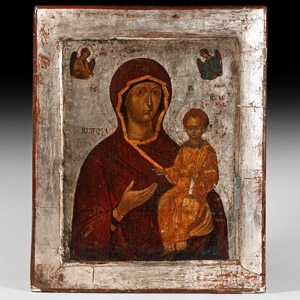
Russian Icon of the Hodegetria of Constantinople
19th century A.D.Sold for (Inc. bp): £715
An icon of Hodegetria with the Virgin wearing a red maphorion embroidered with gold, a dark veil and a dark chiton with double gold embroidery on the cuffs; holding the Child on her left arm and gesturing towards him with the right hand; the Child wearing a yellow brown, gold-woven chiton, holding a scroll in his left hand, while the right one is making the gesture of blessing; the angels Michael and Gabriel to the left and right of the Virgin; on each side of the head of the Virgin inscriptions 'ΜΡ' and 'ΘΥ' (Μήτηρ (τοῦ) Θεοῦ = Mother of God), inscription in Greek letters 'IC XC' (IHCOYC XPICTOC = Jesus Christ) above the child, three letters inside the nimbus of Christ representing the continuous divine self-existence of Christ as God ('O ѾN' = The Only One who always exists); the names of the angles inscribed next to each figure (Aghios Michail and Aghios Gavriil). 869 grams, 29.8 x 24 cm
Property of a London lady, part of her family's collection.
The painting is a copy of the famous replica of the Hodegetria of Constantinople, a Byzantine icon of 14th century, repainted by the icon painter Dionisi in 1482, and today preserved in State Tretyakov Gallery, Moscow. The original icon was destroyed by the Turks at the capture of Constantinople in 1453. The replica was venerated as an 'original' real Hodegetria in the Ascension Convent in Kremlin, Moscow. The icon led the liturgical processions on June 23, August 26, May 21 and October 22 in which the Patriarchs and the Russian Tsars took part. -
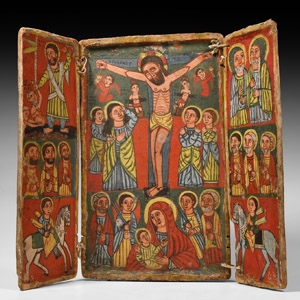
Ethiopian Triptych Icon with Mary and John the Evangelist
16th century A.D.Sold for (Inc. bp): £1,040
A wooden triptych with recessed central panel and two folding doors; the central panel with crucifixion scene with robed Mary and John the Evangelist, another apostle and Mary Magdalen, two crucified thieves to the rear and the angels depicted collecting the blood of God in cups; underneath the Crucifixion scene Virgin Mary and the Child escorted by armed Saint Gabriel and Saint Michael, prophets to the sides; the left door with nude Adam and Eve reaching up to the Resurrection of Christ, beneath them three prophets; the right door with two saints (upper panel) and three prophets; left and right bottom panels with Saint George (Bet Giorgis) and military Saint Victor on horseback; Ethiopian Ge'ez script legends. 760 grams, 35.5 x 21.5 cm
Acquired on the London art market, 2003. UK private collection.
The icon shows the Western influence on Ethiopian art. The first element is the orb which the Child holds in his left hand and the second element is the pose of his right hand. The orb appeared in Ethiopian paintings around 1500 A.D. Moreover, his hand shows two fingers outstretched, the index and middle finger, and the two last fingers folded. -
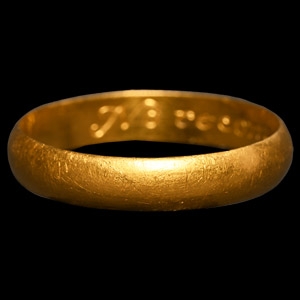
Post Medieval Gold 'No Recompence But Love' Posy Ring
Circa 18th century A.D.Sold for (Inc. bp): £845
A large gold posy ring with D-section hoop and inscribed internally 'No recompence but love' in lower case with 'ML' maker's punch. 3.08 grams, 20.33 mm overall, 18.20 mm internal diameter (approximate size British P 1/2, USA 7 3/4, Europe 16.86, Japan 16)
Acquired on the UK antiques market between 1974-1985. Albert Ward collection, Essex, UK. -
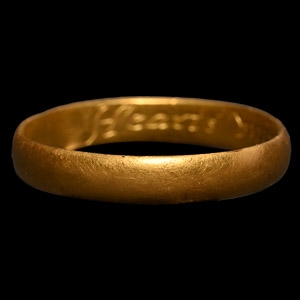
Post Medieval Gold 'Hearts United Lives Contented' Posy Ring
Circa 18th century A.D.Sold for (Inc. bp): £715
A large gold posy ring with D-section hoop, inscribed internally with 'Hearts vnited lives contented' lower case inscription with 'GM' maker's mark punch, possibly for the London goldsmith George Morris, recorded from a dated piece as working 1749-1750. 4.32 grams, 22.46 mm overall, 20.12 mm internal diameter (approximate size British T 1/2, USA 9 3/4, Europe 21.89, Japan 21)
Acquired on the UK antiques market between 1974-1985. Albert Ward collection, Essex, UK.
