
Auction Highlights
-
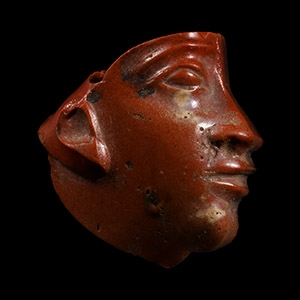
Egyptian Red Glass Face Inlay
Sold for (Inc. bp): £3,640
A red glass insert of a profile face with remains of a pharaonic crown to the forehead. -
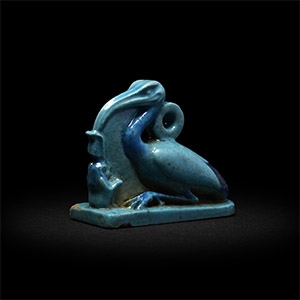
Egyptian Thoth as an Ibis with Maat
Sold for (Inc. bp): £6,500
A blue-glazed composition amulet in the form of an ibis (representing the god Thoth) seated on a wedge-shaped base, facing a figure of Maat appearing as a diminutive stooping female with an ostrich feather; some details to both figures rendered in a darker blue glaze; suspension loop to the rear of the bird's neck. -
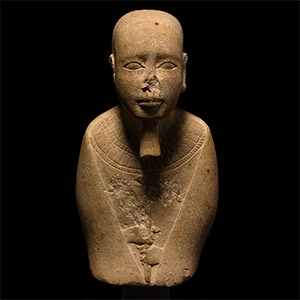
Egyptian Bust of Ptah
Sold for (Inc. bp): £13,000
A white limestone figure of the god Ptah with false beard, wearing an enveloping cloak and a broad wesekh-collar, holding the shaft of a was sceptre; serene, oval face with almond-shaped eyes and fleshy lips; remnants of dorsal pillar to reverse; mounted on a custom-made display stand. -
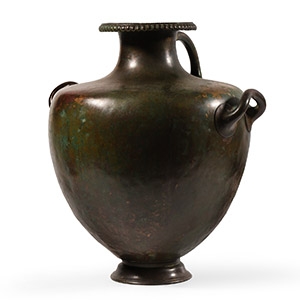
Large Greek Hydria with Egg-and-Dart Motifs
Sold for (Inc. bp): £9,525
A spectacular bronze hydria composed of a tapering body, broad shoulder and waisted neck, the everted rim decorated with egg-and-dart motifs, three round-section handles and tiered, ogival foot; professionally restored. -
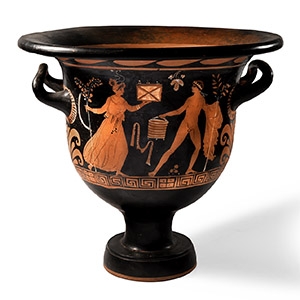
Large Greek Apulian Red-Figure Bell-Krater
Sold for (Inc. bp): £28,600
A red-figure terracotta bell-krater displaying polychrome figural panels between a laurel wreath and a band of Greek key motifs; side a) two robed male figures holding staffs, wearing a taenia or a band around the head, standing facing a central altar; side b) a woman wearing a chiton and holding a casket and olive sprig in her outstretched hands, advancing right towards a nude man standing right, his head turned towards her, holding a bucket and olive sprig, a cloak draped over his arm, elaborate volute palmettes beneath both handles; restored. -
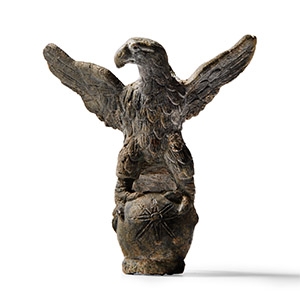
Roman Military Eagle Staff Terminal
Sold for (Inc. bp): £11,050
A free-standing bronze imperial or military eagle terminal from a staff or a sceptre, modelled in the round in a dynamic pose standing on a globe, wings spread, head turned to the right, semi-naturalistic anatomical and feather detailing; the globe bearing an incised eight-armed stylised Macedonian star; sub-triangular lug to back of the neck; collar to globe with hollow underside. -
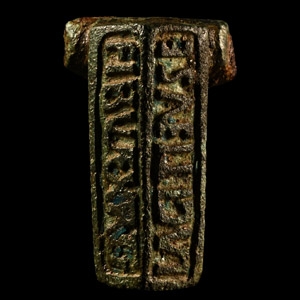
'The Castleford Military Garrison' Romano-British 'Regio Lagitiensis' Inscribed Brooch
Sold for (Inc. bp): £4,940
The best example of only three examples of this type known, a copper-alloy knee brooch composed of a rectangular-section body, spring pin within bow plate and remains of catchplate to reverse; both sides of the body with two panels of Latin lettering moulded in relief: 'FIBUL[A] EX REG LAGITIENSE', translating to 'Brooch from the Regio Lagitiensis' (Roman Castleford); remains of blue glass enamelling to the recessed fields. -
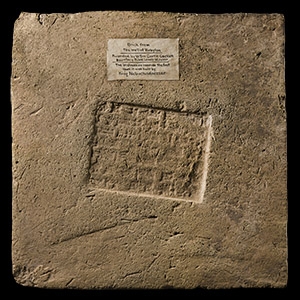
Large 'King Nebuchadnezzar the Great' Brick from the Wall of Babylon
Sold for (Inc. bp): £5,980
A large fired clay brick from the Wall of Babylon bearing six lines of stamped Babylonian cuneiform inscription to one face which reads: 'AG - ku -dur-ri-URU' / 'LUGAL ba-bi-lu' / 'za-ni-nu é-sag-ila' / 'u e-zi-da IBILA' / 'SAG.KAL. sa AG-IBILA-URU' / 'LUGAL ba-bi-lu ana-ku', which translates: 'Nebuchadnezzar, king of Babylon, who provides for Esagila and Ezida, the eldest son of Nabopolassar, king of Babylon, am I'; traces of bitumen on the blank side; accompanied by an old label which reads: 'Brick from the Wall of Babylon / Presented by W.Bro. Gentle-Cackett Secretary Bible Lands Mission / The impression records the fact that it was built by King Nebuchadnezzar [II]'. -
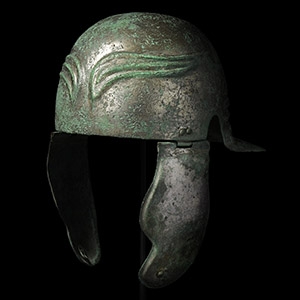
Roman Legionary Helmet with Wings of Jupiter
Sold for (Inc. bp): £52,000
A tinned sheet-bronze legionary helmet of Imperial Gallic Type A with deep rounded bowl, simple C-shaped cut-outs for the ears, integral flared neck-guard extending some way along the sides, corrugated ribs to the occipital area at the rear and corrugated 'wings' or eyebrows (Russel-Robinson's Type E) above the brow; small stud the rear of the neck-guard attaching suspension loops to the underside; hinged bracket at each temple for a deeply curved cheek-guard with gently flared rim, bearing a loop to the inner face to accept an vinculum fastening strap; accompanied by a custom-made display stand. -
.jpg)
Anglo-Saxon Gilt Chip-Carved Mount with Interlaced Panels
Sold for (Inc. bp): £6,240
A gilt copper-alloy mount composed of a broad annular body with slightly domed profile, the body quartered with each cell displaying a chip-carved interlace motif configured A:B:A:B; rim, edges and central cell with raised rim; rivet and flat-section mounting bar to reverse. -
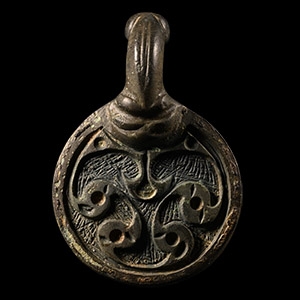
'The Pershore' Anglo-Saxon Hanging Bowl Mount with Horse-Head
Sold for (Inc. bp): £7,150
A bronze bowl mount or escutcheon comprising a discoid panel with gently curved profile and zoomorphic hook; the panel with reserved La Tène comma-leaf decoration on a pounced field (intended to receive enamel fill); the hook with median gusset to the outer face, horse-head finial, bulbous La Tène ornament at the base. -
.jpg)
'The Siddington' Impressive Anglo-Saxon Chip-Carved Saucer Brooch Pair
Sold for (Inc. bp): £24,700
A pair of large Early Anglo-Saxon gilt copper-alloy saucer brooches each comprising a broad (13mm+) angled flange surrounding a central disc with carinated border; outer zone comprising four arches subdivided by hatching to the inner edge and four C-shaped panels with triangular separators, inner zone separated by a carinated border, central disc with four radiating bilinear crescents; pin-lugs and catch to the reverse with traces of mineralised fabric. -
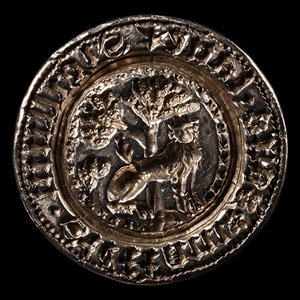
English Medieval Silver Chessman Type Seal Matrix for Stephen of Ale Lane
Sold for (Inc. bp): £3,510
A silver chessman-type seal matrix with pierced trefoil head and knop above; central motif of a leopard statant gardant before a tree, pelletted border and blackletter legend '* sigillum [lozenge] steffani [cinquefoil cinquefoil] ale [cinquefoil lozenge] lane' (for 'seal of Stephen [at?] ale lane'). -
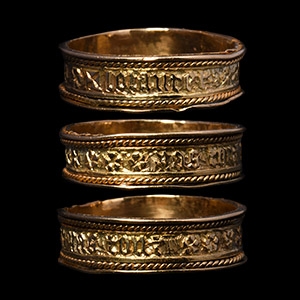
'The Bettiscombe' Medieval Gold 'Loyalty is Everything' Posy Ring
Sold for (Inc. bp): £4,160
An annular gold band with everted upper and lower lip, filigree ropework above and below each rim, with circumferential inscription to the recessed exterior face; of the five separate bands, the central one accommodating an applied strip of paler gold bearing a Medieval French blackletter inscription in relief, reading: '+loiautet (5 five cinquefoils) pas tout (5 five cinquefoils)', or 'Loyalty Passes All'; the inscription band may once have been enamelled; plain interior; the outer rim and twisted band on one edge are slightly bent; cleaned and repaired. -
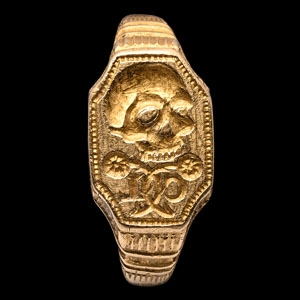
Stuart Period Gold Renaissance Memento Mori Signet Ring with C.L. and Skull
Sold for (Inc. bp): £19,500
A substantial gold signet ring composed of a lentoid-section hoop, expanding capital style shaped shoulders and irregular octagonal bezel engraved with a skull, two flowers below separating the reversed initials in capitals: 'CL', framed by a beaded border. -
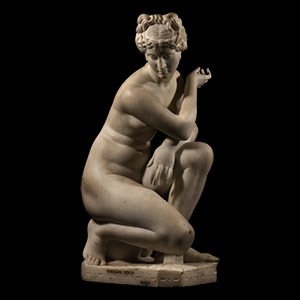
Marble Statue of Kneeling Venus
Sold for (Inc. bp): £14,950
A marble copy of the kneeling Venus (original in the Vatican Museums), crouching on an octagonal base; the arms raised in expressive pose, head tilted, hair drawn up in a chignon; lettering to base 'KNEELING VENUS' and 'ROME'.
-
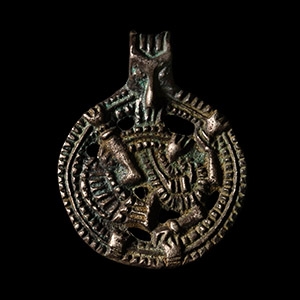
Viking Age Silver Gripping Beast Pendant
Late 10th-early 11th century A.D.Sold for (Inc. bp): £910
A silver Scandinavian pendant of Riddarholmen type with integral loop; the openwork plaque with banded border and four panels, internal stylised zoomorph with hatched panel to the hip, gripping three-fingered hands to the body and border, two detailed feet, clearly visible facing mask below the loop with pellet eyes. 5.48 grams, 32 mm
Private collection formed in Europe in the 1980s. Westminster collection, central London, UK.
Riddarholmen type pendants were also widespread in the historical Rus region centred on Kiev. -
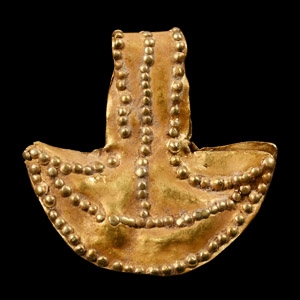
Viking Age Gold Hammer Amulet
9th-12th century A.D.Sold for (Inc. bp): £715
A sheet-gold hammer amulet formed by doubling a single gold sheet; bifacial pellet ornament tracing the perimeter of the hammer and a central motif mimicking the broad plan of the weapon; suspension loop formed within the fold at the neck. 1.57 grams, 20 mm
Acquired 1980-2015. Ex Abelita family collection.
The techniques used to manufacture this pendant (working sheet gold and granulation) had been in the repertoire of the Scandinavian goldsmith since the Iron Age and formed part of the manufacturing process for bracteate pendants and other jewellery items (Reynolds Brown, K. et al., From Attila to Charlemagne. Arts of the Early Medieval Period in the Metropolitan Museum of Art, New York, 2000, p.15-16, 310-1). -
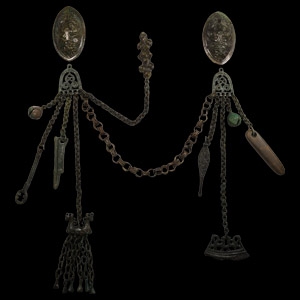
Viking Period Tortoise Brooch and Chain Set
Circa 9th-10th century A.D.Sold for (Inc. bp): £2,210
A bronze female garniture comprising: two tortoise brooches each with pin-bar and catch to the reverse, one with remains of fabric; two D-shaped openwork chatelaines with scroll detailing and loops to the lower edge; chains of varying length supporting utensils including a small hone or whetstone, a crotal bell, a firesteel formed as a steel arc in a bronze frame with horse-head finials, a cosmetic scoop, an equal-arm brooch, a second chatelain with chains and bell-shaped pendants, a model knife-sheath, a latch-lifter with pierced-disc finial, another crotal bell; the two groups linked by a longer chain of larger links. 571 grams total, 8.2-33.5 cm
Acquired 1971-1972. From the collection of the vendor's father. Property of a London, UK, collector. This lot has been checked against the Interpol Database of stolen works of art and is accompanied by search certificate no.11648-198857. -
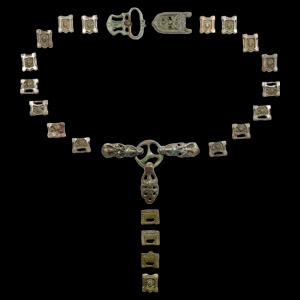
Viking Period Sword Belt Mount Set
Circa 9th-11th century A.D.Sold for (Inc. bp): £572
A suite of bronze and iron fittings for a display belt including a buckle with openwork plate, tongue-shaped end, rectangular repoussé mounts, some with slots to the lower edge to accept a strap to mount a purse, knife or other item, strap-distributor with circular central element and three attachment mounts. 130 grams total, 17-97 mm
Acquired 1971-1972. From the collection of the vendor's father. Property of a London, UK, collector. -
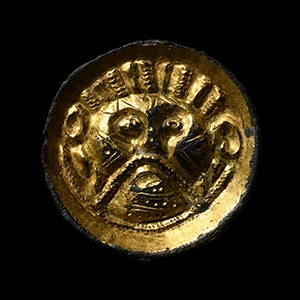
Anglo-Saxon Chip-Carved Saucer Brooch with Face of Woden
5th-8th century A.D.Sold for (Inc. bp): £2,210
A superb chip-carved saucer or button brooch with extensive remains of gilding, displaying a stylised male face with puffy cheeks, large ears, long moustache, raised pellet eyes of different sizes, hair dressed in vertical ribs alternating plain and textured, some chevron and pellet patterning to the face; stub remains of catch fitting to reverse. 5.2 grams, 23 mm
Fine condition, slight scuffing to rim and one cheek.
Found UK. Acquired in the 1990s. From a North Yorkshire private collection, UK.
The brooch does not fall neatly into Avent & Evison's typology, being somewhat larger than the standard forms of button brooch and with an unusually detailed face. Broadly, it resembles Class J with alternating plain and textured vertical strands in the hair but does not have the horizontal band across the brow nor the stylised beard associated with the type. The eccentric placement of the eyes suggests that the image may be the face of the god Woden (Odin) who famously sacrificed one eye in exchange for wisdom. -
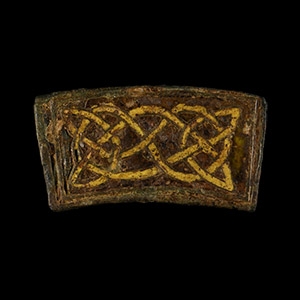
Anglo-Saxon Red and Yellow Enamelled Interlace Mount
7th-8th century A.D.Sold for (Inc. bp): £845
A rectangular copper-alloy mount with a slightly curved profile, the upper face with a yellow-enamelled interlaced knot against a red-brown enamelled field; Hiberno-Saxon workmanship. 6.65 grams, 29 mm
Fine condition, complete.
Found UK. Acquired in the 1990s. From a North Yorkshire private collection, UK.
It is likely that this is a mount from a house-shrine or similar piece of ecclesiastical equipment with studs to the underside and a hole at each end to accept a rivet. -
Anglo-Saxon Gilt Chip-Carved Mount with Interlaced Panels
Circa 7th-8th century A.D.Sold for (Inc. bp): £6,240
A gilt copper-alloy mount composed of a broad annular body with slightly domed profile, the body quartered with each cell displaying a chip-carved interlace motif configured A:B:A:B; rim, edges and central cell with raised rim; rivet and flat-section mounting bar to reverse. 9.98 grams, 28 mm
Fine condition, usage wear to raised surfaces.
Found UK. Acquired in the 1990s. From a North Yorkshire private collection, UK.
The item was originally conceived as an appliqué with central cell probably containing a cabochon garnet or meerschaum disc. At some point later a bar was added across the reverse with the ends of the rivets interrupting the surface design. -
'The Pershore' Anglo-Saxon Hanging Bowl Mount with Horse-Head
6th-7th century A.D.Sold for (Inc. bp): £7,150
A bronze bowl mount or escutcheon comprising a discoid panel with gently curved profile and zoomorphic hook; the panel with reserved La Tène comma-leaf decoration on a pounced field (intended to receive enamel fill); the hook with median gusset to the outer face, horse-head finial, bulbous La Tène ornament at the base. 23.7 grams, 48 mm
Found whilst searching with a metal detector in Pershore, Worcestershire, West Midlands, UK. Accompanied by a copy of the British Museum's Portable Antiquities Scheme Report no.WAW-BC2657. -
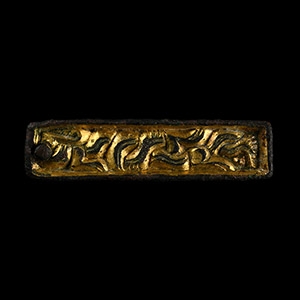
Anglo-Saxon Gilt Chip-Carved Beast Mount
Circa 6th century A.D.Sold for (Inc. bp): £520
A gilt copper-alloy rectangular Style 1 mount displaying a sinuous chip-carved couchant beast in high-relief with good remains of gilding, thick external rim; one remaining rivet and one mounting lug to reverse. 6.72 grams, 45 mm
Found UK. Acquired in the 1990s. From a North Yorkshire private collection, UK. -
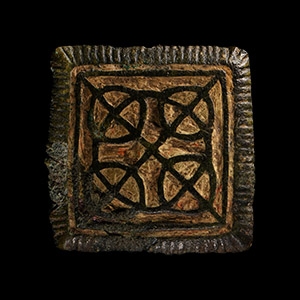
Anglo-Saxon Red Enamelled Mount with Interlace
Circa 8th century A.D.Sold for (Inc. bp): £598
A bronze lozenge-shaped mount with slightly convex profile displaying a quartered geometric motif of crosses composed of knotwork circles, all within a square frame and with a notched outer border; surviving traces of red enamelling within the cells; pierced rectangular mounting lug to reverse. 7.23 grams, 27 mm
Found UK. Acquired in the 1990s. From a North Yorkshire private collection, UK.
The pierced attachment lug is typical of plates attached to horse-harness and similar leather items. -
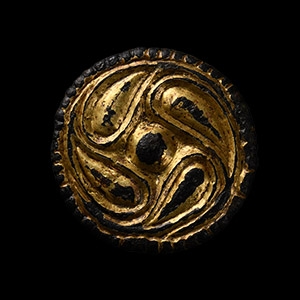
Anglo-Saxon Gilt Chip-Carved Bird's Wing-Whorl Mount
Circa 6th century A.D.Sold for (Inc. bp): £390
A gilt copper-alloy circular mount decorated with a chip-carved whorl composed of four stylised bird's wings radiating from a central knop; four mounting lugs to the reverse. 6.28 grams, 26 mm
Found UK. Acquired in the 1990s. From a North Yorkshire private collection, UK. -
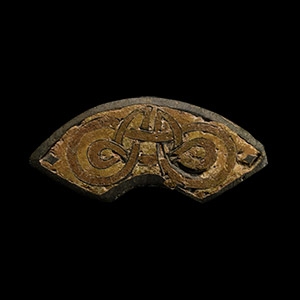
Anglo-Saxon Enamelled Interlace Pelta-Shaped Mount
7th-8th century A.D.Sold for (Inc. bp): £286
A pelta-shaped copper-alloy mount with substantial remains of enamelled decorative designs composed of a russet-coloured interlace motif against a light-coloured field, a lozenge to each external angle; Hiberno-Saxon workmanship. 25.2 grams, 71 mm
Found UK. Acquired in the 1990s. From a North Yorkshire private collection, UK.
The shape of the piece indicates that it is a quadrant from a divided circular pattern, similar to the kinds of enamelled inset and applied panels which appear on Irish house-shrines.
