
Auction Highlights
-
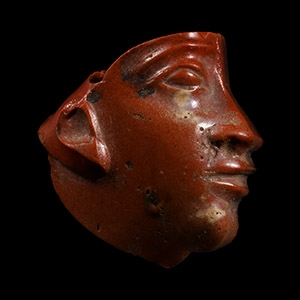
Egyptian Red Glass Face Inlay
Sold for (Inc. bp): £3,640
A red glass insert of a profile face with remains of a pharaonic crown to the forehead. -
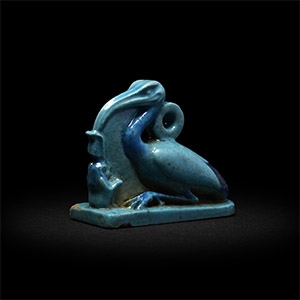
Egyptian Thoth as an Ibis with Maat
Sold for (Inc. bp): £6,500
A blue-glazed composition amulet in the form of an ibis (representing the god Thoth) seated on a wedge-shaped base, facing a figure of Maat appearing as a diminutive stooping female with an ostrich feather; some details to both figures rendered in a darker blue glaze; suspension loop to the rear of the bird's neck. -
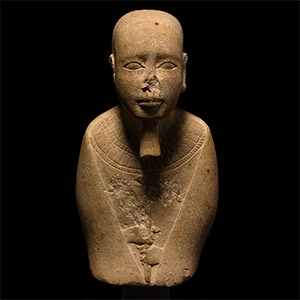
Egyptian Bust of Ptah
Sold for (Inc. bp): £13,000
A white limestone figure of the god Ptah with false beard, wearing an enveloping cloak and a broad wesekh-collar, holding the shaft of a was sceptre; serene, oval face with almond-shaped eyes and fleshy lips; remnants of dorsal pillar to reverse; mounted on a custom-made display stand. -
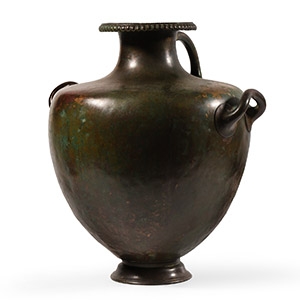
Large Greek Hydria with Egg-and-Dart Motifs
Sold for (Inc. bp): £9,525
A spectacular bronze hydria composed of a tapering body, broad shoulder and waisted neck, the everted rim decorated with egg-and-dart motifs, three round-section handles and tiered, ogival foot; professionally restored. -
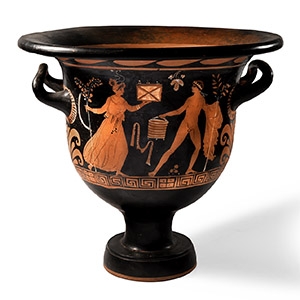
Large Greek Apulian Red-Figure Bell-Krater
Sold for (Inc. bp): £28,600
A red-figure terracotta bell-krater displaying polychrome figural panels between a laurel wreath and a band of Greek key motifs; side a) two robed male figures holding staffs, wearing a taenia or a band around the head, standing facing a central altar; side b) a woman wearing a chiton and holding a casket and olive sprig in her outstretched hands, advancing right towards a nude man standing right, his head turned towards her, holding a bucket and olive sprig, a cloak draped over his arm, elaborate volute palmettes beneath both handles; restored. -
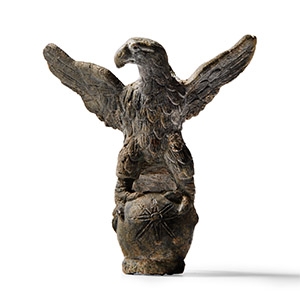
Roman Military Eagle Staff Terminal
Sold for (Inc. bp): £11,050
A free-standing bronze imperial or military eagle terminal from a staff or a sceptre, modelled in the round in a dynamic pose standing on a globe, wings spread, head turned to the right, semi-naturalistic anatomical and feather detailing; the globe bearing an incised eight-armed stylised Macedonian star; sub-triangular lug to back of the neck; collar to globe with hollow underside. -
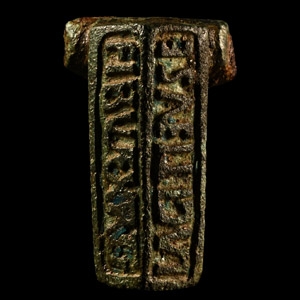
'The Castleford Military Garrison' Romano-British 'Regio Lagitiensis' Inscribed Brooch
Sold for (Inc. bp): £4,940
The best example of only three examples of this type known, a copper-alloy knee brooch composed of a rectangular-section body, spring pin within bow plate and remains of catchplate to reverse; both sides of the body with two panels of Latin lettering moulded in relief: 'FIBUL[A] EX REG LAGITIENSE', translating to 'Brooch from the Regio Lagitiensis' (Roman Castleford); remains of blue glass enamelling to the recessed fields. -
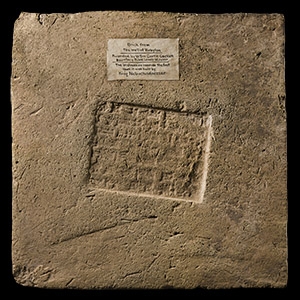
Large 'King Nebuchadnezzar the Great' Brick from the Wall of Babylon
Sold for (Inc. bp): £5,980
A large fired clay brick from the Wall of Babylon bearing six lines of stamped Babylonian cuneiform inscription to one face which reads: 'AG - ku -dur-ri-URU' / 'LUGAL ba-bi-lu' / 'za-ni-nu é-sag-ila' / 'u e-zi-da IBILA' / 'SAG.KAL. sa AG-IBILA-URU' / 'LUGAL ba-bi-lu ana-ku', which translates: 'Nebuchadnezzar, king of Babylon, who provides for Esagila and Ezida, the eldest son of Nabopolassar, king of Babylon, am I'; traces of bitumen on the blank side; accompanied by an old label which reads: 'Brick from the Wall of Babylon / Presented by W.Bro. Gentle-Cackett Secretary Bible Lands Mission / The impression records the fact that it was built by King Nebuchadnezzar [II]'. -
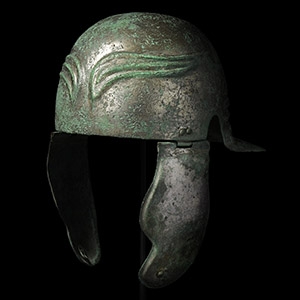
Roman Legionary Helmet with Wings of Jupiter
Sold for (Inc. bp): £52,000
A tinned sheet-bronze legionary helmet of Imperial Gallic Type A with deep rounded bowl, simple C-shaped cut-outs for the ears, integral flared neck-guard extending some way along the sides, corrugated ribs to the occipital area at the rear and corrugated 'wings' or eyebrows (Russel-Robinson's Type E) above the brow; small stud the rear of the neck-guard attaching suspension loops to the underside; hinged bracket at each temple for a deeply curved cheek-guard with gently flared rim, bearing a loop to the inner face to accept an vinculum fastening strap; accompanied by a custom-made display stand. -
.jpg)
Anglo-Saxon Gilt Chip-Carved Mount with Interlaced Panels
Sold for (Inc. bp): £6,240
A gilt copper-alloy mount composed of a broad annular body with slightly domed profile, the body quartered with each cell displaying a chip-carved interlace motif configured A:B:A:B; rim, edges and central cell with raised rim; rivet and flat-section mounting bar to reverse. -
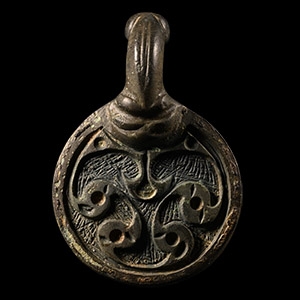
'The Pershore' Anglo-Saxon Hanging Bowl Mount with Horse-Head
Sold for (Inc. bp): £7,150
A bronze bowl mount or escutcheon comprising a discoid panel with gently curved profile and zoomorphic hook; the panel with reserved La Tène comma-leaf decoration on a pounced field (intended to receive enamel fill); the hook with median gusset to the outer face, horse-head finial, bulbous La Tène ornament at the base. -
.jpg)
'The Siddington' Impressive Anglo-Saxon Chip-Carved Saucer Brooch Pair
Sold for (Inc. bp): £24,700
A pair of large Early Anglo-Saxon gilt copper-alloy saucer brooches each comprising a broad (13mm+) angled flange surrounding a central disc with carinated border; outer zone comprising four arches subdivided by hatching to the inner edge and four C-shaped panels with triangular separators, inner zone separated by a carinated border, central disc with four radiating bilinear crescents; pin-lugs and catch to the reverse with traces of mineralised fabric. -
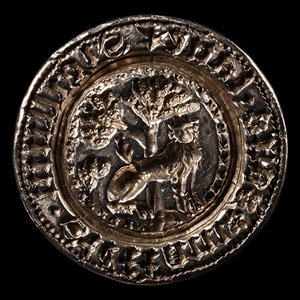
English Medieval Silver Chessman Type Seal Matrix for Stephen of Ale Lane
Sold for (Inc. bp): £3,510
A silver chessman-type seal matrix with pierced trefoil head and knop above; central motif of a leopard statant gardant before a tree, pelletted border and blackletter legend '* sigillum [lozenge] steffani [cinquefoil cinquefoil] ale [cinquefoil lozenge] lane' (for 'seal of Stephen [at?] ale lane'). -
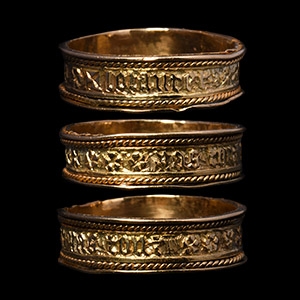
'The Bettiscombe' Medieval Gold 'Loyalty is Everything' Posy Ring
Sold for (Inc. bp): £4,160
An annular gold band with everted upper and lower lip, filigree ropework above and below each rim, with circumferential inscription to the recessed exterior face; of the five separate bands, the central one accommodating an applied strip of paler gold bearing a Medieval French blackletter inscription in relief, reading: '+loiautet (5 five cinquefoils) pas tout (5 five cinquefoils)', or 'Loyalty Passes All'; the inscription band may once have been enamelled; plain interior; the outer rim and twisted band on one edge are slightly bent; cleaned and repaired. -
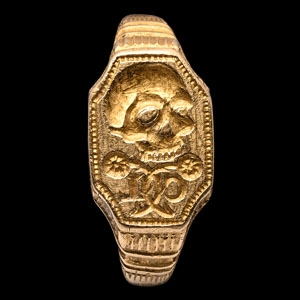
Stuart Period Gold Renaissance Memento Mori Signet Ring with C.L. and Skull
Sold for (Inc. bp): £19,500
A substantial gold signet ring composed of a lentoid-section hoop, expanding capital style shaped shoulders and irregular octagonal bezel engraved with a skull, two flowers below separating the reversed initials in capitals: 'CL', framed by a beaded border. -
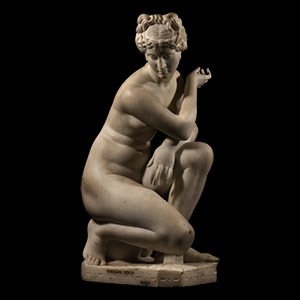
Marble Statue of Kneeling Venus
Sold for (Inc. bp): £14,950
A marble copy of the kneeling Venus (original in the Vatican Museums), crouching on an octagonal base; the arms raised in expressive pose, head tilted, hair drawn up in a chignon; lettering to base 'KNEELING VENUS' and 'ROME'.
-
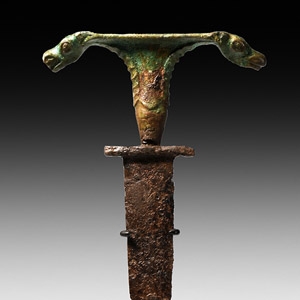
Heniochi Dagger with Beast Heads
4th-2nd century B.C.Sold for (Inc. bp): £520
A short iron dagger with triangular blade, short straight guard surmounted by a bronze pommel characterised by twinned beast heads projecting from each side; accompanied by a custom-made display stand. 170 grams, 28 cm (753 grams total, 39 cm high including stand)
Acquired 1971-1972. From the collection of the vendor's father. Property of a London, UK, collector.
The tribe of the Heniochs, according to Artemidorus of Ephesus, existed during the 5th-1st century B.C., on the Black Sea littoral that is part of present-day Abkhazia. Aristotle describes the Heniochi as a group of people "ready enough to kill and eat men." The dagger shows similarities with the pommel of a sword from Akhul Abaa grave 4 with twinned beast heads. These weapons of subtype I, according to the classification of Gamkrelidze-Shatberashvili-Pirtskhalava-Charkviani, were popular not only in Abkhazia, but throughout the territory of west Georgia during the 4th-1st century B.C. -
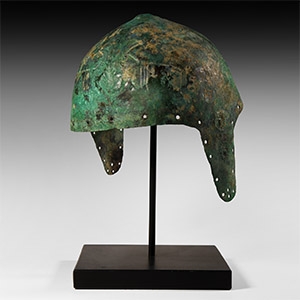
Levantine Helmet with Opposing Ibexes
8th century B.C.Sold for (Inc. bp): £5,200
A Levantine or Assyrian domed bronze helmet of ovoid shape with slightly pointed top and integral cheek-pieces; chased low-relief decoration to both front and back depicting insignia of a pair of opposing ibexes flanking a small palm tree; the edge with regularly disposed holes for fastening of the leather lining; accompanied by a custom-made display stand. 458 grams, 23 cm high (2.36 kg total, 31.5 cm high including stand)
Fine condition, some restoration.
Acquired 1960s-1990s. Late Alison Barker collection, a retired London barrister. Accompanied by an academic report by Dr Raffaele D'Amato. This lot has been checked against the Interpol Database of stolen works of art and is accompanied by search certificate no.11386-190447.
This rare helmet is an unusual example of a conical strap-helmet, linked with similar Greek strap helmets, but until now in the Near East, known only from the Assyrian reliefs. It is shown together with the crested helmets, on the reliefs of Tiglapilaser III and Sennacherib. -
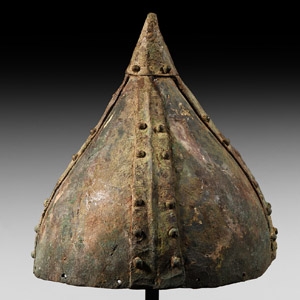
Sassanian Spangenhelm with Rivets
6th-7th century A.D.Sold for (Inc. bp): £4,160
A copper-alloy multi-segmented spangenhelm with an ogival profile, rivetted conical finial and riveted straps running vertically around the circumference, some restoration. 1.14 kg, 23 cm high
UK private collection before 2000. UK art market. Property of a London gentleman. Accompanied by an academic report by Dr Raffaele D'Amato. This lot has been checked against the Interpol Database of stolen works of art and is accompanied by searcher certificate no.11589-199700.
The Spangenhelm is a protective headgear made up from segments or plates held together by a frame. As a popular form of helmet it came to prominence in western Europe in the later Roman Empire, and remained in use for some centuries until replaced by helmets formed from a single sheet. -
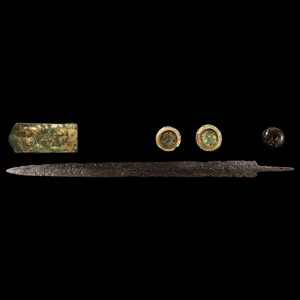
Migration Period Spatha Sword Blade with Fittings
Circa 4th-5th century A.D.Sold for (Inc. bp): £1,950
A military assemblage comprising: a double-edged spatha with a lentoid parallel-sided iron blade and pointed tip, battle nicks to both cutting edges; long tang with a bronze fastening rivet in situ; oblate chalcedony pommel; gilt copper-alloy chape scabbard fitting with fastening holes and a pair of round scabbard or baldric fittings. 937 grams total, 5-81.3 cm
Fine condition
Acquired 1971-1972. From the collection of the vendor's father. Property of a London, UK, collector. Accompanied by an academic report by Dr Raffaele D’Amato. This lot has been checked against the Interpol Database of stolen works of art and is accompanied by a search certificate number no.11587-198852.
Prestigious swords with richly trimmed sheaths, guards and hilts of the Great Migration Period on the Cimmerian Bosphorus are very few, although some specimens have been excavated from Kerch, Phanagoria, Hermonassa and Dzhurga-Oba. They were either custom-made or received as war booty. This sword belongs to a group of spathae of late Roman typology spread among the Germanic and Nomad foederati, and garrison troops of the Northern Black Sea and Bosphorus. -
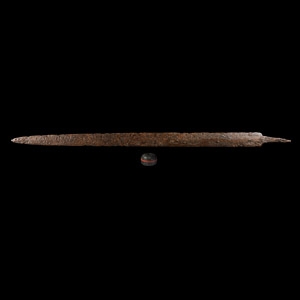
Migration Period Sword Blade with Agate Pommel
Circa 5th-6th century A.D.Sold for (Inc. bp): £975
A two-edged parallel-sided iron blade with broad pointed tip, battle nicks to both cutting edges; accompanied by a discoid agate pommel. 823 grams total, 3.5-83 cm
cleaned and conserved
Acquired 1971-1972. From the collection of the vendor's father. Property of a London, UK, collector. Accompanied by an academic report by Dr Raffaele D’Amato. -
.jpg)
Roman Julius Caesar Sling Shot from the Battle of Munda
45 B.C.Sold for (Inc. bp): £572
A biconical facetted lentoid-section lead sling shot (glans), inscription monogram a combination of letters 'C', 'A' and 'E', for 'C A E S' referring to Julius Caesar. 63.29 grams, 36 mm
Fine condition.
Found near to an important village site, close to Seville, 1960-1970. From an old Spanish collection. Swiss private collection. Accompanied by a copy of the Spanish export licence. Accompanied by an academic paper by military specialist Dr Raffaele D'Amato, dated 4th May 2022 and titled 'Roman Res Publica - Lead Slingshots (glandes) of Caesarian Age - 45 B.C circa'.
The shot (type IIb of the Völling classification) is marked with the abbreviated name of Julius Caesar; it was used in quantity at the Battle of Monda (or Munda) against the last fellows of Pompey, the leaders of the Optimates, on the 17th March 45 BC. Similar shots were used in the Caesar's wars. The slingers of Caesar's age were part of the light infantry. Caesar speaks of his Balearic slingers during the conquest of Gaul. They wore a short tunic, with leather or rope sandals to the feet, and a warm overcoat which could also have been used to store projectiles. They also used a satchel to carry very deadly lead-like stones or bullets. -
.jpg)
Roman Julius Caesar Sling Shot from the Battle of Munda
45 B.C.Sold for (Inc. bp): £715
A biconical facetted lentoid-section lead sling shot (glans), the inscription monogram a combination of letters 'C', 'A' and 'E', for 'C A E S' referring to Julius Caesar. 62.67 grams, 37 mm
Fine condition.
Found near to an important village site, close to Seville, 1960-1970. From an old Spanish collection. Swiss private collection. Accompanied by a copy of the Spanish export licence. Accompanied by an academic paper by military specialist Dr Raffaele D'Amato, dated 4th May 2022 and titled 'Roman Res Publica - Lead Slingshots (glandes) of Caesarian Age - 45 B.C circa'.
The shot (type IIb of the Völling classification) is marked with the abbreviated name of Julius Caesar; it was used in quantity at the Battle of Monda (or Munda) against the last fellows of Pompey, the leaders of the Optimates, on the 17th March 45 BC. Similar shots were used in the civil war among Pompey and Caesar, and in all of Caesar's wars. The funditores of Caesar's age were part of the light infantry. Caesar speaks of his Balearic slingers during the conquest of Gaul. They wore a short tunic, with leather or rope sandals to the feet, and a warm overcoat which could also have been used to store projectiles. They also used a satchel to carry very deadly lead-like stones or bullets. -
Roman Legionary Helmet with Wings of Jupiter
Late 1st century B.C.-early 1st century A.D.Sold for (Inc. bp): £52,000
A tinned sheet-bronze legionary helmet of Imperial Gallic Type A with deep rounded bowl, simple C-shaped cut-outs for the ears, integral flared neck-guard extending some way along the sides, corrugated ribs to the occipital area at the rear and corrugated 'wings' or eyebrows (Russel-Robinson's Type E) above the brow; small stud the rear of the neck-guard attaching suspension loops to the underside; hinged bracket at each temple for a deeply curved cheek-guard with gently flared rim, bearing a loop to the inner face to accept an vinculum fastening strap; accompanied by a custom-made display stand. 2.38 kg total, 29 cm high (41 cm including stand)
typologically important helmet of the utmost rarity, excellent state of preservation.
From a West Coast, USA, arms and armour family collection; thence by descent. Accompanied by an academic report by Dr Raffaele D'Amato. This lot has been checked against the Interpol Database of stolen works of art and is accompanied by search certificate number no.11585-199847.
This important and well-preserved helmet (Cassis) belongs to a small and rare group of helmets of the Weisenau type (modern term). The development of this helmet formed the main category of legionary helmets in 1st and 2nd centuries A.D. This early category was characterised by a very high hemispherical calotte and a slightly sloping, narrow neck guard. They were fitted with a pair of prominent curved eyebrows (symbolising the wings of Jupiter’s thunderbolts) flanking two rivetted bosses. -
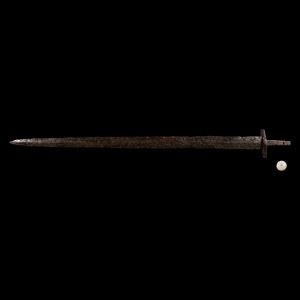
Migration Period Spatha Sword Blade with Sword Bead
Circa 4th-5th century A.D.Sold for (Inc. bp): £572
A double-edged spatha with a lentoid section parallel-sided iron blade with pointed tip; battle nicks to both cutting edges; rhomboid-section cross-guard; a fastening nail on the upper tang; accompanied by a sword bead. 921 grams total, 2.7- 86.5 cm
cleaned and conserved.
Acquired 1971-1972. From the collection of the vendor's father. Property of a London, UK, collector. Accompanied by an academic report by Dr Raffaele D’Amato.
A Migration Period sword, originating from Central Asia, often used by nomadic populations and particularly by the Huns, defined as a Nomadic-Asiatic sword by Menghin, or as a sword with plate guard. The long and thin blade, with a lenticular or lozenge section, was equipped with a guard composed of an iron plate inserted into the tang. Little is known about the scabbard of these swords but it is known that they usually had disc-shaped pommels, and stones hanging from the pommel or hilt. This typology was widespread in Central Europe by the Huns and there are also specimens attested in Gaul in the 5th century. -
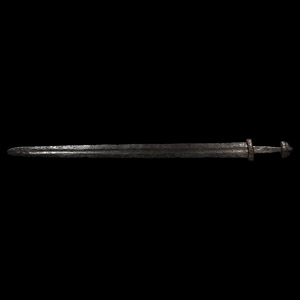
Viking Age Sword with Three-Lobed Pommel
Early 11th century A.D.Sold for (Inc. bp): £4,940
A double-edged cutting sword of Oakeshott Type XII with inlaid hilt and tapering blade with shallow fullers; the lower guard gently curving and decorated with copper inlaid dots, upper guard and three-lobed pommel with similar decoration, traces of silver inlay to the hilt. 720 grams, 90 cm long
Acquired 1971-1972. From the collection of the vendor's father. Property of a London, UK, collector. Accompanied by an academic report by Dr Raffaele D’Amato. This lot has been checked against the Interpol Database of stolen works of art and is accompanied by searcher certificate no.11575-198856.
The sword belongs to the Type XII of the Oakeshott classification (Oakeshott, 1998, pp.37ff.), the characteristics of which are a broad, flat, evenly tapering blade, generally with a good sharp point and tending to widen perceptibly below the hilt. After the publication of the Finnish specimen, Peirce, due to the inlaid inscriptions of this latter, noted a close parallel, both in style and content, with a sword in the Schweizerischen Landesmuseum in Zurich. In the expanded context including the example from Finland, Peirce was able to re-date them to the 11th century. -
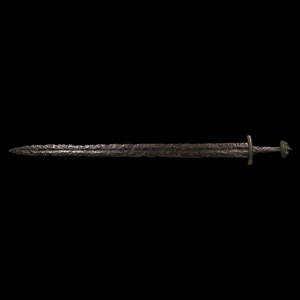
Viking Age Sword with Five-Lobed Pommel
10th century A.D.Sold for (Inc. bp): £12,350
A double-edged sword of Petersen Type L or S variant with straight tapering blade, light traces of pattern-welding and battle-nicks along the blade, tapering fullers and a sturdy long tang; boat-shaped lower guard curving gently towards the blade, decorated with punched ring-and-dot ornament along the edges; the upper guard with Trewhiddle Style ornament, surmounted by an elegant five-lobed pommel decorated with geometric patterns in the same style; cleaned and conserved. 755 grams, 89 cm
Acquired 1971-1972. From the collection of the vendor's father. Property of a London, UK, collector. Accompanied by an academic report by Dr Raffaele D’Amato. This lot has been checked against the Interpol Database of stolen works of art and is accompanied by searcher certificate no.11574-198855. -
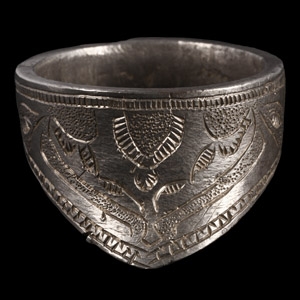
Large Byzantine Silver Archer's Ring
14th-15th century A.D.Sold for (Inc. bp): £715
A substantial silver archer's ring comprising a hoop with reserved triangular ornament on the edges and triangular plaque with foliage motifs, raised central panel with frond motif. 22.61 grams, 34.77 mm overall, 25.16 mm internal diameter
Acquire in the 1990s. Ex Cambridgeshire, UK, collection.
Archer rings in Late Byzantium and the medieval Balkans were connected with the employment of the powerful composite bow, but very often, in 14th century, they were rank symbol for aristocratic noblemen. Archaeological findings of archers’ rings originate mainly from fortified towns, including mining centres. Many were made in bone, simple in design and undecorated. In contrast, the ones made in bronze and silver were usually decorated in rather uniform style, consisting of floral motifs on the head, mostly tulip and foliage, and linear motifs around the edges. This decoration combined Turkish, Central European and Eastern Roman traditional patterns.
