
Passed Lots
Click on the link above
Auction Highlights
-
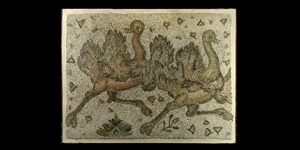
Large Roman Mosaic Panel with Pair of Ostriches
Sold for (Inc. bp): £13,750
A large mosaic frieze depicting a pair of courting ostriches with the male chasing the female to the right, on a background of wind-blown leaves; both the birds with ruffled feathers, the one to the left peering behind; composed of small tesserae in mainly earth colours with matrix border. -
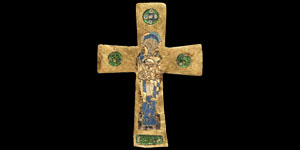
Byzantine Enamelled Gold Cross
Sold for (Inc. bp): £5,500
A sheet gold cross with applied enamelled panels, possibly from an altar or icon(?); discoid panels with rosette (above) and 'MP ΘY' (Mary Thetokos) and rectangular panel at the foot with 'ΙΣΛΙΜΣ' (?); image of Mary standing with infant Jesus, both nimbate. -
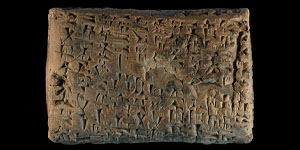
Western Asiatic Old Babylonian Cuneiform Adoption Tablet for a Baby Girl by Priestess Beltani
Sold for (Inc. bp): £6,250
A ceramic pillow-shaped tablet with Akkadian cuneiform text to both broad faces, one long and one short edge, concerning the adoption of a baby girl by Beltani, a priestess; dated to year 8 of Sumu-El of Larsa (circa 1886 BC), numbered '109' to one end; the text reads: 'Beltani, a naditu-priestess, daughter of Warad-Sin and (...) has adopted ... a suckling baby girl from Ya'um, her father, and Shuhatum, her mother. If in the future Ya'um and Shuhatum say 'Set free my daughter!' they will pay 2 minas of silver. In the future there will be no (legal) reversal. Oath sworn by Shamas and Sumu-el. Witnesses: Azalum; Hashishum, daughter of Adad-rabi; Shanmada, daughter of Azalum; Erraja, 'barber', Taphua; Shat-Eshtar; Bela, daughter of Azalum; Ninkarrak ,,,, Bikem daughter of Azalum; Baturatum. Year (named) Sumu-el the king defeated the town Pi-naratim.'. -
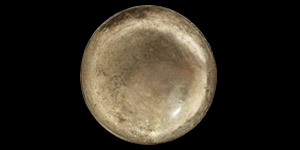
Western Asiatic Pre-Achaemenid Bowl for Ampirish, King of Samati
Sold for (Inc. bp): £8,750
A large silver bowl with chamfered rim; accompanied by an original old scholarly note, typed and signed by W.G. Lambert, late Professor of Assyriology, University of Birmingham, 1970-1993, which states: 'Ancient Iranian Large Silver Dish with Inscription 42.5cm. diam., 9.5 cm. high. This is an extremely large dish, probably the largest of its kind, and in remarkably good condition. It is hammered from sheet metal with a strengthened lip, on which is an inscription in Neo-Elamite cuneiform script: ᵐam-pi-ri-iŝ sunki sa-ma-tirₑ-ra ŝakₑ da-ba-la-na / Ampirish, king of Samati, son of Dabala. This comes from north-west Iran, and dates to c. 600-550 B.C. After the fall of the Assyrian empire in 612 B.C. a short-lived dynasty arose in north-west Iran, founded by Ampirish, who is only known to us from inscriptions on silver. This is a fine example of the silver-ware produced at this time in the area of north-west Iran, and important for the history of ancient Iranian art, being pre-Achaemenid.'. -
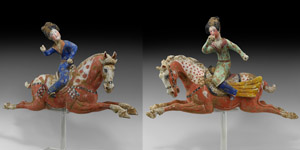
Chinese Tang Polo Player Pair
Sold for (Inc. bp): £9,375
A dynamic pair of ceramic polo-player figures each a galloping horse with legs extended and mane flying, painted harness and bridle detailing, bearing a female rider; one in green floral robe with right arm bent before the body and left hand trailing, the other in dark blue floral robe with right arm bent behind the body; each with custom-made stand. -
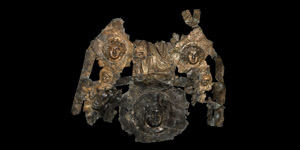
Greek Hellenistic Silver 'Kingdom of Pontus' Horse Front Armour
Sold for (Inc. bp): £10,000
A large silver appliqué, to cover the frontal head of a horse, with richly chased decoration showing the outstanding work of probably Pontus Greek artists; in the centre the head of Athena Promachos (warrior Athena), seen from three quarters, inside a phalera (disc) decorated with foliate motifs; the goddess is represented carrying an attic helmet ornamented with a three-folded plume (tryfaleia); the phalera is positioned and affixed between two female Deities; above a female priestess is performing a sacrifice to a statue of a goddess (probably Athena), standing on a base; on the left and right are two smaller gorgoneia, or representations of the Medusa, the snake-haired Gorgon killed by the hero Perseus, whose gaze petrified men; the phalerae and the other images are mounted upon a structure which represents the straps of a horse muzzle, upon which the fragmentary piece of armour was collocated; mounted on a custom-made stand. -
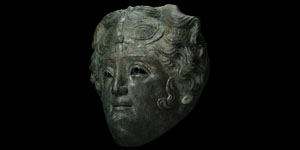
Roman Cavalry 'Mater Castrorum' Sports Mask of an Amazon Warrior
Sold for (Inc. bp): £95,000
Another 'hauntingly unforgettable work of art', with distinct artistic parallels to the famous Crosby Garrett helmet found in Cumbria in 2010; a bronze sports helmet mask of the exceptionally rare Mater Castrorum or female type, showing the head of an Amazon warrior or goddess with locks of wavy hair, topped with a tutulus hairstyle, diadems, garlands and other jewellery; the garland-diadem has a central knot with two hanging curls and is decorated with X-patterns inscribed inside rectangles; this mask was removable, being capable of being taken off at any time, proving that this type of helmet could be used not only during parades and other ceremonies, but also in combat. -
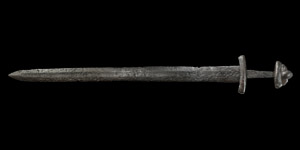
Viking Sword with Tri-Lobed Pommel
Sold for (Inc. bp): £11,250
A Petersen Type L variant Viking sword, the pattern-welded tapered blade with a width of about 5.7cm at the cross-guard, the point and cutting edges well preserved with traces of battlefield use clearly visible along its length; the tapered fullers are 2.2cm at their origin adjacent to the cross-guard; oppositely curved guards are wide, the pommel has a curved base-element and three lobes, with bands of separation between the lobes. -
.jpg)
Viking Silver and Gold Inlaid Axehead
Sold for (Inc. bp): £60,000
An iron axehead with inlaid silver and gold interlace decoration to both lateral faces, the upper face of the blade and the rear of the socket; slender body with scooped lower edge and curved blade, lateral spurs and rectangular panel to the butt; Wheeler's Type I. -
.jpg)
Viking Period Gold Belt Fitting Set
Sold for (Inc. bp): £5,875
A suite of substantial sheet gold belt fittings comprising: fifteen tongue-shaped tags each with four pyramidal bosses to the upper face and beaded wire border, fixing stud with large granule finial, many with remains of the original leather strap inside; seven panels each with two pyramidal bosses, beaded wire borders, slot below to accept a strap, pierced lugs to the reverse; seven similar panels with bosses and beaded wire, lugs to the reverse; possibly Khazar workmanship. -
.jpg)
Viking Period Gold Belt Fitting Set
Sold for (Inc. bp): £12,500
A suite of substantial sheet gold belt fittings comprising: seven tongue-shaped tags each with a beaded double border and central panel of S-scrolled beaded filigree; two similar with volute-scrolled filigree; a D-shaped plaque with central filigree roundel and chevrons; two ellipsoid plaques with chevron and scroll motifs; a rectangular plaque with three filigree S-scrolls; three rectangular plaques each with gabled ends and granules, beaded filigree S-scrolls to each face; four crescent panels with S-scrolls and beaded borders; a large tongue-shaped strap end with beaded filigree chevrons, with remains of leather strap inside; possibly Khazar workmanship. -
.jpg)
The 'Kingsworthy' Anglo-Saxon Horned Woden's Head Appliqué
Sold for (Inc. bp): £17,500
A spectacular gilt-bronze appliqué in the form of a facing male head with horned headgear; piriform face, discoid eyes with garnet (?) cloison inserts, the nose covered by the nasal of the headgear, the beard triangular and the ends of the moustache extending beyond the cheeks; hair covered by a helmet or mask with hatched texture extending around the upper face and developing to two crescent extensions from the temples which meet above the crown of the head; the terminals formed as birds' heads; possible remains of attachment stud to the reverse. Kevin Leahy, National Adviser, Early Medieval Metalwork of the PAS commented: "This striking mount is Early Anglo-Saxon and dates from the 6th to 7th century. Faces like this, wearing a horned headdress (or sporting horns of their own) are well known, appearing on some of the foils decorating the Sutton Hoo helmet, where the warriors carry swords and spears and appear to be dancing. A similar foil was found in a burial at Caenby, Lincolnshire and the horned warrior carrying two spears appears on a gold buckle from Finglesham, Kent. Horned warriors are not restricted to England and appear on a die for making foils found at Torslunda, Sweden, and on a die from Ayton in the Scottish Borders region. The question is: who do these mounts represent? It has been suggested that they depict the god Woden, one of whose attributes was a spear and that the birds' heads on the ends of the horns represent the the god's two ravens. However, these birds often have hooked eagles' beaks not the pointed beaks of ravens. We also see multiple depictions of the horned warrior on the same foil suggesting that it was not the god, although it is possible that the god's image was duplicated to emphasise his power. Woden is sometimes shown with only one eye as he gave up his other eye in exchange for wisdom. The two garnet-inlaid eyes seen here do not preclude the face being that of Woden but it would have been helpful if it had only one eye. Finally, what was this mount used for? Other examples like the one from Rempstone, Notts., has mounting pins on its back as does a mount from Finglesham, Kent. Many of the other mounts, however, lack any signs of a fixing. It is clear that the mount described here was attached to an iron object but we are left guessing what it was: a helmet or a buckle? Unless you find one still attached we are going to be left to wonder." -
.jpg)
The 'Kingswood' Medieval Plantagenet Gold Ring with Garnet
Sold for (Inc. bp): £23,750
A magnificent and important gold finger ring, the plain hoop of rounded D-section with baluster shoulders showing diagonal raised line ornament and combed bar at junction with the broad octagonal 'pie' collet cell closed bezel, containing a polished octagonal garnet of superb quality, size and colour, with cabochon finish. -
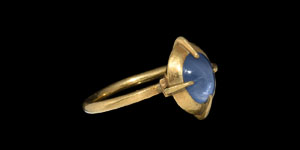
Medieval Gold Ring with Star Sapphire
Sold for (Inc. bp): £6,250
A gold finger ring comprising a round-section hoop, ellipsoid pie-dish bezel with claw setting, inset star sapphire cabochon. -
.jpg)
Medieval Gold St Christopher Iconographic Ring
Sold for (Inc. bp): £22,500
A gold iconographic ring with a rectangular hoop engraved with a depiction of St Christopher carrying Jesus as a child across a swollen river on his back, triangular shoulders with incised lines below the bezel, the hoop formed of seven ovoid panels, each inscribed with a lower-case blackletter initial and a leaf, the letters forming the word 'loyalte' for loyalty; the ring was discovered with 'amer et celer' posy ring inside it, also offered in this sale, the rings were found wedged together and deposited as a sign of eternal love, possibly after the death of a loved one or after a secret love affair was discovered and cruelly ended. -
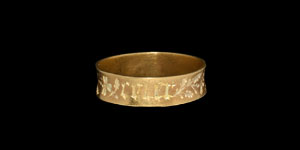
Medieval Gold 'Love and Conceal Our Love' Posy Ring
Sold for (Inc. bp): £10,625
A gold lady's ring with circular hoop with a slightly concave outer face, skillfully engraved with 'amer et celer' French for 'love and conceal [that love]', a tenet for courtly love, the inscription starting with three sprays of flowers, with a different stemmed flower with a smaller flower in front between each word; the ring was discovered inside the St Christopher ring, also offered in this sale, the rings were found wedged together and deposited as a sign of eternal love, possibly after the death of a loved one or after a secret love affair was discovered and cruelly ended. -
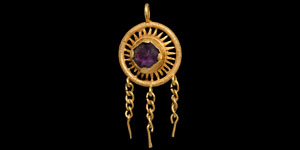
The 'Horncastle' Gold Yorkist Hat Jewel
Sold for (Inc. bp): £3,750
A gold hat jewel with a facetted amethyst in a pierced yellow gold mount with dentilled plaque to the reverse and twisted wire rim with four peripheral loops; the jewel symbolising the 'sun in splendour' (the personal emblem of King Edward IV), with three chain drops below (originally mounted with pearls). -
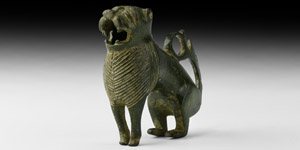
The 'Wenhaston Lion' English Animalier Candlestick
Sold for (Inc. bp): £8,750
A detailed bronze candlestick formed as a crouching lion with open jaws, hatched panels to the chest, recurved tail with serrated outer edge and loop finial providing a handle for carrying; the body pierced vertically from neck to chest to accept a columnar candle holder, now absent and horizontally through the open mouth; front legs with stub paws and hindlegs with horizontal feet; resembling an aquamanile in general form and in some detailing. -
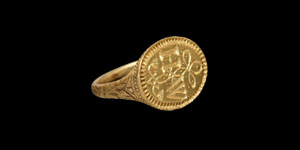
Late Elizabethan William Harvey of Tarrent Launceston Gold Personal Signet Ring
Sold for (Inc. bp): £23,750
A spectacular late Elizabethan (or early Jacobean) gold ring of the Harvey family of Launceston comprising a flat discoid bezel with beading below the rim and band of radiating billets to the face, trefoil interlace motif above and between the initials with floret finials, pointillé detailing; initials 'HW' with neat serifs and 'V' or inverted chevron below, the 'W' formed as two intersecting 'V's; the shoulders with reserved acanthus-leaf ornament; slender D-section hoop. -
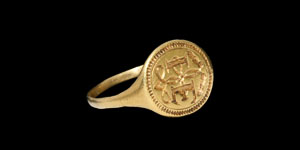
Elizabethan Gold Signet Ring with I E
Sold for (Inc. bp): £6,875
A D-section gold hoop with expanding shoulders, discoid bezel with beaded border, initials 'I E' over a looped entwined ribbon with a tassel to each end. -
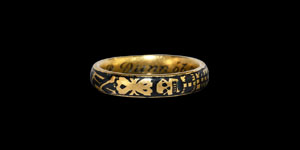
George II Gold 'Dunn Family' Skeleton Memento Mori Ring
Sold for (Inc. bp): £7,250
A gold finger ring, from early in the reign of George II (1727-1760 AD), with reserved, elongated skeleton and skull-and-crossed-bones motifs on a black enamelled field, inscribed in italic script, infilled in black enamel, to the inner face 'R Dunn ob 28 Jan 1731 aet 46' (for R. Dunn who died on 28 January 1731, aged 46 years). -
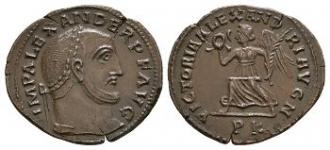
Ancient Roman Imperial Coins - Alexander - Victory Follis
Sold for (Inc. bp): £2,250
Carthage mint. Obv: IMP ALEXANDER PF AVG legend with laureate bust right. Rev: VICTORIA ALEXANDRI AVG N legend with Victory advancing left holding wreath and palm; mintmark P K in exergue. -
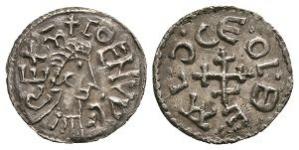
Anglo-Saxon Coins - Coenwulf - London / Ceolbeald - Crosslet Penny
Sold for (Inc. bp): £3,500
Obv: profile bust with +COENVVLF REX M legend. Rev: cross-crosslet with CEOLBEALD legend for the moneyer Ceolbeald at London mint. -
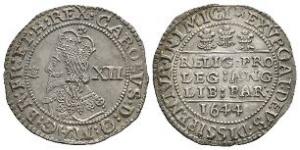
English Stuart Coins - Charles I - Bristol - 1644 BR - Declaration Shilling
Sold for (Inc. bp): £13,750
Obv: profile bust with plumelet before and XII behind and CAROLVS D G MAG BR FR ET H REX legend with four small pellets around larger central pellet at start of legend. Rev: declaration RELIG PRO / LEG ANG / LIB PAR in three lines with three plumes above and date below with EXVRGAT DEVS DISSIPENTVR INIMICI legend with 'BR monogram' mintmark.

20th century AD
Lot No. 4563
Sold for (Inc. premium): £6
