-
.jpg)
Greek Terracotta Figure of Eros, the God of Love
Hellenistic, 3rd-1st century B.C.Estimate: £8,000 - 10,000 (‡+bp*)
Modelled nude in a dynamic pose with his wings spread open, the left leg slightly advanced, and the right arm extended with open palm, a diadem or a fillet on his head; circular socket between the wings; accompanied by a display stand. 808 grams total, 31 cm including stand
Louis-Gabriel Bellon (1819-1899) collection, France. European private collection, 2009. Accompanied by an academic report by Dr Raffaele D’Amato. This lot has been checked against the Interpol Database of stolen works of art and is accompanied by search certificate number no. 13014-246790.
In classical times, Eros was usually depicted as a handsome adolescent, with only his wings distinguishing him from other kaloi and young athletes. Sometimes he was depicted younger and with less masculine features: Lysippos, in the famous statue of Eros of Thespiae, depicted him as a youth. -
.jpg)
Parthian Carnelian Gemstone of a Goat-Headed Rhyton in Gold Ring
4th century B.C.-220 A.D.Estimate: £2,000 - 3,000 (+bp*)
Achaemenid or Parthian oval intaglio engraved with a style standing at the threshold between natural and stiff rigid linear style, depicting a goat-headed rhyton, the vessel terminating in the forepart of a wild goat with the front leg tucked under the body, the head rendered in profile with elegantly arched horns, pronounced muzzle, and carefully incised eye; the neck of the conical rhyton decorated with diagonal and cross-hatched incisions suggesting ribbing or chased metalwork; set in a modern gold ring with a small triangular area at the top left of the stone filled in with gold; supplied with a museum-quality impression. 8.51 grams, 24.02 mm overall, 21.18 mm internal diameter (approximate size British P, USA 7 1/2, Europe 16.23, Japan 15)
Acquired on the European art market. This lot has been checked against the Interpol Database of stolen works of art and is accompanied by search certificate number no.13356-257945.
The subject, a rhyton terminating in an animal protome, belongs to a well-established tradition in Eastern Greek and Achaemenid art of the late Archaic and Classical periods, in which zoomorphic libation vessels were used in ritual and ceremonial contexts. Goat-headed rhyta, though less commonly preserved in glyptic media, are attested in silver and ceramic examples, notably from Asia Minor and Thrace. The stylised horned animal, here likely a wild goat or ibex, is associated with vitality and mountain symbolism, while the rhyton itself signals elite drinking culture and votive use. The use of carnelian is typical of high-quality glyptic production in the 6th to 4th century BC, valued for its durability and ability to take a fine polish. The style and iconography suggest an Eastern Mediterranean origin, most probably Ionian or Anatolian. -
.jpg)
'The Mildenberg' Greek Gold Bull's Head Pendant
Circa 4th century B.C.Estimate: £3,000 - 4,000 (+bp*)
Hollow-formed in sheet gold with finely modelled details and applied granulated wreath between its horns; attachment hole to the rear of the head. 3.05 grams, 21 mm
Christie's, London, 'A Peaceable Kingdom: The Leo Mildenberg Collection', 27 October 2004, no.102. This lot has been checked against the Interpol Database of stolen works of art and is accompanied by search certificate number no.13359- 259201.
In many Greek sanctuaries, large numbers of bull figures of different sizes have been found, which must be regarded as representatives of actual sacrificial offerings. Many of them come from the venerable Sanctuary of Zeus at Dodona, with whom the bull has a special relationship. -
.jpg)
Greek Gold Bead Collection
4th-3rd century B.C.Estimate: £1,200 - 1,700 (‡+bp*)
A collection of necklace pendants and dress appliques comprising: a hollow bead with a truncated conical shape, featuring appliques for precious stone inserts; three studs with a hemispherical dome; a pair of appliques decorated with rosette and mask-shaped elements; a pendant in the form of a myrtle berry, and another fragment. 11.19 grams total, 10-31 mm
Acquired by a Swiss family in the mid-1980s to late 1990s, thence by descent. Private collection, Switzerland, since the late 1990s. This lot has been checked against the Interpol Database of stolen works of art and is accompanied by a search certificate number no.13023-246772.
The iconography of Hellenistic jewellery often incorporates vegetal motifs, reflecting the Greek value of fertility. With its heavy incorporation of plant motifs, including tendrils, blossoms, and a bursting pomegranate, the diadem design symbolises a woman’s reproductive potential and alludes to the female wearer’s social responsibility to produce offspring. -
.jpg)
Etruscan Agate Talismanic Scarab
Late 4th-early 3rd century B.C.Estimate: £500 - 700 (+bp*)
Carved from banded orange agate and formed as a flattened scarab with a striated carapace, pierced for suspension. 3.53 grams, 18 mm
UK private collection, acquired on the English market in the 2000s.
The shape of an Etruscan scarab includes: (1) the scarab gem, where the engraving of the curved back of the stone more or less faithfully imitates the anatomical parts of the scarab beetle; (2) the scaraboid, which retains the overall shape of the scarab gem but with little or no engraving on the curved backside; and (3) the pseudo-scarab, which has an image carved in relief on its curved backside instead of a beetle. All three types have a flat, oval underside which carries an engraved miniature image (device) within a decorated border which is usually hatched. -
.jpg)
Roman White Chalcedony Cameo of a Theatrical Mask
1st century A.D.Estimate: £1,000 - 1,400 (+bp*)
Showing a New Comedy, 'Cook' type theatre mask with an open mouth; supplied with a museum-quality impression. 1.07 grams, 13 mm
Private English collection, formed between the late 1970s and early 1990s. Private collection, London, UK.
Miniature models of theatrical masks were mass-produced in the ancient world, and can be linked with the Dionysiac mysteries, in association with funeral rites, illustrating the Dionysiac thiasos, the orgiastic world of satyrs and maenads. However, they can also be miniature models of masks linked with highbrow Sophoclean and Euripidean tragedy, or with so-called Middle Comedy, which now only survives in fragments. -
.jpg)
Roman Agate Cameo with a Julio-Claudian Portrait of an Emperor
1st century B.C.-1st century A.D.Estimate: £1,000 - 1,400 (+bp*)
Oval cameo with a profile bust facing left, a laurel crown resting on his close-cropped hair; in the background, a second portrait visible 'capita iugata'. 2.5 grams, 20 mm
UK private collection, acquired on the English art market in the 2000s. -
.jpg)
Roman Carnelian Onyx Gemstone with Hermes
2nd century A.D.Estimate: £500 - 700 (+bp*)
Domed body layered horizontally, an engraved figure of standing Hermes facing right, wearing a petasos and holding a caduceus. 2.44 grams, 16 mm
Old French collection, 1980s. UK private collection, acquired in the French art market. -
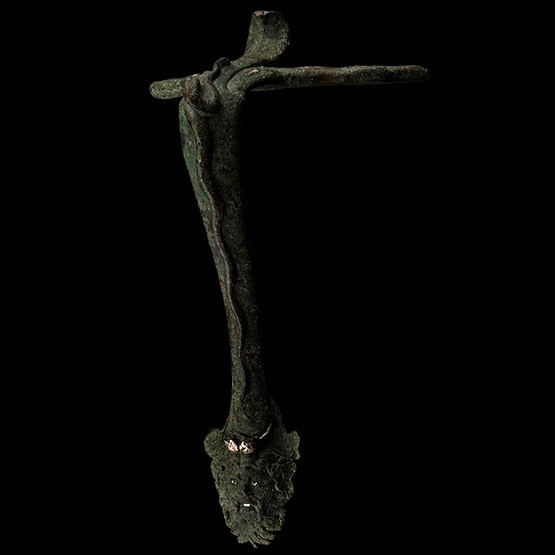
Roman Bronze Vessel Handle with Face
1st century A.D.Estimate: £1,500 - 2,000 (‡+bp*)
Swept in profile, comprising a horizontal crescentic panel to attach to the rim, with inlaid silver detailing, recurved cobra-shaped thumb pad, raised serpent to the outer face of the tapering handle, finial a mask of Bacchus or Pan, facing with volute scrolls to the brow and thick splayed beard; silver diadem and eyes. 110 grams, 14.2 cm
Private collection. with Christie's, London, 11 June 1997, no.97 (part). with Bonhams, 13 April 2000, no.198. Private collection, Europe. Accompanied by copies of the relevant Christie's and Bonhams catalogue pages. Accompanied by a copy of an Art Loss Register certificate. This lot has been checked against the Interpol Database of stolen works of art and is accompanied by a search certificate number no.12529-232161.
These handles, which formed a leafy plant element and an S- or T-shaped animal at the top, were usually attached to the belly of the bronze vessel by a human head. In our example, the broad head of the mask, with its broad moustache and beard, characterised by abundant hair, seems to hark back to the iconography of the Sileni or Pan. -
.jpg)
Roman Bronze Statuette of Resting Hercules
3rd century A.D.Estimate: £4,000 - 6,000 (+bp*)
Depicted as lar and modelled nude in a standing pose with the right hand resting on the handle of his club, left arms supporting the lionskin mantle; hair cut short and beard textured. 715 grams, 15.5 cm
Acquired on the UK art market, 1990s. Private collection, New York, USA. Accompanied by an academic report by Dr Raffaele D'Amato. This lot has been checked against the Interpol Database of stolen works of art and is accompanied by search certificate number no.13295-255447.
The position of the statuette, belonging to the typology of ‘resting’ Hercules, is unconventional, probably belonging to a more archaic period prototype (Reinach, 1897, p.211,7). By the late 300s or early 200s B.C., the depiction of Hercules wearing the lion's skin over his head had fallen out of favour in Greek art. A worshipper probably placed this statuette in a sanctuary as an offering to the deity, or in his house as a symbol of protection. The majority of small Hercules statuettes are ex-votos, and the donors were possibly herdsmen, considering his function as protector of the flocks. Statuettes of the god found in provinces like Gallia, Britannia, or Pannonia might have appealed to Italic soldiers serving further north and could easily have been carried with them on campaign. -
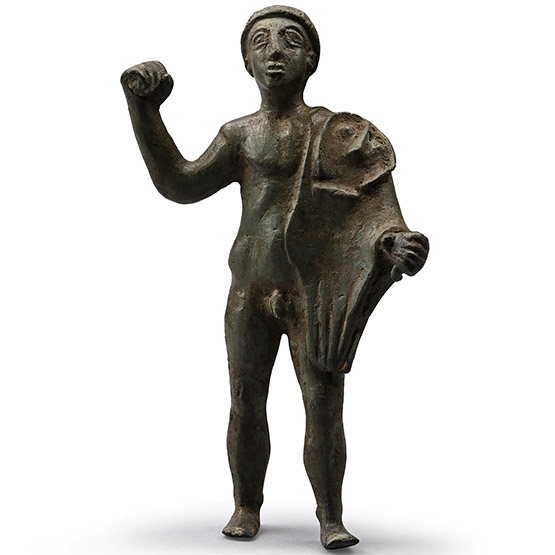
Etrusco-Italic Bronze Figure of Young Hercules
Archaic Style, circa 4th-3rd century B.C.Estimate: £2,500 - 3,500 (‡+bp*)
Modelled in the round figure standing in advancing pose with the right hand raised and fist clenched; left shoulder and arm covered with the skin of the Nemean lion and left hand modelled hollow; hair cut short and textured. 307 grams, 12 cm
Acquired in the mid 1980s-1990s. Private collection, Switzerland, thence by descent. Private collection, since the late 1990s. Accompanied by an academic report by Dr Raffaele D'Amato. This lot has been checked against the Interpol Database of stolen works of art and is accompanied by a search certificate number no.12515-232159.
There were several cult sites of Hercules in Etruria and old Latium, particularly in the Sabellian region, and the bronze statuettes discovered here exhibit a wide range of styles. Etruscan bronzes of the half-god usually represent him with the lion skin draped over his arm (Metropolitan accession number 96.9.419). -
.jpg)
Roman Vessel with Actor's Mask Handle
Early 3rd century A.D.Estimate: £2,000 - 3,000 (‡+bp*)
A squat jar in lead-rich copper-alloy with concentric rings to the base, bulbous body, trefoil mouth with egg-and-dart detailing, strap handle with vine-leaf detailing, actor's mask at the lower end and a lion's head with open mouth at the other. 695 grams, 13.2 cm
Acquired on the Swiss art market, 2001. Private European collection. Accompanied by an academic report by Dr Raffaele D'Amato. This lot has been checked against the Interpol Database of stolen works of art and is accompanied by search certificate number no.12586-232162.
This type of vessel (spouted jugs with trefoil mouth) was part of Roman and provincial bronze instrumentum domesticum, i.e. culinary or domestic utility ware. The typology was assigned by H.U. Nuber to the E type (Millingen type), pieces characterised by a trefoil, highly splayed rim, a short neck and usually a spherical body.

