-
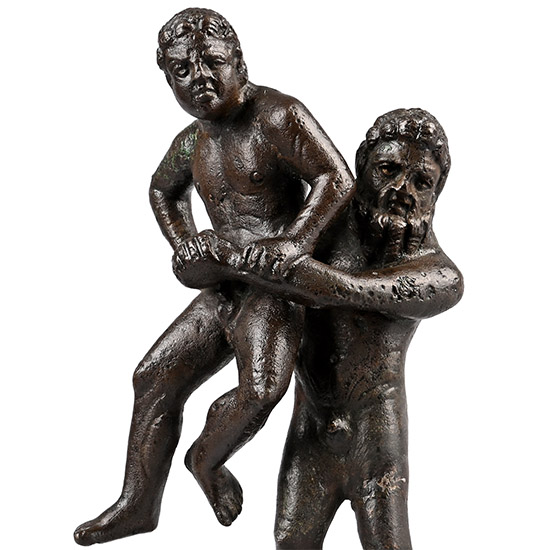
Greek Bronze Hercules and Antaeus Statue Group
Hellenistic, 3rd-1st century B.C.Estimate: £10,000 - 14,000 (‡+bp*)
Dynamic scene of two nude wrestlers, the giant Antaeus and Hercules, Hercules lifting Antaeus off the ground with his arms, while Antaeus is trying to pry his arms open to regain contact with Mother Earth, which would restore his strength; set on a custom-made display stand. 1.01 kg total, 20.3 cm high including stand
Mallams Oxford. From a UK private collection since the 1970s. This lot has been checked against the Interpol Database of stolen works of art and is accompanied by search certificate number no.13333-258242.
Here, the giant Antaeus is depicted with the more common dimensions of the hero, Hercules. Antaeus was a giant, the son of Neptune and Gaia. Antaeus would challenge all passers-by to wrestling matches and remained invincible as long as he remained in contact with his mother, the Earth. As in Greek wrestling, like its modern equivalent, he typically attempted to force opponents to the ground, and he always won, killing them. He built a temple to his father using the skulls of his defeated opponents. Antaeus fought Hercules as he was on his way to the Garden of Hesperides as his Eleventh Labour. Hercules realised that he could not beat Antaeus by throwing or pinning him. Instead, he held him aloft and then crushed him to death in a bear hug. The scene is famously depicted on a Greek krater dating to the sixth century BC and now in the Louvre, and was a popular subject for Renaissance artists. The episode in which Hercules defeats Antaeus is mentioned in Ovid's Metamorphoses. -
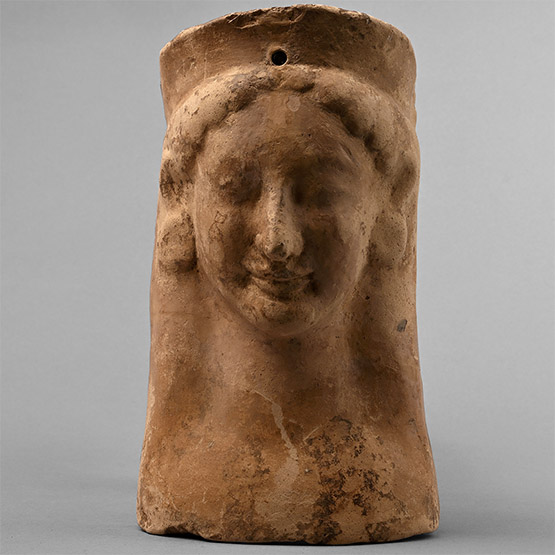
Greek Terracotta Female Protome
Early 5th century B.C.Estimate: £1,200 - 1,700 (‡+bp*)
Mould-made female protome with oval face, graceful nose and typical "archaic" smile; forehead framed by snail-shell curls descending to shoulder-height; with a low polos with a central perforation and large disc earrings. 606 grams, 19.5 cm
Ex Herbert A. Cahn, Kunst der Antike, Basel, 1997. with Paul and Vreny Vosseler-Studer, Riehen. Accompanied by a copy of an Art Loss Register certificate no.S00057826. This lot has been checked against the Interpol Database of stolen works of art and is accompanied by search certificate number no.12474-228714.
The presence of cults in Magna Graecia, although they fell within a well-established pantheon, in which the deity representing the Great Mother or Mother Earth, protector of fertility, natural and human fecundity, as well as health, was the most ancient, traces back to the figure of Demeter. In terracotta statuary, especially in Lucania, the goddess became the prevalent subject of votive or propitiatory offerings, reproduced in numerous variations of pose. The most common is the seated position, a distant tradition and widespread in the ancient world, the so-called 'goddess enthroned' with its multiple meanings, which allowed it to be adapted to various forms of worship. Demeter is a female deity connected to the earthly world and fertility, and therefore also present in Lucanian religiosity. The theme of the archaic protome—a head severed just below the neck—was transformed and expanded between the 5th and 4th centuries B.C., into that of the bust, finished just above the waist. -
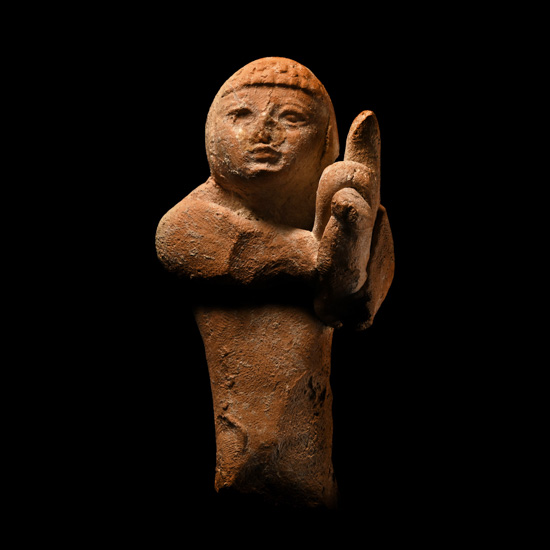
Greek Terracotta Citharode
6th-4th century B.C.Estimate: £1,200 - 1,700 (‡+bp*)
D-shaped in section with close-cut hairstyle, standing, holding a cithara supported on the left arm, strumming with the right hand. 62 grams, 86 mm
Ex Shlomo Moussaieff (1925-2015), Israel. European private collection. This lot has been checked against the Interpol Database of stolen works of art and is accompanied by search certificate number no.13107-246791.
The cithara was the instrument of the ‘virtuosi’, the principal concert instrument of the ancient Greeks. Its sound box was made of wood and was much bigger than that of the lyra. Strips of copper or horn were commonly incorporated into it, which resonated in sympathy with the strings, giving a great breath of sound. -
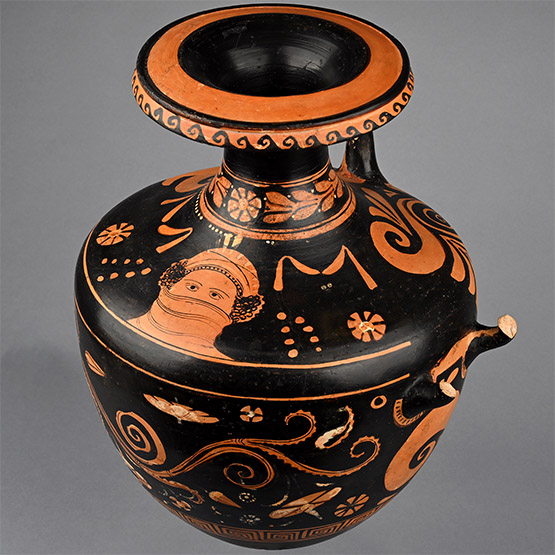
Greek Fragmentary Terracotta Red-Figure Hydria
Paestan or Apulian, 4th century B.C.Estimate: £4,000 - 6,000 (‡+bp*)
Comprising the upper two thirds of the vessel; on the shoulder a facing woman's head with diadem and half-veiled face; rosettes to left and right, with suspended ribbons and dots; vine motif around the body with floral ornaments; to the reverse, palmettes and vines; band of laurel with rosettes around the neck and wavy band at the mouth; reassembled from various fragments with three large areas of restoration, only the beginnings of the handles preserved; mounted on a custom-made stand. 1.95 kg, 31 cm (2.6 kg total, 47.5 cm high including stand)
Ex Herbert A. Cahn, Basel, 1990s. This lot has been checked against the Interpol Database of stolen works of art and is accompanied by search certificate number no.12475-228738.
The face-veiling gesture is a known marriage rite; the diadem may suggest that she is intended to represent Persephone. Alternatively, the veiled woman might be a dancer as many terracotta figurines of dancing women are shown with face-coverings. However, the floral ornaments could indicate a funeral or sepulchral context. -
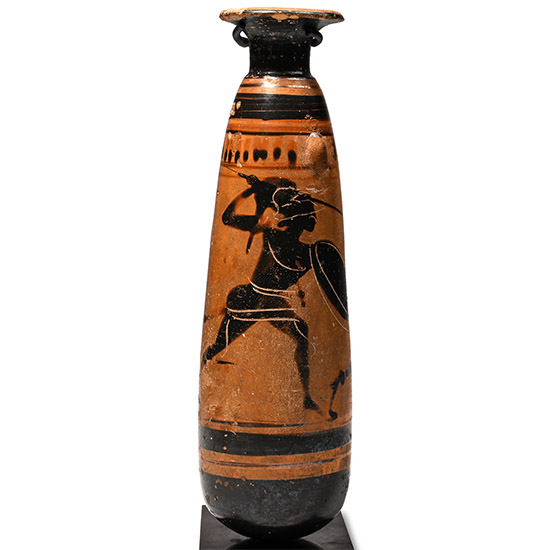
Greek Black-Figure Alabastron with Fighting Warriors
Attic, 500-480 B.C.Estimate: £20,000 - 30,000 (‡+bp*)
Of ovoid shape, short neck and expanded flat rim; painted in horizontal bands with black vertical strokes the shoulder, ovules in the upper part, the central scene representing a Greek Ekdromos fighting a Scythian archer; the Greek warrior, wearing a light sleeveless chiton, and a crested Corinthian helmet, carrying a wide hoplon shield, and a long spear with which he is slashing his opponent; the Scythian archer is wearing a typical tall cap flowing backwards and his long coat-suit, carrying a gorytos, (quiver) and composite bow with arrow; horizontal black stripes below; accompanied by a custom-made display stand. 262 grams total, 16 cm high including stand
Louis-Gabriel Bellon (1819-1899) collection, France. European private collection, 2009. Accompanied by an academic report by Dr Raffaele D’Amato. This lot has been checked against the Interpol Database of stolen works of art and is accompanied by a search certificate number no.13019-246753.
The importance of this alabastron is linked to its iconography, which represents episodes of the Persian Wars, fought 490-480 B.C. Such alabastra are part of a series realised during the period of the conflict and after, and they are an important source of information on the Persian and Greek armies. Here, the two opponents evoke the Greek victories, with a light-armed Greek ekdromos (hoplite fighting in light equipment) killing a Scythian archer, who formed part of the Persian army. The representation of Scythian costume in vase-painting reached its height of popularity between c. 530 and 490 B.C., and went out of fashion after the Graeco-Persian wars, when these clothes began to be associated with the Persian ethnic identity rather than the original Scythian. -
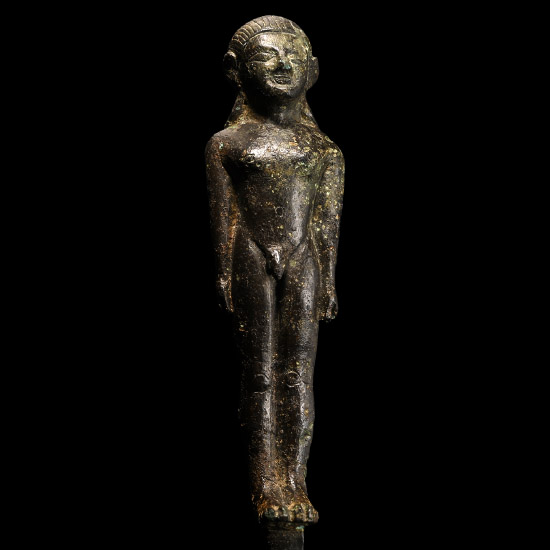
Etruscan Bronze Figure of a Kouros
Late 6th century B.C.Estimate: £2,000 - 3,000 (+bp*)
Depicting a youthful nude kouros standing frontally, with a long, slender body, broad shoulders, a narrow waist, and arms hanging close to the sides; the head, slightly oversized, characterised by an oval face, large almond-shaped eyes, an Archaic smile, and finely modelled ears, the hair arranged in beaded locks framing the forehead and falling onto the shoulders, reflecting the influence of contemporary Greek Archaic sculpture; standing on an integral rectangular base provided with a long tang for attachment. 118 grams, 11.2 cm
Acquired on the European art market between 1960s and 1980s. English private collection, property of a gentleman. Bertolami Fine Art, London, Auction 54, 9 November 2018, no.88. This lot has been checked against the Interpol Database of stolen works of art and is accompanied by search certificate number no.13320-258214.
The elegant proportions and linear modelling place the statuette within the widespread production of Etruscan votive bronzes of the Late Archaic period, probably intended as a sanctuary dedication. -
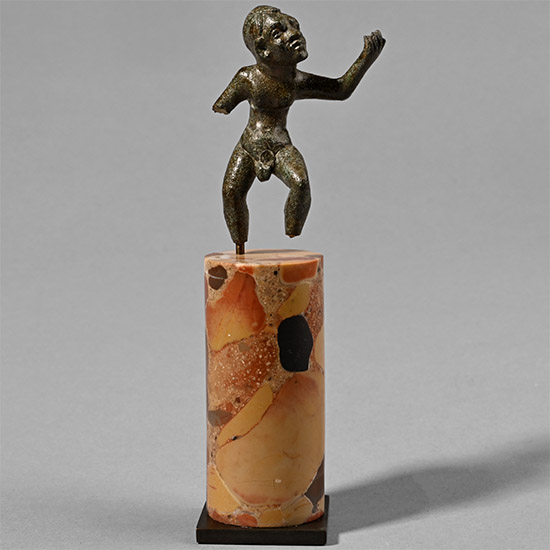
Greek Bronze Statuette of an Alexandrian Dancing Dwarf
Hellenistic, 1st century B.C.-1st century A.D.Estimate: £3,000 - 4,000 (+bp*)
In an active pose with both legs bent and left arm raised dramatically, head tilted to the left; exaggerated facial features, short trimmed hair, slim body with developed pectoral muscles and pronounced kyphosis; mounted on a columnar stand. 295 grams total, 15 cm high imcluding stand
Belgian private art collection of M.A., Brussels, Belgium, 1995. with Gorny and Mosch, 14 December 2011, no.82. This lot has been checked against the Interpol Database of stolen works of art and is accompanied by search certificate number no.13330-258951.
Such figures are often described as ‘grotesques’, yet typically constituted overstated representations of people with dwarfism. Such individuals are invariably shown with exaggerated features such as pot bellies, hunched backs, bald heads, large phalli and angry facial expressions. -
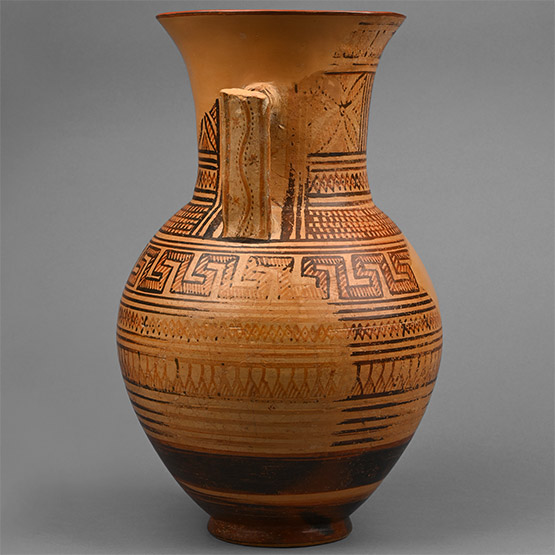
Large Greek Terracotta Oinochoe with Swastikas
Geometric, 8th century B.C.Estimate: £3,000 - 4,000 (‡+bp*)
With flared mouth, wide neck, bulbous body and ring foot, painted in brown and red matte glaze; geometric pattern spread over several registers separated by bundles of encircling stripes, triangles with hatching inside them, neck with metopes containing swastikas, rosettes and rhombuses with a band of rhombuses beneath; the shoulder with five line friezes arranged one above the other; the body decorated with meander and a band of rhombuses and triangles with hatching below, a broad black stripe (in places reddish as a result of misfiring) to the lower part; transition to the ring foot and ring foot painted black; wide strap handle attached to the shoulder and painted on the outside with a wavy line framed by dots, edge stripes and three small stars, the connecting bar patterned with stripes; museum-quality restoration. 2.04 kg, 35.5 cm
Ex Madame P., Paris. Accompanied by an academic report by Dr Raffaele D'Amato. This lot has been checked against the Interpol Database of stolen works of art and is accompanied by search certificate number no.12460-228686.
Vessels of the Geometric period (900-700 BCE) are easily recognisable by their abstract decorative designs, which had their origin in woven textiles and baskets. While early period pottery typically has sparse geometric motifs on a black background, the amount of decoration increased progressively to the point that objects from the late Geometric period are often entirely covered - in this example, even the strap handle. -
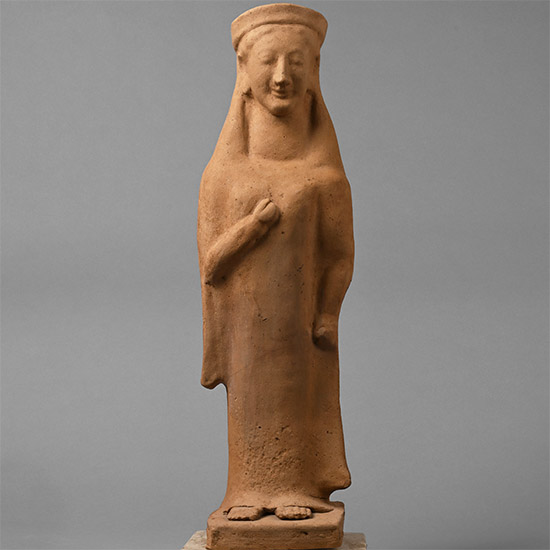
Large Greek Terracotta Figure of a Kore
6th century B.C.Estimate: £4,000 - 6,000 (‡+bp*)
Hollow-formed with scaphoid headdress, long hair hanging behind the shoulders, heavy peplos dress extending to the floor with splayed hem and feet visible beneath; left hand held straight at the thigh, right hand in a fist between the breasts; mounted on a custom-made stand. 6.7 kg total, 57 cm including stand
Swiss private collection, assembled in the 1970s-1980s. with Galerie Serodine, Ascona, Switzerland, 1993. Collection of Dr E.N., Zug, acquired in 1995. This lot has been checked against the Interpol Database of stolen works of art and is accompanied by a search certificate number no.12858-241755.
One of the most typical 6th-century B.C. terracotta female figurines was that of a standing or seated woman wearing a chiton tunic and a himation over it. It was a votive figure offered to the shrines or temples, usually representing the goddess Demeter. The headgear, polos, was an element usually identifying the goddess Demeter or her daughter Persephone. Attica was one of the principal centres of figurine production, but Corinth continued to produce solid standing or seated females with moulded fronts and flat backs. -
.jpg)
Etruscan Bronze Handle Pair with Heads of Medusa
6th-5th century B.C.Estimate: £10,000 - 14,000 (+bp*)
Each formed as a D-shaped fluted bar with the finials formed as grotesque Medusa heads (gorgoneia) in Archaic Greek style with protruding tongue and a pair of bearded snakes framing her forehead; mounted on custom-made display stands. 683 grams total including stand, handle: 10.9-11 cm wide
Ex private collection of Athos Moretti, Bellinzona, Switzerland, in the 1960s. with Christie's, London, 14 June 1978, lot 344. with Sotheby's, New York, 29 May 1987, lot 154. Accompanied by an academic report by Dr Raffaele D’Amato. This lot has been checked against the Interpol Database of stolen works of art and is accompanied by search certificate number no.11773-204596. -
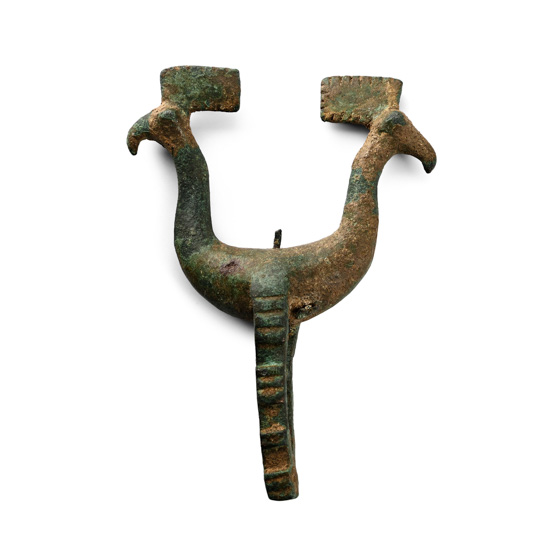
Large Greek Bronze Double-Headed Animal Terminal
Geometric, 8th-6th century B.C.Estimate: £1,200 - 1,700 (‡+bp*)
Comprising a crescentic body with a slender neck at each end, topped by a bird-head with a rectangular crest, vertical legs with raised block detailing conjoined at the lower end into a mounting peg. 55.6 grams, 86 mm
Ex collection Mr K.H., Germany. Private collection, acquired in 2012. This lot has been checked against the Interpol Database of stolen works of art and is accompanied by search certificate no.13077-246757.
Bird figures, standing on plates or discs, are found as votives mainly in Northern Greek sanctuaries of the Geometric Age. They should be regarded as symbolic and sometimes modest gifts to the gods. Some birds were also designed as pendants. The present fitting resembles a rooster, but it could also represent a peacock, and hence is connected with the goddess Hera. -
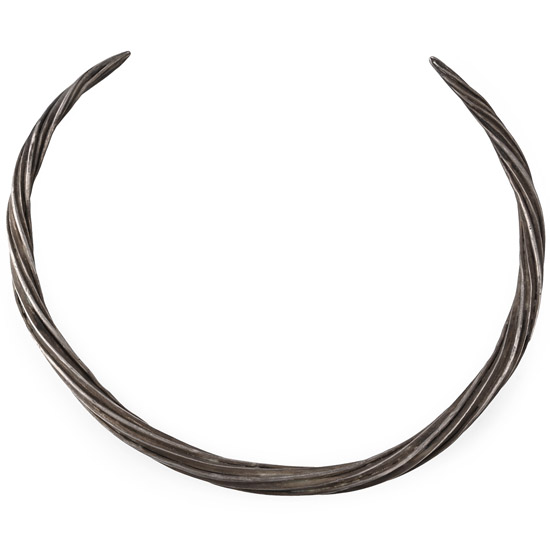
Thracian Silver Twisted Torc
5th century B.C.Estimate: £600 - 800 (+bp*)
Penannular torc twisted around its axis with tapering finials. 221 grams, 19.7 cm
Acquired in the early 1970s. Private collection, Suffolk.

