-
.jpg)
Egyptian Black Steatite Eye of Horus Amulet
Late Period, 664-332 B.C.Estimate: £700 - 900 (+bp*)
Carved unifacial amulet with hatched eyebrow and ribbed suspension loop. 1.45 grams, 19 mm
From a 20th century UK collection.
The wedjat-eye amulet is a representation of the healed eye of the god Horus, featuring both human and falcon elements. The name Wedjat in ancient Egyptian means ‘the one that is sound.’ According to Egyptian mythology, Horus' eye was wounded or taken by the god Seth and restored by Thoth. The wedjat-eye amulet was thought to protect its wearer and bestow the power of recovery and regeneration onto them. It was very popular and used by both the living and the dead. -
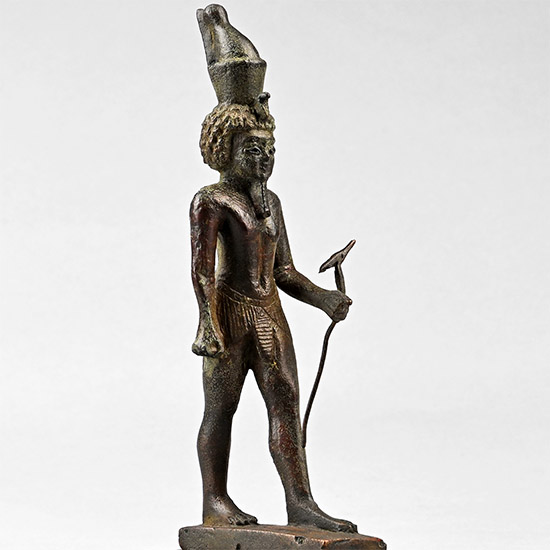
Egyptian Bronze Statuette of the God Neferhotep
Ptolemaic Period, 332-30 B.C.Estimate: £8,000 - 10,000 (+bp*)
Neferhotep depicted advancing on a rectangular base, holding in the left hand the was sceptre, topped with the stylised head of an animal linked to the god Seth, with the right arm held rigid by the side with a clenched fist; wearing a Pschent crown with uraeus above the brow, a short, pleated shendyt kilt, and a broad multi-strand collar; the head features a tightly curled wig, false beard, and lentoid wire rims around the eyes; mounted on a custom-made stand. 345 grams total, 17.3 cm high including stand
Private collection of Mrs Bogaert, formed in 1949, Ghent, near Brussels, Belgium. Ex private collection, London, UK. This lot has been checked against the Interpol Database of stolen works of art and is accompanied by search certificate number no.13310-258230.
Neferhotep was explicitly recognised as a deity with a cult only from the Late Period, although it may have been understood earlier and later as the incarnation of the youthful divine king, since pharaohs from the 18th Dynasty to the Ptolemaic Period are sometimes depicted wearing the same wig. Neferhotep, whose name translates as 'the perfect one is at peace,' was considered to be the son of Hathor and was venerated at Hu (Diospolis Parva), as well as at Karnak, Dendera, and Behbeit el-Hagar. Provenanced statues of the god originate from the Memphite region. -
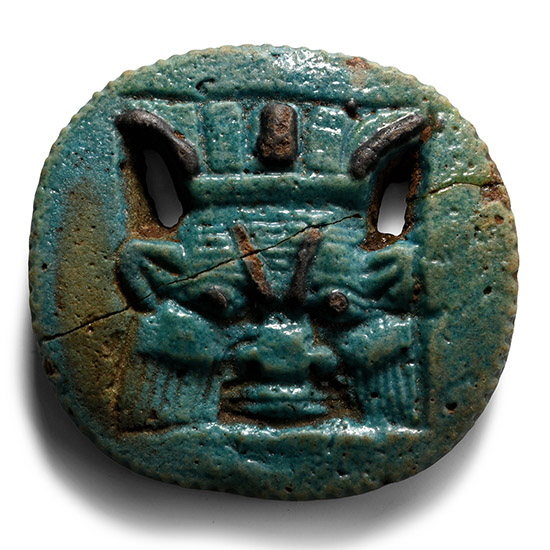
Egyptian Faience Amuletic Bes Plaque
Late Period, 664-332 B.C.Estimate: £1,500 - 2,000 (+bp*)
Oval plaque with ribbed outer edge, central depiction of the typically grimacing face of Bes wearing a feathered headdress. 23.8 grams, 52 mm
From an early 20th century collection.
From the New Kingdom onward, Bes became one of ancient Egypt's most popular apotropaic deities. Despite his somewhat fearsome appearance, Bes served as the patron and protector of pregnant women and children and was also believed to shield them from snakes. -
.jpg)
Egyptian Seated Gold Bastet Cat Amulet
Late New Kingdom-Third Intermediate Period, circa 1069-900 B.C. or laterEstimate: £500 - 700 (+bp*)
Modelled seated on a tongue-shaped base, with simple facial detailing and a suspension loop to the back. 0.54 grams, 8 mm
Ex French art market, 1920s.
The goddess Bastet was believed to be the daughter of the sun god and was shown with the features of a lion up until about 1000 B.C., when she was first portrayed as a cat or human with a cat head. As the daughter of Ra, she was associated with the rage inherent in the sun god's eye, which was considered to be his instrument of vengeance. Her development into a cat goddess occurred during the New Kingdom, but did not fully develop until the Late Period. She was still associated with the destructive power of the sun and was shown on the prow of the solar boat, decapitating the evil serpent Apophis in the Book of the Dead. The maternal, protective and hunting characteristics of the cat are obvious in Bastet, and she was seen as a protector of pregnant women and young children. In the Pyramid Texts, she is invoked by the deceased king to act as his protector and to help him reach the sky to join the sun god; the king proclaims that Bastet is his mother and nurse. Like her counterpart, Sekhmet, Bastet has an aggressive side and, in a text from Karnak, Amenhotep II described his enemies being slaughtered like the victims of Bastet. The goddess had a shrine at Karnak, where she is known as the 'Lady of Asheru', which aligns her closely with the goddess Mut, the consort of Amun-Ra. Her most famous shrine was in the north-east Delta region, at Bubastis, and was known as Per-Bastet or 'the House of Bastet.' Herodotus describes the festival of Bastet as one of the most elaborate in all of Egypt and identifies her with the Greek Artemis. Cemeteries of cats have been excavated at Bubastis, and at Saqqara and Memphis. -
.jpg)
Egyptian Bronze Seated Cat Statuette
Late Period, 664-332 B.C.Estimate: £600 - 800 (+bp*)
Bastet in crouching pose with her tail wrapped close to right side of her body, seated on a tongue-shaped base, with a suspension loop on the creature’s back. 90 grams, 55 mm
Acquired on the UK art market, 1990s. Private collection, New York, USA. -
.jpg)
Monumental Egyptian Granite Statue Base For Prince Parahirwenemef
New Kingdom, 19th Dynasty, circa 1250 B.C.Estimate: £40,000 - 60,000 (‡+bp*)
The reddish granite base and lower part of a kneeling statue of Prince Parahirwenemef, preserving the feet and lower legs with finely detailed sandals and well-modelled toes; part of the kilt survives, with a line of sunken hieroglyphs on either side; a broad front pillar and narrower back pillar rise from the base, both inscribed, while hieroglyphic inscriptions continue around all four sides of the plinth; the mirrored base inscriptions comprise offering formulae invoking Amun-Ra on behalf of the prince together with a series of his royal and military titles, including "royal scribe", "overseer of horses", "troop commander", "group marshaler", and the previously unattested title tpy n mšꜥ ("chief of troops"); a separate inscription on the rear of the plinth names the noblewoman Wadjet-khayty as sn.t=f mr=f ("his sister/wife, his beloved"), providing the first substantial evidence for her relationship with the prince and strongly suggesting that she was his wife. 140 kg, 58.5 cm
Private collection of Mr A., acquired circa 1983-1984. Thence by descent, private collection since the late 1990s. This lot has been checked against the Interpol Database of stolen works of art and is accompanied by a search certificate number no.12887-241732. An article on this significant piece is currently being prepared by Egyptologist Paul Whelan.
Prince Parahirwenemef, the third son of Ramesses II and Queen Nefertari, is depicted in several relief scenes and two colossal statues associated with Ramesses II's temples, as well as in two smaller statues, both surviving only in fragmentary form. The inscriptions on this previously unrecorded statue base preserve the previously unattested military title tpy n mšꜥ ("chief of troops"), expanding the known titulary of Parahirwenemef and reinforcing his close association with the Ramesside chariot corps. The monument also provides the first substantial evidence concerning the noblewoman Wadjet-khayty, previously known only from a brief reference to a lost Karnak monument, strongly supporting her identification as the prince's wife. Together, the inscriptions make an important contribution to the study of Ramesside royal genealogy, military administration, and princely sculpture. -
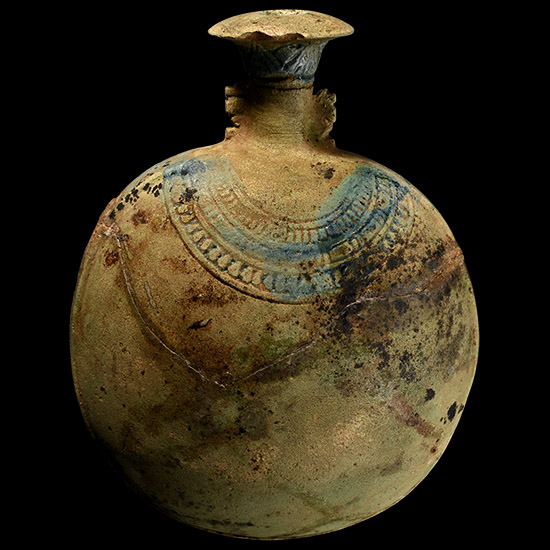
Egyptian Glazed Faience New Year Flask with Baboons
Late Period, 664-332 B.C.Estimate: £2,000 - 3,000 (+bp*)
Lentoid body with segmented collars and blue detailing around the shoulders, neck with papyrus stalk detailing and a domed rim; addorsed stylised baboons flanking the neck. 263 grams, 16 cm
Acquired on the UK art market, 1990s. Private collection, New York, USA. This lot has been checked against the Interpol Database of stolen works of art and is accompanied by search certificate number no.13350-255452.
The concept of renewal is expressed through the form, decoration, and inscriptions of this type of flask. Their rounded bodies evoke the sun disc, symbolising daily rebirth, while the squatting baboons flanking the mouth allude to those that greeted the rising sun each morning. The blue collar decoration, including floral motifs, as seen here, symbolises the renewal of the agricultural cycle through the annual Nile inundation. The papyrus-capital spout reinforces this theme of regeneration. Although traditionally dated exclusively to the 26th Dynasty, examples recovered from Late Period and early Ptolemaic contexts indicate that their popularity actually endured for several centuries. -
.jpg)
Egyptian 'Becker' Serpentine Vessel
New Kingdom, 18th Dynasty, circa 1450 B.C.Estimate: £2,500 - 3,500 (‡+bp*)
Piriform jar with wide, flat rim and short neck, narrow neck and flat base. 1.2 kg, 15.5 cm
Ex Becker collection, 1920s. Private collection, Los Angeles, USA, 1990s. Private European collection. Accompanied by an academic report by Dr Raffaele D’Amato. This lot has been checked against the Interpol Database of stolen works of art and is accompanied by a search certificate number no.12576-232111.
Three forms of serpentine were mainly used by the ancient Egyptians for stone vessels: a) green or grey serpentine with black veins; b) translucent green serpentine with black patches; c) granular black serpentine with intermixed grey or brown granules. Type a) serpentine, i.e. the green or grey one with black veins, has the longer time range, and was used for vessels from the Predynastic Period (Naqada II) through the New Kingdom. It was used for stone vessels, but also became common for statuettes and small toilet vessels. The class of green glazed kohl pots, many with carved or openwork decoration which are usually called ‘glazed steatite’ were more likely to be made of serpentine. The type here represented is a form known in the New Kingdom: a bag-shaped jar with neck, flat base, and wide thin rim. Similar vessels have been found in Thebes, Amarna, Kahun, among other localities. -
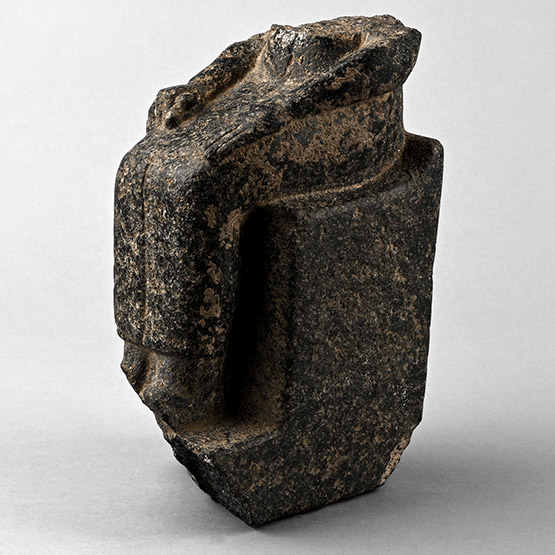
Egyptian Granite Seated Figure of an Official
Middle Kingdom, 2nd millennium B.C.Estimate: £2,500 - 3,500 (‡+bp*)
Comprising the torso and legs clad in an ankle-length robe and seated on a rectangular-section seat with stepped base and short, curved backrest and rear dorsal pillar; the left hand carved with the palm resting along the thigh; the right hand similarly placed but with the hand gripping a folded piece of cloth of which the ends are draped over the lower thigh above the knee; traces of an old label to reverse. 4.1 kg, 18.7 cm
Private collection, Europe. with Bonhams & Brooks, 8th November 2001, no.265. Private collection, Europe. Accompanied by copies of the relevant Bonhams & Brooks catalogue pages. This lot has been checked against the Interpol Database of stolen works of art and is accompanied by a search certificate number no.12584-232097.
The official would have been shown wearing a longer cloak-like garment rather than a waist-height kilt, as the line of the folded edge is visible above where a waistband would typically be. -
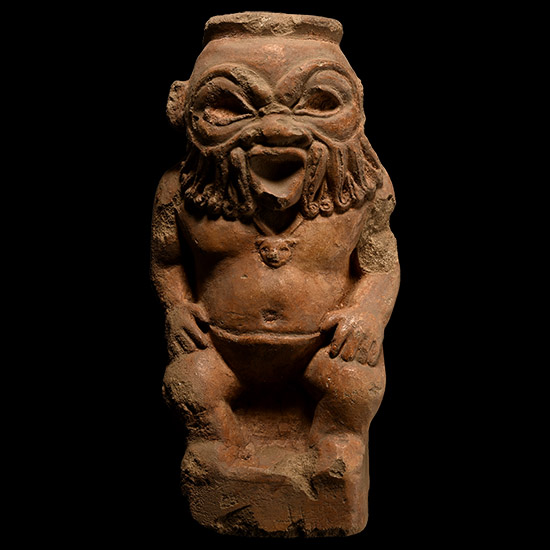
Egypto-Roman Seated Limestone Statuette of Bes
Ptolemaic-Roman Period, circa 332 B.C.-300 A.D.Estimate: £2,000 - 3,000 (+bp*)
Modelled in the round in a crouching pose on a rectangular base; the beard modelled in hanks with curled ends, the eyes recessed to accept inserts, mouth gaping; animal head amulet on the chest suspended on a cord; socket to reverse; chipped. 942 grams, 18.5 cm
Bonhams, London, 4 July 1995, no.36. Private collection, New York, USA. This lot has been checked against the Interpol Database of stolen works of art and is accompanied by search certificate number no.13294-255443.
From the New Kingdom onwards, Bes became one of ancient Egypt's most popular apotropaic deities. Despite his somewhat fearsome appearance, Bes served as the patron and protector of pregnant women and children and was also believed to shield them from snakes. -
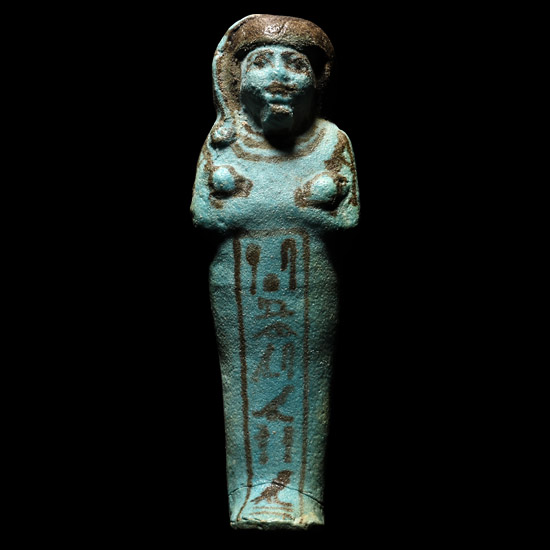
Egyptian Blue Glazed Shabti for Hor
New Kingdom, 19th Dynasty, 13th century B.C.Estimate: £1,500 - 2,000 (+bp*)
Modelled with a rounded wig and sidelock; painted black detailing to the eyes, lips, collar and agricultural tools held in the crossed hands; painted vertical panel to lower body with hieroglyphic legend “The illuminated one, the Osiris, the sem priest, the great director of craftsmen, Hor, justified” (sḥḏ wsı͗r sm wr ḫrp(w) ḥmw(w)t ḥr mꜣꜥ-ḫrw); repaired. 146 grams, 13.8 cm
Acquired on the UK art market, 1990s. Private collection, New York, USA.
Although the inscription names the owner as Hor, it seems likely that this shabti was made for a high official named Hori. Several sem priests named Hori are known. It seems plausible that this shabti belonged to the Hori who was the son of Prince Khaemwaset, son of Ramesses II, since a similar example was found alongside those of the prince in a chamber in the Serapeum (Mariette, A., Le Sérapéum du Memphis, Paris, 1857, pl. 10). -
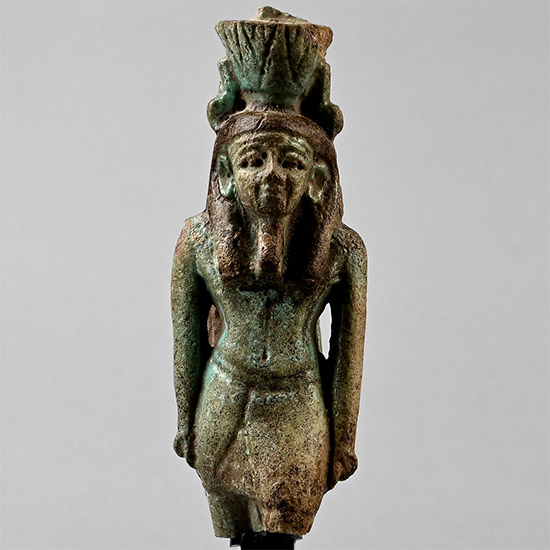
Large Egyptian Green Faience Figure of Nefertum with Figure of Sekhmet to the Reverse
Ptolemaic Period, circa 332-30 B.C.Estimate: £2,000 - 3,000 (+bp*)
Modelled standing with arms held vertically at his sides, wearing a tripartite wig surmounted by a lotus flower flanked by scrolled leaves; dorsal pillar with low-relief image of Sekhmet in lioness-headed form and solar disc above; mounted on a custom-made stand. 480 grams total, 19.5 cm high including stand
with Art Ancient, London, UK. Private collection, London, UK. This lot has been checked against the Interpol Database of stolen works of art and is accompanied by search certificate number no.13352-257009.
Nefertum is often depicted with a prominent lotus blossom above his head, symbolising both his divine beauty and his connection to the sun's rejuvenating power. He is sometimes portrayed with a lion's head or a lioness’s mane, or, as here, accompanied by an image of his lioness mother, Sekhmet, on his back, emphasising his link to her fierce and healing powers.

