-
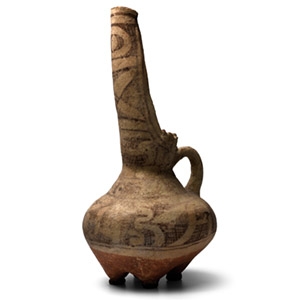
Western Asiatic Painted Terracotta Vessel
9th-8th century B.C.Estimate: £400 - 600 (+bp*)
Bulbous body with four stub legs, tall neck and internal strainer, tall scooped edge to the rim, loop handle to the rear; body and neck painted with geometric motifs, red paint on the base and legs. 1.16 kg, 32.3 cm
UK collection, 1990s. Acquired on the UK art market, before 2000. Private collection, Mr M.V., a London-based businessman.
Artefacts from Amlash date from the late second millennium B.C. through to the Partho-Sasanian period, with most dated to the 9th and 8th centuries B.C. Zoomorphic drinking or ritual vessels are abundant in Amlash pottery and usually feature depictions of animals common to that region. Such vessels have been recovered across Mesopotamia and Anatolia, and they were known as Bibru. They were produced as ceremonial drinking vessels, dedicated to specific deities, but they might also have served as drinking vessels for the social elite and royal family members. -
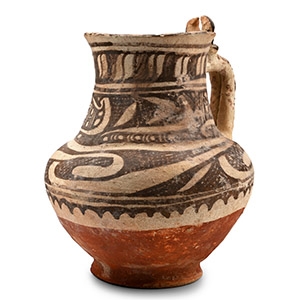
Large Western Asiatic Terracotta Painted Jug
8th-9th century A.D.Estimate: £400 - 600 (+bp*)
With squat profile, broad shoulder, wide neck and flared rim; strap handle with thumb-pad to the rim; bands of reserved tendrils on a hatched field. 818 grams, 18.5 cm
UK collection, 1990s. Acquired on the UK art market, before 2000. Private collection, Mr M.V., a London-based businessman. -
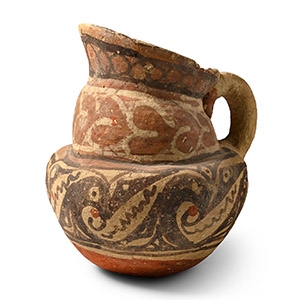
Western Asiatic Painted Terracotta Vessel
8th-9th century A.D.Estimate: £200 - 300 (+bp*)
Squat in profile and of tiered construction with strap handle and broad pouring lip, bands of polychrome painted foliage decoration. 407 grams, 12.7 cm
UK collection, 1990s. Acquired on the UK art market, before 2000. Private collection, Mr M.V., a London-based businessman. -
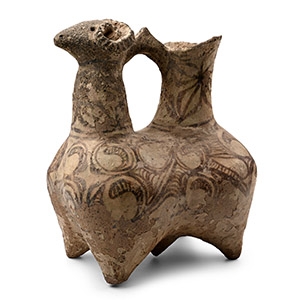
Western Asiatic Ceramic Zoomorphic Vessel
8th-9th century A.D.Estimate: £500 - 700 (+bp*)
Comprising four conical legs supporting a double globular body with conical neck and ram's head, spout to the rear with strainer connected by a bridging loop; applied painted hatched spiral detailing; old label to the underside: 'YAZDANI 211C LONDON'. 1.06 kg, 19.5 cm
UK collection, 1990s. Acquired on the UK art market, before 2000. Private collection, Mr M.V., a London-based businessman. -
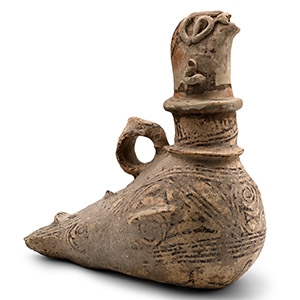
Western Asiatic Terracotta Vessel with Bird Head
8th-9th century A.D.Estimate: £300 - 400 (+bp*)
Aviform body with loop handle and applied collars and detailing to the neck and head; painted spiral tendril design. 612 grams, 18 cm
UK collection, 1990s. Acquired on the UK art market, before 2000. Private collection, Mr M.V., a London-based businessman. -
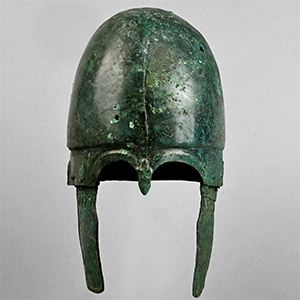
Greek Bronze Chalcidian-Type Helmet
Circa 5th-4th century B.C.Estimate: £12,000 - 17,000 (+bp*)
Hammered from sheet-bronze, hemispherical dome with a seam at the front and back, the seams secured together with a series of pins, threaded through rivet holes; from the front, a repoussé ridge forming curved brows leading down towards a nasal decorated with four pellets; two small perforations above the right brow and a perforation on either side of the top section; two cheek guards present, a characteristic of the helmet’s type, attached to the helmet with hinges, allowing for easier wear and construction; the cheek-pieces rectangular in shape and curved at the back; a horizontal band of inverted triangles decorating the top of each cheek guard, each pierced towards the bottom, where an inner lining would have been attached, two curved cut-outs behind to accommodate ears; accompanied by a custom-made display stand. 1.46 kg total, 48 cm including stand
Previously with the Parthenon Gallery, WC1, London, UK; acquired 2010. From the J.L. collection, Surrey, UK. Accompanied by an academic report by Dr Raffaele D'Amato. This lot has been checked against the Interpol Database of stolen works of art and is accompanied by search certificate number no.12909-244364.
The Chalcidian helmet was a popular type of helmet in the Hellenistic world, particularly in the Greek-occupied region of southern Italy, during the 5th and 4th centuries. However, types have also been found from the mid-6th century BC. It was a lightweight progression from the Corinthian helmet and allowed the wearer better hearing and vision than its older, bulkier Corinthian counterparts. The term ‘Chalcidian’ originates from its frequent depiction on pottery once thought to have come from the Euboean city of Chalcis. This variant of the Chalcidian helmet, featuring hinged cheekplates, is also known as the Lucanian type, as it was used extensively in Lucania. This type of helmet was still in use by the time of Alexander the Great, particularly by the hoplites, heavy infantrymen, and is thought to have developed into the Attic helmet, used well into the Imperial Roman era. -
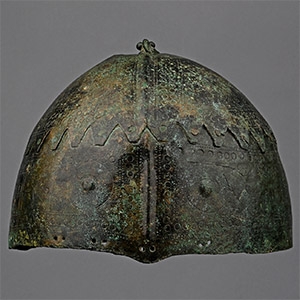
Highly Decorated Caucasian Bronze Helmet
6th century B.C.Estimate: £40,000 - 60,000 (+bp*)
Formed as a domed bowl with a rivetted overlay on the top, a bird of prey finial at the crown with a raised vertical ridge before the beak; extensive decoration on the body comprising annulets, lines, ring-and-dot motifs and pointillé borders, a circumferential border of rectangular panels on the lower part of the helmet, each rectangle divided into four triangular panels with herringbone and ring-and-dot decoration; a short nose-guard beneath the raised ridge, four raised bosses flanking the ridge, depicting apotropaic eyes; the lower rim pierced for the attachment of internal lining. 650 grams, 21 cm wide
Ex German private collection, M.B., Mainz, 1980s. Acquired from the above by the current owner. Accompanied by an academic report by Dr Raffaele D’Amato. This lot has been checked against the Interpol Database of stolen works of art and is accompanied by search certificate number no.12902-242697.
The helmet belongs to a limited series of helmets found in the Caucasus, discovered in archaeological complexes of the Colchis-Koban Culture, adding another chapter to the history of a series of important Caucasian helmets. Its decoration rivals that of a helmet of the Krasnodar Museum, until now the most complete and decorated in this category. All the helmets of this typology were decorated according to a certain scheme, but the present helmet and the one from Krasnodar are richer in terms of symbols and ornaments. The decoration and similarity with other helmets in this series suggest that the present helmet could have been made for the military elite of the North-West Caucasus in Central Caucasian workshops. Most likely, the owner was part of the elite of the local tribes of the North-West Caucasus of the Maeotic circle. -
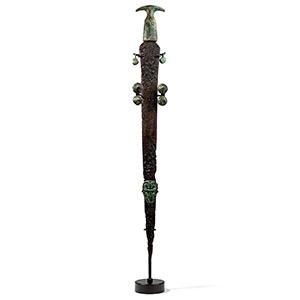
Caucasian Bronze Hilted Iron Sword
Iron Age, 8th-6th century B.C.Estimate: £4,000 - 6,000 (+bp*)
A broad sword with tapering blade and rounded shoulders, bronze hilt with crescentic pommel and apotropaic eye motifs to both sides; accompanied by bronze scabbard or baldric elements including a pair of eyelets with suspension loops, four circular appliqués with conical tips and ropework borders, and a scabbard chape with two opposing ibexes; mounted on a custom-made display stand. 2.2 kg total, 78 cm including stand
From the private collection of a London gentleman, from his grandfather's collection formed before the early 1970s. Accompanied by an academic report by Dr Raffaele D'Amato. This lot has been checked against the Interpol Database of stolen works of art and is accompanied by search certificate number no.12914-245170.
The sword belongs to the Caucasian culture of the Colchis, and represents a very rare typology. A similar blade was found together with early Scythian arrows during excavations at Karmir-Blur. A similar combination found at Kulanurkhva’s excavations suggests that the appearance of such blades in Abkhazia is linked to the Scythian campaigns in Near Eastern Asia. -
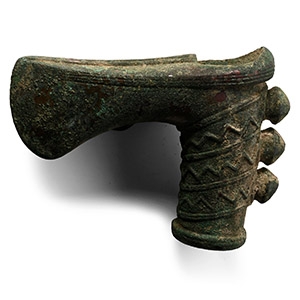
Elamite Decorated Bronze Axehead
2nd-1st millennium B.C.Estimate: £500 - 700 (+bp*)
With a slender, scooped blade, a round socket with a ribbed outer flange, and three lobed extensions to the rear of the socket with low-relief decorative bands. 360 grams, 10.4 cm
French collection, 1980s. Acquired on the London art market. Private collection, London, UK. -
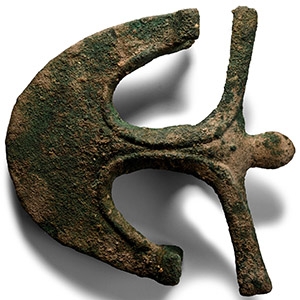
Elaborate Canaanite Bronze 'Anchor' Axehead
Early 2nd millennium B.C.Estimate: £800 - 1,000 (‡+bp*)
Comprising a deep crescentic blade with two spurs at each end intended to brace against the shaft, a narrow neck, and flared socket with vertical spurs to the reverse and a knop finial. 305 grams, 11.2 cm wide
Acquired in the mid 1980s-1990s. Private collection, Switzerland, thence by descent. Private collection, since the late 1990s. -
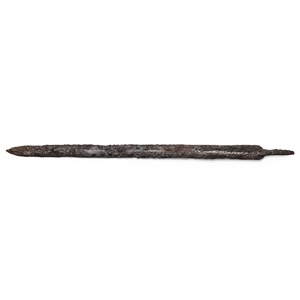
Merovingian Iron Pattern-Welded Sword
Circa 6th century A.D.Estimate: £2,000 - 3,000 (+bp*)
A double-edged spatha with a lentoid parallel-sided blade and pointed tip; evidence of battle nicks on both cutting edges; long tang and traces of wooden scabbard on the blade; signs of damask pattern running along the length of the blade, especially on the upper part; cleaned and conserved. 694 grams, 86.5 cm
From the private collection of a London gentleman, from his grandfather's collection formed before the early 1970s. Accompanied by an academic report by Dr Raffaele D’Amato. This lot has been checked against the Interpol Database of stolen works of art and is accompanied by search certificate number no.12919-245174.
Usually the term ‘damascened’ is only used for blades, describing the way in which their individual rods are forged to create a desired pattern effect that remained visible on the surfaces of the finished product (technique B.II.1.2.). The shape and regularity of the pattern was essentially dependent on the number and nature of the individual rods and on the skills of the blacksmith. The scholars differentiate on this basis more or less careful and complicated variants (e.g. striped, diamond, herringbone, angular, rosette, mosaic, etc.), in which the individual rods from different iron lamellae, which are parallel or twisted (torsion pattern-welding), were built up often in connection with each other (technique B.II.1.2.1-2). Combining striped rods that were partially straight and partially twisted - clockwise or counter-clockwise - allowed the formation of a very decorative blade. -
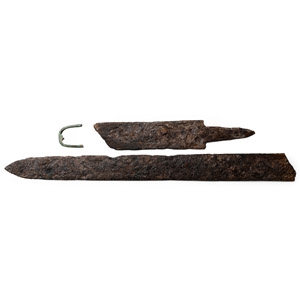
Saxon Sacrificed Iron Spatha with Bronze Chape
5th-6th century A.D.Estimate: £1,500 - 2,000 (+bp*)
Double-edged long sword (spatha) of type Osterburken-Kemathen; the blade with squared shoulders, broken into two parts for sacrificial reasons, tapering towards the point; sturdy tang partially preserved; wooden traces of the scabbard and hilt still visible; accompanied by a bronze outer rim of a scabbard; restored. 630 grams total, 78 cm long
From the private collection of a London gentleman, from his grandfather's collection formed before the early 1970s.
The deliberate fragmentation of a sword, often into three pieces, was a symbolic act of ‘killing’ the weapon, which was then placed as a grave good or offered in a ceremonial context. This was a Germanic custom already visible in the Vandal Przeworsk culture around the 3rd or 4th century A.D., which continued in Northern European areas until the 5th and the 6th centuries A.D.

