-
.jpg)
Old Babylonian Cylinder Seal with Two Standing Figures
2nd millennium B.C.Estimate: £1,500 - 2,000 (‡+bp*)
Representing a god in short mantle and round cap with upturned brim, holding a mace in his left hand, before him a goddess standing in a horned crown and kaunakes, her hands raised in supplication; accompanied by a museum-quality impression. 8.96 grams, 27 mm
Ex Mr J.K. collection, USA. Acquired from the above, 1997. This lot has been checked against the Interpol Database of stolen works of art and is accompanied by a search certificate number no.12581-232131.
The seals of the First Isin Dynasty were much more varied than those just preceding the Third Dynasty of Ur. Often the chief god - probably Shamash - is standing, and the 'introducing' goddess is facing him, while the worshipper is not pictured. The seals are a mine for the understanding of the old Babylonian costume. The tunic of the female goddess here is made of tufted material that the Greeks called kaunakes, the weave of which imitated the effect of the earlier sheepskin costumes. -
.jpg)
Cappadocian Stone Cylinder Seal with Court Scene
Circa 2000-1900 B.C.Estimate: £1,200 - 1,700 (‡+bp*)
Frieze including two standing attendants in flounced floor-length robes before a laden table and a seated figure in similar robes, the seated figure drinking from a vessel through a drinking pipe, behind him a stag with a small animal between its legs, a border of pellets above and below. 21.9 grams, 40 mm
Acquired in the mid 1980s-1990s. Private collection, Switzerland, thence by descent. Private collection, since the late 1990s. -
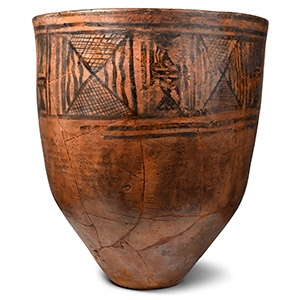
Monumental Western Asiatic Pottery Jar
Circa 3000 B.C.Estimate: £2,000 - 3,000 (+bp*)
Comprising a sharply tapering lower body, parallel-sided upper body and rounded rim; decorated in dark brown with thirteen square panels with central saltire on a hatched field; repaired. 17 kg, 64 cm high
with Mahboubian Gallery, London, UK, 1974. Private collection, London, UK. This lot has been checked against the Interpol Database of stolen works of art and is accompanied by search certificate number no.12972-245238. -
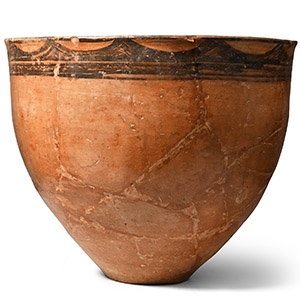
Large Western Asiatic Pottery Jar
Circa 3000 B.C.Estimate: £600 - 800 (+bp*)
Comprising a broad body with slightly flared rim and rounded body tapering to a narrow base; painted multilinear band below the rim with scoops above; repaired. 5 kg, 33.5 cm
with Mahboubian Gallery, London, UK, 1974. Private collection, London, UK. -

Achaemenid Silver Alabastron with Duck Handles
Circa 500 B.C.Estimate: £800 - 1,000 (+bp*)
With a bag-shaped tubular body and a rounded base; applied loop handles to the shoulders, each formed as a duck's head. 95 grams, 13.2 cm
London art market, 1980s-2000s. Private collection, London, UK. -
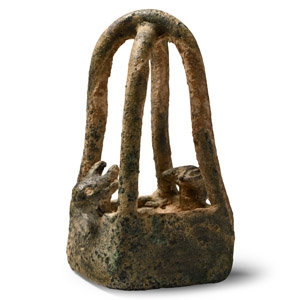
Western Asiatic Bronze Cage Weight
2nd-1st millennium B.C.Estimate: £600 - 800 (+bp*)
Comprising a rectangular basket with two overlapping U-shaped handles, two bull heads resting on the edge of the basket. 198 grams, 74 mm
From the collection of a gentleman, acquired on the London art market in the 1990s. -
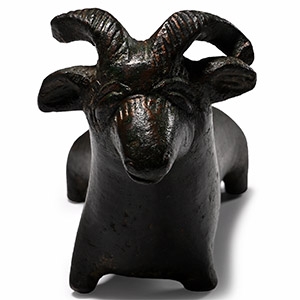
Western Asiatic Bronze Ram-Shaped Kohl Vessel
Circa 1500 B.C.Estimate: £800 - 1,000 (‡+bp*)
Modelled as a stylised ram with stocky body and short legs, exaggerated head with curving horns and large ears, tubular mouth with remains of the applicator closing the opening. 425 grams, 11.4 cm
Private collection Dr Rudolf and Leonora Blum, Zumikon, Switzerland. with Galerie Rhéa, Zurich, Switzerland. -
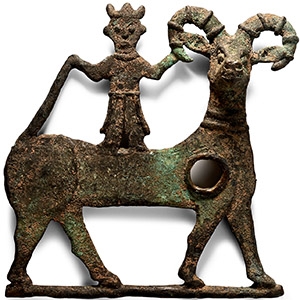
Luristan Bronze Horse Bit Cheek-Piece with Master of Animals
8th–7th century B.C.Estimate: £2,000 - 3,000 (+bp*)
Formed as an advancing ram on a baseline with head turned to face the viewer, applied collar, standing human figure holding the tail; circular hole to the shoulder to accept the bit; mounted on a display stand. 212 grams, 12.7 cm (601 grams total, 18.4 cm including stand)
A.P. family collection, Europe, from 1969, partly transferred to the United Kingdom in 1981. London art market, after 2000. This lot has been checked against the Interpol Database of stolen works of art and is accompanied by search certificate number no.12974-245211.
Horse equipment was an important symbol of status and power in the Iron Age Near East. Elaborate bits with decorated cheek-pieces were not only practical items for controlling horses but also served a display function, reflecting the wealth and rank of their owners. -
.jpg)
Luristan Bronze Horse Bit Cheek-Pieces Modelled as Winged Gryphons
8th–7th century B.C.Estimate: £2,500 - 3,500 (+bp*)
Comprising a matched pair of cheek-pieces, each a winged gryphon standing on a baseline with head turned to face the viewer, curled tail to rump, lateral horns to the brow; pierced at the shoulder to accept the bit; mounted on a custom-made stand. 423 grams total, 10.4-10.7 cm (1.07 kg total, 26 cm wide including stand)
A.P. family collection, Europe, from 1969, partly transferred to the United Kingdom in 1981. London art market, after 2000. This lot has been checked against the Interpol Database of stolen works of art and is accompanied by search certificate number no.12975-245210.
Horse equipment was an important symbol of status and power in the Iron Age Near East. Elaborate bits with decorated cheek-pieces were not only practical items for controlling horses but also served a display function, reflecting the wealth and rank of their owners. The sphinx, a creature combining human and animal features, was a common protective figure in the art of the period. Winged sphinxes, in particular, were associated with divine guardianship and the protection of rulers and warriors. The use of such imagery on horse gear underscored the prestige of cavalry and chariotry in the 8th–7th century BCE, when mounted warfare played a central role in the expansion of Near Eastern empires. -
.jpg)
Bactrian Bronze Zebu Vessel with Stopper
1st millennium B.C.Estimate: £15,000 - 20,000 (+bp*)
Modelled in the round as a zebu standing four-square with head raised; columnar muzzle with shallow slit mouth, discoid eye-sockets to accept and inlay; lateral loops at the shoulder and tubular filler-hole; separate hump forming a lid with corresponding loops for attachment. 870 grams, 16.5 cm wide
Private collection, New York, 1987. with Bonhams, London, 1 May 2013, no.154. Accompanied by a copy of the relevant Bonhams catalogue pages. Accompanied by a copy of French passport no.119527. Accompanied by an academic report by Dr Raffaele D’Amato. This lot has been checked against the Interpol Database of stolen works of art and is accompanied by search certificate number no.12976-245249.
The majestic zebu bull, with its heavy dewlap and wide curving horns, was considered to be a symbol of majesty and power since the first civilizations of the Indus Valley. It was the leader of the herd, the strength and virility (then symbol of fecundity) of which protected the group and ensured the procreation of the species. This is the reason why it was often chosen for sacrificial rites. It probably represented the emblem of the most powerful clans or top classes of Mohenjo-Daro and Harappa and it was the most impressive motif found in these cities, appearing constantly on painted pottery and bronze or clay figurines of the Indus area. -
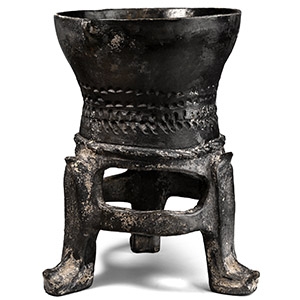
Large Azerbaijan Hasanlu Tepe Pottery Vessel
1st millennium B.C.Estimate: £1,500 - 2,000 (+bp*)
Comprising a broad bell-shaped bowl with flat rim attached by a thick trunk with four rows of angled impressions to a tripod base with sturdy curved legs with inner supporting ring and keeled finials. 5.28 kg, 35.5 cm
with Mahboubian Gallery, London, UK, 1974. Private collection, London, UK. -
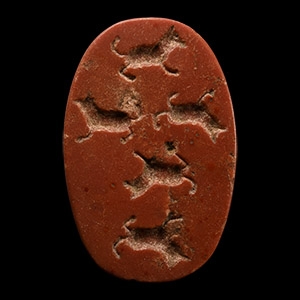
Large Proto-Sumerian Red Jasper Seal
Circa 3000 B.C.Estimate: £800 - 1,000 (‡+bp*)
Plano-convex in section with incuse animal forms to the underside. 82.8 grams, 66 mm
Private collection. Acquired from a Swiss collection, 2002.

