-
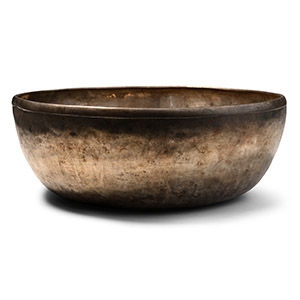
Roman or Gandharan Silver Bowl
Circa late 1st century B.C.-early 1st century A.D.Estimate: £1,500 - 2,000 (+bp*)
Squat in profile with gently domed base, curved sidewall with carination below the rim. 233 grams, 18.1 cm
Acquired from a private UK collection prior to 1979. Ex Julian Sherrier collection, a leading figure in Gandharan art. with Christie's, New York, sale 2337, 14th September 2010, no.51 (part). Accompanied by the original Christie's bar code label. -
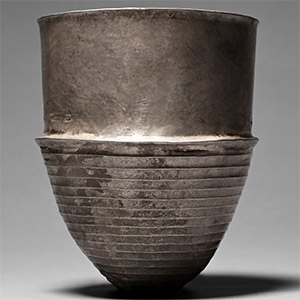
Roman or Gandharan Silver Carinated Cup
Circa late 1st century B.C.-early 1st century A.D.Estimate: £3,000 - 4,000 (+bp*)
Formed from a single sheet, the ovoid base carinated with plain upper portion, slightly flared lip to the rim. 95 grams, 10.4 cm
Acquired from a private UK collection prior to 1979. Ex Julian Sherrier collection, a leading figure in Gandharan art. with Christie's, New York, sale 2337, 14th September 2010, no.56A (part). Accompanied by the original Christie's lot ticket. This lot has been checked against the Interpol Database of stolen works of art and is accompanied by search certificate number no.12961-244455. -
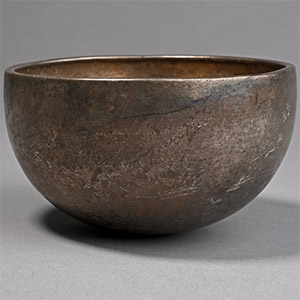
Roman or Gandharan Silver Cup
Circa late 1st century B.C.-early 1st century A.D.Estimate: £1,500 - 2,000 (+bp*)
Hemispherical in profile with rounded underside, thickened rim. 232 grams, 11.4 cm
Acquired from a private UK collection prior to 1979. Ex Julian Sherrier collection, a leading figure in Gandharan art. with Christie's, New York, sale 2337, 14th September 2010, no.41 (part). Accompanied by the original Christie's lot ticket. -
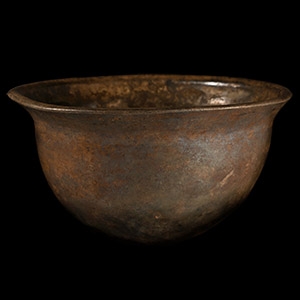
Roman Silver Bowl
2nd century A.D.Estimate: £650 - 750 (+bp*)
Bell-shaped with thickened rim and rounded underside. 322 grams, 13.2 cm wide
Usage wear.
Acquired early 1990s. Ex private American collection; thence by descent. Private Swiss collection since 1998. -
.jpg)
Life-Size Roman Bronze Head of an Empress
Mid-3rd century A.D.Estimate: £40,000 - 60,000 (+bp*)
A member of the Imperial family, possibly an empress, depicted with an elaborate coiffure, the hair at the back of the head parted in the middle and the two strands folded over each other, then pulled to the front to form a looped horizontal layer parted in the middle of the smooth forehead and drawn back, individual curls represented as vertical lines along the forehead hairline up to the exposed ears, two locks hanging down the sides behind the ears, extending to the upper part of the neck; beautiful facial rendering with stoic expression, exquisite detailing to the eyebrows, eyelids and pupils; snub-nose, closed lips, thin and graceful neck; mounted on a custom-made display stand. 4.07 kg, 40.5 cm high including stand
Acquired on the German art market, early 1970s. German private family collection; by gift to the owner's son in 2015. Private collection, London. Accompanied by an academic report by Dr Raffele D'Amato, and Dr Marina Mattei, former curator of the Capitoline Museums for over 40 years. This lot has been checked against the Interpol Database of stolen works of art and is accompanied by a search certificate number no.12607-234556.
The mature age of the woman depicted in the portrait is revealed by the oval gaunt, deep-set eyes and the folds at the sides of the nose and mouth. The woman’s head shows the typical traits of the full and mature 3rd century A.D., executed in a Hellenistic style tradition. Our sculpture is well inserted in the imperial portrait type, bearing technical and aesthetical parallels to portraits in bronze. The hairstyle could be Scheitelzopf (or reverse plait), tightened by a hairnet, pinned to the top of the head. The same type of hairstyle, albeit with variations in the details (decorative curls and position of the hair loop), is found on a few other portraits of women that were dated to the Period of Gallienus by Marianne Bergmann. Some of the portraits in this typologically related group are likely to be private portraits. Hereby physiognomic features and especially imperial coin portraits need to be taken into account. In this context, it is important to compare the portrait with that of Trebonianus Gallus in the MET. Like the sculpture of Trebonianus Gallus, the head fits stylistically with Roman provincial bronzes from the Eastern Mediterranean or North Africa, possibly from workshops of Asia Minor or from the great metropolis of Alexandria, where bronze statuary was more common and Hellenistic influences remained strong. -
.jpg)
Etruscan Bronze Lion Head
Central Italy, late 6th century B.C.Estimate: £10,000 - 14,000 (‡+bp*)
A decorative fitting with roaring mouth and protruding fangs and tongue, the whiskers depicted in raised radiating ridges, with lidded, elongated almond-shaped eyes and small, round ears; mounted on a custom-made display stand. 1.11 kg total, 17.5 cm including stand
with Christie’s, New York, 8 June 2001, no.58. Donati collection, Lugano, prior to 1982. Collection of Banca della Svizzera Italiana, Lugano, prior to 1986. Formerly in the Bourgknecht collection, Switzerland. Accompanied by Art Loss certificate no.S00123227.
This head was probably, as was the parallel head of the Barberini Tomb, originally attached to a magnificent bronze cauldron. These large cauldrons of hammered bronze were realised with heads and necks of two lions and two gryphons attached to the rim. The cauldrons were spherical in form and rested on a stand. -
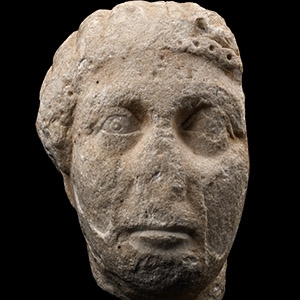
Roman Marble Head of a Woman
3rd-4th century A.D.Estimate: £6,000 - 8,000 (+bp*)
Carved in three-quarter view, with hair dressed in a chignon with frontal band and wavy segments; soft facial features with much detailing remaining to the proper right eye and mouth; likely a frieze fragment; mounted on an old collector's display stand with typed label 'Marble, woman's head / Egypt / C.25-100 A.D. / Cat.No. 6169'. 8.45 kg, 39 cm high
Acquired in trade from the San Franciscanum Museum, Israel, prior to 1980. with Archaeologia, pre 1983, Switzerland and Canada. Accompanied by an academic report by Dr Raffaele D’Amato. This lot has been checked against the Interpol Database of stolen works of art and is accompanied by search certificate number no.12964-242755.
The arrangement of the hair is characteristic of female portraits dating between the late Severan and Tetrarchic periods. The head, due to the treatment of the hair, finds comparisons with a female portrait in the Museo Nazionale Romano, depicting an elderly woman of the Antonine era, and with another female portrait in the same museum, dated to the third decade of the 3rd century A.D., reworked in the Tetrarchic period, and which showed a Severan so-called Nest Frisur hairstyle. The sculpture in question can therefore be dated between the full 3rd century A.D. and the first decades of the 4th century A.D. based on the hairstyle, the shape of eyes and eyebrows. -
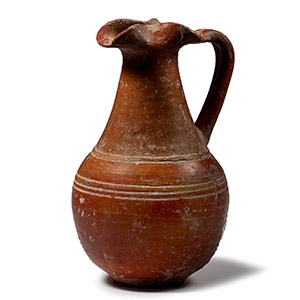
Phoenician Terracotta Jug with Handle
Circa 8th century B.C.Estimate: £600 - 700 (‡+bp*)
Globular body decorated with circumferential banding, low foot, conical neck with pinched spout, strap handle to the rear. 395 grams, 18.5 cm
Acquired in the mid 1980s-1990s. Private collection, Switzerland, thence by descent. Private collection, since the late 1990s. -
.jpg)
Roman Marble Head of Cupid on Georgian Pedestal
1st -2nd century B.C. and laterEstimate: £20,000 - 25,000 (‡+bp*)
Carved in the round as a bust of a child with short hair combed into a peak, fleshy features, lips slightly parted in a smile, fitted to an 18th century marble pedestal; mounted on a display stand with collection note 'Buste d'Enfant / Epoque Romaine / 1er Siècle'. 6.12 kg total, 30 cm including stand
Collection of B. Poindessault (1935-2014), France, acquired before October 1975. Oger & Blanchet Enchères, Paris, 2014. German private collection, Cologne. Private collection, acquired in 2015. Accompanied by an academic report by Dr Marina Mattei. Accompanied by a copy of an Art Loss Register certificate, no.S000104583 Accompanied by a copy of French passport no.167453. This lot has been checked against the Interpol Database of stolen works of art and is accompanied by search certificate number no.12931-246329.
The finely sculpted head represents a young child, probably intended as Eros (Cupid). Such depictions were produced in numerous variations to illustrate the stages of childhood and the capacity of children to undertake meaningful or symbolic actions. The softly modelled features and gentle expression recall the celebrated work of Boethos, The Boy Strangling the Goose, as well as the widespread images of Eros and the Erotes found throughout Greco-Roman sculpture and painting. In Greco-Roman art, representations of children occupied an important and evolving role. Initially, youthful figures were portrayed as miniature adults, but from the 4th century BC onwards - particularly during the Hellenistic and Roman periods - artists began to study children’s anatomy more closely, reproducing their characteristic proportions and expressions with naturalistic sensitivity. The figure of Eros, the constant companion of Aphrodite, became the quintessential model of the child in ancient art, identifiable by his traditional attributes of wings and bow. As evidenced by numerous statuettes and wall paintings unearthed at Pompeii, scenes of childhood were among the most popular subjects for adorning the gardens and interiors of wealthy Roman villas. These figures appear in lively and varied activities - playing, working, performing, or interacting with animals such as birds, hares, and dolphins - celebrating both the charm and vitality of early life within an idealised artistic vision. -
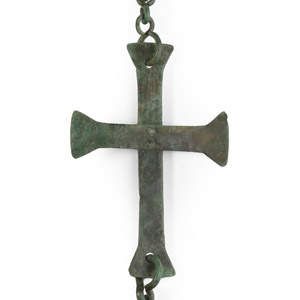
Byzantine Bronze Polycandelon Hanger Chain with Cross
5th-7th century A.D.Estimate: £300 - 400 (+bp*)
Comprising a substantial link chain with a large cross composed of two rivetted plates. 372 grams, 87 cm
Ex German art market, 2000s. Acquired from an EU collector living in London. From the collection of a Surrey, UK, gentleman. -
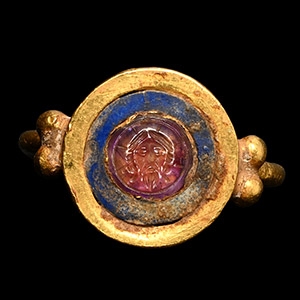
Byzantine Gold Ring with Head of Christ Gemstone
Circa 6th-8th century A.D.Estimate: £4,500 - 6,500 (+bp*)
Round-section hoop with granules to the shoulders, discoid bezel with inset lapis lazuli circle enclosing a later amethyst gemstone with facing bust of Christ Pantocrator. 10.36 grams, 25.80 mm overall, 20.26 mm internal diameter (approximate size British S, USA 9, Europe 19, Japan 18).
Ex collection of a London lady, 1980s. This lot has been checked against the Interpol Database of stolen works of art and is accompanied by search certificate number no.12968-246371. -
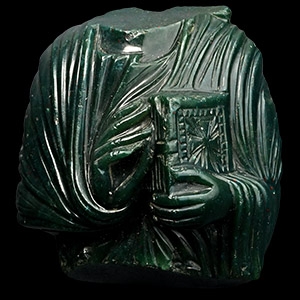
Byzantine Nephrite Icon Fragment with Christ Blessing
11th century A.D.Estimate: £12,000 - 17,000 (+bp*)
Fragment of a figure carved in the half-round, with pleated garment, holding a book with a cross in the left hand and touching its edge with the right hand; to the reverse, a low-relief cross with knops to the angles, abbreviated legends 'IC / XC / NI / KA' for 'Jesus Christ is Victorious' in seriffed capitals in the spandrels of the cross, each with a superscript macron. 38 grams, 40 mm
New Forest, UK, collection, 1950s. Alexander Cotton collection, UK, 1970-1980s. London gallery 1990s, latterly a London gentleman's collection, 2000s. Accompanied by an academic report by Dr Raffaele D’Amato. This lot has been checked against the Interpol Database of stolen works of art and is accompanied by a search certificate number no.12912-244440.
This magnificent, if fragmentary, icon belongs to the most florid period of Byzantium’s renaissance, when, under the aegis of the Macedonian Dynasty, the political, military, cultural and economic power of the Roman Empire reached the last apex of its glory. The figure detailed in bloodstone here represents Christ, as is clear not only from the cross engraved on the back, but also from the garments he is wearing. It is likely that it is Christ as Pantocrator who is represented, maybe originally forming part of a more complex icon representing the Deesis. While this subject in Eastern Roman art is usually reserved for monumental decoration, it is sometimes found on smaller-scale objects as well, such as cameos and steatite icons.

