-
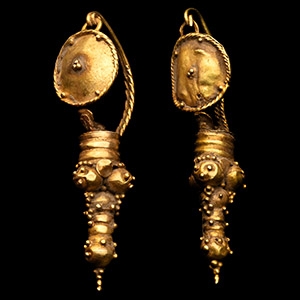
Roman Gold Earring with Matched Copy
2nd-3rd century A.D. and laterEstimate: £1,000 - 1,400 (+bp*)
Featuring a large central boss with and pendant decorated with fine granulation; discus decorated with a central cluster of granulation with four simple granules to the edges; boss framed with gentle ropework around the edges; hanging pendants with a cylindrical bead, and cluster of granulated hollow spheres; with another reproduction earring to make a pair. 7.25 grams total, 46 mm
Ex collection of a deceased Japanese gentleman, 1970-2010. -
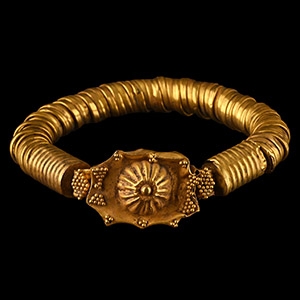
Roman Gold Spiral-Twisted Wire Bracelet with Central Bezel
2nd-3rd century A.D.Estimate: £4,000 - 6,000 (‡+bp*)
Penannular hollow-form bracelet formed from a spiral-wound rod with an end-cap and loop; closure by means of a hollow-formed cap with fluted sidewall and dome to upper face with granulation detailing. 35.78 grams, 80 mm
with Bukowski's Stockholm, December 2002, no.719. Acquired by the current owner from the above. Private collection, Stockholm. Accompanied by copies of a Swedish cultural export licence, no. RAA-2025-1646. Accompanied by an academic report by Dr Raffaele D'Amato. This lot has been checked against the Interpol Database of stolen works of art and is accompanied by search certificate number no.12958-242701.
Such bracelets were widespread in the Roman period, during the 2nd and 3rd centuries A.D., with a variation of dimensions, bezels and materials. On some artefacts, the sleeves making up the twist were hollow tubes filled with stucco, resin or plaster, preventing them from deforming. The stucco was left in the sleeve to give it a greater impact resistance, but this did not allow for longer welding of the tubes by fire, because the composition would boil. -
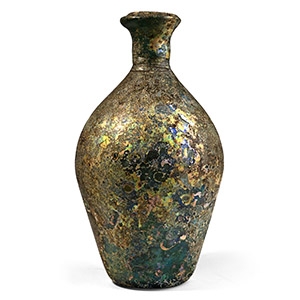
Large Eastern Roman Green Glass Bottle with Iridescence
2nd-3rd century A.D.Estimate: £2,500 - 3,500 (+bp*)
Piriform in profile with a narrow neck and flared mouth with a chamfered rim, dimple base. 945 grams, 29.5 cm high
From the Xavier Guerrand-Hermès private collection. with Artcurial, Paris, 25 March 2014, no.39. Private collection, London, UK. This lot has been checked against the Interpol Database of stolen works of art and is accompanied by search certificate number no.12959-245241.
On ancient glass, iridescence is the soft play of colour that develops as the surface ages and becomes silica-rich. Minute layers form over time and break light into shifting blues, greens and golds. It is not a modern finish but something time has drawn out of the material itself, so the pattern and palette are unique to each piece. Collectors prize good, stable iridescence because it lifts the form: ribs read more crisply, profiles glow, and simple vessels take on depth and movement. Museums now tend to preserve these surfaces rather than polish them away, recognising both their beauty and what they tell us about an object’s long life (though it is not, by itself, a dating test). For display, iridescent glass performs brilliantly under gentle, directional light, where the colours “turn” as the vessel is moved. Well-preserved, even iridescence of this quality is not common and adds materially to the presence and desirability of the piece. -
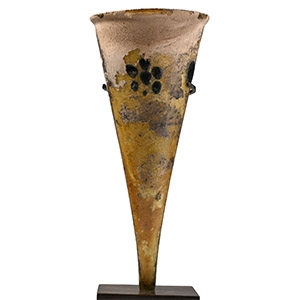
Roman Glass Flask with Dotted Rosettes
2nd century B.C.-1st century A.D.Estimate: £1,000 - 1,400 (+bp*)
Conical body with rounded base, applied clusters of blue glass around the body, everted rim; traces of iridescence; mounted on a custom-made stand. 254 grams total, 20.8 cm
From an important collection of glass, London, UK, 1990s. -
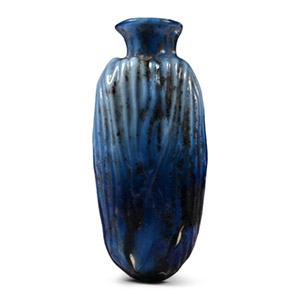
Roman Deep Blue Glass Date Flask
1st century A.D.Estimate: £2,500 - 3,500 (‡+bp*)
Mould-blown with elliptical body, short neck and thick everted rim, with modelled wrinkles imitating the texture of a dried date. 41.7 grams, 80 mm
Dr Gonik & Me Wirth, Geneva, 1970s. Private collection, Europe. Accompanied by an academic report by Dr Raffaele D'Amato. This lot has been checked against the Interpol Database of stolen works of art and is accompanied by a search certificate number no.12394-226935.
Dates were not only a staple of the Mediterranean diet, used to sweeten food and wine, but also a symbol for the New Year and a fruit often given as a gift on the occasion. -
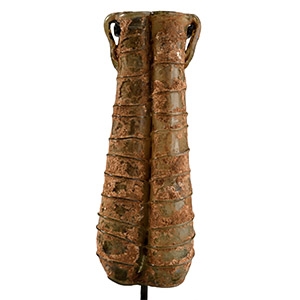
Roman Glass Double Unguentarium
4th-5th century A.D.Estimate: £400 - 600 (+bp*)
Comprising two conjoined tapering tubular cells, with applied handles at the shoulder; mounted on a custom-made stand. 89 grams total, 13.5 cm including stand
From an important collection of glass, London, UK, 1990s. -
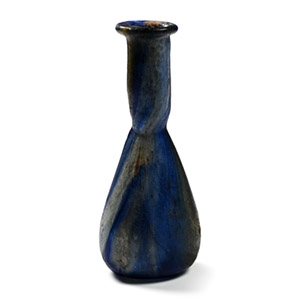
Roman Marbled Blue Glass Bottle
1st century A.D.Estimate: £1,200 - 1,700 (‡+bp*)
An iridescent unguentarium with piriform body, tubular neck with everted rolled rim. 19.7 grams, 83 mm
Acquired on the European art market in 2001. -
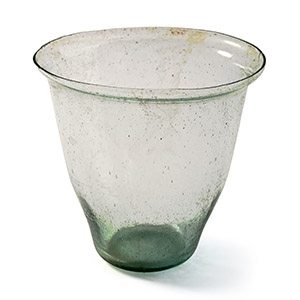
Roman Light Green Glass Lamp
Circa 4th century A.D.Estimate: £300 - 400 (+bp*)
Tapering body with pontil base, slightly everted rim; traces of iridescence. 41 grams, 80 mm
From an important collection of glass, London, UK, 1990s. -
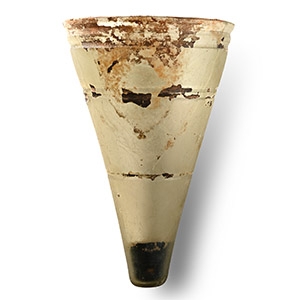
Large Roman Cut Glass Beaker
4th-5th century A.D.Estimate: £2,000 - 3,000 (+bp*)
A beaker or lamp with thick conical body and pontil base, five horizontal grooves cut around the body; traces of iridescence. 289 grams, 18.5 cm
Dr Jutaro Kawabe, Nagoya, Japan, his collection formed in the 1960s-1970s. with Hoshigaoka Gallery until the late 1990s. Private collection, London, UK. This lot has been checked against the Interpol Database of stolen works of art and is accompanied by a search certificate number no.12830-241334.
Conical vessels of this form were either used as a lamp or a beaker; notably during the late imperial period in the eastern provinces of the Roman Empire and in the early Migration period. Deep cuts on this piece suggest it was used with suspension chains or ropes, making it highly likely that this example was used as a lamp. -
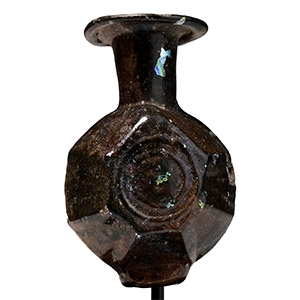
Roman Decorated Mould Blown Glass Amphoriskos
Circa 1st-2nd century A.D.Estimate: £2,000 - 3,000 (+bp*)
Comprising a biconvex body with ellipsoid base, short neck with everted rim and strap handle; the body facetted, with concentric rings to the central panel on each side; mounted on a custom-made stand. 82 grams total, 95 mm including stand
From an important collection of glass, London, UK, 1990s. This lot has been checked against the Interpol Database of stolen works of art and is accompanied by search certificate number no.12960-246379.
The word amphoriskos, Greek for 'small amphora', refers in the Graeco-Roman world to the shape of the object, a miniature version of the two-handled metal or ceramic vessels that contained oil or wine. Core-formed glass was made by dipping a removable core that gives the vessel its shape into a molten glass mixture. -
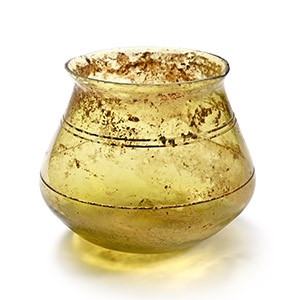
Roman Glass Cup with Wheel-Cut Lines
1st-2nd century A.D.Estimate: £700 - 900 (+bp*)
With biconvex body, dimple base, convex rim, wheel-cut circumferential bands. 131 grams, 95 mm
From an important London collection of glass, 1990s. This lot is accompanied by an illustrated lot declaration signed by the Head of the Antiquities Department, Dr Raffaele D'Amato.
This form is similar to beakers produced in Roman Cyprus. The rim and the wall of these objects are very thin; in one similar beaker in the Cesnola collection they are less than 0.1 cm thick. They belong to the Vessberg beaker type A.II.α. -
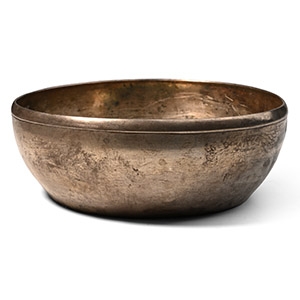
Roman or Gandharan Silver Flat-Bottom Bowl
Circa late 1st century B.C.-early 1st century A.D.Estimate: £1,500 - 2,000 (+bp*)
Squat in profile with a gently domed base, curved sidewall with carination below the rim. 244 grams, 17 cm
Acquired from a private UK collection prior to 1979. Ex Julian Sherrier collection, a leading figure in Gandharan art. with Christie's, New York, sale 2337, 14th September 2010, no.51 (part). Accompanied by the original Christie's lot ticket and bar code label.

