-
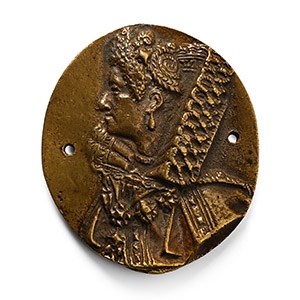
Post Medieval Bronze Medallion of Maria Magdalena of Austria
France, 17th century A.D.Estimate: £200 - 300 (+bp*)
A heavy medallion bearing the profile bust of Maria Magdalena of Austria (1587-1629), cast from a medal by Guillaume Dupré, circa. 1613; pierced twice through the edge for mounting. 93 grams, 76 mm
Private collection, UK.
Maria Magdalena of Austria (1587-1629) was the Archduchess of Austria, Grand Duchess of Tuscany and wife of Cosimo II de’ Medici (1589-1636). -
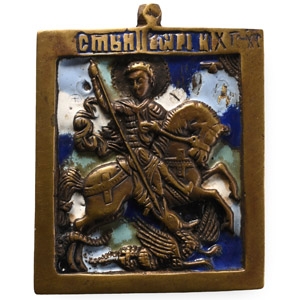
Russian Orthodox Enamelled Bronze Travel Icon with Saint George
19th century A.D.Estimate: £120 - 170 (+bp*)
Saint George on horseback, dispatching the dragon with a spear; the saint dressed in lamellar Roman cuirass and seated on a high-ended saddle secured by breast, rump, and belly straps; Old Slavic inscription on the top, reciting Saint George (Свято́й Гео́ргий ). 90 grams, 65 mm
Acquired from Chris Martin-Zakheim, Iconastas, 5 Piccadilly Arcade, London SW1. From the private collection of a West London, UK, gentleman, formed since the early 2000s.
According to the Christian tradition, Saint George would have lived between the end of the 3rd century and the beginning of the 4th century: born into a noble Christian family, he became an officer in the Roman army and was then named a praetorian by Diocletian. But when the same emperor decided to resume the persecutions, Saint George became a victim despite his important political rank. His role in the development of the faith is so important that he is included among the Great Martyrs of the Eastern Church and his fight against the dragon becomes a symbol par excellence of the fight for good which defeats evil. -
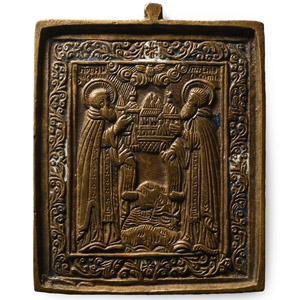
Russian Orthodox Enamelled Bronze Travel Icon with Saints Zosima and Sabbas
Circa 1820 A.D.Estimate: £120 - 170 (+bp*)
Depicting Saint Zosima and Saint Sabbas in front of the Solovetsky Monastery; both nimbate and dressed inAbbot’s garments, holding the model of the monastery offered to God, represented in the sky as a dove upon a cloud; arabesque frame; inscriptions in Old Slavonic with the names of the saints. 108 grams, 88 mm
Acquired from Chris Martin-Zakheim, Iconastas, 5 Piccadilly Arcade, London SW1. From the private collection of a West London, UK, gentleman, formed since the early 2000s.
Saints Zosima and Sabbas or Sabbatius were highly venerated Orthodox saints, founders of the Solovetsky Monastery, a fortified monastery located in the White Sea in Northern Russia. This double portrait shows Zosima and Sabbas holding up a model of their religious institution, which resembles a small medieval city. Solovetsky Monastery obtained big investments from the city of Novgorod and established itself as one of the richest monasteries in Russia. -
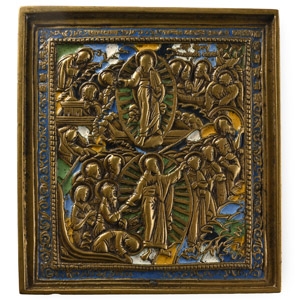
Russian Orthodox Enamelled Bronze Travel Icon with Anastasis
19th century A.D.Estimate: £200 - 300 (+bp*)
With blue, yellow, white and green enamel, representing the Anastasis (Resurrection of Christ); the Saviour represented on two registers, in the upper one (Resurrection) emerging from the grave, surrounded by the hesychastic light, with the Roman soldiers falling asleep, and the apostles and a cherubin beside him; in the lower register (Descent into Hades) Christ surrounded by the same divine light, leading the people from the Limbo, Adam and Eve, King David and Salomon and other souls to heaven; the frame decorated with gilt arabesques on blue enamel, inscriptions in Old Slavonic at the top. 200 grams, 11 cm
Acquired from Chris Martin-Zakheim, Iconastas, 5 Piccadilly Arcade, London SW1. From the private collection of a West London, UK, gentleman, formed since the early 2000s.
The iconography is typical of the Anastasis or Resurrection of Christ, with the gates of Hades broken under the feet of the Christ, echoing the phrase: 'Christ is Risen From the Dead, Trampling Down Death by Death, and Upon Those in the Tombs Bestowing Life!' -
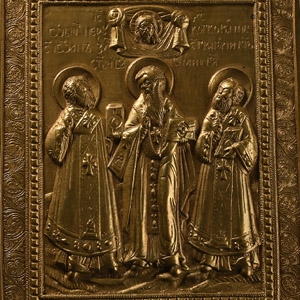
Russian Bronze Travel Icon with the Three Hierachs of Orthodoxy
19th century A.D.Estimate: £120 - 170 (+bp*)
Depicting Saint Basil the Great, Saint Gregory the Theologian and Saint John Chrysostomus, all nimbate and holding their holy writings, under the vision of the Holy Mandylion; Saint Basil wearing a bishop's sakkos, the other two wearing the usual orthodox priest's garb, phelonia; all three wearing a brocade band, omophorion, with four crosses; inscriptions in Old Slavonic with the names of the Saints, on the Nimbus of Jesus, the letters 'O Ѡ N' (‘I AM’); names of the Saints in the background in Old Slavonic; framed by double moulding, the first decorated with crenellated elements, the second with arabesques. 270 grams, 11.5 cm
Acquired from Chris Martin-Zakheim, Iconastas, 5 Piccadilly Arcade, London SW1. From the private collection of a West London, UK, gentleman, formed since the early 2000s.
The icon is the so-called icon of the three hierarchs, Saint Gregory the Theologian (Gregory of Nazianzus), Saint Basil the Great (Basil of Caesarea) and Saint John Chrysostom, archbishop of Constantinople. All three were important fathers of the church who strove to clarify and crystallise Dogma, for the unity of the faith, of the Liturgy and the needs of philosophy and letters. -
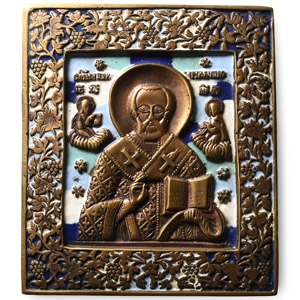
Russian Orthodox Enamelled Bronze Travel Icon with Saint Nicholas
19th century A.D.Estimate: £250 - 350 (+bp*)
Representing Saint Nicholas of Myra with a book in his left hand and making the gesture of blessing with his right, dressed as a bishop with sticharion, covered by omophorion, and surmounted by an epitrachelion embroidered with crosses; the saint flanked by Jesus and Virgin Mary, Christ holding the gospel, Mary the bishop’s epitrachelion; Cyrillic inscriptions 'Saint Nikolaos the Wonderworker (СВЯТЫЙ НИКОЛА ЧУДОТВОРЕЦ), Iesus Christos (ΙΣ ΧC) and Mother of God (ΜΡ ΘΥ)' on the enamelled background. 348 grams, 10.7 cm
Acquired from Chris Martin-Zakheim, Iconastas, 5 Piccadilly Arcade, London SW1. From the private collection of a West London, UK, gentleman, formed since the early 2000s.
The icon features meticulous craftsmanship typical of Orthodox iconography. The enamel colors, despite the passage of time, retain their vibrant intensity, highlighting the key elements of the depicted images. The refined details and use of enamel give depth and luminosity to the icon, making it a precious example of the Russian Orthodox tradition. -
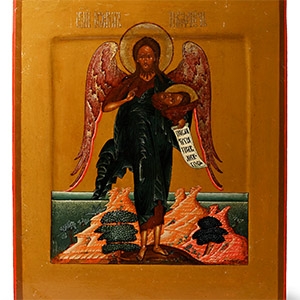
Russian Wooden Icon with St John the Baptist
19th century A.D.Estimate: £1,500 - 2,000 (+bp*)
Comprising a painted board with mounting panel and slots to the reverse, gessoed surface with painting of St John the Baptist standing nimbate with wings spread behind him, left hand supporting a bowl containing his severed head and holding an unfurled scroll with Cyrillic text 'Repent ye, for the Kingdom of Heaven is at hand,' (Matthew 3:2); right hand raised in blessing; landscape with sand-dunes and trees; gilded title above; the upper border with gilt Slavonic inscription reading 'Holy John the Forerunner'; from the Palekh Icon School, probably made in Mstera circa 1890. 1.02 kg, 31 cm high
Fine condition.
Ex property of a London lady, part of her family's collection. This lot has been checked against the Interpol Database of stolen works of art and is accompanied by a search certificate no.11546-196366.
The Palekh icon school emerged in the 17th century, inspired by the Moscow and Suzdal traditions of icon painting. Although preserving many features of traditional Russian iconography, the school created its own style that remained active into the 18th century. The hallmarks of the school include the frequent use of gold on the clothes of the saints and a rich palette. Bodies are shown as tall and slender and abrupt transitions between light and shadow are distinctive features of Palekh icons. The wings of Saint John derive from the double meaning of the Greek word used to describe him in Mark 1:2 - Angelos, meaning both messenger and angel. John is often called a 'Heavenly Man' and 'Earthly Angel' in Orthodoxy. At his feet is shown a small tree with an axe cutting into it, illustrating Luke 3:9, 'And now also the axe is laid unto the root of the tree...' -
.jpg)
Metal-Thread Embroidered Silk Panel with the Tughra of Sultan Mahmud II
Ottoman Empire, circa 1808-1839 A.D.Estimate: £18,000 - 24,000 (+bp*)
Rectangular in plan, the lime green silk field with two large roundels of red silk tied by a tassel in the rococo style, signature of Sultan Mahmud II contained within a mosque lamp, ten smaller roundels of alternating cream, orange and cream silk; large central rectangular panel and two bands above incorporating inscriptions in Thuluth, tughra of the Sultan framed by swags in lower part of field, ground richly decorated with floral swags and vegetal motifs, backed. 17.8 kg, 294 x 179 cm
Acquired before 2000. Private collection, UK. with Bonhams, London, 6 October 2008, no.216 (est. £80,000 - £120,000). This lot has been checked against the Interpol Database of stolen works of art and is accompanied by a search certificate number no.12741-235157.
The inscriptions comprise: in two horizontal cartouches: Qur'an, surah al-Ahzab (XXXIII, verses 45-46) inscription contained in mosque lamp; the signature of Sultan Mahmud Il in the two large roundels: the Shahadah in the six roundels above central rectangular panel; the names of the four Orthodox Caliphs, and the Imams Hasan and Husain in the central panel; Quran, surah al-Baqarah (Il), verse 255, ayat al-Kursi in the six side panels; the names of the companions of the Prophet in the lower part; the tughra of Sultan Mahmud. -
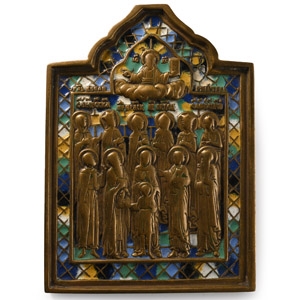
Russian Orthodox Enamelled Bronze Travel Icon with Saint Julyttas and Her Son Cyricus
19th century A.D.Estimate: £200 - 300 (+bp*)
With polychrome enamel in green, blue and yellow, framed by a square border with pointed doom, representing Saint Julyttas and her son Cyricus, surrounded by Saints; on the top, Christ Pantokrator, nimbate, making the gesture of blessing and holding a Gospel, seated upon a cloud and surrounded by Cyrillic letters 'ΙC ΧΡ' (Jesus Christ); Cyrillic inscriptions above some of the saints. 325 grams, 13.5 cm
Acquired from Chris Martin-Zakheim, Iconastas, 5 Piccadilly Arcade, London SW1. From the private collection of a West London, UK, gentleman, formed since the early 2000s.
Made of bronze with brightly coloured enamels, this icon was intended for private devotion, often carried by pilgrims and Orthodox believers for spiritual protection. St. Julyttas and her son Cyricus (Ки́рик и Иули́тта), among the most venerated figures in Russian tradition, are depicted in the centre, surrounded by other saints, a symbol of the communion of the righteous. -
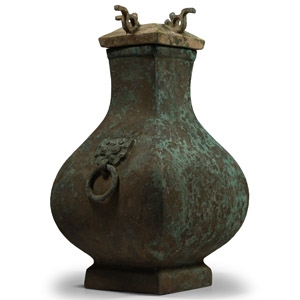
Chinese Archaic Style Bronze Vessel
20th century A.D.Estimate: £100 - 140 (+bp*)
Square in section and piriform in profile with taotie masks supporting drop handles, domed lid with four dragon appliqués. 3.2 kg, 34 cm high
Ex West Country, UK, collection, 1990s, and Desmond Morris. This lot is accompanied by an illustrated lot declaration signed by the Head of the Antiquities Department, Dr Raffaele D'Amato. -
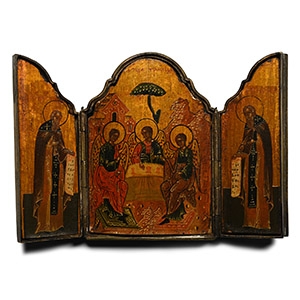
Russian Travelling Triptych Icon with Silver Mounts
Circa 1800 A.D.Estimate: £600 - 800 (+bp*)
Comprising: wooden triptych with gilt field and painted figures of St Nikolas and St Charalambos in the lateral panels and SS Konstantine, Helen and Barbara in the central panel, each with red lettering above; house in a purpose-made silver case with engraved scene to the central panel of Maria Theotokos flanked by celestial figures holding a crown above her head; front panels with facing figures of SS Nikolas, Barbara, Konstantine, Helena and Charalambos; in a custom-made wooden travelling case with hooked fastener. 331 grams total, 11.8 x 9.4 cm including case
Ex Iconastas, London SW1, UK, in 1997. Property of a London, UK, gentleman collector. Accompanied by a copy of the Iconastas invoice no.7463 dated 7 April 1997. -
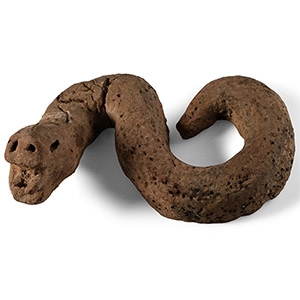
Egyptian Style Terracotta Snake
20th century A.D. or earlierEstimate: £80 - 100 (+bp*)
With D-section body and S-curved coils, head raised and mouth gaping to reveal a forked tongue; repaired. 456 grams, 18 cm
Acquired 1970s-1996. Property of a North American collector. London collection, 2016.

