-
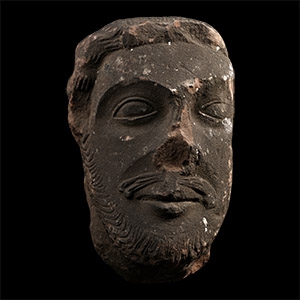
Post Medieval Red Sandstone Corbel Head
Circa 18th-19th century A.D.Estimate: £350 - 450 (+bp*)
Carved with centre-parted wavy hair, large lentoid eyes, neat beard and moustache; irregular to rear. 8.7 kg, 27 cm
Found in a garden in North Yorkshire, UK. -
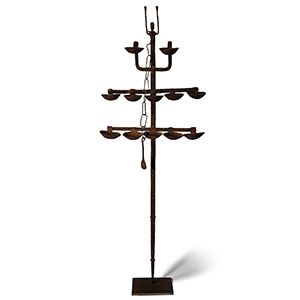
Dogon Iron Multiple Oil Lamp Stand
Circa 19th century A.D.Estimate: £400 - 600 (+bp*)
Iron flat-section shaft with three tiered cross-bars, the two lowest each with five iron lamp-bowls to the forward face; above, a U-shaped bar with a lamp bowl at each upper end; top of the shaft developing to an anthropomorphic torso with ellipsoid head and two narrow arms raised vertically; chain around the neck with hand-forged extinguishing spoon; mounted on a square base; Dogon, Mali, workmanship. 6.25 kg total, 132 cm including stand
From the private collection of Dr Hans-Joachim Koloss, Berlin, Germany, 1975-2002. Gorny & Mosch, Munich, Germany, auction 279, no.410. Accompanied by a copy of the Gorny & Mosch invoice and illustrated catalogue listing. Accompanied by a copy of the German cultural export licence.
The figure is probably a Nommo, a primordial ancestral spirit in Dogon cosmogony. A Nommo is usually considered to be amphibious, hermaphroditic and fish-like. They are typically depicted in Dogon art with a humanoid upper torso, and a fish-like lower torso and tail. -
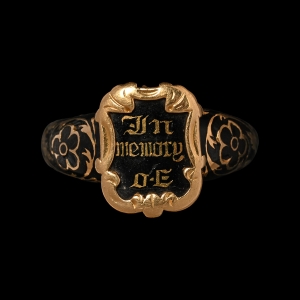
Engraved Gold and Black Enamel Memento Mori Ring
19th century A.D.Estimate: £600 - 800 (+bp*)
With D-section tapering hoop, black enamel finish with reserved rosettes and tendrils, the bezel an ornate heater shield with reserved text 'In memory OE' and copperplate engraving to the inner face '1852 / obt.63', 'Mrs.Sarah Hems, obt.26 May' and stamped assay marks: crown, '18', leopard's head, gothic 'k' in octagonal panel (dated to 1845). 4.14 grams, 22.74 mm overall, 17.43 mm internal diameter (approximate size British O, USA 7, Europe 14.98, Japan 14)
Acquired on the UK art market. Property of an East Sussex collector. -
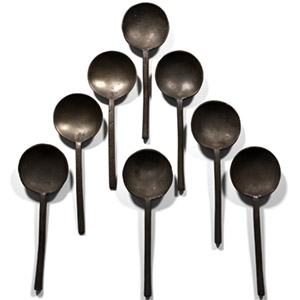
Pewter Spoon Collection
Circa 17th-18th century A.D.Estimate: £100 - 140 (+bp*)
Each with a shallow circular bowl and sturdy stem, six with a stamped X-motif within pelletted border to the bowl, and two with three stamped rosettes above letters(?). 839 grams total, 16.5 cm
Acquired in the Netherlands in the 1990s. Ex Cambridgeshire, UK, gentleman. This lot is accompanied by an illustrated lot declaration signed by the Head of the Antiquities Department, Dr Raffaele D'Amato. -
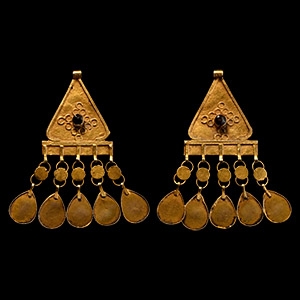
Roman Style Gold Earring Pair with Garnets
20th century A.D.Estimate: £300 - 400 (+bp*)
Each a triangular plaque with filigree border, central cell with inset garnet cabochon surrounded by applied filigree annulets, transverse bar below with discoid dangles. 4.04 grams total, 49 mm
with Archaeologia, Switzerland, before 1983. Ex private North American collection. London private collection, 2016. -
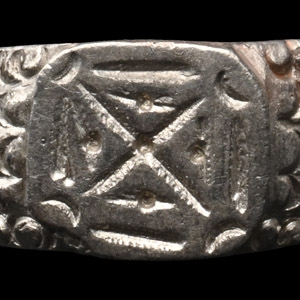
Post Medieval Silver Ring with Saltire Cross
Circa 17th-18th century A.D.Estimate: £100 - 140 (+bp*)
Substantial hoop with decorative panels flanking the square bezel, the bezel with incuse saltire cross. 7.80 grams, 24.15 mm overall, 19.95 mm internal diameter (approximate size British T, USA 9 1/2, Europe 21.26, Japan 20)
Ex German art market, 2000s. Acquired from an EU collector living in London. From the collection of a Surrey, UK, gentleman. -
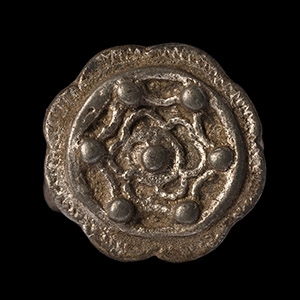
Georgian Period Silver Ring with Floral Design
Circa 18th century A.D.Estimate: £100 - 140 (+bp*)
With lateral spurs and stepped shoulders, the bezel an octofoil with raised hexafoil motif and pellets. 11.08 grams, 25.60 mm overall, 19.72 mm internal diameter (approximate size British Q, USA 8, Europe 17.49, Japan 16)
Acquired on the London art market in the late 1980s-1990s. From the family collection of an East London, UK, gentleman. -
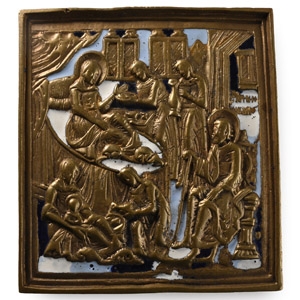
Russian Orthodox Enamelled Bronze Travel Icon with the Birth of the Virgin
19th century A.D.Estimate: £200 - 300 (+bp*)
Presenting an architectural setting with figures in two chambers framed with cornices, columns and furnitures; the upper chamber showing Saint Anna in birthing bed with two attendants; the lower room with two attendants bathing an infant; on the right Saint Joachim seated upon a cathedra; Old Slavonic inscription reciting ‘The birth of the most holy mother of God’. 230 grams, 98 mm
Acquired from Chris Martin-Zakheim, Iconastas, 5 Piccadilly Arcade, London SW1. From the private collection of a West London, UK, gentleman, formed since the early 2000s.
According to the Protoevangelium of James, Mary's parents were called Anna and Joachim and conceived Mary at a late age. -
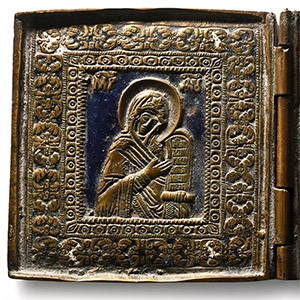
Russian Orthodox Enamelled Bronze Triptych Icon with Christ, Virgin Mary and Saint John
Circa 1820 A.D.Estimate: £400 - 600 (+bp*)
Depicting the Deesis divided in three panels, with Jesus Christ at the centre, Saint Mary on the left panel and Saint John the Baptist on the right; God holding the Gospel in his left hand and raising his right hand in blessing; Mary with veiled head and mantle, wearing a maphorion mantle over an embroidered robe and holding a scroll; Saint John, portrayed as an elderly man, wearing a camel-skin robe, winged and holding a bowl containing an infant with flexed legs and raised right hand, the saint’s right hand pointing toward the infant Jesus, his left hand holding a scroll with the prophecy of Isaiah, while the right hand is raised in blessing gesture; Old Slavic inscription around the figures: 'ΙC ΧΡ' (Jesus Christ); 'ΜΡ ϴΥ'(Mother of God), ‘Saint John the Precursor’ (Иоа́нн Предте́ча); the images framed by a pseudo-vegetal and abstract decorations; the instruments of the Passion and the city of Jerusalem on the cover. 553 grams, 10 cm
Ex David Miller, Hemel Hempstead, London, UK. From the private collection of a West London, UK, gentleman, formed since the early 2000s.
The Deisis or Deesis (Деисус, Gk. for “supplication”) was the depiction of the Virgin, John the Baptist and possibly many more saints interceding with Christ on behalf of mankind. -
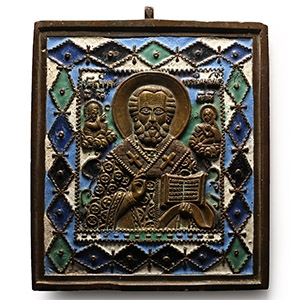
Russian Orthodox Enamelled Bronze Travel Icon with Saint Nicholas
19th century A.D.Estimate: £300 - 400 (+bp*)
Representing Saint Nicholas of Mira, with a Gospel in his left hand and making the gesture of blessing with his right, dressed as a bishop, with sticharion, covered by omophorion, and surmounted by an epitrachelion, all embroidered with crosses; the saint flanked by Jesus and Virgin Mary, Christ holding the Gospel, Mary the bishop’s epitrachelion; Cyrillic inscriptions 'Saint Nikolaos the Wonderworker (СВЯТЫЙ НИКОЛА ЧУДОТВОРЕЦ), Iesus Christos (ΙΣ ΧC) and Mother of God (ΜΡ ΘΥ)' on the enamelled background. 341 grams, 12.1 cm
Acquired from Chris Martin-Zakheim, Iconastas, 5 Piccadilly Arcade, London SW1. From the private collection of a West London, UK, gentleman, formed since the early 2000s.
The icon features meticulous craftsmanship typical of Orthodox iconography. The enamel colors, despite the passage of time, retain their vibrant intensity, highlighting the key elements of the depicted images. The refined details and use of enamel give depth and luminosity to the icon, making it a precious example of the Russian Orthodox tradition. -
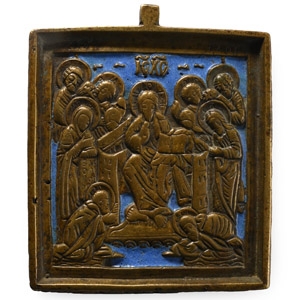
Russian Orthodox Enamelled Bronze Travel Icon with Extended Deesis
19th century A.D.Estimate: £120 - 170 (+bp*)
Depicting a Deesis with Jesus at the centre, Saint Mary on the left and Saint John the Baptist on the right; Jesus seated upon a throne, depicted with the open Gospel in his left hand and raising his right hand in blessing; Mary, with veiled head and mantle, wearing a maphorion mantle over an embroidered robe and holding a scroll; the Deesis surrounded by a theory of saints, with Saint Zosima and Saint Sabbas making the Proskynesis in front of the Christ; Old Slavic inscription above the figures: 'ΙC ΧΡ' (Jesus Christ). 67 grams, 64 mm
Acquired from Chris Martin-Zakheim, Iconastas, 5 Piccadilly Arcade, London SW1. From the private collection of a West London, UK, gentleman, formed since the early 2000s.
The Deisis or Deesis (Деисус, Gk. for “supplication”) was the depiction of the Virgin, John the Baptist and possibly other saints interceding with Christ on behalf of mankind. -
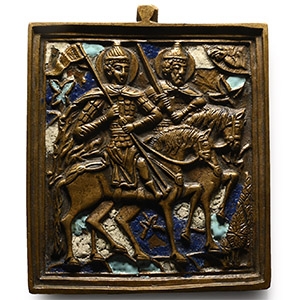
Russian Orthodox Enamelled Bronze Travel Icon with Saints Boris and Gleb
19th century A.D.Estimate: £300 - 400 (+bp*)
Saint Boris and Saint Gleb depicted on horseback wearing Russian medieval armour, holding a cross standard and a sword, each wearing a conical helmet; on the right upper corner, the hand of God. 260 grams, 10.7 cm
Acquired from Chris Martin-Zakheim, Iconastas, 5 Piccadilly Arcade, London SW1. From the private collection of a West London, UK, gentleman, formed since the early 2000s.
Boris and Gleb were the sons of Vladimir of Kyiv, the first Christian Prince of Rus; they were killed in 1015 and 1019 in the civil struggles for the succession to the throne, and sanctified for their faith. Standards with their image were worn by the medieval Russian army.

