-
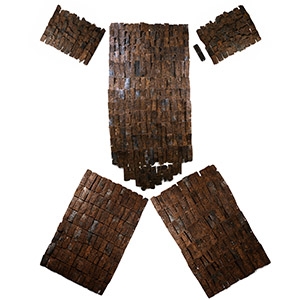
Chinese Jin Jurchen Warrior Signed Suit of Iron Plate Armour
1224 A.D.Estimate: £4,000 - 6,000 (+bp*)
A complete suite of rectangular iron plates to form a protective coat; the plates provided with a series of holes close to the long edges by which they were laced together into articulating panels; one plate with inscription in Chinese script recording: 'first month of the Datong era / control of the propagation of Armour. Yanhui'. 8.5 kg total, 3-11.1 cm
From the private collection of a London gentleman, from his grandfather's collection formed before the early 1970s. Accompanied by a positive archaeometallurgy report by Dr Brian Gilmour PhD, Dip Cons, FSA, FCIFA, FRMS. Accompanied by an academic report by Dr Raffaele D’Amato. This lot has been checked against the Interpol Database of stolen works of art and is accompanied by a search certificate number no.12051-216403. This lot has been cleared against the Art Loss Register database, and is accompanied by an illustrated lot declaration signed by the Head of the Antiquities Department, Dr Raffaele D'Amato.
The Datong Era (大同, 1224–1233) is a name used for the reign of Puxian Wannu, a Jurchen warlord who established the Eastern Xia Dynasty in 13th century China. However, the war with the Jurchen states took more than 30 years: having first invaded the Jurchen borders in 1211, the Mongols finally defeated the Jin Empire only in 1234, while the Eastern Xia fell in 1246. -
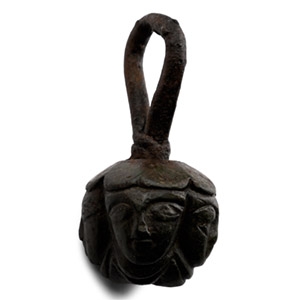
Medieval Bronze Flail Head with Four Heads
14th-15th century A.D.Estimate: £500 - 700 (+bp*)
Formed as four radiating D-shaped masks beneath a rosette, substantial suspension loop. 114 grams, 60 mm
From the private collection of a London gentleman, from his grandfather's collection formed before the early 1970s. This lot is accompanied by an illustrated lot declaration signed by the Head of the Antiquities Department, Dr Raffaele D'Amato. -
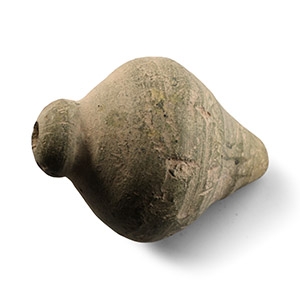
Miniature Byzantine 'Greek Fire' Ceramic Fire Bomb or Hand Grenade
9th-11th century A.D.Estimate: £100 - 140 (+bp*)
Small and biconical in profile with narrow point; intended to be filled with explosive liquid and a wick, and used as a hand grenade. 89 grams, 67 mm
From an important specialist collection, London, UK, 1990s onwards. Accompanied by an academic paper by military specialist Dr Raffaele D'Amato, dated 15 July 2019 and titled 'Eastern Roman Empire - Greek Fire Bomb or Hand Grenade (μεσαίον kακάβιον) 9th-11th century AD'.
Apart from the use of siphons or manual flame-throwers called cheirosiphona, special corps of Roman soldiers employed terracotta grenades, in the form of small jars, abundantly evidenced in archaeological excavations. They were called μεσαία kακαβιά or κυτροκακάβια where the former had a bulbous shape and the latter a more cylindrical form. -
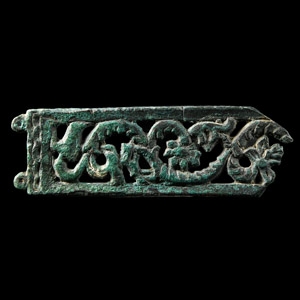
Eastern Roman Tinned Bronze Composite Belt Mount
8th century A.D.Estimate: £100 - 140 (‡+bp*)
Displaying openwork floriate decoration within a tongue-shaped frame; two pierced attachment lugs to the rear. 27.9 grams, 93 mm
From the collection of a North American gentleman, formed in the 1990s.
The belt is of composite type, decorated with scrollwork in Byzantine style. Many authors discuss the possibility that these belts were produced in the Eastern Roman capital or that they were made in the workshops of the Avar Khaganate, maybe with Roman matrices for producing sheet ornaments. -
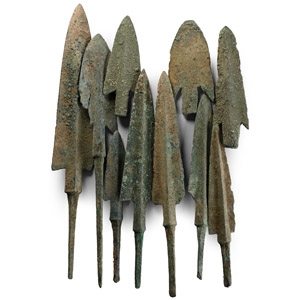
Luristan Bronze Arrowhead Collection
2nd-1st millennium B.C.Estimate: £100 - 140 (+bp*)
Mainly barbed and tanged types of slender profile. 287 grams total, 6.2-17.7 cm
Ex London, UK, collection, 1990s. -
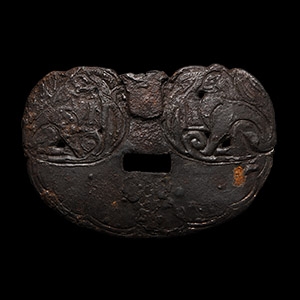
Japanese Bronze Sword Guard with Seated Beasts
16th-17th century A.D.Estimate: £180 - 240 (‡+bp*)
Facing each other in relief, incised scallops below. 46 grams, 97 mm
From the collection of a North American gentleman, formed in the 1990s. -
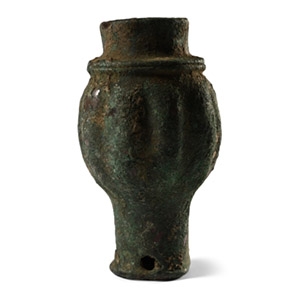
Luristan Bronze Macehead
13th-7th century B.C.Estimate: £100 - 140 (+bp*)
Comprising a cylindrical shaft with flared mouth, rounded flanges around the swollen head, horizontal stepped bands; Sara Gorz type. 416 grams, 98 mm
Acquired 1980-2015. Ex Abelita family collection. This lot is accompanied by an illustrated lot declaration signed by the Head of the Antiquities Department, Dr Raffaele D’Amato. This lot is accompanied by an illustrated lot declaration signed by the Head of the Antiquities Department, Dr Raffaele D'Amato. -
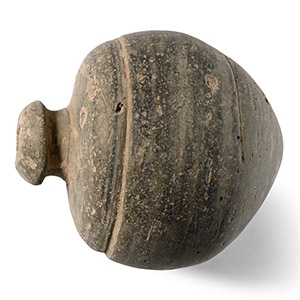
Byzantine 'Greek Fire' Ceramic Fire Bomb or Hand Grenade
9th-11th century A.D.Estimate: £100 - 140 (+bp*)
Ovoid body with impressed ring to the shoulder, domed filler-hole; intended to be filled with explosive liquid and a wick, and used as a hand grenade. 251 grams, 84 mm
From an important specialist collection, London, UK, 1990s onwards. Accompanied by an academic paper by military specialist Dr Raffaele D'Amato, dated 15 July 2019 and titled 'Eastern Roman Empire - Greek Fire Bomb or Hand Grenade (μεσαίον kακάβιον) 9th-11th century AD'.
Apart from the use of siphons or manual flame-throwers called cheirosiphona, special corps of Roman soldiers employed terracotta grenades, in the form of small jars, abundantly evidenced in archaeological excavations. They were called μεσαία kακαβιά or κυτροκακάβια where the former had a bulbous shape and the latter a more cylindrical form. -
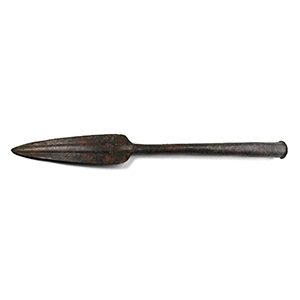
Luristan Bronze Socketted Spearhead
2nd-1st millennium B.C.Estimate: £300 - 400 (+bp*)
Comprising a lentoid-section, leaf-shaped blade with tapering socket. 285 grams, 38 cm
Ex Abelita family collection, 1990s. -
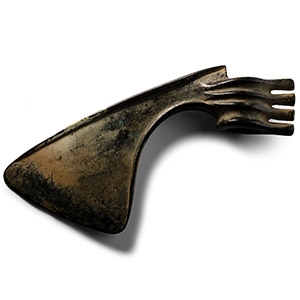
Luristan Comb-Backed Axehead
2nd-1st millennium B.C.Estimate: £250 - 350 (+bp*)
With ribbed openwork socket terminating in a butt formed of four cones, the blade expanding from the socket. 400 grams, 21 cm
From a London collection, early 2000s. -
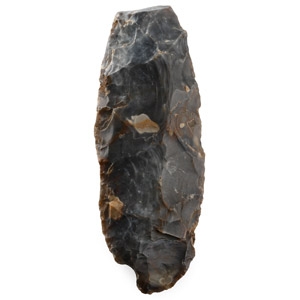
Stone Age Knapped Flint Axehead
Neolithic Period, 6th-4th millennium B.P.Estimate: £100 - 140 (+bp*)
Double-edged with curved edge and square butt, in blue-grey patinated flint and upper face white with some cortex. 168 grams, 13.3 cm
Found Stowmarket, Suffolk, UK. -
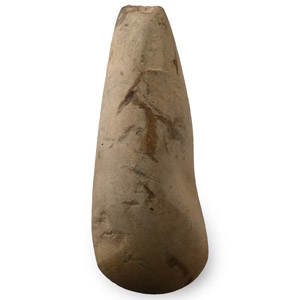
Stone Age Polished Flint Axehead
Neolithic Period, 6th-4th millennium B.P.Estimate: £200 - 300 (+bp*)
Piriform in plan and lentoid in section, tapering towards the square butt; broad crescentic blade. 486 grams, 16 cm
Found Stowmarket, Suffolk, UK.

