-
.jpg)
Byzantine Bronze Oil Lamp
6th-7th century A.D.Estimate: £600 - 800 (+bp*)
Comprising: a squat body and large nozzle with shallow socketed rim, hinged lid to filler-hole with striped pattern, handle formed with lobed cross and loop to rear, annular foot. 376 grams, 13.7 cm
From the collection of a gentleman, acquired on the London art market in the 1990s. -
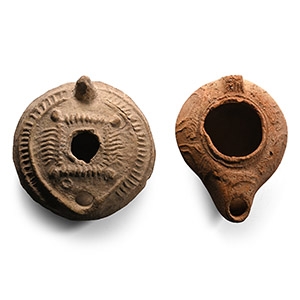
Byzantine Ceramic Oil Lamp Collection
6th-8th century A.D.Estimate: £180 - 240 (‡+bp*)
Comprising: a piriform lamp with a band of stylised quadrupeds surrounding the large filler hole, ribbed handle; a discoid lamp with raised linear decoration, wheel motif to base. 195 grams total, 9.6-10.1 cm
with Galerie Rhéa, Zurich, Switzerland. -
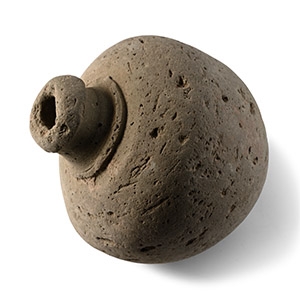
Byzantine 'Greek Fire' Ceramic Fire Bomb or Hand Grenade
9th-11th century A.D.Estimate: £100 - 140 (+bp*)
Ovoid in profile with domed filler hole, linear decoration; intended to be filled with explosive liquid and a wick, and used as a hand grenade. 269 grams, 85 mm
From an important specialist collection, London, UK, 1990s onwards. Accompanied by an academic paper by military specialist Dr Raffaele D'Amato, dated 15 July 2019 and titled 'Eastern Roman Empire - Greek Fire Bomb or Hand Grenade (μεσαίον kακάβιον) 9th-11th century AD'.
Apart from the use of siphons or manual flame-throwers called cheirosiphona, special corps of Roman soldiers employed terracotta grenades, in the form of small jars, abundantly evidenced in archaeological excavations. They were called μεσαία kακαβιά or κυτροκακάβια where the former had a bulbous shape and the latter a more cylindrical form. -
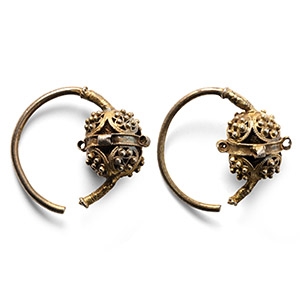
Byzantine Silver-Gilt Filigree Earrings
8th-12th century A.D.Estimate: £250 - 350 (+bp*)
A matching pair of hoop earrings, each adorned with intricate openwork spheres with filigree and applied pellets. 9.48 grams total, 30-31 mm
Private collection, UK. -
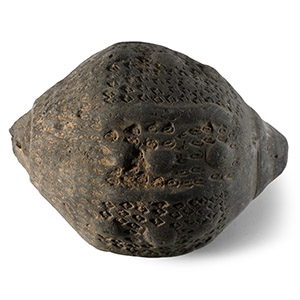
Byzantine 'Greek Fire' Ceramic Fire Bomb or Hand Grenade
9th-11th century A.D.Estimate: £100 - 140 (+bp*)
A piriform missile with domed filler-hole (chipped), segmented flanges to the sidewall and impressed texture; intended to be filled with explosive liquid and a wick, and used as a hand grenade. 844 grams, 13 cm
From an important specialist collection, London, UK, 1990s onwards. Accompanied by an academic paper by military specialist Dr Raffaele D'Amato, dated 15 July 2019 and titled 'Eastern Roman Empire - Greek Fire Bomb or Hand Grenade (μεσαίον kακάβιον) 9th-11th century AD'.
Apart from the use of siphons or manual flame-throwers called cheirosiphona, special corps of Roman soldiers employed terracotta grenades, in the form of small jars, abundantly evidenced in archaeological excavations. They were called μεσαία kακαβιά or κυτροκακάβια where the former had a bulbous shape and the latter a more cylindrical form. -
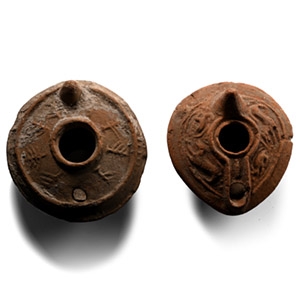
Byzantine Ceramic Oil Lamp Collection
6th-8th century A.D.Estimate: £180 - 240 (‡+bp*)
Comprising: a discoid lamp with low-relief branch motif surrounding the filler hole; a piriform lamp with a channel connecting the filler hole and nozzle, a low relief scene of a hound chasing a hare on both side of the filler hole, the base with a spoked wheel motif. 180 grams total, 84-88 mm
with Galerie Rhéa, Zurich, Switzerland. -
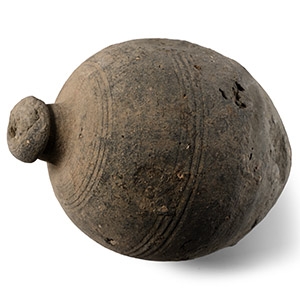
Byzantine 'Greek Fire' Ceramic Fire Bomb or Hand Grenade
9th-11th century A.D.Estimate: £100 - 140 (+bp*)
Ovoid in profile with linear decoration; intended to be filled with explosive liquid and a wick, and used as a hand grenade. 805 grams, 13 cm
From an important specialist collection, London, UK, 1990s onwards. Accompanied by an academic paper by military specialist Dr Raffaele D'Amato, dated 15 July 2019 and titled 'Eastern Roman Empire - Greek Fire Bomb or Hand Grenade (μεσαίον kακάβιον) 9th-11th century AD'.
Apart from the use of siphons or manual flame-throwers called cheirosiphona, special corps of Roman soldiers employed terracotta grenades, in the form of small jars, abundantly evidenced in archaeological excavations. They were called μεσαία kακαβιά or κυτροκακάβια where the former had a bulbous shape and the latter a more cylindrical form. -
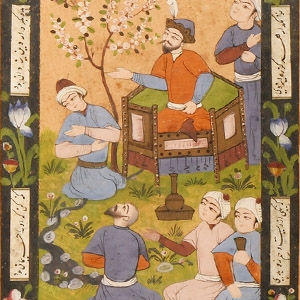
Persian Framed Watercolour Painting Group
Late 19th-early 20th century A.D.Estimate: £100 - 140 (+bp*)
Framed and glazed and displaying polychrome figural scenes bordered by flowering plants and panels of script: one depicting a tea(?) ceremony set in a landscape featuring blossoming trees and birds; a prince or other figure seated on a bolster, in a landscape featuring a brook and blossoming trees, surrounded by attendants. 932 grams total, 31 x 21.5 cm each
Acquired by the vendor's father on the UK art market, before 1990. -
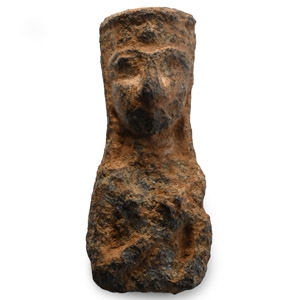
Northern Syrian Bronze Female Figure
Early 1st millennium B.C.Estimate: £150 - 200 (+bp*)
The upper part of a flat-backed female figurine, her arms crossed at the chest and wearing a conical headdress. 44.7 grams, 55 mm
From the collection of a gentleman, acquired on the London art market in the 1990s. -
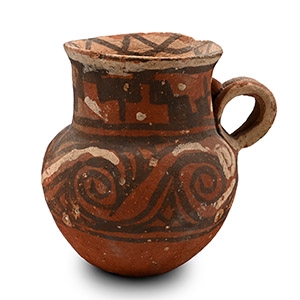
Western Asiatic Red-Painted Terracotta Vessel
8th-9th century A.D.Estimate: £150 - 200 (+bp*)
With broad shoulder and a wide neck, flared rim; ribbed loop handle with applied pellet above; polychrome painted scroll and mesh designs. 320 grams, 11.5 cm wide
UK collection, 1990s. Acquired on the UK art market, before 2000. Private collection, Mr M.V., a London-based businessman. -
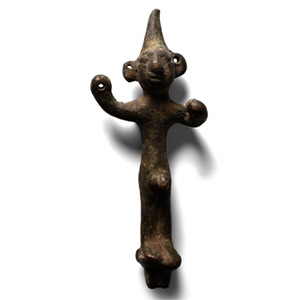
Canaanite Bronze Male Warrior God Statuette
Early 2nd millennium B.C.Estimate: £400 - 600 (+bp*)
Modelled in the round with holes to the ears to accept separate rings (absent) and right hand open to accept a weapon. 27 grams, 68 mm
Acquired in Paris and London, 1970s. From a collection of Canaanite gods in bronze, from the collection of a London, UK, gentleman. This lot has been cleared against the Art Loss Register database, and is accompanied by an illustrated lot declaration signed by the Head of the Antiquities Department, Dr Raffaele D'Amato. -
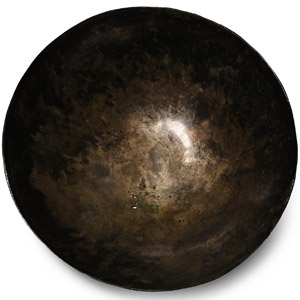
Sasanian Decorated High Tin Bronze Bowl
3rd-7th century A.D.Estimate: £100 - 140 (+bp*)
Hemispherical in section with rolled rim, incised ring to centre and below rim. 220 grams, 17.5 cm
Acquired 1980-2015. Ex Abelita family collection. This lot has been cleared against the Art Loss Register database, and is accompanied by an illustrated lot declaration signed by the Head of the Antiquities Department, Dr Raffaele D'Amato.

