-
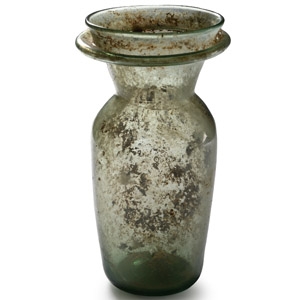
Roman Glass Bottle
3rd-4th century A.D.Estimate: £200 - 300 (+bp*)
With dimpled base, flared neck and carinated flange below the mouth, rounded rim. 102 grams, 12.9 cm
From an important London collection of glass, 1990s. This lot is accompanied by an illustrated lot declaration signed by the Head of the Antiquities Department, Dr Raffaele D'Amato.
The vessel's shape is a simplified version of a cup decorated with a zigzag line. This is characteristic of Palestinian workshops. Two similar vessels, similar to this one, have been found in Palestine: one in Beit Fajjar, dating to the late 3rd-4th century CE, the other in an unidentified location. -
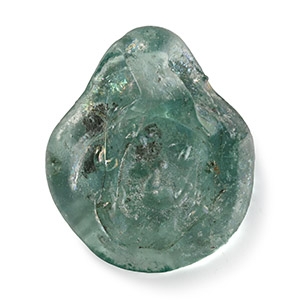
Roman Glass Pendant
1st-4th century A.D.Estimate: £100 - 140 (+bp*)
Discoid with impressed design of a bull's heads with cross above, objects in the field. 3.38 grams, 26 mm
From the private collection of the late Mr S.M., 1969-1999. -
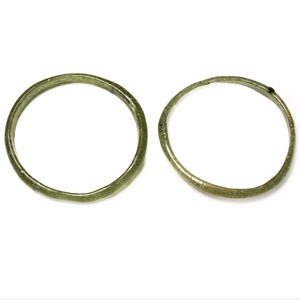
Roman Green Glass Bangle Pair
1st-4th century A.D.Estimate: £100 - 140 (+bp*)
Each plano-convex in section in green glass with striated surface. 23 grams total, 72-75 mm
Acquired on the UK art market in the late 20th century A.D. From the private collection of the late David King (1940-2024), Hoddesdon, Hertfordshire, UK. -
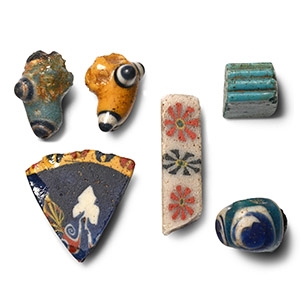
Roman Glass Inlay, Bead and Fragment Group
1st-4th century A.D.Estimate: £700 - 900 (‡+bp*)
Comprising: a polychrome mosaic glass fragment with leaf decoration and a banded yellow rim; a white mosaic glass inlay with red and black floral motifs; an oblate bead with 'eye' motifs; a turquoise-coloured thick inlay of four fingers with white nail detailing; a blue and a yellow shoe-shaped fragment with applied bosses. 5.48 grams total, 9-20 mm
Ex private Swiss collection. Acquired by Galerie Rhéa, Zurich, from the above in 2011. -
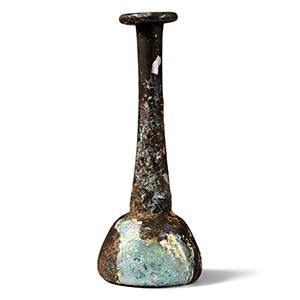
Roman Highly Iridescent Glass Bottle
Circa 1st century A.D.Estimate: £200 - 300 (+bp*)
With a domed body and a pontil base, a tall neck with trumpet-shaped mouth and rolled rim; some iridescence. 37 grams, 16.3 cm
From an important collection of glass, London, UK, 1990s. -
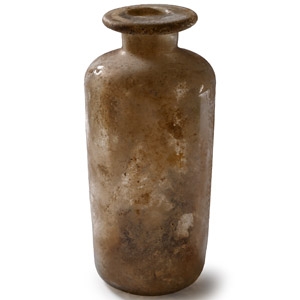
Roman Glass Bottle
3rd-4th century A.D.Estimate: £200 - 300 (+bp*)
Mould-blown bottle comprising a flat-based tubular body and short neck with returned flange rim. 94.2 grams, 14 cm
From an important London collection of glass, 1990s. This lot is accompanied by an illustrated lot declaration signed by the Head of the Antiquities Department, Dr Raffaele D'Amato.
Most of similar examples of Roman bottles have been found in the Eastern Mediterranean. Earliest examples have been found in Roman Lusitania (Pombalinho-Santarem). The type lasted until the 4th century A.D. (Samaria-Sebaste, Israel). -
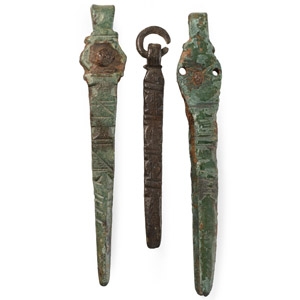
Roman Bronze Tweezer Group
3rd-4th century A.D.Estimate: £100 - 140 (+bp*)
Comprising three pairs of tweezers, each with linear decoration and one with a suspension loop. 23.6 grams total, 54-75 mm
Ex German art market, 2000s. Acquired from an EU collector living in London. From the collection of a Surrey, UK, gentleman. -
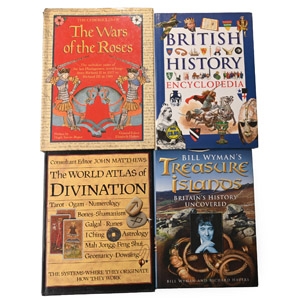
Books on British History - 4 Titles
1992-2005 A.D.Estimate: £20 - 30 (+bp*)
Bill Wyman and Richard Havers - Bill Wyman's Treasure Islands, Britain's History Uncovered, 2005, hardback with dustjacket, 299 pp, colour images; The World Atlas of Divination, London, 1992, hardback with dustjacket, 224 pp, colour images; British History Encyclopedia. From early man to present day, 1999, hardcover with dustjacket, 256 pp, colour images; The Chronicles of The War of the Roses, Surrey, 1996, hardcover with dustjacket, 320 pp, colour images. 5.57 kg total, 27 x 20.5 - 30.5 x 23 cm
Property of a Nottinghamshire, UK, gentleman. -
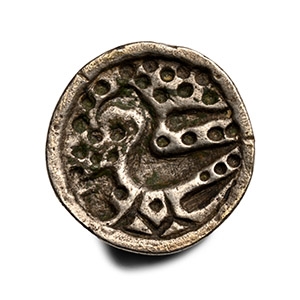
Byzantine Silver Stamp Seal with Bird
6th-8th century A.D.Estimate: £250 - 350 (+bp*)
Conical body with integral loop above, underside with a standing bird with hooked beak, pelletted field. 11.7 grams, 24 mm
Private collection, UK. -
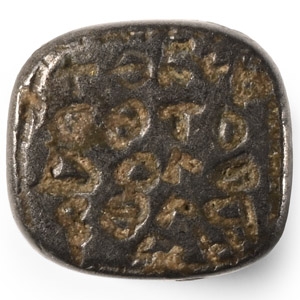
Byzantine Seal Matrix with Inscription
Circa 11th-12th century A.D.Estimate: £150 - 200 (+bp*)
With inscription '+ΘKEB / OΘTO / ΔΟΛΟ / ΤΘΛΑ' for 'ΘΕΟΤΟΚΕ ΒΟΗΘΕI ΤΩ ΔΟΥΛΩ ΤΟΥ ΘΕΟΥ ΛΑΔΕ' (Mother of God, help Lades, the servant of God). 13.1 grams, 18 mm
From an important collection formed before 1988, London and Geneva. This lot is accompanied by an illustrated lot declaration signed by the Head of the Antiquities Department, Dr Raffaele D’Amato. This lot is accompanied by an illustrated lot declaration signed by the Head of the Antiquities Department, Dr Raffaele D'Amato.
The stamp seals that have survived in large numbers from Byzantium are objects a few centimeters high and conical in shape, featuring a sealing surface at the lower end and a pendant at the upper end. They served the same function as signet rings and were used to seal everyday objects, primarily in private areas, using wax and other soft materials. -
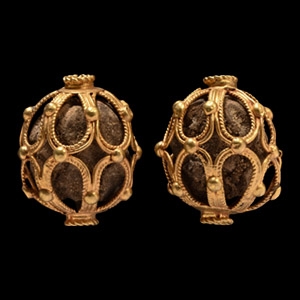
Byzantine Gold Openwork Beads
12th-13th century A.D.Estimate: £650 - 850 (‡+bp*)
Each a spherical cage with ropework texturing, granule at each node; oval glass bead within. 13.8 grams, 22 mm each
Acquired on the Swiss art market, 1998. Private collection, Europe. -
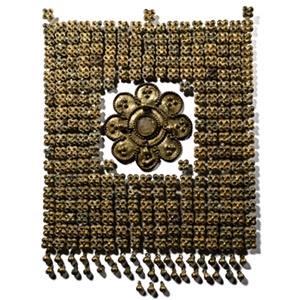
Byzantine Gilt Bronze Horse Harness Decoration Set
8th-10th century A.D.Estimate: £1,500 - 2,000 (+bp*)
Comprising: a large octofoil harness frontal plate with beaded rim and granulation; studs with quatrefoil plates; bell-shaped dangles. 556 grams total, 11-92 mm
From the private collection of a London gentleman, from his grandfather's collection formed before the early 1970s. This lot has been checked against the Interpol Database of stolen works of art and is accompanied by a search certificate number no.12687-234699. This lot has been cleared against the Art Loss Register database, and is accompanied by an illustrated lot declaration signed by the Head of the Antiquities Department, Dr Raffaele D'Amato.

